Horseshoe Bend is the highest-impact single frame in the American Southwest — a 270-degree meander of the Colorado River slicing through Navajo sandstone, viewed from a rim that drops 1,000 feet straight to the water. The shot almost takes itself, which is both the location’s gift and its trap. Every photographer who shows up at 5 p.m. on a Saturday in June gets the same backlit, crowd-riddled image. The notes below are how to avoid that and actually build a portfolio frame from one of the most overshot overlooks on earth.
Hours, access, and the jurisdiction detail that trips up park-pass holders
Horseshoe Bend is open daily from sunrise to sunset, year-round. The parking lot gates open precisely at sunrise and are staffed — and locked — by sunset. According to the official City of Page site, late arrivals cannot enter through the exit lane, which is fitted with reverse tire spikes, and roadside parking on US-89 is enforced with traffic poles positioned a quarter mile in either direction of the lot entrance. This matters for photographers: there is no legal way to stay through blue hour or attempt night photography under current rules. If you want after-hours access for astrophotography, you would need to arrange that directly with the City of Page (928-645-8861) well in advance — and approval is not guaranteed. For practitioners, see our breakdown of shutter for wedding flash. For practitioners, see our breakdown of tethered capture in Lightroom.
A jurisdictional note that catches a lot of visitors: the NPS confirms that the Horseshoe Bend Overlook itself sits within Glen Canyon National Recreation Area, but the parking lot is on City of Page land. America the Beautiful passes and Glen Canyon annual passes do not apply to the parking fee. Despite what many online guides still claim, this is not a Navajo Nation Tribal Park — the City of Page operates the lot and sets its own fee schedule. The distinction matters: no tribal photography permit process applies here.
Parking — the fee, the lot, and what happens when it fills
The City of Page charges $10 per passenger vehicle (cars, trucks, RVs) and $5 per motorcycle. Commercial vehicles scale up: vans and buses under 15-person capacity pay $35, 15–35-person vehicles pay $70, and buses over 35 pay $140. The official site states no discounts and no refunds. Payment is cash or card; tap-to-pay is not accepted. The fee is good for one visit — if you want both sunrise and sunset in the same day you will pay twice.
The lot is large — purpose-built in 2019 when Page took over management — but it fills faster than most photographers expect. Peak arrival waves hit between 9–11 a.m. and again 4:30–6:30 p.m. for sunset. On summer weekends and during spring break, the lot can reach capacity before 8 a.m. There is no overflow. If you arrive and it is full, your only legal option is to wait at the entrance for a space, or return at a different time. Plan to arrive by 5:30 a.m. in June to guarantee a spot without a wait for a sunrise shoot, or by 3:00 p.m. for a sunset session during peak season.
The trail: what ADA-compliant actually means here
The trail from the north end of the parking lot to the overlook rim is 1.5 miles round-trip (0.75 miles each way). The NPS describes it as an Architectural Barriers Act (ABA)-compliant hardened path, accessible by wheelchair and passable with strollers. Two shade structures are positioned along the trail length, but there is no shade at the overlook itself. The path replaced a steep, sandy approach that required real scrambling; the current surface is packed and graded. In practical photography terms, this means a full tripod, a rolling camera bag, and a telephoto lens case are all manageable on the way out. Budget 15–20 minutes each way at a relaxed pace; rushing the return in summer heat is where people get into trouble.
The light: when each version of this shot actually works
The overlook faces roughly west-southwest. The Colorado River makes its loop below and slightly to the west. Understanding how the sun moves relative to that geometry is the entire game here.
Sunrise: shooting into shadow with better crowds
 Save
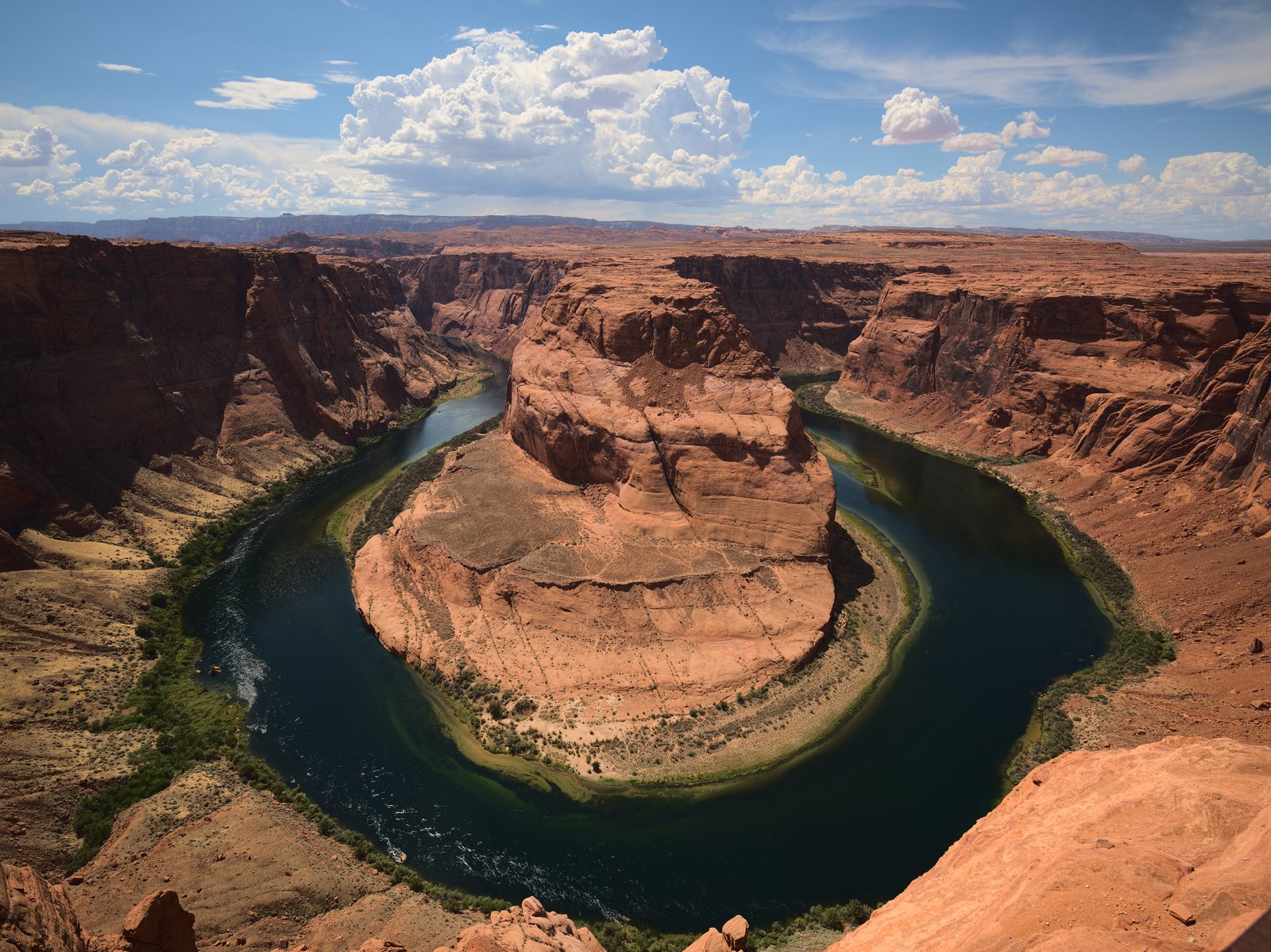
SaveIn late spring and early summer, sunrise over Page arrives early. In June, the sun clears the horizon around 5:10–5:15 a.m. MST (Arizona does not observe daylight saving time). Because the overlook faces west, the sun rises behind you. The canyon walls and the river will be in heavy shadow for the first 60–90 minutes after dawn — sometimes longer. As noted in the Horseshoe Bend sunrise-to-sunset photo series, the bend itself stays in shadow at sunrise as the sun is positioned behind the photographer looking west. By roughly 8:00–9:00 a.m. in June, the sun has climbed high enough that light begins spilling into the canyon from the rim edges, but the deepest sections of the gorge don’t fully illuminate until closer to 10 a.m.
For photographers, this produces a distinct split-toning opportunity: a warm sky behind you reflecting into a still, dark river, with the canyon walls caught in side-light as the sun rises higher. The dynamic range is more manageable than sunset. The crowds are dramatically lower — arriving at or before sunrise gives you access to the prime rim positions with potentially fewer than a dozen other photographers. The June parking lot effectively opens around 5:10 a.m.; plan to be in line by 5:00 a.m. to walk out before the light shifts.
Midday: full illumination, worst crowds, useful for telephoto
 Save
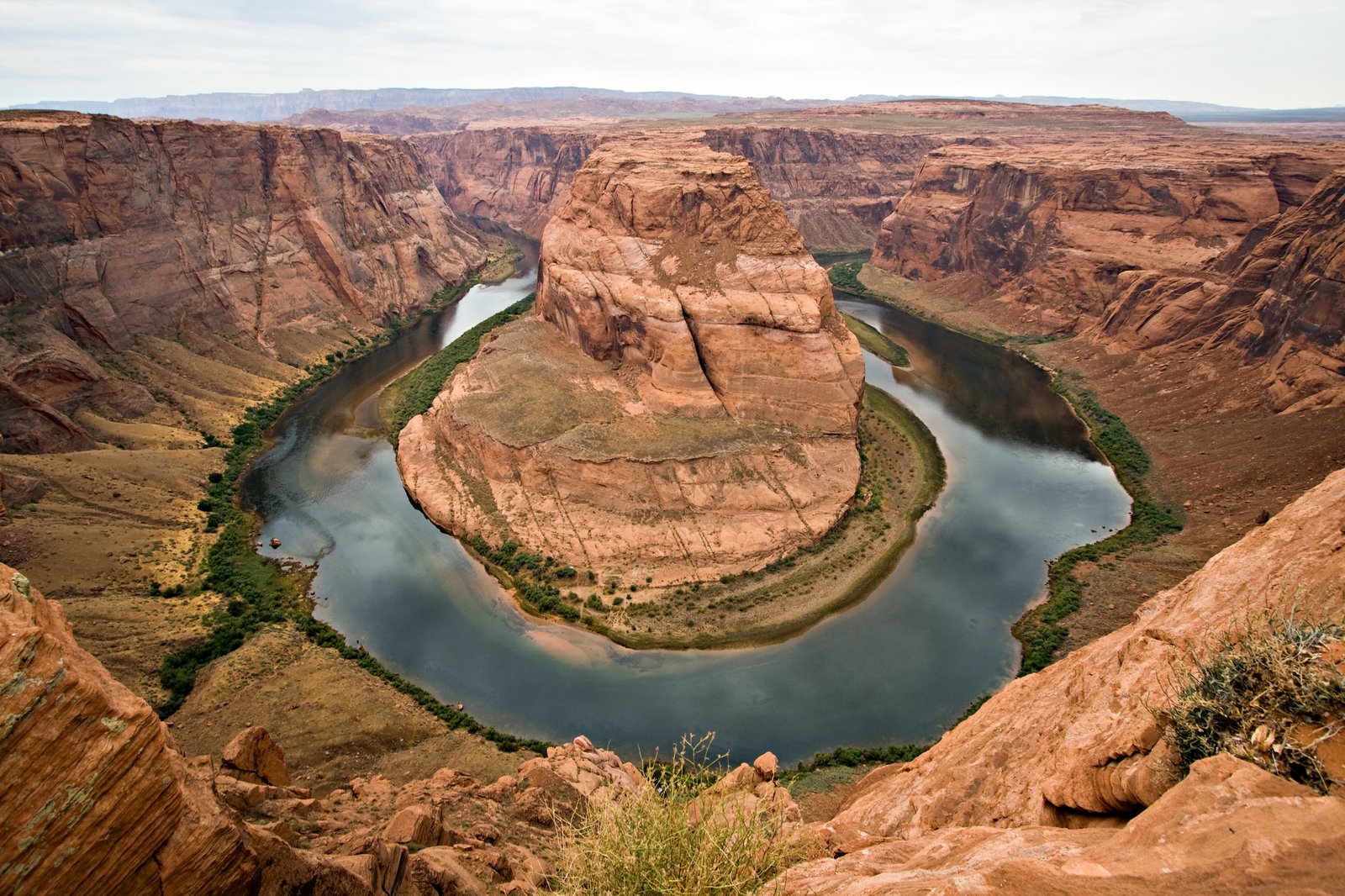
SaveBetween roughly 10 a.m. and 2 p.m. in summer, the full canyon is lit. The sandstone glows amber. The river shifts from dark green to a luminous turquoise under overhead light. The crowds are at maximum density. For the standard ultra-wide rim shot, midday light is flat and harsh. But midday is the only window where telephoto isolations of the river bend work well — the water is fully illuminated, the reflection color is strongest, and the canyon walls catch textured side-light from slightly overhead. If you are attempting a 200–400mm compression shot of the bend’s curves, or trying to isolate a section of the inner gorge wall, midday is your best technical opportunity despite the conditions being photographically challenging in the conventional sense.
Sunset: dramatic sky, extreme dynamic range, a lens hood is mandatory
 Save
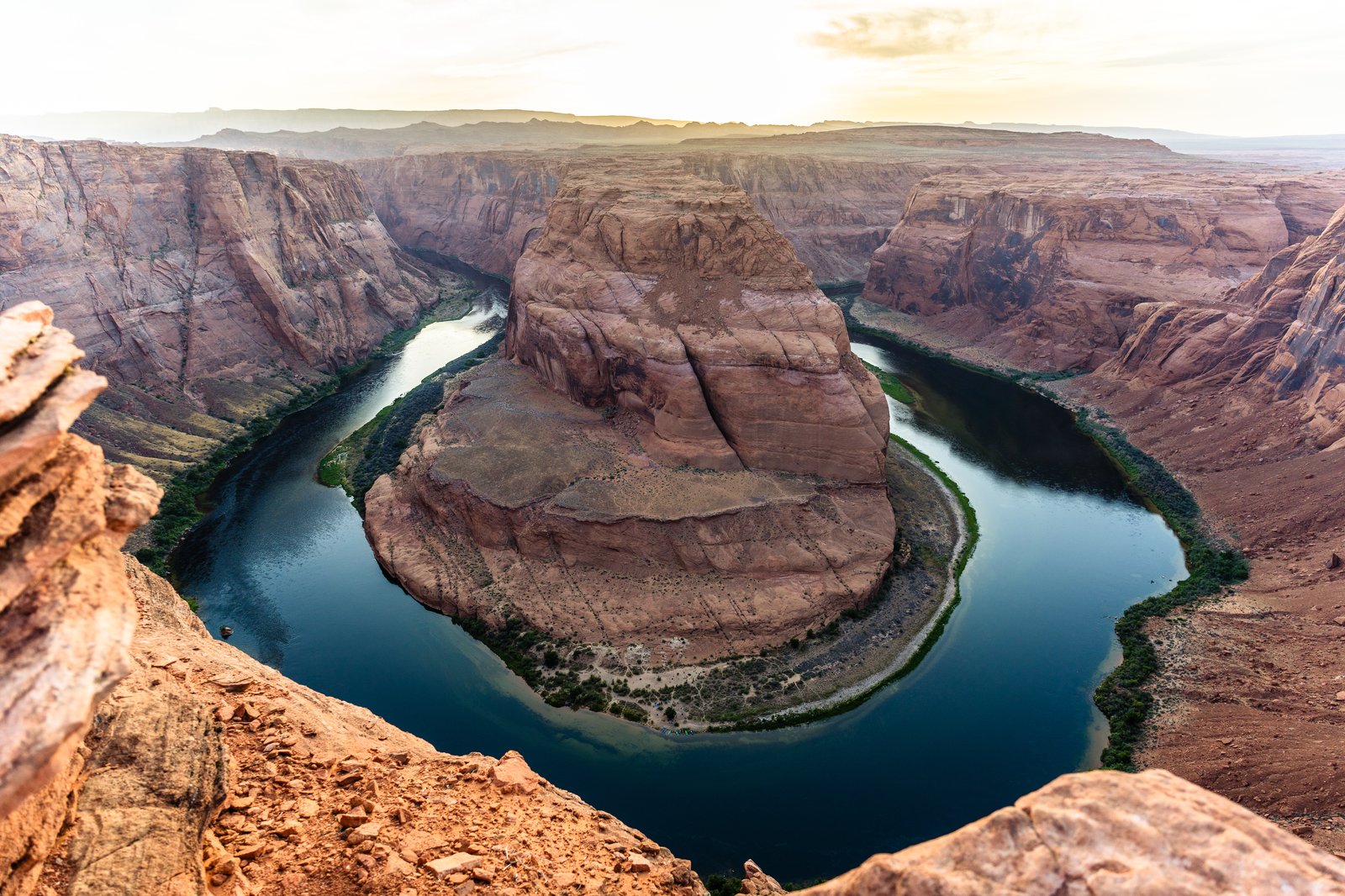
SaveSunset in June arrives around 7:40–7:50 p.m. MST. As the sun drops toward the western horizon, it moves directly into your field of view at the overlook — you are essentially shooting into it. This produces two problems and one major opportunity. The problems: lens flare is severe without a well-seated hood, and the dynamic range between the bright sky and the now-shadowed canyon floor expands to seven or more stops. The opportunity: the canyon walls catch the last raking orange light before the sun drops, the sky turns saturated pink and red, and the river reflects the full spectrum. Professional landscape photographers note this seven-stop dynamic range means you will need either HDR bracketing (3–5 exposures at one-stop increments) or a 3–4 stop graduated ND filter held across the sky to pull a single clean exposure. The bend itself falls into deep shadow by roughly 30 minutes before official sunset; the color payoff is in the sky and the reflected light on the water, not the illuminated canyon walls. For canyon-wall texture at sunset, the window is narrow — approximately 45 to 60 minutes before sunset when the walls catch warm side-light from low in the west before going dark.
Compositions: focal lengths, positions, and what 99% of visitors miss
The default composition is the full loop — every curve of the bend, the river, the canyon walls, all in a single frame. To capture this without cropping, you need to be close to the rim and wide. On a full-frame camera, 11–14mm is the working range; 14mm captures the full scene comfortably, while anything shorter introduces barrel distortion that bends the straight canyon rims into curves. On an APS-C crop sensor, you need 10mm or wider. A 24–70mm lens will not cover the full loop from any single position; it will cut off at least one side of the bend. If you are working with a longer lens, stitching a three-to-five-frame panorama in post is a viable and high-resolution alternative — use a tripod with a level head and overlap each frame by 30 percent.
The rim stretches for hundreds of feet in both directions from the main fenced platform, and most photographers cluster within 50 feet of the center lookout point. Walking 100–200 feet to the left (south) or right (north) along the unfenced rim gives you angles that include the canyon walls as foreground elements rather than pure negative space — the rock formations at those positions frame the bend differently and remove crowd spillage from your edges. These off-center positions also place the river loop slightly below-center in the frame, which can give compositions more visual weight.
For telephoto work (85–400mm), the targets change entirely: compression of the inner gorge walls, isolation of the river reflection bands, and details of the Navajo sandstone striations on the inner bend. At 200mm on full-frame, you can fill the frame with the bend’s inner curve and lose all sense of scale. This is one of the more underused approaches at Horseshoe Bend and produces images that do not look like every other shot from the overlook. Bring a monopod or use the railing for stability if you are not on a full tripod.
Tripods, permits, and the rule that catches commercial shooters
For solo photographers and small groups, tripod use at Horseshoe Bend does not require a separate permit under current rules. The overlook is on NPS-managed Glen Canyon National Recreation Area land once you leave the parking lot. The Glen Canyon Special Use Permit page clarifies the rules that now govern photography on federal lands under the FILM Act: no permit or fee is required for still photography or filming if the activity involves eight or fewer individuals, uses hand-carried equipment only, occurs in areas open to the public, does not require exclusive site use, and does not adversely impact park resources or other visitors. A tripod qualifies as hand-carried equipment and does not by itself require a permit for an individual photographer or a small crew.
The threshold shifts in two ways. First, if your group exceeds eight people — including subjects, assistants, and photographers — you move into permit territory. Second, commercial photography workshops and tours, even small ones, may require a Commercial Use Authorization (CUA) separate from the filming permit. Glen Canyon’s SUP office (GLCA_SUP@NPS.GOV) confirms that photo tour leaders operating as a business should inquire before bringing paying clients. Applications require 45 business days to process — that is roughly nine calendar weeks. Do not show up with a paid workshop group without pre-clearance.
On the parking lot side, which is City of Page land, no separate photography ordinance has been published that applies to tripod use or individual commercial work beyond the standard parking fee. The City of Page contact for permit questions is 928-645-8861.
Drones — the answer is no
Drone flight at Horseshoe Bend is prohibited. Glen Canyon National Recreation Area’s posted rules ban the launching, landing, or operation of any uncrewed aircraft — defined explicitly to include model airplanes, quadcopters, and drones, for any purpose including recreation or commerce — within the boundaries of Glen Canyon NRA and Rainbow Bridge Monument, except by written authorization from the Superintendent. In practice, no recreational permits are granted. The site is among the most heavily visited in the Arizona strip corridor and the NPS has actively enforced this ban. Violations carry penalties of up to $5,000 and six months’ imprisonment. The official Horseshoe Bend site reinforces this: no drones are allowed on the trail. The aerial images you see from Horseshoe Bend on stock sites are almost entirely old photographs taken before enforcement, or were taken without authorization. Do not bring your drone.
Gear recommendations
The gear list for Horseshoe Bend is short but unforgiving on a few items.
- Ultra-wide zoom (11–14mm full-frame equivalent): This is non-negotiable for the full-loop shot. A 16–35mm covers the scene but clips the bend on both sides; you will need to stitch or crop. Rectilinear is better than fisheye for accurate horizon lines.
- Telephoto (85–400mm): For compression work and canyon wall isolation during midday. Often the more rewarding lens for photographers who already have the standard shot covered.
- Sturdy tripod: Required for sunset’s seven-stop dynamic range bracketing and for any low-light work near sunrise. The rim surface is flat sandstone with some loose grit; standard rubber feet grip adequately. Do not set up on the very edge with a heavy rig without testing stability.
- Graduated ND filter (3–4 stop, soft edge): Essential for single-exposure sunset captures where the sky exceeds the canyon’s exposure value by three or more stops. A 4-stop GND held across the upper sky pulls the exposure into a range that allows a properly exposed canyon in a single frame. For aperture control in bright midday conditions, a 6-stop solid ND opens your options for slower shutter speeds to smooth the river surface.
- Lens hood: Mandatory at sunset. The low western sun shoots directly into your front element. Without a hood seated fully on the lens, you will fight veiling flare across the entire frame. Rectangular hoods provide better coverage than round hoods on wide-angle zooms.
- Extra batteries and a full memory card: No power on-site. Summer heat accelerates battery drain. Bring at least two charged batteries if you are bracketing for HDR.
- Polarizer: Useful midday to cut glare off the river surface and deepen the turquoise color in the water. Rotate it carefully — at a polarizer’s maximum effect on wide angles, color shift across the sky can look uneven.
For sensor sensitivity management during low-light shooting near sunrise, see our guide to ISO settings in landscape photography — the key decision at Horseshoe Bend is whether to push ISO in the pre-dawn shadow or hold at base ISO and accept a longer exposure on the tripod.
Heat, water, and the 1.5-mile arithmetic
The trail to Horseshoe Bend has no shade at the overlook and only two partial shade structures along the path. In June, Page, Arizona averages high temperatures of 90°F (32°C). July averages reach 95–96°F (35–36°C), with peaks exceeding 102°F regularly. Some July days carry 14 or more hours of direct sunlight. The 0.75-mile walk to the rim is not technically demanding, but the return is uphill and in most summer hours, conducted in direct desert sun with no wind break.
The NPS is explicit: there is no water available along the trail or at the overlook. Restrooms are located only in the parking lot — use them before starting the walk. Bring at minimum 1 liter of water per person for the round trip in May or October; in June, July, or August, 2 liters is the floor, not the ceiling. Heat exhaustion incidents at this site are common enough that the NPS maintains active warning language on the page. If you are shooting a full session from pre-sunrise through midday, three liters per person is not excessive. A wide-brim hat and SPF 50 sunscreen are not optional accessories in summer — the open sandstone surface reflects and radiates heat from below as well as above. Do not underestimate how quickly a person can become symptomatic at 95°F with a camera bag on their back and no shade.
What not to do — the cliff, the deaths, and the invisible edge
The single most important thing to understand about Horseshoe Bend is that the rim is genuinely dangerous in a way that photographs do not communicate. The drop from the overlook to the river is 1,000 feet — vertical, uneven Navajo sandstone. The fenced viewing platform at the center of the overlook has a railing. The rest of the rim does not. The NPS states explicitly: “Much of the rim remains exposed to the 1,000-foot drop, so watch your footing and keep track of your children and pets.”
People have died here. On February 14, 2022, an adult male who had stepped outside the safety railing fell from the cliff edge and died. Witnesses confirmed he was outside the railing in a dispersed crowd. This was not an isolated incident — multiple falls have been documented at this site going back to at least 2010, including a woman who fell to her death in 2010 while along the unprotected rim. The pattern in nearly every documented incident is the same: people move outside the fenced platform, approach the edge for a better angle or photograph, and lose footing or misjudge the proximity of the edge.
For photographers, the temptation is particularly acute. The best low-angle shots require getting close to or past the edge. If you choose to work outside the railing, treat every step as if the ground may crumble — because on weathered sandstone, it sometimes does. Never crouch or kneel within six feet of the unfenced rim without a second person present who is not holding a camera. Do not lie prone at the edge unless you have secure footing behind you. Do not allow subjects, assistants, or clients you are directing to approach the unfenced edge while your eye is in the viewfinder. Children and pets on leash are permitted on the trail, but the rim is no place for them outside the fenced platform area.
For wide-angle shots from the unfenced rim positions, the practical advice from experienced landscape photographers is to set the tripod, compose, and then step back from the edge to trigger the shutter with a remote or a two-second timer delay. This keeps you from instinctively leaning forward to look in the viewfinder while standing at a 1,000-foot drop.
What not to photograph — and the clichés worth skipping
Beyond the safety imperative, there are creative dead ends worth naming. The centered, symmetrical wide-angle shot from the main platform is on approximately 40 million Instagram posts. If your goal is a recognizable image that communicates “I was there,” that shot works. If your goal is a portfolio image, you need to move. The off-center positions left and right of the platform produce compositions where the canyon rim enters the frame as a leading line rather than a pure V-shape — that small shift removes your image from the pile of identical shots immediately.
Avoid the temptation to use extreme post-processing to manufacture a “moody” version of the standard shot — oversaturated orange rock and electric blue water is the second most common version of this image and reads as immediately artificial. The sandstone’s actual color in good light — warm ochre transitioning to deep red with cooler buff shadows — is more interesting and harder to replicate.
You cannot access the river or the banks below the overlook from this trail. The Colorado River is accessible via boat from Lake Powell upstream; attempting any descent from the rim is both illegal and physically impossible on the sheer walls below the overlook. Do not attempt any scrambling below the rim edge.
Logistics
Address and coordinates: Horseshoe Bend Overlook, 1000 N US-89, Page, AZ 86040. GPS: 36.8791° N, 111.5105° W. The parking lot entrance is clearly signed on US-89 approximately 4 miles south of downtown Page.
Hours: Open daily, sunrise to sunset. Official City of Page site states hours “may vary” — use a reliable sunrise/sunset tool (timeanddate.com or the USNO) and check exact times for your specific date. Arizona does not observe daylight saving time and stays on Mountain Standard Time year-round.
Restrooms: Available in the parking lot only. None on the trail or at the overlook.
Water: None on-site beyond what you carry. The nearest services are in Page, approximately 4 miles north. Stock up before leaving Page for any session over two hours.
Accessibility: The trail meets ABA (Architectural Barriers Act) standards and is confirmed passable for wheelchairs and strollers. The fenced platform at the overlook is accessible. Uneven sandstone terrain exists near the unfenced rim sections accessed off-trail.
Cell service: Generally available on Verizon and AT&T along the trail and at the overlook. Do not rely on cell service for navigation — the parking lot and trailhead are clearly marked.
Weather: June through August brings the Arizona monsoon pattern starting in mid-July. Late-afternoon thunderstorms are common and build quickly. Check radar before any afternoon session and leave the exposed rim if lightning is within 10 miles. Storm light immediately before a monsoon cell arrives can produce extraordinary photographs — but the margin between good light and dangerous exposure is measured in minutes, not hours.
Nearby options: Antelope Canyon (Upper and Lower) is approximately 5 miles north in Page and requires a Navajo Nation guide tour. Lake Powell’s Wahweap Marina is 7 miles north for boat access. The Page Rim Trail provides an alternative sunset vantage point with less crowding and no entry fee. Wire Pass and The Wave are accessible on the same road corridor for photographers willing to plan additional permit-required visits.
More photography spots in this area
Gear Blueprint: What to Pack for This Shoot
Horseshoe Bend is a 1,000-foot cliff overlook in the Arizona desert. You need to cover an extreme wide angle for the full meander, deal with intense sun-to-shadow contrast, and stabilize for HDR brackets at the edge in wind.
- Wide-angle 14-24mm or 16-35mm lens — You cannot fit the full bend with anything longer than ~20mm on full frame.
- Sturdy tripod (carbon fiber) — The rim is breezy; aluminum legs vibrate. You want a tripod that’s rigid but pack-able for the 0.75-mile walk in.
- Graduated ND filter (3-stop soft) — The canyon rim is 4+ stops brighter than the water inside the bend at sunrise.
- Polarizer (CPL) — Cuts haze and deepens the river’s green-blue color from the overlook angle.
- Wide-brim hat + UV sun sleeves — No shade at the overlook. Mid-day temps hit triple digits.
- 1L+ insulated water bottle — The walk back in afternoon heat will dehydrate you fast.
- Microfiber lens cloth (3-pack) — Red sand on every surface, including your front element.
- Headlamp (red-light mode) — For pre-dawn setup. Red mode preserves night vision while you’re framing.
Affiliate disclosure: links above go to Amazon. We may earn a small commission at no extra cost to you. We only recommend gear we’d take ourselves to this specific location.