By Edin Chavez | Updated October 2026
 Save
SaveSome links are affiliate links. If you buy through them, we may earn a commission.
The best boudoir sessions are not the ones with the most gear. They are the ones where everyone knows the plan, the room is warm, the person in front of the camera feels in charge, and the photographer is not scrambling for a battery.
Preparation is the product. A calm shoot gives you better expressions, easier posing and fewer awkward moments than any extra light ever will.
This checklist is for photographers, and it is useful for anyone preparing to be photographed, since it shows what a good process looks like. It covers the conversation before the session, wardrobe, the room, the support person, timing, agreements, backups and delivery. It is not a pose tutorial. It is not a lighting guide either, since that lives in the pillar guide, the dark and moody guide and the high-key guide. And it is not legal advice or a contract template. For anything legal, get proper advice.
Adults only. Always.
Part 1: The conversation before the booking
Everything starts with a clear, relaxed conversation. This can be a call, a video chat or a long message thread. Whatever you choose, the aim is the same: the person should understand exactly what will happen and feel free to change their mind.
Cover these topics:
- What they want from the session. Gift, personal milestone, portfolio, or just for themselves. This shapes the whole plan.
- Look and mood. Soft and bright, dark and dramatic, classic, playful. Show reference images and ask what they like and what they do not.
- Coverage. What will be worn, what will be shown and what will not. Agree on this in plain words in advance. Nothing should be a surprise on the day.
- Touch. If you would ever need to adjust a strap, a sheet or hair, ask first, and offer alternatives such as demonstrating a position yourself or giving verbal direction. Many photographers choose not to touch at all.
- Who will be there. More on this below.
- Retouching preferences. Level of editing, whether any features should be left exactly as they are, and what they would like to see before anything is final.
- Where photos will go. Private only, shared with a partner, used for a portfolio, posted online. Do not assume. Ask, and write the answer down.
Everything agreed should be written down in a way both sides can see. You can use your own paperwork. A short email recap works as a start, but a proper agreement for model use and privacy is a question for a qualified professional.
One more thing. Say this out loud: anyone can pause or stop at any time, for any reason, and when they do, the session pauses or stops. Mean it. It is the single most important sentence in the whole process.
Part 2: Wardrobe that works for the person
Wardrobe is about comfort first, style second. If someone feels awkward in what they are wearing, you will see it in every frame.
Questions to guide the choice:
- Is it comfortable? Straps that dig in, fabric that itches or shoes that hurt will show on the face.
- Is the coverage right? Pick pieces that match the coverage the person agreed to. It is easy to bring more than one option.
- Does it fit the mood? Lace and light fabrics suit airy looks. Darker pieces suit moodier looks. A robe, an oversized shirt, a sheet or a blanket are great extra layers that help people ease in.
- Will it be comfortable for several hours? Some people want to change layers or take breaks.
- Does it photograph well? Very shiny fabrics can clip highlights in bright light. Very fine patterns can shimmer. That is a note to you, not a rule.
A good habit is to ask the person to bring two or three options, and to bring a robe or cover-up for between sets. The robe is not a luxury. It is the thing that lets someone breathe between setups.
Do not tell anyone what size, shape or look their body should have in order to wear something. Wardrobe is a choice for the person, not an evaluation.
Part 3: The room and the temperature
The room sets the mood before you take a single photo.
- Temperature. A cold room makes everyone tense. Warm the space ahead of time, and have something warm available, such as a robe or blanket.
- Privacy. Close doors, shut curtains, and make sure no one can walk in. If you are in a rented space, a hotel or a home, confirm privacy and the rules of the space beforehand.
- Space. Clear clutter. Pillows, sheets and furniture are part of the frame, so tidy them. Check that the background is clean from the angles you plan to shoot.
- Changing area. Give the person a private place to change.
- Water and snacks. Simple, and it helps.
- Music. Ask what they would like to listen to.
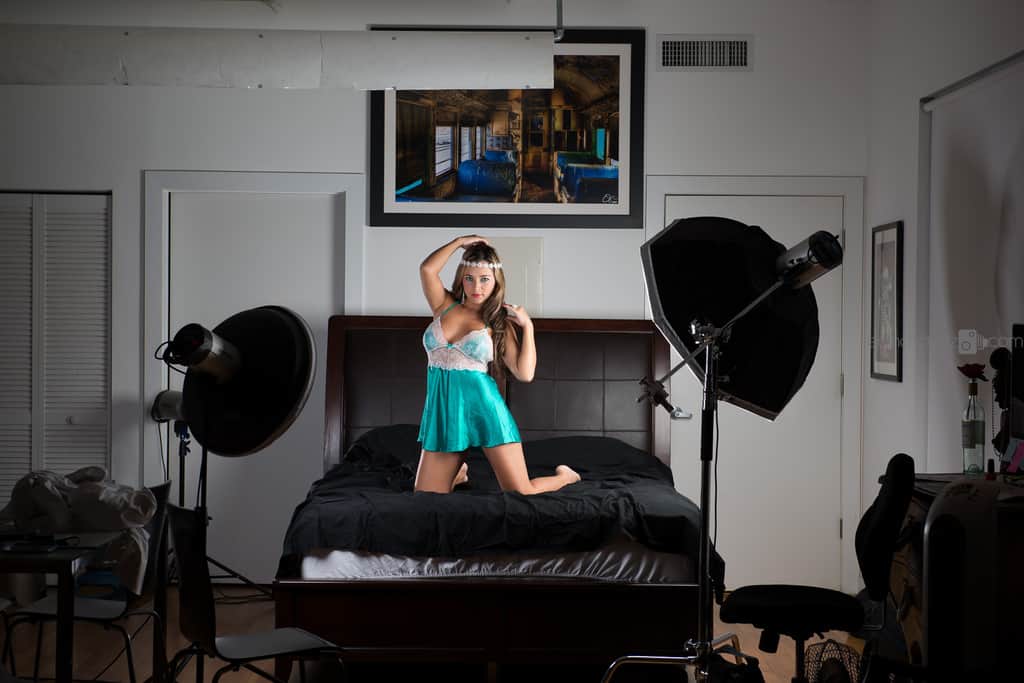
Here is a view of a bedroom set that shows how much space a comfortable setup can take up, including stands, modifiers and furniture. It is just a look at a working room. You do not need this much, and I am not suggesting any specific equipment from the photo.
 Save
SaveIf you are working in a small room, simplicity wins. One window, one lamp, one clean wall can be enough. Practice with a friend or a stand-in before the day so you know how the light works in that exact space.
Part 4: The support person
Some people want a friend, partner or family member present. Others want to be alone with the photographer. Others want an assistant or makeup artist in the room. All of these are valid, and the choice belongs to the person being photographed.
Things to settle ahead of time:
- Who comes, if anyone. The person decides.
- Where they will sit. Clear of the lens, with a view that helps the person feel safe, not watched.
- What they can do. Hold a robe, give honest reactions, or simply be there.
- What happens if the person wants them to leave or stay. It can change during the session, and that is fine.
If you work with an assistant, make sure the person knows who they are before the day, and that they have no objection.
Part 5: Timing and pacing
Rushed sessions feel rushed. Plan a rhythm that gives everyone room.
A simple structure:
- Arrival and settling in (15 to 30 minutes). Chat, water, show the room, confirm the plan again.
- Warm-up frames. Easy, clothed or covered setups so the person gets used to the camera.
- Main looks. Move through outfits and setups at an unhurried pace, with breaks.
- Quick review (optional). Some people love seeing a few frames on the back of the camera. Others do not. Ask first.
- Wrap up. Thank them, explain what happens next and when to expect photos.
Build in breaks, and leave extra time for changing and resets. Sessions often take longer than planned, so pad the schedule.
Makeup and hair add time. Check whether they are part of the booking, and when they will happen.
Part 6: Your own preparation
Photographers, this part is yours. A calm shoot also means you are not troubleshooting under pressure.
- Charge and check everything. Camera batteries, flash batteries, spare cards.
- Test your light in the actual room. Do a few test frames with a stand-in so you can fine-tune before the person arrives.
- Clean your lens and sensor area. Bright photos show every speck.
- Pack a small kit. Safety pins, clips, lint roller, a steamer or iron if wardrobe needs it, tissues, hair ties and a few snacks.
- Have a shot plan, but be flexible. A short list of looks and a few reference images, not a rigid script.
- Decide your backup routine. Know where files will go before the first frame.
A simple rule to remember: the camera is the least important thing in the room. The person is the most important.
 Save
SavePart 7: Safety, boundaries and respect on the day
Your behavior sets the tone. A few non-negotiables:
- Direct with words, not hands. Describe what you are looking for. Offer to show a position on yourself first. Ask before any touch, and respect a no.
- Check in often. “How are you feeling?” “Want a break?” “Is this still okay?” Ask without pressure.
- Never push. If someone hesitates, move on to something else.
- Respect the pause. If a person says pause or stop, you stop. No questions asked.
- Keep the session professional. No comments about a person’s body that you would not make in front of their closest friend.
Do not give medical, skincare or diet advice. You are not qualified, and it is not your job.
Part 8: Backups, storage and privacy
These photos are personal. Treat them with care.
- Back up immediately after the session. Copy your files to at least two places before you leave the room if you can.
- Use reliable storage. A rugged drive is a good place for a second copy. No storage solution can guarantee absolute safety, so keep more than one copy.
- Control access. Keep the files away from shared folders, cloud albums that sync automatically to other devices, and anyone who does not need them.
- Delete what you promised to delete. If you told the person you will remove rejected frames, do it.
- Do not promise absolute confidentiality. Be clear about what you will do, and what you cannot control.
Part 9: Editing and delivery
Go back to the agreement you made before the session.
- Retouching. Stay inside the level you agreed to, and keep skin natural. If the person asked to see a few edits before final delivery, do it. Our guide on cleaning up a portrait in Lightroom is a useful base for gentle, natural edits.
- Building your skills. If you want to improve your editing, the Lightroom editing course in our Academy covers color, masking, detail and export. It is a general editing course, not a boudoir course.
- Delivery. Use a private gallery with access controls and share the link only with the person, or whoever they have named. SmugMug has privacy controls you can read about on their privacy page. It does not guarantee confidentiality.
- Usage. Only use photos in the ways that were agreed in advance. If you want to use a photo for something new, ask again.
- Follow-up. A short thank-you message goes a long way.
 Save
SaveThe checklist
Before booking
- Adult confirmed
- Look and mood discussed
- Coverage agreed in plain words
- Touch preference agreed
- Support person decided by the person
- Retouching preferences recorded
- Usage and sharing agreed
- Pause or stop rule said out loud
Before the day
- Wardrobe options chosen for comfort
- Room warm, private and tidy
- Changing area ready
- Batteries, cards and light tested
- Robe or cover-up ready
- Backup plan ready
On the day
- Settle in, confirm the plan again
- Warm-up frames first
- Regular check-ins and breaks
- Stop when asked
After the day
- Back up files in two places
- Edit within agreed level
- Deliver privately
- Use photos only as agreed
Gear box: small things that make a session calmer
Gear is secondary, but a few items help.
- Backup drive: Samsung T7 Shield 1TB at B&H. Keep at least two copies. No drive guarantees security.
- Reflector (soft fill): Impact 5-in-1 reflector at B&H. Includes diffusion, gold, silver, silver-gold and white surfaces, but not black.
- Weight for stands: A filled 15 lb sandbag. A sandbag adds weight but does not guarantee stability, so keep stands out of walkways.
- Gallery delivery: SmugMug. No discount claims.
None of the photos in this article show a person endorsing any product.
Some links are affiliate links. If you buy through them, we may earn a commission.
Q&A: boudoir session preparation
How far ahead should I plan a boudoir session?
Long enough to have a real conversation, choose wardrobe and agree on details. Often a couple of weeks gives room, but there is no fixed rule.
What should I wear?
Whatever feels comfortable and fits the coverage you agreed to. Bring two or three options and a robe.
Can I bring someone with me?
Yes, if you want to. The choice is yours, and you can change it on the day.
Does the photographer have to touch me to pose me?
No. Direction can be given verbally or by demonstration. Touch should only happen if you have agreed to it, and you can say no at any time.
What if I want to stop in the middle?
You can pause or stop any time, for any reason, and the photographer should stop right away.
How much retouching will happen?
That is something to agree on before the session. Say what you would like left alone, and ask to see edits first if you want.
Who will see the photos?
Agree ahead of time who may receive or access them, and ask how access is controlled. No delivery method can guarantee that an authorized viewer will not copy or share them.
Can a photographer guarantee my photos stay private?
No one can promise absolute confidentiality. Ask what steps the photographer takes and what they will not do.
Do I need to prepare my skin or my body for the shoot?
There is no required preparation. For medical or skincare questions, ask a qualified professional.
What gear does the photographer need?
Less than you think. A reliable camera, light that works in the room, spare batteries, backups and a calm plan matter most.
Is this a contract template?
No. It is a planning checklist. For agreements, ask a qualified professional.
Final thoughts
A bigger kit will never beat a calm room and a clear plan. Agree on the details, put comfort first, protect the files and respect every pause. Do that and the photos will look like what they are: a person who felt safe enough to be themselves.
Run the checklist before your next session.
Related reading in this series: window-light boudoir photography, one-light boudoir photography and small-room boudoir photography.
Source note: Workflow ideas draw on guidance from Icon Photography School and Amateur Photographer. All photos by Edin Chavez. Photos are illustrative. This article is not legal, medical or professional advice.