Savannah doesn’t need a polish. The light does the work — Spanish moss filtering it through live oaks, the Savannah River throwing back river-traffic gold at sunset, gas-lamp halos on cobblestone after a summer rain. If you’ve been chasing a Southern city that rewards a slow walk and a tripod, this is it. Twenty-two squares laid out in 1733, a historic district most of America’s biggest cities would kill for, and weather that hands you fog mornings nine months a year.
This guide is built around the spots working photographers actually shoot when they fly into SAV — not the postcard list. Compositions, timing, gear notes, and the order I’d hit them in over three days. Travel photography in Savannah is a study in restraint: the city is already cinematic, so the job is to stop overcooking it.
 Save
Save
Find your next photography guide.
1. Forsyth Park Fountain
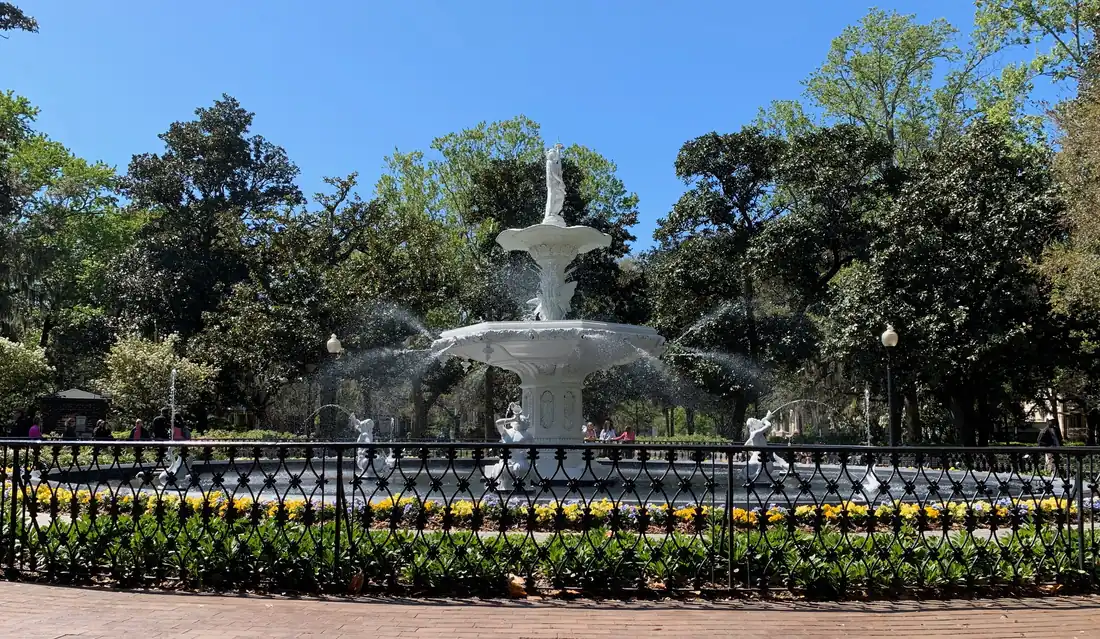
Start here so you can stop thinking about it. The 1858 cast-iron fountain anchors the south end of Forsyth Park and frames cleanly against the oak canopy in three directions. Shoot from the north walkway at f/8, around 35mm full-frame, with the central axis of the path aligned dead-center — the symmetry is the shot. Golden hour washes the water with warm light; blue hour after the streetlamps flick on at 8:45pm in summer is the better frame.
If you only have one morning, get here by 6:15am. Wedding parties start booking the spot at 7:30am sharp and you will lose your foreground. A polarizer helps cut glare on the water at midday; a sturdy tripod earns its keep at blue hour for 4–8s exposures. The aperture you pick matters more than you think — f/11 is too soft, f/5.6 has too thin a depth, f/8 is the right answer.
2. Bonaventure Cemetery
 Save
Save
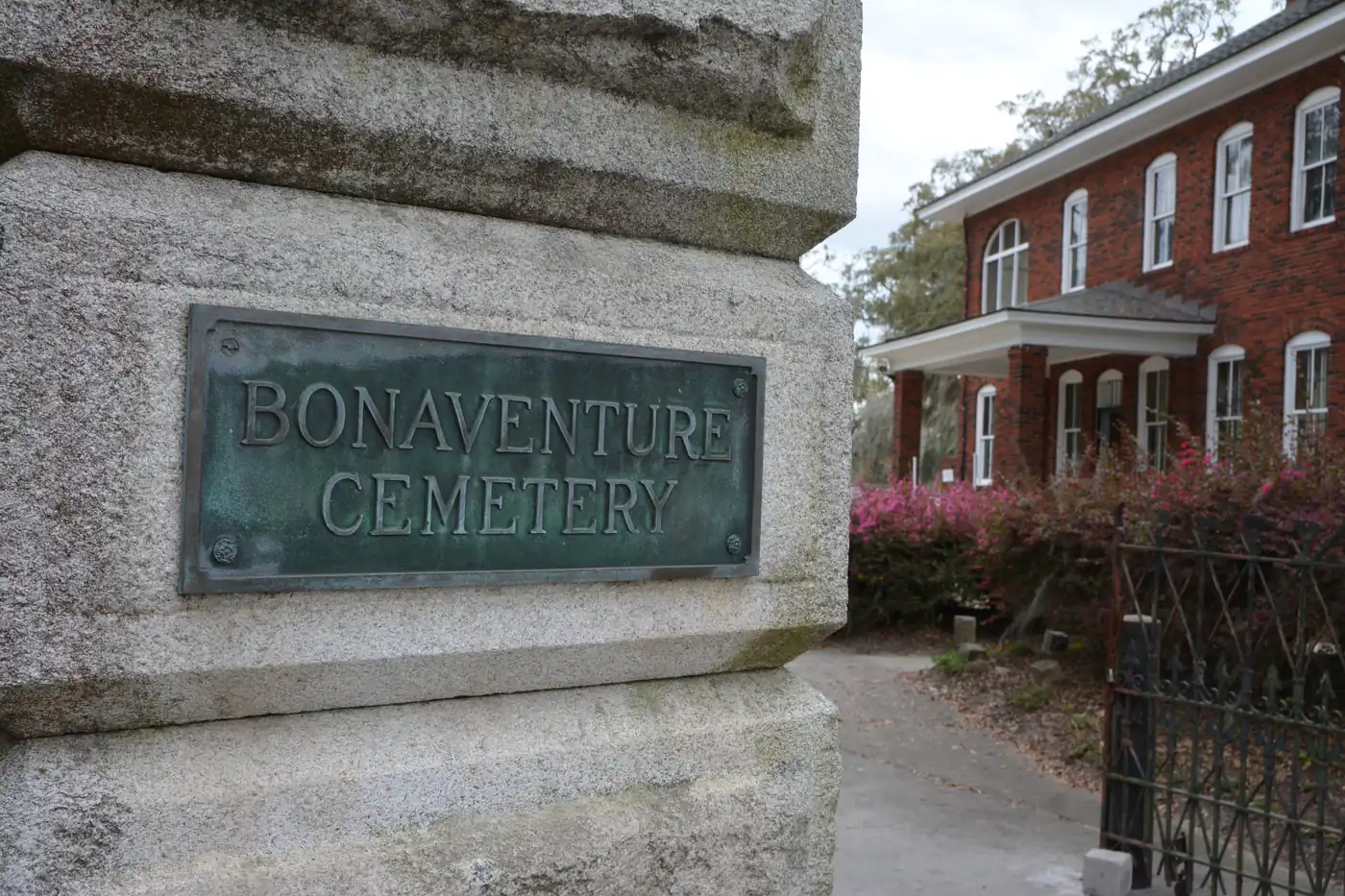
Ten minutes east on Bonaventure Road. The cemetery is open 8am to 5pm and the moss-draped live oak avenues are the strongest individual frame in Savannah, full stop. Don’t shoot the famous Bird Girl statue — it’s been moved to the Telfair and the replica isn’t here. Instead, walk the perimeter avenues. Section H has the densest moss canopy. A 24-70 covers most of it, but an 85mm prime at f/2 isolates single headstones against a moss-blurred background in a way the zoom can’t touch.
Foggy mornings here, which happen roughly half of October through February, are the assignment-worthy frames. Bring a rain cover and a microfiber — the moisture will fog your front element inside thirty seconds.
3. River Street
 Save
Save
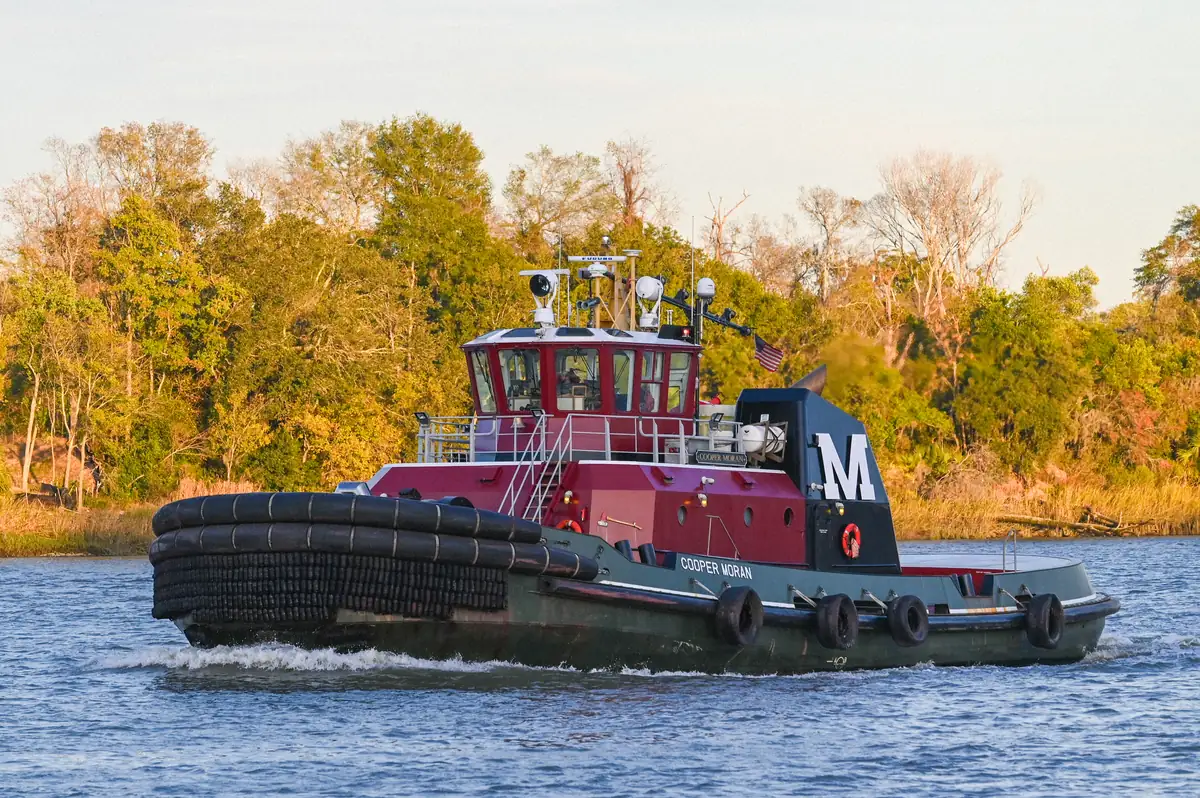
The cobblestone strip along the Savannah River runs for nine blocks and reinvents itself three times during the day. Sunrise belongs to the eastern end near the Marriott — tankers and tugboats backlit against the rising sun, the Talmadge Memorial Bridge as a graphic anchor. Midday is too harsh; come back at golden hour for the cargo-ship parade. Blue hour after 8:30pm summer gets you the gas-lamp warm-tungsten contrast against the cobalt sky that River Street is famous for. A small travel tripod is non-negotiable here because the river breeze kills handheld below 1/30s.
4. Historic Squares — Chippewa, Madison, Monterey
 Save
Save
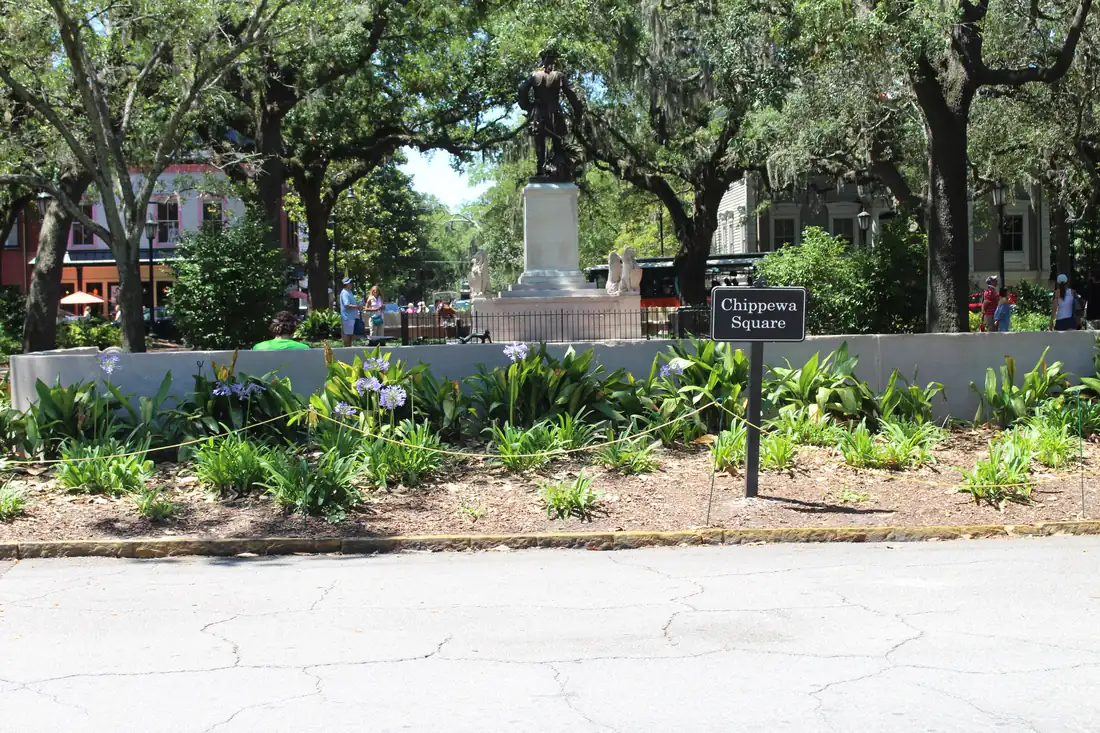
Of the twenty-two surviving squares, three are worth a tripod. Chippewa Square (the Forrest Gump bench square — the bench is gone, the square remains) has the cleanest sight-lines and the James Oglethorpe statue as a center subject. Madison Square has the Sergeant Jasper monument with a backdrop of the Green-Meldrim House. Monterey Square has the Pulaski Monument and arguably Savannah’s best surrounding architecture — the Mercer-Williams House on its southwest corner is the building from Midnight in the Garden of Good and Evil.
Shoot at 28-35mm to compress the canopy. Mornings before 8am have the fewest tourists; the squares get unwalkable by 11am.
5. Wormsloe Historic Site
South of downtown, 8 miles by car. The mile-and-a-half oak avenue leading to the Wormsloe ruins is the most-photographed driveway in America for a reason. Get here at gate opening (9am) to beat the cars driving down it. Shoot from the center of the lane at 24mm to capture the full vault of moss-draped oak overhead. A neutral-density filter lets you blur the occasional passing car at f/8 for a slightly cleaner frame. Admission is $10 and worth it.
6. Tybee Island Lighthouse
Twenty minutes east of Savannah. The 1736 lighthouse (rebuilt to its current form in 1867) is one of seven remaining colonial-era lighthouses on the Atlantic and probably the most photogenic. Climb the 178 steps for a roof-level perspective of the beach and dunes — or shoot it from the base for that classic black-and-white banded tower against a blue sky. Tybee’s beaches face east, so sunrise here is a separate full session. Worth the early alarm.
7. SCAD Museum of Art
Architectural photography pivot. The Savannah College of Art and Design’s museum sits in the bones of an 1853 Central of Georgia Railway depot — the brick rail arches and modern white interior cuts make for strong contemporary compositions. Interior shooting requires permission for tripods. The exterior brickwork at sunset glows orange against the modern white annex and is one of the easiest “wow” frames in town.
8. Cathedral of St. John the Baptist
The cathedral’s twin spires anchor Lafayette Square. Interior shots require a high-ISO body and a fast wide — 16-35mm f/2.8 at ISO 3200 will get you the stained-glass frames without flash. Tripods are not permitted inside during services. The exterior shot at blue hour from the south side of the square, with the spires lit and the live oaks silhouetted, is a Savannah classic.
9. Jones Street
“The most beautiful street in North America” gets thrown around a lot. Jones Street has more justification than most. The brick sidewalks, gas lamps, antebellum townhouses, and tunnel of moss-draped oaks deliver a frame at any focal length. Telephoto compression from the western end at 85-200mm flattens the gas lamps into a beautifully layered receding line. Shoot it at blue hour for the lamp glow.
10. Owens-Thomas House and Slave Quarters
One of the best-preserved Regency-style buildings in America, with the unflinching context of its slave quarters open as part of the tour. Photographically: the south-facing facade catches gorgeous afternoon light, and the original urban courtyard has shooting angles you can’t get anywhere else in the historic district. Interior photography is permitted without flash.
When to Visit Savannah for Photography
October through April is the working window. Summer (June-September) is brutally humid, thunderstorms cut your evenings short, and the light goes flat fast. The shoulder months — March and November — give you fog mornings, comfortable midday temps, and the cleanest blue-hour skies. April brings azalea bloom which detonates color across the squares. February is statistically the foggiest month and the best for cemetery work.
Suggested 3-Day Shoot Itinerary
Day 1 — Historic District. 6am Forsyth Fountain blue hour. 7:30 breakfast. 9am Chippewa, Madison, Monterey Squares. Midday SCAD Museum (interior, low light). 4pm Jones Street prep. 7pm Jones Street blue hour. 8:45pm River Street blue hour.
Day 2 — Bonaventure + Wormsloe. 8am Bonaventure (gate opens 8am). 11am drive Wormsloe. Noon Wormsloe oak avenue. Afternoon downtown rest. Sunset Cathedral exterior + Lafayette Square.
Day 3 — Tybee Island. 5:30am drive Tybee. Sunrise on the beach. 9am Tybee Lighthouse exterior + climb. Drive back. Afternoon Owens-Thomas House. Sunset wherever the light is best.
Three days is enough to cover the city without burning out. Five days is comfortable if you want fog mornings and weather contingency.
Settings Notes for Savannah-Specific Conditions
The Spanish moss canopy drops two to three stops of light under the squares. Be ready to push ISO into the 1600-3200 range for handheld walking shots. Blue hour drops fast — the window from “lights on” to “sky goes black” is about eighteen minutes. Pre-scout your blue-hour compositions during the day. The river creates a thermal layer that lifts haze through golden hour; a polarizer cuts the worst of it, but plan on Lightroom’s dehaze slider doing the rest.
Savannah rewards photographers who slow down. Walk the same square three times — once at sunrise, once at midday for context, once at blue hour — and you’ll have three completely different sets of frames. The city was designed for walking; do that.
What to Pack
Savannah’s specific demands: humidity protection, low-light capability, tripod for blue hour, and a polarizer for the squares and river. Here’s what comes out of my bag for a Savannah trip:
- Camera body — full-frame mirrorless with good high-ISO performance. The Sony A7 IV or Canon R6 Mark II at B&H handle Savannah’s interiors and blue-hour exteriors without breaking a sweat.
- 24-70mm f/2.8 or 24-105mm f/4. The 24-70 f/2.8 from B&H is the single most useful lens here.
- Sturdy travel tripod. Carbon fiber for the airline weight allowance. Peak Design Travel Tripod at B&H or the Manfrotto Befree on Amazon.
- Circular polarizer. Non-negotiable for the river and fountain. Breakthrough X4 CPL on Amazon.
- Microfiber cloths and silica gel. The humidity will fog your front element. Microfiber pack on Amazon.
- Rain cover for the camera. Summer thunderstorms appear in twenty minutes flat.
Last updated June 2026.
Find your next photography guide.
Want to go further? The ShutYourAperture Academy’s Wander & Capture: Travel Photography (7 modules, 28+ lessons) is built to help you cover the art and practice of photographing a place well.
Put yourself in the photographs
After photographing the squares yourself, consider a Private Vacation Photoshoot in Savannah if you want portraits from the trip. A professional photographer makes the images of you; this is not a workshop for learning to photograph Savannah. Confirm the meeting location and deliverables before booking.
Tour links are affiliate links. I may earn a commission if you book through them, at no extra cost to you.