Photography Guide to Spain: Regions, Best Months & Field Notes
~14 min read · 2026-05-07 For practitioners, see our breakdown of tone curve for film looks. For practitioners, see our breakdown of ISO and dynamic range.
shutyouraperture-20). Buying through these links costs you nothing extra and helps fund our free guides.
Spain is a country where eight UNESCO heritage cities, three distinct climate zones, and 8,000 km of varied coastline create one of Europe’s most photogenically diverse single-country itineraries. This is the working photographer’s field guide to the country: when to be there for the light in each region, what gear actually fits, the eight photo regions explained with their best months and headline subjects, the 2026 drone and security-photography law, the cultural etiquette that separates respectful documentary frames from tourist photographs, and the post-processing notes for the Spanish color palette. Plan with the same rigor you bring to portrait or wedding work.
Get the Spain Ultimate Photographer’s Guide
Every location below — pre-mapped with GPS, golden-hour timing, gear recommendations, cultural rules, and a 14-day itinerary. Downloaded by 200+ working photographers.
 Save
SaveWhy Spain is a photographer's dream
Spain rewards photographers who plan around regions, not cities. The Iberian Peninsula compresses extraordinary geographic range into a country smaller than Texas: the Atlantic-fed green hills of Asturias and Galicia in the north, the Mediterranean coastline of Catalonia and Valencia, the white-village Andalusian south, the central high plateau of Castilla, the volcanic Canary Islands, and the Balearic archipelago. Add eight world-class UNESCO old towns (Toledo, Salamanca, Cordoba, Granada, Seville, Avila, Caceres, Cuenca) and a working photo trip becomes a planning exercise in geography rather than a search for things to shoot. Light quality varies dramatically by region: the harsh dry midday sun of inland Andalusia in July is unphotographable, but the same country offers the soft Atlantic light of San Sebastian on the same date. Choose your latitude with intent.
For first-time visitors the temptation is the canonical Madrid-Cordoba-Granada-Seville south-Spain loop. That is a fine introduction, but Spain rewards photographers who plan around regions: the rugged Atlantic seascapes of Asturias and Cantabria are a different photographic country than Mediterranean Catalonia, and the volcanic Canaries are a different country again. Decide your photographic priority first — coastal seascape, urban architecture, religious procession, mountain landscape, astrophotography — and then choose the region that delivers it best in the month you can travel.
When to photograph Spain: month-by-month
Spring (April-May) and autumn (September-October) are the working-photographer’s sweet spots: comfortable temperatures across the whole country, blooming or harvest landscapes, smaller crowds at headline sites, and softer light at lower sun angles. Summer is brutal in Madrid, Cordoba, and Seville (40C+ daytime, August shutdowns), but glorious on the Atlantic coast and in the Pyrenees. Winter offers bare-bone tourist crowds, snow on the Sierra Nevada and Pyrenees, fog in central Spain, and the lowest hotel rates of the year — underrated for moody architectural and landscape work.
| Month | What to expect |
|---|---|
| January | Sierra Nevada snow; foggy Castilian plains; uncrowded Alhambra; harsh blue skies on Costa del Sol. |
| February | Almond blossom in Andalusia; Carnival in Cadiz and Tenerife; rainy Galicia; clear Pyrenees days. |
| March | Las Fallas in Valencia (mid-March); first wildflowers; Holy Week (Semana Santa) builds across south. |
| April | Andalusian Holy Week processions (Seville, Malaga); Feria de Abril; ideal weather countrywide. |
| May | Best month overall: festivals, light, weather. Cordoba's Patios festival; Mallorca shoulder season. |
| June | Long days (sunset 21:30+ in north); summer solstice fires (Galicia); start of beach crowds. |
| July | San Fermin (Pamplona); Atlantic north fine; central and southern interior brutal heat. Avoid Cordoba. |
| August | Mediterranean coast at peak crowds; many Madrid restaurants close; Tomatina (Bunol) last Wednesday. |
| September | Best autumn month: warm days, grape harvest in Rioja, Mediterranean swimming still possible. |
| October | Golden light, smaller crowds, autumn in northern forests, ideal Andalusian temperatures. |
| November | First snow on Sierra Nevada; rainy Atlantic coast; uncrowded Madrid; San Andres bull festivals. |
| December | Christmas markets in Madrid, Barcelona; New Year on Puerta del Sol; ski season opens. |
The complete Spain guide is $47
All vantage points above + 5 bonus secret spots, printable map, gear pack list, and editing recipes. One-time payment, instant download, lifetime updates.
The single biggest planning mistake first-time photographers make is booking interior Andalusia (Cordoba, Seville, Granada) in July or August. Daytime temperatures of 40-45C destroy any chance of patient composition work. The same dates on the Atlantic coast (San Sebastian, Bilbao, Costa da Morte) deliver perfect 22-26C light. If your only window is mid-summer, do the north. The south will still be there in October.
The 8 photo regions of Spain
Spain divides into eight photogenically distinct regions. The list below is organized roughly clockwise from the southern tip of Andalusia through the Mediterranean coast, central plateau, Atlantic north, and finally the offshore archipelagos. Pick two or three regions for a 7-14 day trip — trying to cover all eight in a single visit produces tired travel photography rather than considered portfolio work.
Andalusia (south)
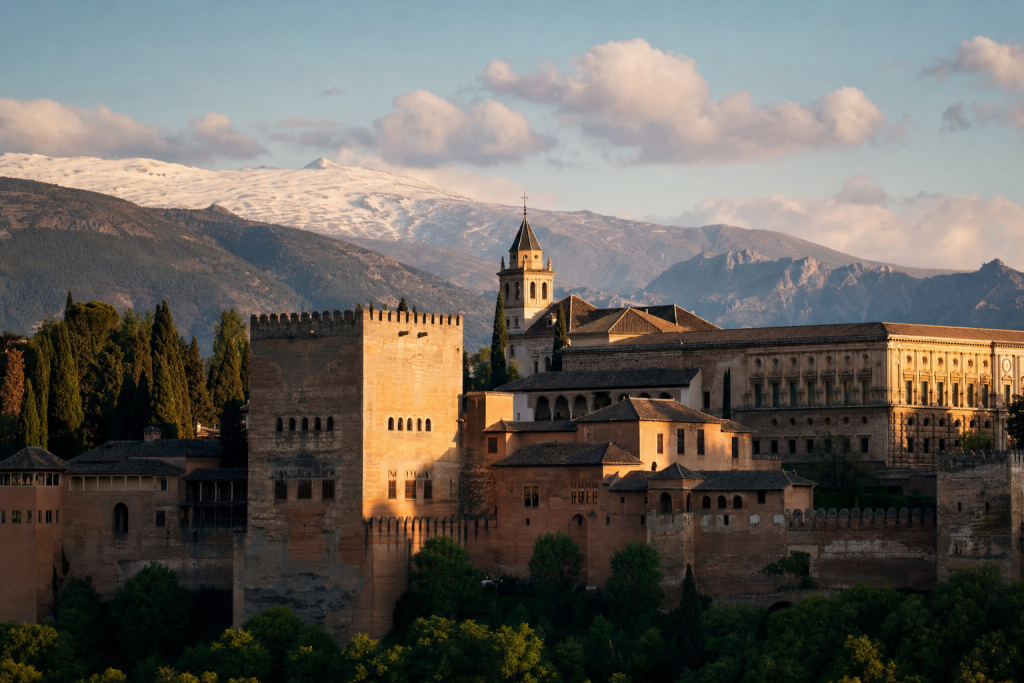
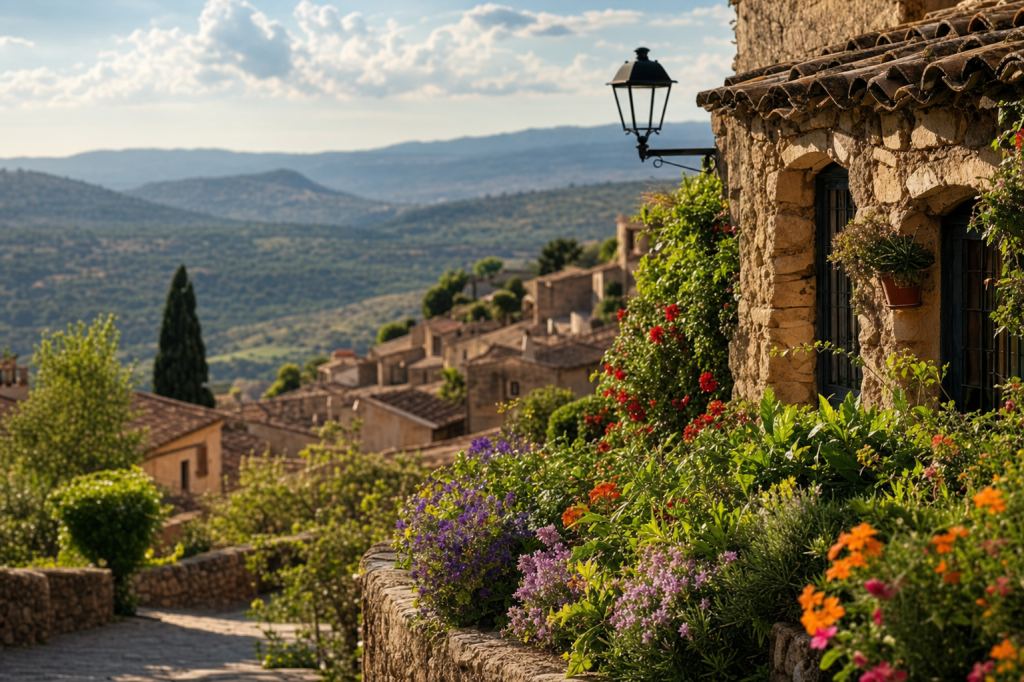
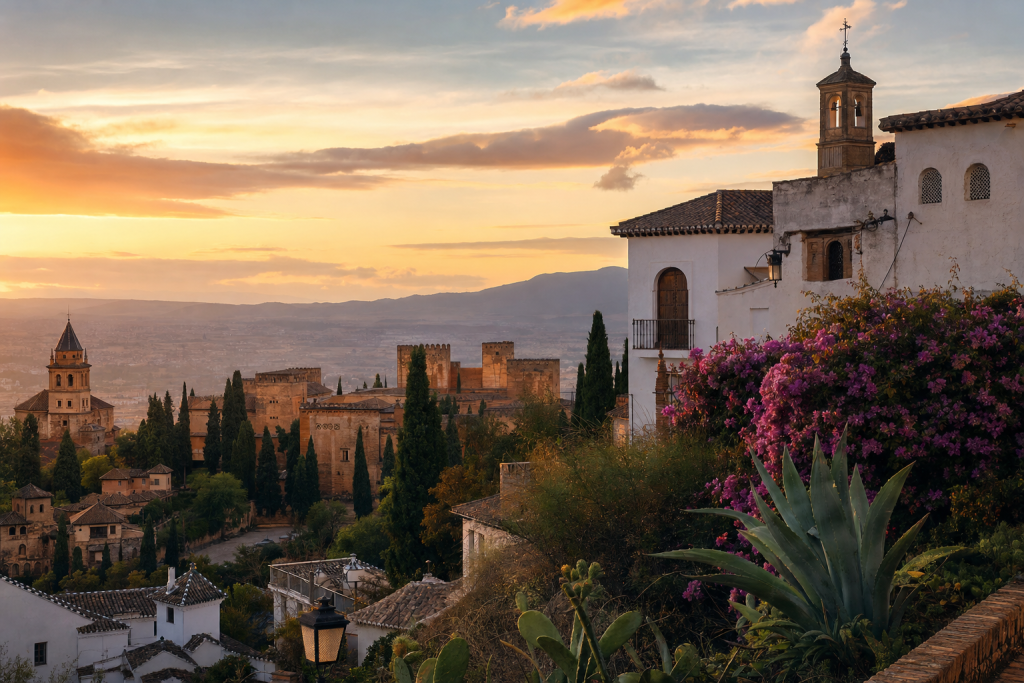
Highlights: Granada (Alhambra, Albaicin), Cordoba (Mezquita, Patios), Seville (Plaza de Espana, Real Alcazar), Ronda (cliff bridge), Cadiz (Atlantic coast), white villages of the Sierra de Grazalema and Pueblos Blancos.
Best time: October-May. Summer is unphotographable in interior Andalusia (40C+).
Photo focus: Moorish architecture, white-village hill towns, flamenco interiors, Atlantic surf coast.
Catalonia (northeast)
Highlights: Barcelona (Sagrada Familia, Park Guell, Casa Batllo, Gothic Quarter), Costa Brava (Cap de Creus, Cadaques), Girona (medieval old town, Game of Thrones filming locations), Pyrenees (Cerdanya, Vall de Boi UNESCO Romanesque churches).
Best time: May-June and September-October. July-August coastal crowds are intense.
Photo focus: Modernista architecture, medieval streets, dramatic Costa Brava cliff coast, Pyrenees Romanesque.
Castile and Madrid (central)
Highlights: Madrid (Retiro, Plaza Mayor, Royal Palace, museum mile), Toledo (UNESCO old town), Segovia (Roman aqueduct, Alcazar), Avila (medieval walls), Salamanca (Plateresque sandstone university). El Escorial royal monastery.
Best time: April-June and September-November. July-August Madrid empties as locals flee the heat.
Photo focus: Imperial architecture, fortress old towns, plateau landscapes, museum interiors (where permitted).
Basque Country and northern coast
Highlights: San Sebastian (La Concha bay, old town), Bilbao (Guggenheim, Casco Viejo), San Juan de Gaztelugatxe (the spiral causeway from Game of Thrones), the Picos de Europa national park, Asturian fishing villages.
Best time: May-September. Wet and grey October-April but moody and atmospheric for landscape work.
Photo focus: Atlantic seascapes, mountain landscapes, contemporary architecture, fishing village color.
Galicia (northwest)
Highlights: Santiago de Compostela (cathedral, pilgrim arrival), Costa da Morte (lighthouses, dramatic Atlantic), Cies Islands, Ribeira Sacra (river canyon vineyards), the Camino de Santiago.
Best time: June-September. The rest of the year is genuinely wet (worth it for moody work).
Photo focus: Celtic-Atlantic atmosphere, pilgrim photography, dramatic ocean coast, rias and estuaries.
Valencia and Costa Blanca
Highlights: Valencia (City of Arts and Sciences, Albufera rice paddies, Las Fallas in March), Albarracin (the most photogenic medieval village in Spain), Penyal d'Ifac coastal rock, Costa Blanca beaches.
Best time: April-June and September-October. Summer beach scrum applies.
Photo focus: Calatrava futurist architecture, rice-paddy landscapes, hilltop medieval village pink sandstone.
Balearic Islands
Highlights: Mallorca (Tramuntana mountain range, Cap de Formentor, Valldemossa, Soller), Menorca (calm beaches, Talayotic ruins), Ibiza (sunset coves, Dalt Vila), Formentera (turquoise water).
Best time: May-June and September-October. July-August is package-tourism saturation.
Photo focus: Mediterranean cliff coast, turquoise sea, mountain villages, golden-hour beach work.
Canary Islands
Highlights: Tenerife (Teide volcano national park, dark sky reserve), Lanzarote (volcanic landscapes, Cesar Manrique architecture), La Palma (astrophotography reserve), Fuerteventura (dunes), Gran Canaria (varied microclimates).
Best time: Year-round. December-March is the most reliable for photographers escaping European winter.
Photo focus: Volcanic landscape, astrophotography (Tenerife and La Palma have IDA dark-sky designations), vast dune fields, lava-coast seascapes.
Photography rules and legal restrictions in Spain
Spanish photography law tracks EU norms with a few country-specific quirks. The 2015 “Citizen Security Law” (Ley Mordaza) restricts photographing on-duty police and security personnel without consent — penalties can reach EUR 30,000 in extreme cases. In practice this rarely affects tourists but applies during protests or arrests. Religious processions during Holy Week are public events but tradition asks photographers not to use flash and to keep a respectful distance from penitents; many cofradias post explicit no-flash signs. Most museums allow non-flash photography (Prado is permissive in some galleries, restrictive in others — check signage). The Alhambra requires timed entry tickets and strict photography rules in the Nasrid Palaces (no tripods, no flash). Spain’s drone law in 2026 follows EU Regulation 2019/947: any drone with a camera or over 250g requires operator registration, remote ID since January 2024, mandatory liability insurance under Royal Decree 129/2023, and EU class marking (C0-C6). Flying over urban areas, beaches, and inside national parks requires explicit permits that are routinely denied to tourists. The default assumption is: do not bring a drone unless you have done registration and permits in advance. Fines for unauthorized flight in protected areas have reached EUR 10,000-15,000.
The practical photographer’s checklist for Spain in 2026: bring tripods but assume they are banned indoors at major sites; assume drones require advance registration and insurance and likely a permit; assume any direct on-duty police photo is legally fraught; expect no-flash and no-tripod signs at the Alhambra Nasrid Palaces, the Mezquita, the Sagrada Familia interior, and many smaller churches. When in doubt, ask the on-site staff before raising the camera.
Gear recommendations for Spain
Spain’s diversity demands a flexible kit. The minimum useful combination: a 16-35mm or 24-70mm wide zoom for old-town streets, plazas, and architecture; a 70-200mm telephoto for the white-village hill scenes, religious procession compression, and Picos mountain compression; one fast prime (35mm or 50mm f/1.8) for Holy Week street work and tapas-bar interior portraits where wide and telephoto fail. Two camera bodies are useful for travelers who want to keep one zoom and one prime instantly available. A polarizer makes a real difference on the Costa Brava, in the Pyrenees, and at any volcanic Canary location — deeper sky, cleaner reflections in tide pools. A 6-stop ND for waterfall and fountain work in the Pyrenees and at the Plaza de Espana fountains. Tripod for Alhambra blue-hour exteriors (interior tripods banned), Pyrenees astro work, and Canary star-trail nights. Battery management matters in summer interior (40C+) and winter Pyrenees (-5C); carry doubles.
One detail specific to Spain: heat management for camera bodies and batteries in interior summer. Mirrorless bodies overheat aggressively in sustained 40C+ direct sun. Plan to shoot at 6-9am and 7-9pm, store gear in shaded backpacks during midday, and carry double the battery count you would in cooler climates. The reverse problem applies in Pyrenees and Sierra Nevada winter — keep a spare battery against your body to maintain charge, and let cold gear acclimatize gradually before going indoors to avoid condensation.
 Save
Save7-day and 14-day itinerary suggestions
7-day Spain photography loop
Day 1-2: Madrid (Plaza Mayor blue hour, Retiro morning, Royal Palace, Toledo as a half-day side-trip with the viewpoint from Mirador del Valle). Day 3-4: train to Cordoba (Mezquita opening hour at 8:30am, walk the Patios neighborhood). Day 5-7: Granada (Alhambra Nasrid Palaces with timed entry, sunset from Mirador de San Nicolas looking back at the Alhambra). This is the canonical first-time photographer’s loop. Adjust to add Seville if you have an extra day.
14-day Spain photography portfolio trip
Days 1-3: Madrid + Toledo. Days 4-5: high-speed train to Cordoba then Seville (Plaza de Espana blue hour, Real Alcazar morning entry, Triana sunset from the bridge). Days 6-8: Granada (Alhambra full day, Albaicin morning, Sierra Nevada sunset). Days 9-10: drive the white villages (Ronda, Setenil, Olvera, Grazalema). Days 11-13: fly to Barcelona (Sagrada Familia interior light, Park Guell at sunrise, Costa Brava day trip to Cadaques). Day 14: optional San Sebastian extension via train. The 14-day version covers Spain’s iconic south plus the modernist northeast and is a viable working photographer’s portfolio trip.
Cultural etiquette and respectful photography
Spaniards are generally relaxed about photography in public, but a few specific cultural notes apply. Holy Week processions are religious events first and tourist spectacle second — photographers who cluster around penitents with flash are seen as disrespectful and may be asked to leave. Flamenco performances in tablaos and festivals usually post no-flash and no-video rules; respect them. Street markets like the Boqueria in Barcelona and Triana in Seville are photographable but ask vendors before tight-frame portraits — the answer is usually yes and a small tapas purchase is courteous. The Gypsy/Roma communities of Sacromonte (Granada) and Triana (Seville) have strong feelings about being photographed without consent — do not shoot tight portraits or interior scenes without explicit permission. Bullfighting is photographable from the public seats but is ethically fraught; many photographers decline. Catalan and Basque political events sometimes attract police attention to photographers; stay alert and avoid framing officers or arrests.
The deeper rule beneath all of this: Spain is a country where strangers will start conversations with you in cafes and bars, where lunch lasts two hours, and where the photogenic moments often happen during the conversation, not before or after. Photographers who slow down, eat the meal, and shoot what arises produce stronger Spanish portfolios than photographers running a tight tourist itinerary with the camera always at eye level. The country rewards patience.
Transit, logistics, and getting around Spain
Spain has Europe’s best high-speed rail network for photographers. The AVE network connects Madrid to Cordoba (1h 45m), Seville (2h 30m), Barcelona (2h 30m), Malaga, Valencia, and Zaragoza. Buy second-class tickets in advance via Renfe.com — first class isn’t worth the premium for camera-bag travelers. Within cities, Madrid and Barcelona have excellent metros; Seville and Valencia have efficient bus networks. For the white villages, rural Andalusia, the Pyrenees, and the white-village belt around Ronda, a rental car is essential — public transport doesn’t reach the photogenic small towns. Drive on the right; toll roads are common but most have non-toll alternates with the same scenery. Parking in old town centers is restricted by ZBE (low-emission zones) — book hotels with parking explicitly. Domestic flights (Iberia, Vueling) connect mainland Spain to the Balearics and Canary Islands at low cost; book ahead for camera carry-on size compliance.
Post-processing the Spanish palette
Spain’s color signature varies by region and demands different edit approaches. Andalusian whites need clean highlights without clipping (the Alhambra’s red walls against white village walls is a high-dynamic-range scenario every photographer underestimates). Pull highlights -30, lift shadows +20, watch for clipping on the white facades. For the orange-red sandstone of Salamanca and Toledo, a slight HSL push of orange saturation and a warm split-tone in highlights brings the stone to life without going overboard. For Costa Brava and Mediterranean coast frames, deep-blue water responds well to a vibrance push (+15) rather than saturation. Holy Week processional frames demand black-and-white conversion; the candle-lit interiors and white-hooded penitents are a classic monochrome subject. The 20-preset Spain-themed Lightroom pack in the matched product below handles all of these scenarios with calibrated starting points.
One Spain-specific edit detail worth flagging: the country’s old-town stone palette varies by region in ways most generic travel presets miss. Toledo and Salamanca are warm sandstone-orange; Cordoba mixes orange, red, and Moorish green-blue tile; Granada balances Alhambra red against white Albaicin walls; Seville is heavily white with terracotta accents; Barcelona is grey stone with Modernista color pops. A single global edit applied to Spain frames flattens these regional palettes. Use HSL adjustments to preserve regional color identity: small global tone curve, regional HSL pushes per location.
Quick Amazon shortcuts to the gear most useful for this kind of shot. Use them if Prime shipping or Amazon credit makes more sense than B&H. As an Amazon Associate ShutYourAperture earns from qualifying purchases.
 Save
SaveFrequently asked questions
When is the best time of year to photograph Spain?
April-May and September-October are the best overall windows: pleasant temperatures across the entire country, soft light at lower sun angles, smaller crowds at headline sites, and either spring blooms or autumn harvest. Summer (July-August) is excellent on the Atlantic north coast but unphotographable in interior Andalusia.
Do I need a drone permit in Spain in 2026?
Almost certainly yes if your drone has a camera or weighs more than 250g. EU Regulation 2019/947 requires operator registration, mandatory civil liability insurance under Royal Decree 129/2023, EU class marking (C0-C6), and remote ID since January 2024. Flying over urban areas, beaches, and inside national parks requires explicit permits that are routinely denied to tourists. Default assumption: do not bring a drone unless registered and insured in advance.
Are tripods allowed at the Alhambra and other major sites?
No tripods are permitted inside the Nasrid Palaces of the Alhambra. Most major Spanish museums (Prado, Reina Sofia, MNAC) prohibit tripods inside galleries. Tripods are fine outside in public plazas during quiet hours. The Sagrada Familia in Barcelona allows handheld photography only, no tripods or flash.
Can I photograph Holy Week processions in Seville and Malaga?
Yes, photographing Semana Santa is widely accepted as a documentary tradition. The cultural rules are: no flash directed at penitents, do not block the procession route, do not enter cofradias' designated areas without invitation, and treat the event as a religious observance first and a photo subject second. Many of the most powerful Holy Week photographs come from telephoto compression at distance rather than wide shots up close.
How far in advance should I book Alhambra tickets for photography?
At least 6-8 weeks in advance for high season (April-October). Tickets sell out, and the Nasrid Palaces have strict timed entries. Book directly via the official Alhambra site (alhambra-patronato.es). The first morning slot at 8:30am gives you the best light and smallest crowds inside the Nasrid Palaces.
More travel photography guides: browse the complete photography by country hub → for sibling guides on the world’s top photo countries. See also the Italy photography guide and France photography guide for the rest of the southern Europe trio.
All links go to Viator (a TripAdvisor company), the world’s largest marketplace for guided experiences. Tagged as affiliate per FTC.
All links go to B&H Photo Video, the trusted pro source. Tagged as affiliate per FTC.
Common questions about the Spain guide
Is the Spain photography guide worth $47?
For most photographers, yes. The guide saves 8-12 hours of trip-planning research and prevents the most common mistake of Spain photography: shooting at the wrong time of day. If a single better frame is worth $47 to you, the guide pays for itself on day one. Buyers get every GPS coordinate, every golden-hour window, every cultural rule, and a printable shot list.
Does the Spain guide include GPS coordinates?
Yes — every vantage point in the guide has Google Maps-ready GPS coordinates so you can pin them before you fly. The guide also includes a printable map showing all locations clustered by walking distance, so you can build efficient half-day routes.
What's in the Spain PDF that isn't in this article?
The article shows the highlights. The PDF includes: 5 additional secret spots not published online, a 14-day itinerary with daily routes, the full camera-settings cheat sheet for every scenario in Spain, a printable gear packing list, post-processing recipes with screenshot examples, and a list of local guides we trust for portrait commissions.
Do I get the Lightroom presets too?
The $47 guide is the PDF only. The matching Spain preset pack is a separate $19 download — most buyers grab both as a bundle and save the editing time. Both are instant download, both work on Lightroom Classic and Lightroom Mobile.
Will the guide work for a Spain trip in 2026?
Yes. The guide is updated annually as fees, restrictions, and new vantage points change. All buyers get free lifetime updates. The 2026 edition includes the latest drone rules, museum photography policies, and seasonal light data for the year.
Visiting more than Spain?
Bundle multiple destination guides and save planning time across the trip:
- France Photographer’s Guide ($47)
- Italy Photographer’s Guide ($47)
- Bali Photographer’s Guide ($47)
- Tokyo Photographer’s Guide ($47)
- Kyoto Photographer’s Guide ($47)
Or get all 60+ destinations in one bundle: Photo Atlas — every guide, every map, $97.
What to Pack
A focused landscape kit handles every shot at Spain without breaking your back. Here is the working photographer's pack list — every link goes to B&H Photo Video (our primary supplier) or Amazon (for accessories and same-day delivery in the US).
| What & Why | B&H | Amazon |
|---|---|---|
Wide-angle zoom (14-35mm range) The single most important lens for sweeping vistas. Pair with a circular polarizer for skies and water. | Shop B&H → | Shop Amazon → |
Sturdy travel tripod Carbon fiber, packs to 15 inches, holds steady in wind off the coast. Essential for blue-hour and long-exposure work. | Shop B&H → | Shop Amazon → |
Circular polarizer (77mm or 82mm) Cuts haze, deepens sky, reveals texture in water. Non-negotiable for landscape work. | Shop B&H → | Shop Amazon → |
10-stop ND filter For 30-second exposures that turn moving water and clouds into silk. | Shop B&H → | Shop Amazon → |
Extra batteries (3 minimum) Cold weather and long exposures eat batteries. Carry triple what you think you need. | Shop B&H → | Shop Amazon → |
Fast SD/CFexpress cards V90 or CFexpress depending on your body. Two cards minimum so a failure mid-trip is recoverable. | Shop B&H → | Shop Amazon → |
Microfiber lens cloths Salt spray, mist, and dust will ruin every shot if you don't carry a cloth. | Shop B&H → | Shop Amazon → |
B&H and Amazon links are affiliate links. We earn a small commission on purchases at no extra cost to you. We only recommend gear we use or would buy ourselves.