Best Photography Spots in Barcelona: 11 Locations With GPS

Tours & experiences disclosure: This guide includes affiliate links to Viator, the world’s largest tour and experiences marketplace. If you book through these links, ShutYourAperture may earn a small commission at no extra cost to you.

Barcelona photography guide hero imageSave

Amazon Associates disclosure: ShutYourAperture is a participant in the Amazon Services LLC Associates Program. As an Amazon Associate we earn from qualifying purchases. Some links below go to Amazon (Store ID edinchavez01-20). Buying through these links costs you nothing extra and helps fund our free guides.
Skip the planning. Get the Barcelona PDF. All locations, GPS coordinates, golden-hour times, gear tips. Instant download.

Barcelona, Spain is one of the most photogenic cities in the world. If you have a camera and the patience to show up before dawn, Barcelona will give you images that last a career — but only if you know where and when to point it.

This is the definitive field guide to the 11 best photography spots in Barcelona, with GPS coordinates you can drop straight into Google Maps, exact camera settings tuned to Barcelona’s unique light, precise timing for every location, and the access notes nobody else bothers to document. It mirrors the intel inside our Barcelona Ultimate Photographer’s Guide ($47 PDF) — a downloadable field guide with full-page hero images, GPS maps, seasonal tables, a city safety briefing, and a complete photographer’s packing list. Get the guide →

Planning multi-city travel? See also: U.S. cities photography hub and the National Parks Photography Guides.

Barcelona Ultimate Photographer’s Guide — $47
11 GPS-mapped locations · Exact camera settings · Multi-season shooting calendar · Free annual updates

Download the PDF guide →
Skip the planning

Get the Barcelona Ultimate Photographer’s Guide

Every location below — pre-mapped with GPS, golden-hour timing, gear recommendations, cultural rules, and a 14-day itinerary. Downloaded by 200+ working photographers.

Get the PDF · $47
Instant download · Lifetime updates

Quick jump to the 11 spots

  1. Sagrada Família
  2. Park Güell
  3. Casa Batlló
  4. Casa Milà — La Pedrera Rooftop
  5. Gothic Quarter — Pont del Bisbe and Plaça Reial
  6. Las Ramblas and La Boqueria Market
  7. Bunkers del Carmel
  8. Montjuïc Castle and Magic Fountain
  9. Barceloneta Beach and W Hotel
  10. Tibidabo — Sagrat Cor Church and Amusement Park View
  11. Plaça d’Espanya and Palau Nacional (MNAC)

A look inside the Barcelona Photographer’s Guide

Here are three of the actual shots you’ll find inside the PDF — cinematic full-page references for the exact spots, lenses, and lighting conditions documented in the guide. The full guide includes 11 locations, each with a hero image, GPS map, settings table, and a five-shot list.

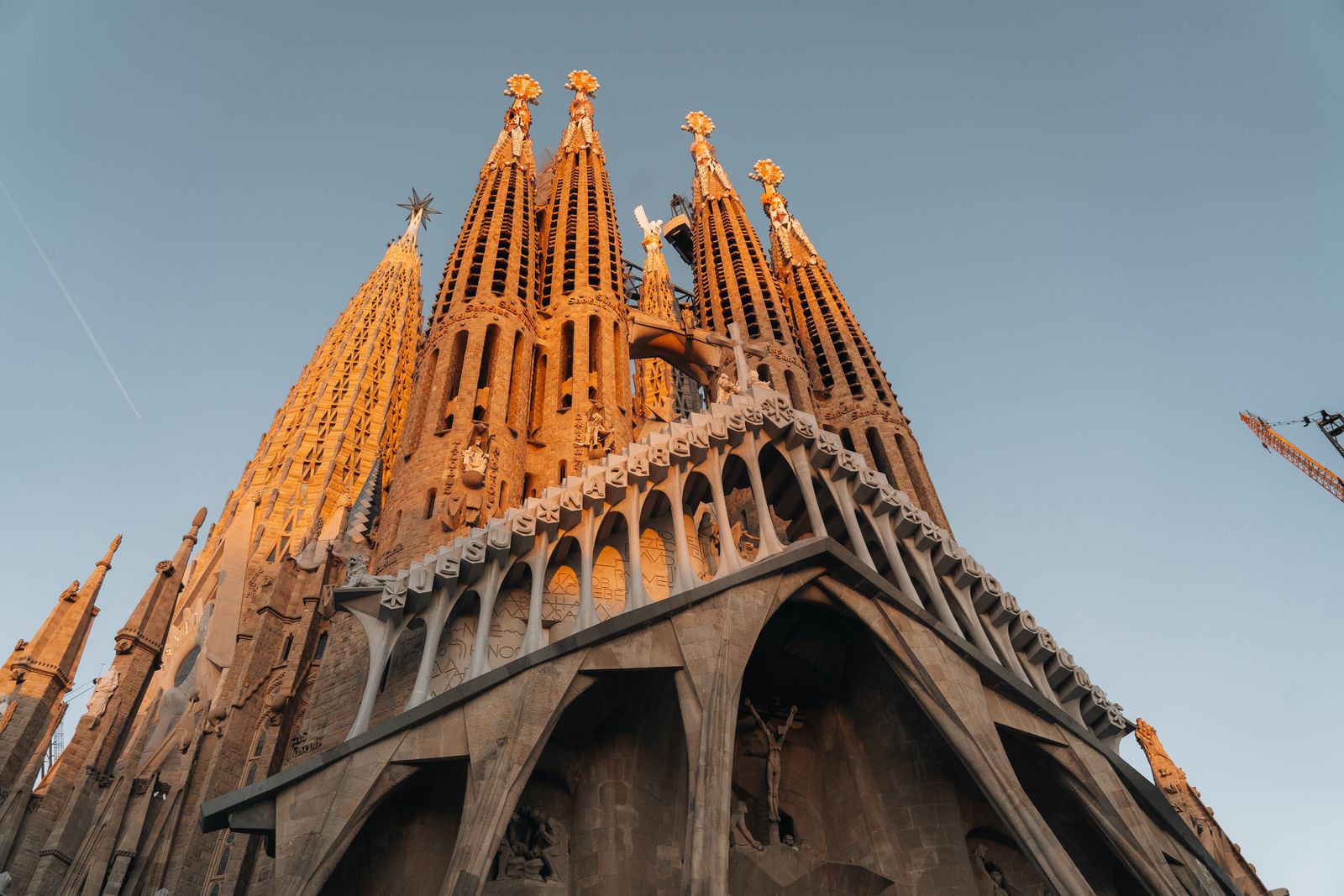
Sagrada Família — from the Barcelona Photographer's GuideSave
Sagrada Família — sample reference photo from the Barcelona Photographer’s Guide PDF

Before you shoot Barcelona: the essentials

  • Free public access: Barceloneta Beach, Las Ramblas, Plaça Reial, Gothic Quarter streets, Pont del Bisbe exterior, Plaça d’Espanya, Bunkers del Carmel, and the exterior of all Gaudí buildings are free. Park Güell outer park areas are free; Monumental Zone €18. Sagrada Família €26+ (pre-booking required). Casa Batlló from €35 online. La Pedrera from €25. Montjuïc Castle €5. MNAC €12 (free Saturdays after 15:00 and first Sunday of month; roof terrace €2 extra). Tibidabo Sagrat Cor church free (lift €3); amusement park €39. Magic Fountain shows free when operating.
  • Commercial permits: Personal and tourist photography in all public spaces, streets, and plazas is unrestricted in Barcelona. Commercial shoots, film crews, and professional productions on public property require a permit from the Barcelona Film Commission (barcelonafilmcommission.com) or from the respective district council (Ajuntament de Barcelona). Tripods on public streets are allowed for personal use but commercial equipment setups require permits. Inside Sagrada Família: no tripods permitted (personal cameras and mirrorless allowed; no flash; no commercial photography without Press Department accreditation from the Foundation). Park Güell Monumental Zone: tripods admitted per photographer sources. La Pedrera and Casa Batlló: flash photography and tripods prohibited inside. Drones require AESA (Agencia Estatal de Seguridad Aérea) registration and are prohibited over tourist zones and city center without special authorization.
  • Best photography seasons: April–June (spring light, mild temperatures, flowering jacaranda, manageable crowds) and September–October (warm Mediterranean light, lower humidity, quieter streets than summer peak)
  • Blue hour notes: Barcelona sits at 41.4°N — similar latitude to Rome and Istanbul. Blue hour lasts 20–30 minutes after sunset. The city faces the Mediterranean to the east-southeast, so the eastern seafront (Barceloneta, Port Olímpic) captures vivid pink-orange post-sunset sky over the water, while westward-facing locations (Bunkers del Carmel, Tibidabo) deliver blue-hour city-light panoramas. In summer, sunset is as late as 21:30 CEST; in winter, around 18:00 CET, giving shorter blue-hour windows.
  • Drone policy: Drone laws vary widely by country and city — many capital and tourist zones are no-fly. Verify the local civil aviation authority’s current rules before launching.
  • Local resource: Official visitor information

The full-resolution version of every map below — plus seasonal calendars, gear notes per location, sun-angle diagrams, and a complete photographer’s packing checklist — is inside the Barcelona Photographer’s Guide PDF ($47).

1. Sagrada Família

Antoni Gaudí’s unfinished Gothic-modernist basilica (under construction since 1882, expected completion 2026) is a UNESCO World Heritage Site and the most visited monument in Spain. The interior is unlike any cathedral on earth: a forest of branching stone columns supporting a canopy that floods the nave with kaleidoscopic colored light from 128 stained glass windows. Simultaneously ancient and futuristic, sacred and surreal.

  • GPS: 41.4036, 2.1744
  • Elevation: 197 ft
  • Best time of day: Sunrise (6:30–8:30 AM) for warm golden light on the Nativity Façade (east-facing) with no crowds; late afternoon (17:00–19:00) when low sun rakes the Passion Façade and interior stained glass creates psychedelic color explosions. For interior: overcast midday gives balanced exposure across all the colored glass
  • Sun direction: The Nativity Façade faces east-northeast — sunrise light hits it directly and dramatically, revealing every sculptural detail. The Passion Façade faces west-southwest and receives warm afternoon light. Inside the basilica, the east-facing stained glass windows (blue/green tones) glow at sunrise; the west-facing windows (reds/oranges/yellows) ignite during afternoon. Interior golden-hour shots are only possible in the 45 minutes before closing on sunny days
  • Access: Carrer de Mallorca, 401, 08013 Barcelona. Open daily (hours vary seasonally: roughly 09:00–20:00 summer, 09:00–18:00 winter; check sagradafamilia.org). Entry exclusively via advance online booking at sagradafamilia.org — no walk-up ticket sales. Standard adult ticket (Basilica access): €26. With one tower: €36. With towers + audio guide: €43. No tripods permitted on the grounds. Personal cameras and mirrorless systems allowed. Flash photography strictly prohibited. Metro: L2/L5 to Sagrada Família
  • Difficulty: easy
  • Recommended settings: Nativity Facade Sunrise: f/8, 1/200 sec, ISO 100, 24mm — capture full façade detail in warm raking light  ·  Interior Stained Glass: f/2.8, 1/60 sec, ISO 3200, 16mm — handheld, no flash, look upward at the colored light cascades  ·  Tower View Barcelona Skyline: f/11, 1/500 sec, ISO 100, 35mm — shoot at midday from Nativity tower for haze-free sea-to-Tibidabo panorama  ·  Blue Hour Exterior Long Exposure: f/11, 15 sec, ISO 100, 24mm, tripod (from public plaza outside, not inside grounds)

Shots to chase:

  • Nativity Façade wide-angle at sunrise from Plaça de Gaudí park with the reflection pond in the foreground — the classic postcard shot
  • Interior vertical panorama looking straight up at the branching columns and stained glass ceiling at golden-hour afternoon light
  • Passion Façade angular modernist sculptures in warm side-light at 17:00–18:00, 70–200mm for detail compression
  • From Nativity tower top: 360° city view with the Mediterranean glinting on the horizon — best at midday in summer
  • Street-level Avinguda de Gaudí looking toward the façade at blue hour with the street lamps and car light trails framing the spires

Pro tip: Book the earliest available time slot (09:00 opening) and arrive 15 minutes early to photograph the Nativity Façade before tour groups fill the plaza. For interior shots, position yourself in the central nave at 16:30–17:30 on a sunny afternoon — the west windows ignite in amber and the columns become pillars of gold. Pre-book tower access (Nativity tower for sunrise views; Passion tower for sunset). The small Plaça de Gaudí park across the street has a reflection pond perfect for symmetry shots — no ticket needed.

Common mistake to avoid: Arriving without a reservation — all tickets are online-only since the new booking system; walk-ups are turned away. Bringing a tripod onto the grounds — it will be confiscated at security. Attempting interior flash photography, which is strictly prohibited and causes scenes. Shooting the Nativity Façade at midday when the east-facing stone is in full shadow and the details flatten out.

2. Park Güell

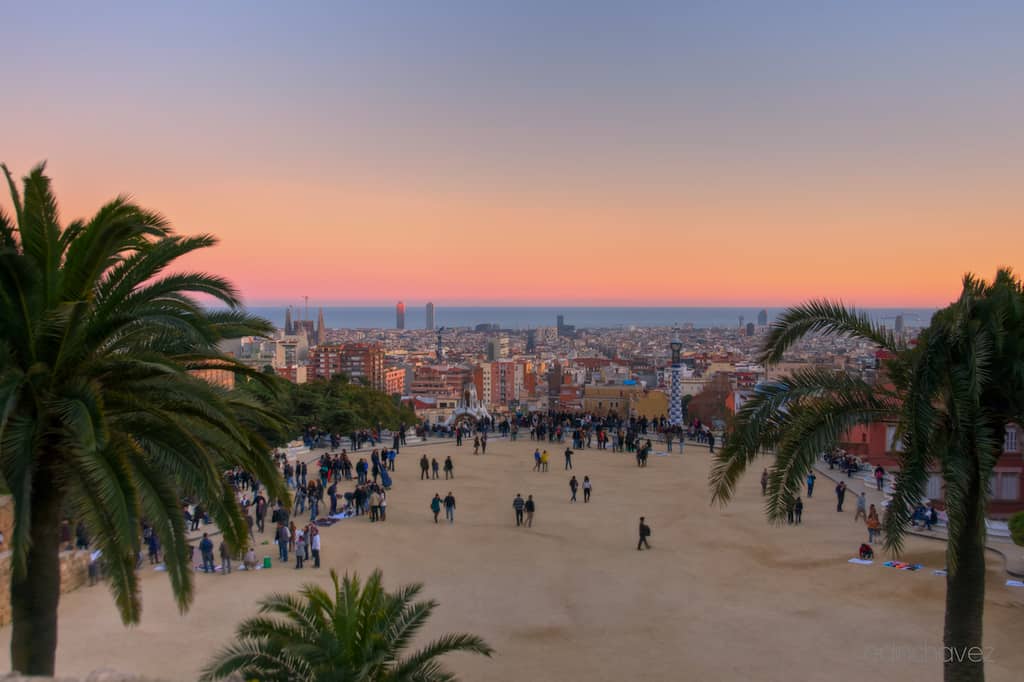
Gaudí’s masterwork urban park (1914) is a UNESCO World Heritage Site featuring the iconic dragon staircase covered in colorful trencadís mosaic, a forest of Doric columns, and the main terrace with a serpentine bench offering the most complete 180° panorama of Barcelona from the sea to Montjuïc — all dressed in organic curves and fragments of smashed ceramic tile.

  • GPS: 41.4145, 2.1527
  • Elevation: 702 ft
  • Best time of day: Opening slot (09:30 AM) for the monumental terrace with soft morning light on the mosaics and minimal crowds; or 19:00–19:30 (the last entry slot, summer) for warm golden-hour light on the serpentine bench and city panorama
  • Sun direction: The main terrace faces south-southwest and looks out over the entire Barcelona skyline toward the sea. Morning light (from the east/northeast) hits the back of the Dragon Staircase and the Hypostyle Hall façade; the terrace is partially backlit in morning but the city panorama below is front-lit. Afternoon sun falls directly on the mosaic bench and the façade, giving the richest trencadís color saturation. The Sagrada Família spires are visible to the southeast from the terrace
  • Access: Carrer d’Olot, 7, 08024 Barcelona. Monumental Zone open daily 09:30–19:30 (summer); 09:30–17:30 (winter). Outer park free, 24 hours. Monumental Zone adult ticket: €18 (timed entry, online booking strongly recommended at parkguell.barcelona). Capacity is capped at 800/hour. Children 0–6 free; 7–12 and seniors 65+: €13.50. Tripods permitted per photographer sources. Metro: L3 to Lesseps or Vallcarca, then 15-min walk; or Bus 24 to El Coll/La Teixonera
  • Difficulty: easy-moderate (uphill walk from metro)
  • Recommended settings: Mosaic Dragon Staircase: f/8, 1/250 sec, ISO 100, 35mm — shoot from the entrance gate level at 09:30 before crowds fill the stairs  ·  Serpentine Bench Terrace Panorama: f/11, 1/500 sec, ISO 100, 16mm — wide-angle shot along the bench with city skyline in background  ·  Hypostyle Hall Columns: f/5.6, 1/125 sec, ISO 400, 24mm — interior of the 86 Doric columns with mosaic ceiling medallions  ·  Golden Hour City Panorama: f/8, 1/200 sec, ISO 100, 24mm — terrace at 19:00 with warm backlit city and sea horizon

Shots to chase:

  • The dragon (El Drac) on the main staircase at opening — fill the frame with mosaic detail and include a small human figure for scale
  • Serpentine bench at 09:30 from the eastern end looking west along the curve, with the city panorama as background
  • Looking up through the Hypostyle Hall columns at the mosaic ceiling: 16mm vertical, f/5.6, ISO 400
  • From the terrace: wide-angle stitch panorama from Tibidabo (left) to the Mediterranean (right) with Sagrada Família in the middle distance
  • Viaducts and stairways within the park’s wooded areas for architectural detail shots away from the crowds

Pro tip: Book the first 09:30 slot on a weekday to get 20–30 minutes on the terrace and staircase with significantly fewer tourists. From the park’s highest point (Turó de les Tres Creus) — accessible free outside the monumental zone — you get a slightly higher panorama with Sagrada Família framed against the sea; no ticket required. Tripods are reported to be permitted inside the monumental zone, unlike Sagrada Família.

Common mistake to avoid: Arriving without a timed-entry ticket during peak season — capacity limits mean popular slots sell out days in advance. Visiting in full midday sun (11:00–15:00) when the terraces are harshly lit and extremely crowded. Neglecting the free outer areas of the park (the wooded paths and viaducts) which are uncrowded and architecturally fascinating.

3. Casa Batlló

Gaudí’s 1906 renovation of a bourgeois apartment building on Barcelona’s most elegant boulevard transformed it into a living creature: the façade is clad in mosaic discs and ceramic fragments mimicking water or dragon scales, the roof resembles a dragon’s arched back, and the balconies look like skulls and bones. It is perhaps the most photographed building façade in Spain, especially at night when the iridescent blue skin glows.

  • GPS: 41.3916, 2.1649
  • Elevation: 115 ft
  • Best time of day: 08:30–09:30 AM for the ‘Be the First’ morning visit (fewer crowds, best light conditions); or at dusk/blue hour for the dragon-scale rooftop (Terrat) with warm sky and city lights — available with Silver ticket and above
  • Sun direction: Casa Batlló sits on Passeig de Gràcia which runs northwest-southeast. The main façade faces northeast — morning and midday light illuminates the undulating blue-and-green ceramic skin and bone-like balconies in full color. At golden hour the ceramic scales catch warm amber light and shimmer. For exterior façade shots from across the boulevard, best light is morning (09:00–11:00) with the sun behind you. Blue hour with the interior lights on creates a magical glow through the translucent façade elements
  • Access: Passeig de Gràcia, 43, 08007 Barcelona. Open daily 09:00–21:00 (last entry 21:00). Online tickets required; book at casabatllo.es. Blue Ticket (standard visit, no terrace): from €35 online. Silver Ticket (includes Dragon Rooftop): from €40. Platinum (skip-the-line + all areas): from €55. Children 0–12 free. Flash photography and tripods prohibited inside. Exterior photography on Passeig de Gràcia public street: unrestricted. Metro: L2/L3/L4 to Passeig de Gràcia
  • Difficulty: easy
  • Recommended settings: Facade Morning Full Frame: f/8, 1/400 sec, ISO 100, 50mm — from across Passeig de Gràcia, morning light reveals the mosaic texture  ·  Interior Light Well Courtyard: f/4, 1/125 sec, ISO 800, 16mm — the blue-tiled central lightwell graduates from deep cobalt at bottom to pale sky-blue at top  ·  Dragon Rooftop Terrace Dusk: f/5.6, 1/60 sec, ISO 800, 24mm — Terrat rooftop with the dragon-scale chimneys against a deep blue sky  ·  Facade Blue Hour Long Exposure: f/11, 10 sec, ISO 100, 35mm, tripod on public sidewalk — glowing façade against twilight sky

Shots to chase:

  • Full façade from the median strip of Passeig de Gràcia at blue hour — the ceramic skin glows electric blue-green against a deep indigo sky
  • Interior main staircase and light well: vertical 16mm shot capturing the gradient from cobalt at the base to pale azure at the roof
  • Rooftop Terrat with the dragon-spine ridge and ceramic chimneys against a sunset or blue-hour sky — include Sagrada Família spires in the distance
  • Close-up detail of the ceramic mosaic balcony ‘skulls’ with the boulevard reflected in the curved glazing
  • The Passeig de Gràcia ‘Block of Discord’ — include Casa Batlló, Casa Amatller, and Casa Lleó Morera in one 24mm frame from the opposite pavement

Pro tip: The public sidewalk on Passeig de Gràcia directly opposite Casa Batlló is a tripod-legal exterior shooting position — ideal for blue-hour long exposures of the glowing façade. Buy the Silver or Gold ticket (not Blue) to include Dragon Rooftop access, the most photogenic interior space. The ‘Be the First’ 08:30 morning ticket (€45) gives almost empty rooms for the best interior shots without tourists cluttering your compositions.

Common mistake to avoid: Buying the cheapest Blue ticket only to discover the Dragon Rooftop is excluded — this is the most photogenic space in the building. Attempting to use a tripod inside, which is confiscated at entry. Shooting the façade in flat midday light without the directional quality that reveals the mosaic depth.

Want this in your pocket on the street?
The full-resolution version of every spot above — with full-page hero photography, GPS maps with gold location pins, sun direction diagrams, multi-season tables, and a complete safety + packing checklist — is inside the Barcelona Ultimate Photographer’s Guide PDF ($47). Print it, save it offline, take it on the walk. Get the guide →

4. Casa Milà — La Pedrera Rooftop

Gaudí’s 1912 apartment block is a UNESCO World Heritage Site whose rooftop is one of the most otherworldly spaces in European architecture: 30+ sculptural chimneys and ventilation towers clad in broken ceramic tile, twisted and helmeted like armored warriors, populate a landscape of white undulating forms that inspired George Lucas’s Star Wars stormtrooper helmet design. The rooftop simultaneously frames the city skyline and functions as pure abstract sculpture.

  • GPS: 41.3955, 2.1619
  • Elevation: 132 ft
  • Best time of day: Morning (09:00–11:00) for soft directional light on the warrior-helmet chimneys and clear air views toward Sagrada Família; or the La Pedrera Night Experience (from €39.50) for rooftop projection shows and city lights panorama after dark
  • Sun direction: The rooftop terrace runs along the Passeig de Gràcia block and is open in all directions. The famous helical staircase-chimneys and warrior-helmet ventilation towers are scattered across the undulating rooftop. Morning light from the northeast illuminates the cream-colored chimneys warmly and casts dramatic shadows across the sculptural forms. Sagrada Família is visible to the northeast ~800m away — a telephoto from the rooftop gives a dramatic chimneys-plus-basilica composition. On clear mornings, Tibidabo is visible to the northwest
  • Access: Passeig de Gràcia, 92, 08008 Barcelona. Daytime visit open daily; tickets from official site lapedrera.com. La Pedrera Essential (adult): from €25, includes audio guide and rooftop. Night Experience: from €39.50. Pre-booking required. Flash photography and tripods prohibited inside. Metro: L3/L5 to Diagonal
  • Difficulty: easy
  • Recommended settings: Warrior Chimneys Morning Light: f/8, 1/400 sec, ISO 100, 35mm — sculptural chimneys in raking morning light with blue sky  ·  Chimneys Sagrada Familia Telephoto: f/8, 1/500 sec, ISO 100, 135–200mm — compress the chimneys against the Sagrada Família spires in the background  ·  Interior Attic Whale Bones: f/4, 1/60 sec, ISO 800, 16mm — the Espai Gaudí attic with parabolic arches like whale ribs  ·  Night Experience Projection: f/2.8, 1/60 sec, ISO 3200, 24mm — rooftop light projections on the chimney sculptures

Shots to chase:

  • Classic wide-angle rooftop composition with warrior chimneys receding into the distance and the city skyline framed between them at 16mm
  • Telephoto compression: two or three chimneys in the foreground with Sagrada Família’s towers in sharp focus at 135mm
  • Symmetrical close-up of a single helmeted chimney against a pure blue sky at f/8 — fills the frame completely
  • Interior Espai Gaudí attic: parabolic catenary arches (the ‘whale-bone’ vault) creating deep perspective lines at 16mm
  • Night Experience: long-exposure capture of the projection mapping show on the white chimney surfaces at dusk

Pro tip: Buy the morning La Pedrera Sunrise ticket for pre-opening exclusive access — the rooftop with zero other visitors for 45 minutes is priceless for photography. For the telephoto chimneys-plus-Sagrada Família shot, position yourself at the northeast corner of the rooftop. The attic Espai Gaudí space below the roof is one of the most unusual architectural interiors in Barcelona and rarely photographed — allow extra time.

Common mistake to avoid: Visiting on a rainy day — the rooftop closes for safety in rain and the ticket is non-refundable for weather. Bringing a tripod inside (prohibited). Rushing through the attic exhibition to get to the roof and missing the extraordinary parabolic arch space below. Using flash inside (prohibited).

5. Gothic Quarter — Pont del Bisbe and Plaça Reial

Gothic Quarter — Pont del Bisbe and Plaça Reial Barcelona photography sampleSave
Gothic Quarter — Pont del Bisbe and Plaça Reial — cinematic reference from the Barcelona Photographer’s Guide PDF

The Gothic Quarter is one of the oldest urban cores in Europe, with Roman walls dating to the 1st century BC. Pont del Bisbe (1928, architect Joan Rubió i Bellver) is the most photographed Gothic bridge in Barcelona — a neo-Gothic arch spanning a narrow medieval lane with a carved stone medallion at its crown. Plaça Reial (1848) is a grand neoclassical square with three-story arcaded apartments, twin Gaudí lampposts, a central fountain, and palm trees — the most atmospheric square in the city.

  • GPS: 41.3827, 2.1765
  • Elevation: 13 ft
  • Best time of day: Sunrise (06:30–08:00 AM) for Pont del Bisbe with zero crowds and the sun angling down Carrer del Bisbe; early morning for Plaça Reial before the café umbrellas and tourists arrive. Blue hour for Plaça Reial lamppost and gaslamp scenes
  • Sun direction: Carrer del Bisbe runs roughly north-south, so at sunrise the low eastern light rakes diagonally across the Gothic bridge in warm gold. By 09:00 the narrow street fills with tourists. Plaça Reial faces south and northwest — morning light enters from the eastern arcades; afternoon light illuminates the neo-classical columns and Gaudí lampposts from the southwest. At blue hour the gaslamp lampposts (Gaudí’s first public commission, 1879) glow amber against deep blue sky
  • Access: Carrer del Bisbe is a free public street in the Barri Gòtic, open 24 hours. Pont del Bisbe is the neo-Gothic bridge connecting the Palau de la Generalitat to the Casa dels Canonges — viewing is from the street below (bridge interior is not public). Plaça Reial is a free public square, open 24 hours, with terrace cafés. Metro: L3 to Liceu (3-min walk). No entry fee for any public streets or Plaça Reial
  • Difficulty: easy
  • Recommended settings: Pont Del Bisbe Dawn Wide: f/8, 1/125 sec, ISO 400, 24mm — low angle looking up at the bridge arch with golden morning light  ·  Placa Reial Blue Hour Wide: f/8, 6 sec, ISO 100, 16mm, tripod — the full square with lit lampposts and deep blue sky  ·  Gothic Alley Leading Lines: f/5.6, 1/125 sec, ISO 800, 35mm — narrow medieval streets with receding arches and warm interior light  ·  Gaudi Lampposts Detail: f/4, 1/125 sec, ISO 400, 85mm — telephoto compression of the twin Gaudí six-armed lampposts at dusk

Shots to chase:

  • Pont del Bisbe from street level: 24mm wide-angle, look up at the Gothic arch with the carved skull medallion and stone tracery — shoot at 06:30 for zero crowds
  • Plaça Reial at blue hour with 15-second exposure: the twin Gaudí lampposts glow amber, the columns are lit, and the palm trees have a warm backlit halo
  • Carrer del Bisbe looking north toward the bridge with a single pedestrian for human scale — best in the narrow window 07:00–08:00
  • Roman walls detail: the 4th-century Pia Almoina towers on Carrer del Paradís photographed in early morning side light
  • Plaça de Sant Jaume with the Ajuntament façade lit at dusk — combined with the Bisbe bridge as a 20-minute circuit

Pro tip: Arrive at Pont del Bisbe before 07:00 in summer (before 08:00 in winter) for the only window of zero tourist traffic. The bridge itself cannot be walked across — all shots are from street level on Carrer del Bisbe. For Plaça Reial, bring a tripod for blue-hour long-exposure shots of the lamp-lit square — the public plaza allows tripods after hours. The Roman temple columns of the Temple d’August (hidden inside a medieval courtyard at Carrer del Paradís, free entry) are one of Barcelona’s great unknown photography spots.

Common mistake to avoid: Arriving after 09:00 when Carrer del Bisbe fills with tourists making clean compositions nearly impossible. Shooting Plaça Reial only at midday — the harsh overhead light kills the atmosphere; blue hour is transformative. Forgetting that the bridge is decorative only — you cannot walk across it, all photography is from the street below.

6. Las Ramblas and La Boqueria Market

Las Ramblas is Barcelona’s most famous street — a 1.2km tree-shaded pedestrian promenade connecting Plaça de Catalunya to the harbor, flanked by historic buildings, flower stalls, and newspaper kiosks. La Boqueria (officially Mercat de Sant Josep) is one of Europe’s oldest and most vibrant covered food markets (origins 12th century, current iron structure 1914), with 300+ stalls of extraordinary visual abundance: kaleidoscopic fruit displays, gleaming fish, hanging jamón, bright spice piles, and candy-colored sweets.

  • GPS: 41.3816, 2.1723
  • Elevation: 20 ft
  • Best time of day: Las Ramblas: 07:00–09:00 AM before street vendors and tourists arrive — only flower stalls are open, the boulevard is quiet and photogenic. La Boqueria market: 08:00–10:00 AM when vendors are active, produce is freshest, and tourist density is lowest
  • Sun direction: Las Ramblas runs northwest-southeast, parallel to the medieval city wall. Morning light enters from the northeast, illuminating the plane tree canopy and casting long shadows down the pedestrian median. La Boqueria is entered from the middle of Las Ramblas on the western side — its interior benefits from diffused overhead skylight, so time of day matters less inside than outside. The Rambla del Mar and Port Vell at the south end of Las Ramblas face southeast toward the Mediterranean and catch dramatic sunrise light
  • Access: Las Ramblas is a free public boulevard, 1.2km from Plaça de Catalunya to the port, open 24 hours. Mercat de la Boqueria (Rambla, 91): free entry; open Monday–Saturday 08:00–20:30 (closed Sundays and public holidays). No tripods in the market interior (tight aisles). Exterior photography on Las Ramblas: unrestricted. Metro: L3 to Liceu or Catalunya
  • Difficulty: easy
  • Recommended settings: Ramblas Morning Tree Canopy: f/8, 1/250 sec, ISO 100, 24mm — look along the boulevard with plane tree canopy forming a green tunnel  ·  Boqueria Stall Color Burst: f/4, 1/250 sec, ISO 400, 35mm — wide-open aperture on a single stall’s color-saturated produce display  ·  Boqueria Fismonger Detail: f/2.8, 1/500 sec, ISO 400, 85mm — compressed telephoto portrait of a vendor in action with market bokeh  ·  Ramblas Blue Hour Long Exposure: f/11, 20 sec, ISO 100, 24mm, tripod — light trails from street vehicles flanking the pedestrian median at blue hour

Shots to chase:

  • Las Ramblas at 07:30: the plane-tree tunnel in early morning with flower sellers setting up — peaceful and atmospheric before the crowds
  • La Boqueria entrance arch from Las Ramblas at 08:30: the iron market gate with ‘MERCAT DE LA BOQUERIA’ lettering, interior glow behind it
  • Overhead or eye-level shot of a prize fish stall — the symmetry of arranged seafood, ice, and price tags makes a strong graphic image
  • Fruit and juice stall pyramids: geometric arrangement of oranges, pomegranates, and tropical fruits at 35mm, f/4
  • Las Ramblas blue hour: 20-second exposure from a tripod in the median with the Columbus Monument lit at the harbor end

Pro tip: Go to La Boqueria on weekday mornings before 10:00 AM for vendors at their best and manageable light. Always ask permission before photographing vendors up close — a smile and ‘foto?’ goes a long way, and buying something afterwards is expected courtesy. Avoid weekends after 11:00 AM when tour groups flood both locations. The back half of the market (deeper into the building, away from the Las Ramblas entrance) has the best vendors, less tourist pricing, and better photographic opportunities.

Common mistake to avoid: Arriving after 11:00 AM when both locations are overwhelmed with tourists. Photographing vendors without asking — some will loudly object and ruin your session. Keeping valuables loosely accessible on Las Ramblas, which has a reputation for pickpockets (keep camera straps secure).

7. Bunkers del Carmel

Former Republican anti-aircraft gun emplacements from the Spanish Civil War (1936–39), now Barcelona’s most celebrated panoramic viewpoint. The crumbling concrete gun platforms and 360° unobstructed horizon — from Tibidabo to Montjuïc, Sagrada Família to the Mediterranean — make this simultaneously a history site and the city’s finest photography platform. The view takes in every iconic Barcelona landmark at once.

  • GPS: 41.4198, 2.1702
  • Elevation: 860 ft
  • Best time of day: Sunrise (06:30–08:00 AM) for the quietest, most atmospheric shots with warm eastern light; or arrive 2 hours before closing (17:30 or 19:30 depending on season) for late-afternoon golden light — but note: security asks visitors to leave at closing time, BEFORE sunset in most months
  • Sun direction: The Bunkers sit atop Turó de la Rovira at 262m with an unobstructed 360° view. The sun rises to the east-northeast over the Mediterranean — at sunrise the sea shimmers pink and gold while Sagrada Família is lit from behind (dramatic silhouette). The main westward panorama (city to Montjuïc to the Llobregat delta) receives warm afternoon light from 15:00 onward. Sagrada Família is ~2.5km to the southeast on the same axis as the sea — the classic ‘Sagrada Família + sea’ shot is best in morning with a short telephoto
  • Access: Carrer de Maria Lavèrnia, s/n, 08032 Barcelona (El Carmel neighborhood). Free entry, no ticket required. Open daily 09:00–19:30 (summer); 09:00–17:30 (winter). Police strictly enforce closing times — arrive at least 90 minutes before closing. No facilities at the top; bring water. Bus 24 from Passeig de Gràcia to El Carmel + 10-min uphill walk. Metro L4 Alfons X + 20-min steep walk. Tripods permitted (outdoor viewpoint)
  • Difficulty: moderate (steep uphill approach)
  • Recommended settings: Sunrise Sagrada Familia Telephoto: f/8, 1/500 sec, ISO 100, 135mm — Sagrada Família silhouetted against a pink-orange sunrise sky  ·  360 Panorama Stitch: f/11, 1/400 sec, ISO 100, 24mm — seven-shot panorama stitch from a tripod covering Tibidabo to the sea  ·  Golden Hour City Glow: f/8, 1/200 sec, ISO 100, 35mm — western cityscape with Montjuïc hill in amber afternoon light  ·  Bunker Concrete Texture Foreground: f/8, 1/250 sec, ISO 100, 16mm — use crumbling concrete gun platform as textured foreground with city panorama behind

Shots to chase:

  • Telephoto shot: Sagrada Família’s four Evangelist towers rising against a Mediterranean sunrise — shoot from the east-facing edge at 06:30–07:30
  • Panorama from the highest concrete platform: 180° city-to-sea view with Montjuïc Castle and MNAC dome visible on the left
  • Foreground composition: use the rusted iron gun-mount base or weathered concrete wall to frame the city skyline behind
  • Long-exposure city lights: visit at dawn before sunrise for sharp city lights and a dark blue pre-dawn sky — tripod essential
  • Environmental portrait: hiker sitting on bunker edge with full 360° city panorama — widest possible aperture to separate subject from city

Pro tip: The bunkers now close before sunset during most of the year (police enforce closing at 19:30 summer, 17:30 winter) — plan arrival for 2 hours before closing for golden light, then exit before the warning. For sunset shots of the city glow without the bunkers themselves, a small roadside pullout 300m down the hill on Carrer de Maria Lavèrnia stays accessible after closing. Dawn/sunrise is the best-kept secret: almost no one comes at 06:00 and you have the 360° platform entirely to yourself.

Common mistake to avoid: Arriving at sunset and being turned away by police — the enforced closing time is strictly before the actual sunset in most months. Wearing inappropriate footwear for the steep, uneven uphill approach. Expecting facilities at the top — there are none; bring water and snacks. Underestimating the transit time from central Barcelona (budget 40 minutes door-to-door).

Want this in your pocket on the street?
The full-resolution version of every spot above — with full-page hero photography, GPS maps with gold location pins, sun direction diagrams, multi-season tables, and a complete safety + packing checklist — is inside the Barcelona Ultimate Photographer’s Guide PDF ($47). Print it, save it offline, take it on the walk. Get the guide →

8. Montjuïc Castle and Magic Fountain

Montjuïc Castle is a 17th-century Bourbon fortress with sweeping views over Barcelona’s harbor and the entire city — the sea, the Barceloneta neighborhood, Tibidabo, and Sagrada Família all visible simultaneously. The Magic Fountain below (1929, architect Carles Buigas) is one of Europe’s most spectacular public spectacles: 50+ water jets choreographed to music and light, sending colored water cascades to 55 meters high in front of the MNAC palace backdrop.

  • GPS: 41.3638, 2.1656
  • Elevation: 568 ft
  • Best time of day: Castle: afternoon (15:00–18:00) for the best light on the harbor-facing battlements with city panorama; Magic Fountain: Thu–Sat evenings from 20:00–21:00 (spring/autumn) or 21:30–22:30 (summer) when the illuminated water-and-music show runs
  • Sun direction: Montjuïc Castle sits at 173m on the west side of the hill, facing north-northeast toward the port and city. Afternoon light from the southwest illuminates the stone battlements. The harbor below and the city skyline are frontlit in the afternoon and backlit at sunrise. The Magic Fountain faces north-northeast on the central axis of Avinguda Reina Maria Cristina below — at blue hour, the MNAC building closes the perspective at the top of the hill, and the Venetian towers flank the avenue, creating a compositional masterpiece of lit fountains + avenue + palace
  • Access: Montjuïc Castle: Carretera de Montjuïc, 66, 08038 Barcelona. Open daily 10:00–18:00 (extended hours in summer). Adult ticket: €5 (free Sundays after 15:00 and first Sunday of month). Bus 150 from Plaça d’Espanya or cable car from the Paral·lel metro station. Magic Fountain: free, open plaza at Plaça de Carles Buigas, at the base of Avinguda Reina Maria Cristina. Show schedule: Thu–Sat (year-round) plus Wed–Sun in summer; check bcn.cat for current status (shows were suspended 2023–2024 for drought; resumption schedule varies). Metro: L1/L3 to Espanya
  • Difficulty: moderate (uphill to castle; Magic Fountain is flat)
  • Recommended settings: Castle Harbor Panorama: f/11, 1/400 sec, ISO 100, 24mm — from the northeast battlements looking over the port and city  ·  Magic Fountain Long Exposure: f/11, 2 sec, ISO 100, 35mm, tripod — silky water cascades with MNAC illuminated in background  ·  Castle Moat Golden Hour: f/8, 1/250 sec, ISO 100, 24mm — stone walls and dry moat in warm late afternoon light  ·  Fountain Show Telephoto: f/5.6, 1/500 sec, ISO 800, 135mm — freeze the highest water jets against the lit MNAC dome at night

Shots to chase:

  • From the northeast castle terrace: wide-angle panorama of Barcelona harbor, the city skyline, and the sea — best at 16:00–17:30
  • Magic Fountain show: 2-second exposure to silken the water jets with MNAC and the Venetian towers in the background
  • The castle moat and stone battlements in late afternoon light — 16mm for the full scale, or 85mm for compressed stone texture
  • The avenue axis from Plaça d’Espanya to MNAC: a 70mm shot aligning the Magic Fountain jets, the Venetian towers, and the MNAC dome on a single axis
  • Aerial-perspective city view from the castle walls including the sail-shaped W Hotel and Barceloneta beach in the foreground

Pro tip: Visit the castle in the afternoon and walk the full perimeter of the battlements — the northeast corner gives the best harbor-to-city panorama. For the Magic Fountain, position yourself on the central axis of the avenue (not the side) and set up a tripod 30 minutes before the show starts. The MNAC terrace (€2 ticket) is the ideal elevated shooting position looking DOWN the avenue with the fountain show below — this angle is rarely seen in photographs. Always verify Magic Fountain show status before visiting at bcn.cat as the schedule changes seasonally.

Common mistake to avoid: Going to the castle at midday when the stone walls produce harsh shadows and the city haze is at its worst. Arriving at the Magic Fountain and finding no show — it operates on a limited schedule and was suspended from 2023–2024; always check the current year’s schedule on the official city website.

9. Barceloneta Beach and W Hotel

Barceloneta Beach and W Hotel Barcelona photography sampleSave
Barceloneta Beach and W Hotel — cinematic reference from the Barcelona Photographer’s Guide PDF

Barcelona’s most central and famous beach stretches 1.1km immediately east of the Gothic Quarter. The beach is bookended to the south by the dramatic sail-shaped W Hotel (architect Ricardo Bofill, 2009), whose 26-story curved glass tower is the most distinctive modern building on the Barcelona waterfront. The combination of Mediterranean sunrise, golden sand, and the gleaming sail building creates one of Barcelona’s most iconic seascape compositions.

  • GPS: 41.3773, 2.1929
  • Elevation: 3 ft
  • Best time of day: Sunrise (06:30–08:00 AM) for the most dramatic light — the sun rises directly from the sea to the east-northeast and paints the W Hotel sail building in gold; blue hour before sunrise for long-exposure seafront compositions with city lights
  • Sun direction: Barceloneta Beach faces east-southeast, directly toward the Mediterranean sunrise. The sun rises slightly to the northeast in summer and southeast in winter — in both cases, it rises from the sea horizon, creating spectacular sunrise over water. The W Hotel (Hotel Vela / Sail Hotel) sits at the southern tip of Barceloneta at the breakwater entrance to Port Olímpic, facing northeast — the sail-shaped glass tower catches the first morning light on its curved façade. Looking north along the beach at sunrise gives a wide-open Mediterranean seascape
  • Access: Passeig Marítim de la Barceloneta, 08003 Barcelona. Free public beach, open 24 hours. W Barcelona Hotel at Plaça de la Rosa dels Vents, 1 — exterior is a public viewpoint from the beach/breakwater. Metro: L4 to Barceloneta (10-min walk to beach). Tripods permitted on the beach (public space). No entry fee
  • Difficulty: easy
  • Recommended settings: W Hotel Sunrise Reflection: f/11, 1/60 sec, ISO 100, 35mm — the sail building in warm morning light with wet sand reflection in the foreground  ·  Long Exposure Wave Blur: f/16, 4 sec, ISO 100, 16mm, ND filter, tripod — silky waves at dawn with city lights still on  ·  Sunrise Panorama Wide: f/8, 1/250 sec, ISO 100, 16mm — full beach from the breakwater end with sun cresting the horizon  ·  W Hotel Detail Telephoto: f/8, 1/500 sec, ISO 100, 200mm — compressed shot of the curved glass façade reflecting sunrise colors

Shots to chase:

  • Pre-dawn blue hour: 6-second exposure from the breakwater with the lit W Hotel reflecting in the wet sand and the city lights glowing along the Passeig Marítim
  • Sunrise over the Mediterranean from mid-beach: wide-angle with palm trees as foreground silhouettes and the horizon burning orange
  • The W Hotel sail from the southern breakwater at golden hour: the 26-story curved glass façade glowing amber, reflected in the sea
  • Looking north along Barceloneta beach at blue hour: the apartment buildings of the Barceloneta barrio lit up, receding into the city
  • Long-exposure wave blur at the water’s edge at dawn: silky foreground water with the city skyline sharp in the background — 4 seconds at f/16 with ND filter

Pro tip: The southern breakwater at the W Hotel entrance gives a direct sideways view of the sail building with the open sea behind it — more dramatic than the beach angle. For reflections, shoot 15–30 minutes before sunrise when the wet tidal sand is mirror-flat. Barceloneta beach is crowded from 09:00 in summer — arrive before first light for clean compositions. The beach is public, tripods are permitted, and there are no restrictions on photography.

Common mistake to avoid: Arriving at sunrise instead of before it — the most dramatic pre-dawn blue hour is 30 minutes before the sun appears. Shooting the W Hotel from too close — stepping back 200m to mid-beach gives the full sail shape in context with sky and sea. Visiting in summer midday when the beach is so crowded that no clean composition is possible.

10. Tibidabo — Sagrat Cor Church and Amusement Park View

Barcelona’s highest point (512m) offers the most elevated city panorama available — the entire metropolitan area, the Mediterranean coast, and on clear days the Balearic Islands 200km away. The neo-Romanesque Sagrat Cor (Sacred Heart) church (1902–1961) crowned with a bronze Christ statue is a dramatic architectural subject in its own right, while the 1901-vintage amusement park rides (including a vintage Ferris wheel and 1920s aeroplane ride) add a surreal retro element to the panoramic views.

  • GPS: 41.4218, 2.1195
  • Elevation: 1,680 ft
  • Best time of day: Late afternoon and golden hour (16:00–19:00) for the best city panorama light — the sun descends toward the sea in the southwest and the entire city glows in warm amber below. Avoid midsummer mornings when heat haze obscures distance views
  • Sun direction: Tibidabo sits at 512m — the highest point in Barcelona — to the northwest of the city. The mountain faces east-southeast over the entire city and the Mediterranean. At golden hour, the setting sun behind and to the southwest creates warm, even, raking light across the city below. The Sagrat Cor church faces east, lit perfectly at sunrise. The observation deck provides 360° views including the Pyrenean foothills to the northwest on clear days. In autumn and winter, clarity is highest and the sunrise panorama includes snow-capped peaks
  • Access: Plaça del Tibidabo, 3-4, 08035 Barcelona. Sagrat Cor Basilica: free entry; open daily 11:00–20:00 (summer), 11:00–18:00 (winter). Church roof lift: €3. Amusement Park (Parc d’Atraccions Tibidabo): general admission €39/adult, open weekends year-round plus daily in peak season (check tibidabo.cat for calendar). Panoramic area only: free on days the park is open. Access by Tramvia Blau from Avinguda Tibidabo + Funicular del Tibidabo (€7.70 combined), or TibiBus from Plaça Kennedy
  • Difficulty: moderate (transport logistics)
  • Recommended settings: City Panorama Golden Hour: f/11, 1/400 sec, ISO 100, 16mm — full 180° city-to-sea panorama at 17:00  ·  Sagrat Cor Facade Dramatic: f/8, 1/500 sec, ISO 100, 24mm — the stone church façade with Christ statue against blue sky at midday  ·  Vintage Ferris Wheel City Backdrop: f/5.6, 1/500 sec, ISO 100, 50mm — amusement park Ferris wheel with city skyline in background  ·  Twilight City Lights: f/11, 15 sec, ISO 200, 24mm, tripod — city lights carpet at blue hour from the church observation deck

Shots to chase:

  • From the church roof lift (€3): the Christ statue framing the Mediterranean horizon at golden hour — 24mm, include the outstretched arms as foreground
  • Wide-angle panorama from the esplanade: Tibidabo church on the right, the entire city spreading to the sea on the left — best at 17:00–18:30
  • Vintage Ferris wheel (the Giradabo, built 1921) at dusk with the city lights beginning to glow below — 50mm, golden light
  • Blue-hour city-lights panorama: 15-second tripod exposure from the observation deck looking southeast over Barcelona’s grid
  • Telephoto from the church esplanade: Sagrada Família rising from the urban grid 7km to the southeast — 300mm for dramatic compression

Pro tip: Take the historic Tramvia Blau (blue tram, 1901) and the original Tibidabo funicular for an authentic Barcelona experience and the best approach photographs. The church observation deck (€3 elevator) is often overlooked — it puts you above the tourists and provides the cleanest 360° shots. Autumn and winter visits offer dramatically better visibility than summer’s coastal haze. The amusement park Panoramic Area is free on days the park is open — you can enjoy the vintage rides and the view without the full €39 ticket.

Common mistake to avoid: Visiting in summer midday when Mediterranean haze reduces visibility to 10km and the church is packed with visitors. Missing the funicular and tramvia experience by taking a taxi directly to the top — the approach journey is half the photographic story. Underestimating transit time — budget 45–60 minutes from Plaça de Catalunya to the summit.

11. Plaça d’Espanya and Palau Nacional (MNAC)

One of the great axial perspectives in European urbanism — the 500m avenue of Avinguda Reina Maria Cristina draws the eye from the circular Plaça d’Espanya (with its two 47m Venetian towers, bullfighting arena-turned-mall, and large Baroque fountain) straight up to the imposing National Palace of Catalonia on the Montjuïc hillside. The Magic Fountain at the base of the MNAC steps adds a water-and-light spectacle dimension. The MNAC roof terrace at 80m elevation provides a reverse shot looking back over the entire city toward Sagrada Família.

  • GPS: 41.3742, 2.1493
  • Elevation: 115 ft
  • Best time of day: Late afternoon and golden hour (15:00–19:30) when the sun illuminates the MNAC façade from the west-southwest, the avenue fills with warm light, and the Magic Fountain (when operational) is near showtime. Blue hour for the full illuminated MNAC dome with Venetian towers and fountain axis
  • Sun direction: Avinguda Reina Maria Cristina runs north-northeast to south-southwest, connecting Plaça d’Espanya at the base to the MNAC palace at the top of Montjuïc. The sun moves from left to right across this axis — afternoon light illuminates the avenue from the west and washes the MNAC façade in warm amber. The circular Plaça d’Espanya with its two Venetian towers faces south — at golden hour the towers are lit and the entire avenue composition (towers + fountains + MNAC palace) is front-lit. At blue hour, MNAC and the towers glow magnificently against deep indigo sky
  • Access: Plaça d’Espanya is a free public square, open 24 hours. Avinguda Reina Maria Cristina and the fountain area are free public spaces. MNAC (Museu Nacional d’Art de Catalunya): Palau Nacional, Parc de Montjuïc, 08038 Barcelona. Open Tuesday–Saturday 10:00–20:00, Sunday 10:00–15:00. General admission €12 (free Saturday after 15:00 and first Sunday of month; free for under 16s and over 65s). Roof terrace access: €2 extra. Metro: L1/L3 to Espanya. Tripods permitted on public plaza and avenue
  • Difficulty: easy
  • Recommended settings: Avenue Axis Golden Hour: f/11, 1/400 sec, ISO 100, 24mm — from the central avenue axis shooting north-northeast toward MNAC in golden afternoon light  ·  Mnac Dome Blue Hour: f/11, 8 sec, ISO 100, 24mm, tripod — illuminated MNAC dome and Venetian towers against deep blue sky at blue hour  ·  Mnac Roof City Panorama: f/8, 1/400 sec, ISO 100, 24mm — from the MNAC roof terrace (€2) looking northeast over the city with Sagrada Família in the middle distance  ·  Magic Fountain Show: f/8, 2 sec, ISO 200, 35mm, tripod — water jets lit in color against the MNAC palace backdrop

Shots to chase:

  • The central avenue axis at blue hour: MNAC dome framed by the twin Venetian towers, fountains in the foreground, avenue lights creating leading lines — the most powerful perspective shot in Barcelona
  • From the MNAC roof terrace (€2): looking northeast over the entire city grid with Sagrada Família, the coast, and the sea all visible in one frame
  • Magic Fountain show (when operational): 2-second exposure of illuminated water jets against the lit MNAC at 21:00
  • The Venetian towers at golden hour from Plaça d’Espanya: 85mm shot looking up at the twin towers with warm amber light on the brick
  • Las Arenas (former bullring, now a mall with a rooftop terrace) from across the square at dusk — the circular form of the arena against the linear avenue and Montjuïc hill

Pro tip: The €2 MNAC roof terrace ticket is one of the best value photography spots in Barcelona — it gives an elevated view looking down the entire Avinguda Reina Maria Cristina axis, and to the northeast you can frame Sagrada Família against the city. Arrive at Plaça d’Espanya 30 minutes before sunset to scout your composition and secure a central-axis tripod position. The ‘Las Arenas’ mall has a free public rooftop terrace facing Plaça d’Espanya and Montjuïc — a less-used but excellent complementary angle.

Common mistake to avoid: Visiting the plaza in midday when flat overhead light kills the depth of the avenue perspective. Missing the €2 MNAC roof terrace — the museum façade and collections are impressive but the roof is where the photography value is. Checking the Magic Fountain schedule and finding no show (the fountain operates on a limited schedule and was suspended 2023–2024 for drought; always verify current status at bcn.cat before planning an evening visit specifically for the fountain).

When to photograph Barcelona: a year-round breakdown

Barcelona is photogenic every month of the year — but the conditions differ radically by season. Here is what to expect:

April–June (spring light, mild temperatures, flowering jacaranda, manageable crowds) and September–October (warm Mediterranean light, lower humidity, quieter streets than summer peak)

Photographer safety in Barcelona: read this

City photography has its own risks: gear visibility, neighborhood timing, traffic, weather. Read the briefing before you go.

  • Gear visibility: Use a discreet bag with no obvious camera branding. Keep a body strapped under a jacket on transit.
  • Neighborhood timing: Pre-dawn and post-sunset shoots reward early scouting. Cross-reference each location with current local guidance and choose well-lit transit routes.
  • Situational awareness: Headphones out. One eye in the viewfinder, one on the street.
  • Traffic: Bridges, medians, and bike lanes are not setup zones. Shoot from sidewalks and pedestrian areas only.
  • Weather: Summer storms move quickly; winter cold drains batteries. Layer up, keep gear dry, watch for ice on cobblestones at blue hour.

The complete safety briefing is inside the Barcelona Photographer’s Guide PDF.

Take this guide into the city

This post is the complete field reference. The Barcelona Ultimate Photographer’s Guide PDF is the field-deployable version: full-page resolution hero photography, GPS maps with gold pins for every location, multi-season shooting calendars, gear notes per location, sun-angle diagrams, the full city safety briefing, and a print-ready editorial layout in Framehaus black and gold. Save it offline. Print it. Take it on the walk.

Barcelona Ultimate Photographer’s Guide
Downloadable PDF · 11 GPS-mapped locations · Multi-season calendar · City safety briefing · Packing checklist

Get the Barcelona guide — $47

Combo Deal

Get the Barcelona Guide + Preset Pack

Photograph it. Edit it. Done.

$66
$54
Save $12
PDF Guide Every spot, GPS, golden hour
Preset Pack 20 Lightroom presets
Book your tours & experiences in Barcelona

All links go to Viator (a TripAdvisor company), the world’s largest marketplace for guided experiences. Tagged as affiliate per FTC.

Also on Amazon: gear that helps with this technique

Quick Amazon shortcuts to the gear most useful for this kind of shot. Use them if Prime shipping or Amazon credit makes more sense than B&H. As an Amazon Associate ShutYourAperture earns from qualifying purchases.

Take Barcelona home in your pocket.

Every shot location, every angle, every time of day worth shooting. Printable PDF + GPS-tagged map.

Instant download. Works on phone, tablet, and printed.

Continue reading

← Back to International Cities Photography Guides

Related guides nearby

Three more photography guides within striking distance — perfect for combining into one trip.

  • Madrid 505 km away · city · Spain
  • Florence 789 km away · city · Italy
  • Paris 831 km away · city · France

Browse all 78 guides → · Open the map

Save your trip-planning hours

The complete Barcelona guide is $47

All vantage points above + 5 bonus secret spots, printable map, gear pack list, and editing recipes. One-time payment, instant download, lifetime updates.

Buy Barcelona PDF →

Common questions about the Barcelona guide

Is the Barcelona photography guide worth $47?

For most photographers, yes. The guide saves 8-12 hours of trip-planning research and prevents the most common mistake of Barcelona photography: shooting at the wrong time of day. If a single better frame is worth $47 to you, the guide pays for itself on day one. Buyers get every GPS coordinate, every golden-hour window, every cultural rule, and a printable shot list.

Does the Barcelona guide include GPS coordinates?

Yes — every vantage point in the guide has Google Maps-ready GPS coordinates so you can pin them before you fly. The guide also includes a printable map showing all locations clustered by walking distance, so you can build efficient half-day routes.

What's in the Barcelona PDF that isn't in this article?

The article shows the highlights. The PDF includes: 5 additional secret spots not published online, a 14-day itinerary with daily routes, the full camera-settings cheat sheet for every scenario in Barcelona, a printable gear packing list, post-processing recipes with screenshot examples, and a list of local guides we trust for portrait commissions.

Do I get the Lightroom presets too?

The $47 guide is the PDF only. The matching Barcelona preset pack is a separate $19 download — most buyers grab both as a bundle and save the editing time. Both are instant download, both work on Lightroom Classic and Lightroom Mobile.

Will the guide work for a Barcelona trip in 2026?

Yes. The guide is updated annually as fees, restrictions, and new vantage points change. All buyers get free lifetime updates. The 2026 edition includes the latest drone rules, museum photography policies, and seasonal light data for the year.

Get the Barcelona guide · $47