
Maroon Bells is the most-photographed mountain scene in North America — and arguably the hardest one to actually photograph well. The twin fourteeners, Maroon Peak (14,163 ft) and North Maroon Peak (14,019 ft), rise directly above Maroon Lake and face due east, which means sunrise alpenglow lands on the peaks while the valley is still in shadow and the lake is glassy and still. That combination of factors produces images that hang in galleries and live on magazine covers. It also produces a lakeside scrum of 200 photographers standing shoulder to tripod during peak fall weekends. These notes explain how to get ahead of the crowd, which literally means arriving before the crowd — sometimes two hours before it. For practitioners, see our breakdown of Library module workflow. For practitioners, see our breakdown of ISO and detail preservation.
The shuttle system and what it means for your shoot window
Maroon Bells sits inside the White River National Forest, administered by the U.S. Forest Service Aspen-Sopris Ranger District. Because the access road — Maroon Creek Road — ends at a trailhead with limited parking, the Forest Service and Pitkin County restrict private vehicle access. Between May 22 and October 18, private vehicles are banned from Maroon Creek Road from 8:00 AM to 5:00 PM. During those nine hours, the only way in or out is the RFTA (Roaring Fork Transportation Authority) shuttle, which runs every 15 minutes from the Maroon Bells Welcome Center at Aspen Highlands Ski Area, located at 75 Boomerang Road in Aspen. The shuttle ride takes roughly 15 minutes each way.
For photographers, this creates two dedicated golden windows when private vehicles can reach the lake: before 8:00 AM and after 5:00 PM — which happen to align almost exactly with sunrise and sunset. Those windows are not automatic, however. A trailhead parking reservation is required even during private-vehicle hours. Reservations cost $10 per vehicle and are made at visitmaroonbells.com, the official reservation portal managed by the Aspen Chamber Resort Association. Both shuttle tickets ($16 adult, $10 children 12 and under and seniors 65+) and trailhead parking reservations are booked through the same site. Walk-up shuttle tickets may be available on some days due to no-shows, but during September fall foliage peak, the shuttle fills well in advance. Book early — reservations often sell out weeks ahead on September weekends.
Campground reservations are a separate path into the area. Visitors holding confirmed reservations at Silver Bar, Silver Bell, or Silver Queen campgrounds — booked through Recreation.gov — do not need an additional parking reservation for Maroon Lake. If your shoot timing is flexible, arriving the night before and staying at one of these sites is the most reliable way to guarantee lakeside access at 5:30 AM with no competition from the shuttle.
Certain visitors are exempt from the road restriction: handicapped placards and vehicles transporting children under two years old in a restraining car seat do not need advance reservations and are not subject to the 8 AM–5 PM restriction. Everyone else — including ride-share vehicles like Uber and Lyft, which are explicitly not permitted to drive you up during restricted hours — must use the shuttle or a parking reservation.
The light — when each subject works
Sunrise alpenglow on Maroon Peak and North Maroon Peak
 Save
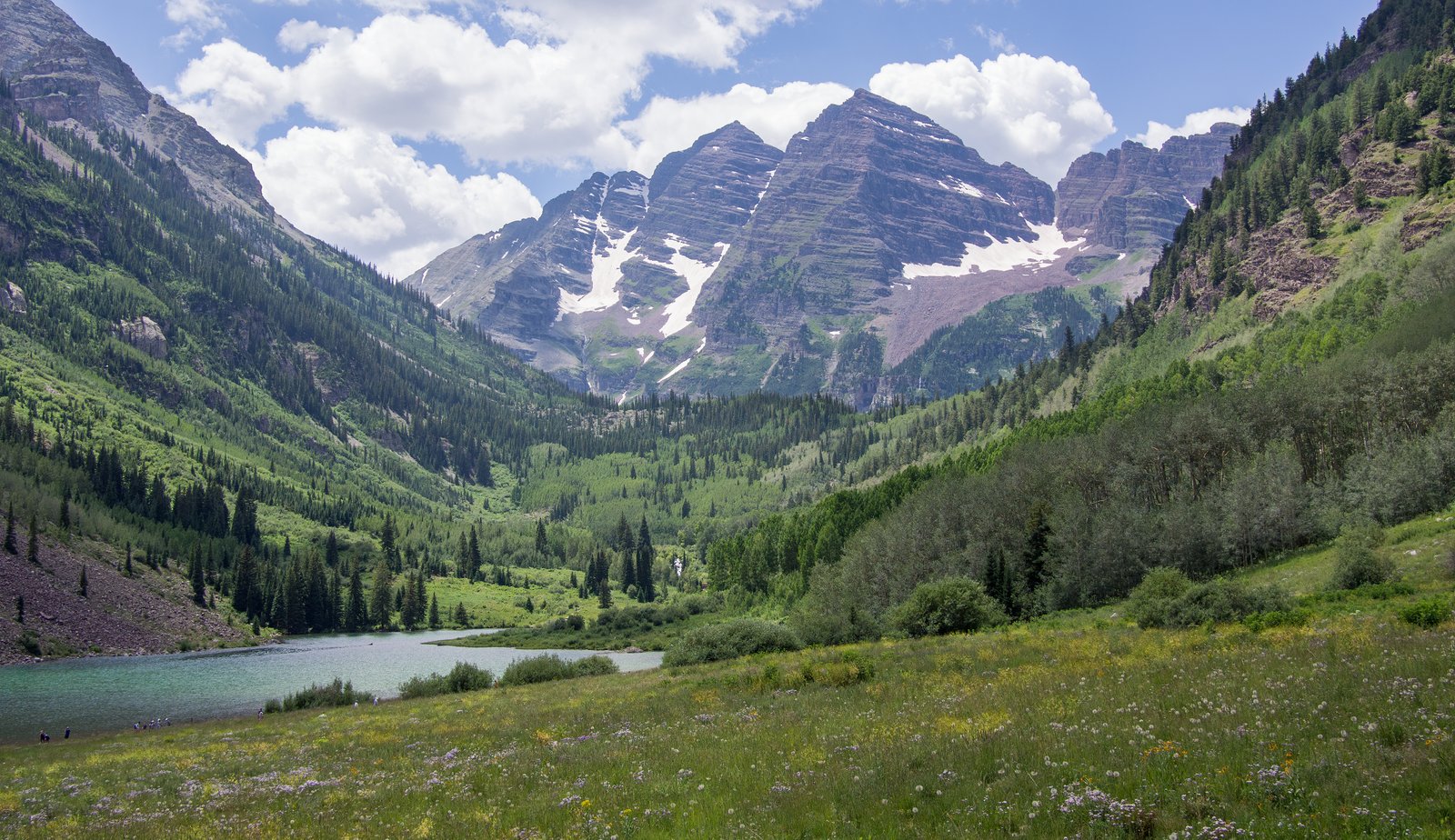
SaveBecause both peaks face east-southeast, the first light of the day hits the maroon-colored mudstone and limestone faces directly, turning them from dark burgundy to vivid orange-red. This alpenglow phase begins roughly 10–15 minutes before official sunrise and fades as the sun clears the ridge and becomes a hard overhead source. In late September, sunrise at this elevation typically falls between 6:45 AM and 7:10 AM (Mountain Daylight Time). You need to be at the lake shore before 6:30 AM to claim a composition and set up your tripod before the light changes. If you drive in on a parking reservation, the gate opens early enough that you can leave Aspen around 5:45 AM and arrive with time to scout.
Wind is the variable no app reliably predicts at Maroon Lake. The lake sits in a natural bowl, and the surrounding terrain channels cold air from the peaks downslope through the night. By early morning, that drainage wind typically dies, leaving the lake surface flat and mirror-smooth for roughly 45–90 minutes after first light. By 8:30–9:00 AM, convective heating begins, the valley warms, and surface ripples appear. Once the wind picks up, the reflection breaks. Glass-water conditions in fall are most likely on calm, clear mornings — overcast or front-passage days frequently produce choppy surfaces even before sunrise. Check WindFinder or Mountain-Forecast for the Maroon Bells area 24 hours before your shoot. A predicted calm wind (under 5 mph) at the trailhead at 6 AM is a strong indicator of reflective conditions.
Mid-morning aspen light
Some photographers, particularly those who prefer the fully lit aspen groves over alpenglow, target the 9:00–10:30 AM window during peak fall color. By this time, the sun has worked its way down the faces of the peaks and is illuminating the golden aspen forests that fill the valley below. The warm light on the trees and the maroon-tinted peaks above creates a different but equally compelling palette. The trade-off is a busier lake shore and the loss of glass-water reflections, but the aspen color rendering in direct light is spectacular in its own right. Fall color peak at Maroon Bells typically runs from September 20–30, with the exact timing shifting up to a week depending on precipitation and temperature the preceding weeks.
Blue hour and the case against sunset
Sunset is a trap at Maroon Bells. Because the peaks face east, the setting sun in the west illuminates the backside of the mountains and puts the main faces in shadow. You will not get warm light on the peaks at sunset. What you will get — if skies are clear — is blue-hour cool light on the peaks reflecting into the lake, which is a legitimate and underrated composition. After-5-PM parking reservation holders who drive up in the evening often find the lake to themselves. The shuttle’s last run from Maroon Lake back to Aspen Highlands is at 5:00 PM, so the crowd departs with the buses. If you hold a parking reservation for the evening window and have warm layers, the post-5 PM lake is a different experience than the pre-8 AM version: quieter, cooler, and with a more contemplative quality of light.
Compositions: what to shoot and where to stand
The 24–70mm classic wide from the lake shore
 Save
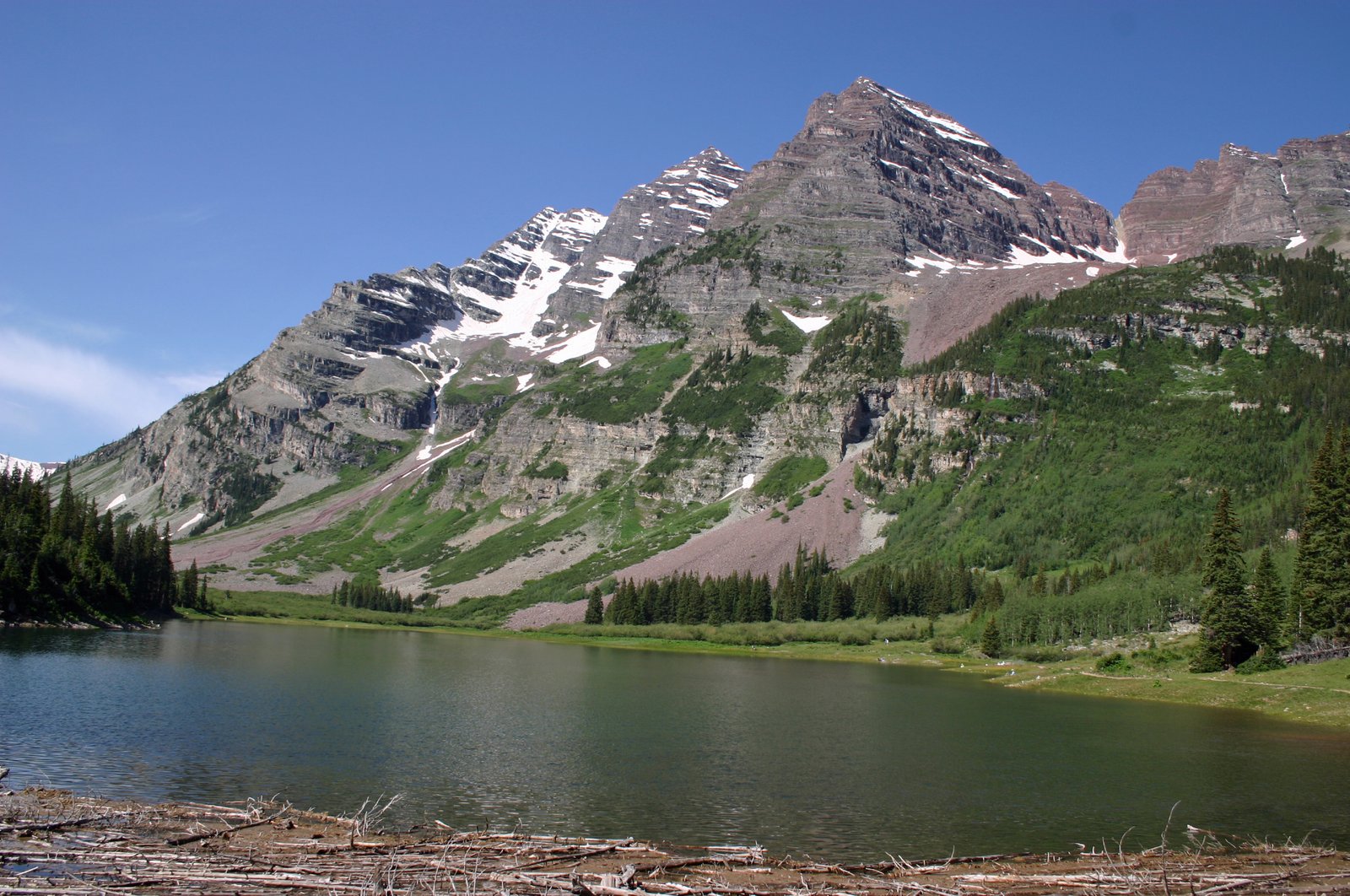
SaveThe canonical Maroon Bells image is made from the northeast shore of Maroon Lake, standing at or near water level, with a 24–50mm focal length. At 35mm on a full-frame sensor, you get roughly equal portions of sky, mountain, and reflection — a balanced thirds composition that works cleanly as a horizontal print. A slightly wider view at 24–28mm lets you include the aspen treelines flanking the peaks on either side, adding color and framing depth. The conventional spot to set your tripod is on the right-side bank of the lake (looking toward the peaks), where a small graveled area gives a slightly elevated position above the waterline. Note that the Forest Service has installed erosion-control barriers close to the water’s edge; you cannot always wade to the absolute shoreline. This affects how much reflection you can capture, particularly later in fall when water levels drop. Scout the bank edge carefully before first light so you are not guessing in the dark. Consider also shooting a panoramic stitch in the 35–45mm range — at this location, the full scene including both flanking treelines can comfortably fill a 2:1 or 3:1 panoramic that is impractical to achieve in a single frame.
70–200mm telephoto isolation
Most photographers arrive with a wide-angle and nothing else. A 70–200mm lens opens up a completely different set of images. At 135–200mm, you can compress the peaks and isolate the upper third of Maroon Peak and North Maroon Peak with the sky behind them, eliminating the lake foreground entirely. This framing emphasizes the dramatic texture of the cliff faces — the layered mudstone tilted at roughly 60 degrees — and, during alpenglow, produces an image that reads as abstract geology lit from below. The telephoto also lets you shoot from the trail head toward the shuttle drop-off area, which places you farther from the lake but compresses the aspen groves between the peaks. Another telephoto subject: the fall treeline transition on the north-facing slopes, where a hard line divides gold aspen from evergreen fir. At 200mm this boundary becomes a compositional element rather than background noise.
Foreground rock and wildflower placement
The paved scenic loop around Maroon Lake (roughly 1 mile) gives you multiple access points to the shoreline. The south side of the lake, reached by crossing the footbridge from the main parking area, provides a very different foreground than the standard north-bank position. From this angle, mid-summer wildflowers — primarily Indian paintbrush, columbine, and wild asters — frame the lake edge and can be positioned in the immediate foreground at a low shooting angle. Use a wide-angle at 16–24mm with the camera close to the ground, focus-stacking two or three frames (near foreground at f/8, mid and far at f/11) to get sharp flowers and sharp peaks in the same final image. In late September, replace wildflowers with lichen-covered rocks and fallen aspen leaves along the shoreline. A flat stone in the foreground with the peaks reflected behind it is a composition that photographs surprisingly well at f/11 in early alpenglow.
Crater Lake: the 1.8-mile alternative viewpoint
 Save
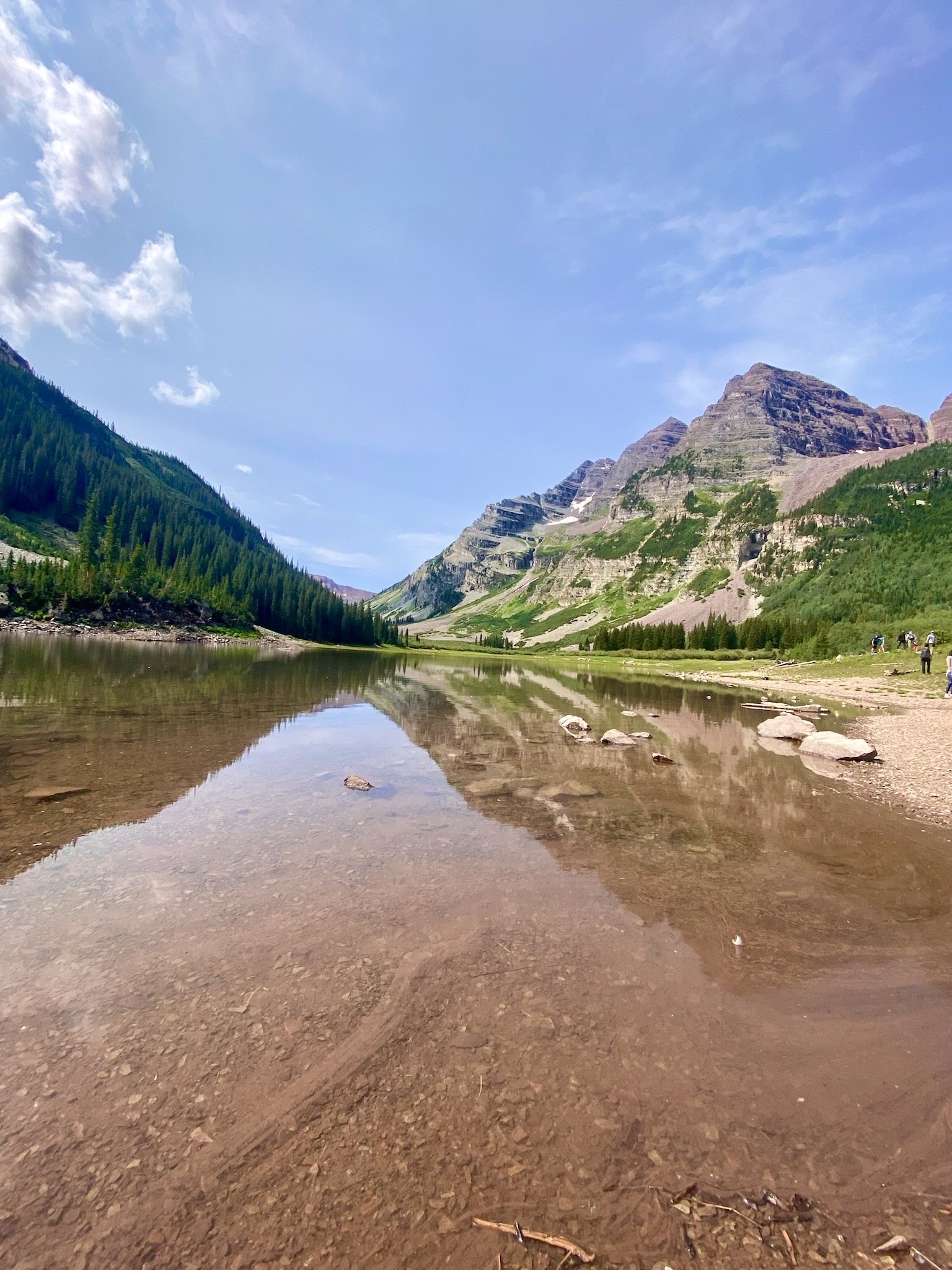
SaveHiking the Crater Lake Trail (1.8 miles one way from Maroon Lake, approximately 500 feet of elevation gain, rated moderate) puts you directly below the peaks at a high alpine lake at 10,076 feet. The viewpoint from Crater Lake is fundamentally different from the classic shot: you are inside the cirque, looking up at both peaks almost directly overhead rather than looking across the valley. The scale is dramatic in a way the standard Maroon Lake composition does not convey. There is no perfect reflection here — Crater Lake is shallower and more turbulent — but the isolation of the peaks against sky, the rocky terrain, and the waterfall visible on the cliff face above the lake make this a strong telephoto target. Budget a full hour for the hike in from the lake and the same back. The trail is rocky in its upper half; hiking boots are required. Crater Lake sits within the Maroon Bells-Snowmass Wilderness, and the wilder character of the scene away from the day-use crowds often shows in the finished image. Early morning arrivals who hike in before the shuttle starts can reach Crater Lake before 8 AM with the peaks still in alpenglow.
Permits, restrictions, and the rules that catch commercial shooters
Drones are prohibited. The trail to Crater Lake and the wilderness beyond is part of the congressionally designated Maroon Bells-Snowmass Wilderness. Per U.S. Forest Service wilderness regulations, unmanned aircraft systems (UAS) are classified as mechanized equipment and cannot take off, land, or operate within designated Wilderness areas. This is not a day-use restriction — it is a permanent prohibition covering the entire Maroon Bells-Snowmass Wilderness boundary, which begins at the Maroon Lake trailhead. Even in the non-Wilderness portions of the scenic area (the paved parking area, shuttle drop zone, and lake shore loop), drones are strongly discouraged and generally prohibited under area-specific forest orders. Do not fly here. Violations are federal offenses, subject to fines up to $5,000 and equipment confiscation.
Tripods are permitted for personal photography throughout the Maroon Bells Scenic Area, including the lake shore and the Crater Lake trail. Set up on the designated graveled areas and avoid going off-trail to reach shoreline positions. The Forest Service has installed erosion barriers along parts of the lake edge to protect the bank from trampling; respect these and set up behind them.
Commercial photography — defined as shooting for clients, stock libraries, advertising, or any project intended to generate revenue, including assignment editorial — requires a special use permit from the White River National Forest. Per White River National Forest Special Use guidance, a SF-299 application and supplemental commercial filming form must be submitted a minimum of 10 working days before the shoot date. Contact the Aspen-Sopris Ranger District at (970) 925-3445 to initiate the permit process. Under the FILM Act (signed January 2025), groups of fewer than six people engaged in small-scale photography do not need a permit for purely personal or non-commercial work — but this exemption does not cover professional photography for hire, client work, or stock licensing. If in doubt, call the ranger district before your shoot date; unpermitted commercial work in National Forest lands is a federal violation.
Overnight wilderness permits are required for camping within the designated overnight permit zones of the Maroon Bells-Snowmass Wilderness. These are reserved in advance through Recreation.gov. Bear-resistant food containers (IGBC-approved) are mandatory — rangers will ticket and remove visitors without them. Campfires are prohibited at Crater Lake and above 10,800 feet anywhere in the wilderness. Group size is capped at 10 people.
Seasons and road conditions
Maroon Creek Road typically opens around May 15 each year, weather dependent. Snow on the upper road and avalanche debris can delay opening into late May. Even when the road opens, Maroon Lake itself may be partially frozen and the peaks heavily snow-covered through the end of May — a viable but demanding season for landscape work that requires cold-weather preparation.
Wildflower season runs from early July through mid-August. Indian paintbrush, columbine, wild asters, lupine, and fleabane fill the meadows along Maroon Creek and the lake shores during this window. July and August also bring the highest probability of afternoon thunderstorms — typically building by noon, arriving by 2:00–3:00 PM, and clearing by evening. Plan to be off exposed terrain and out of the watershed by midday.
Golden aspen season peaks from approximately September 20–30, though this window can shift a week earlier or later depending on the summer’s heat and precipitation. The aspens on the valley floor and surrounding slopes above Maroon Lake turn simultaneously, creating a complete bowl of gold that frames both peaks. This is the window most photographers target and the most competitive period for permits and parking reservations. Book shuttle tickets and parking reservations as soon as they open — typically February or March of the same year. Weekdays (Monday through Wednesday) are significantly less crowded than weekends during this window.
Maroon Creek Road closes for the season in late October or early November, depending on snowfall. The Forest Service does not plow the road past the T-Lazy-7 Ranch gate. Once closed, the only access to Maroon Lake is on foot or skis — a 6-mile one-way approach from the T-Lazy-7 gate. Winter photography at the Bells is spectacular but requires serious backcountry preparation. Snowmobile tours to the general area (not to Maroon Lake itself) can be arranged through T-Lazy-7 Ranch.
Altitude warning: Maroon Lake sits at 9,580 feet above sea level. Visitors arriving from lower elevations — particularly from Denver (5,280 ft) — can experience acute mountain sickness symptoms including headache, nausea, and shortness of breath. Spend at least one night in Aspen (7,908 ft) before an early-morning shoot. Hydrate aggressively beginning the day before. Do not attempt the Crater Lake hike on the same day you arrive from the Front Range.
Gear recommendations for Maroon Bells
Weather-sealed bodies are not optional here — they are the price of admission for serious landscape work at this location. Afternoon thunderstorms can materialize with minimal warning, and even morning shoots in September can involve frost and mist. A camera body rated to at least IPX4 splash resistance is the baseline. Carry a rain sleeve in your pack regardless of the morning forecast; conditions at 9,500 feet routinely outpace anything an app shows for Aspen proper.
For landscape photography at Maroon Bells, the essential lens kit is: a wide-angle zoom in the 16–35mm range (or equivalent on crop sensor) for the classic lake reflection composition and panoramic stitches; a standard zoom in the 24–70mm range for flexible lake-shore framing; and a telephoto zoom in the 70–200mm range for peak isolation, aspen texture compression, and wildlife. Primes are welcome but you will walk away wishing you had the reach of a 200mm when elk appear in the meadow behind the lake or when alpenglow hits only the upper cliff face and you want to compress that into a tight frame.
A sturdy carbon-fiber tripod is non-negotiable. The most important images at Maroon Bells — blue-hour reflections, pre-dawn setups, long-exposure waterfall shots on the Crater Lake trail — all require a stable platform. Ball head with an Arca-Swiss clamp is the standard for speed when you are moving positions around the lake in low light. Bring a remote shutter release to eliminate camera shake at slow shutter speeds.
Filters: a 2- or 3-stop graduated neutral density filter (or a reverse ND grad) is highly useful at sunrise, when the sky directly behind the peaks is significantly brighter than the shadowed foreground. A circular polarizer is essential for daytime work — it reduces glare off the lake surface, saturates aspen foliage, and deepens the blue of the sky at the cost of one to two stops of light. Stack a CPL behind your ND grad for maximum control. In the pre-dawn window you will not need either; it is entirely about managing long exposures of a dark scene, where a 10–30 second exposure at ISO 400 and f/8 is a typical starting point.
Logistics
Drive time from Denver: Approximately 3 hours 45 minutes (200 miles via I-70 West to CO-82 East through Glenwood Springs). For a sunrise shoot in late September, leaving Denver by 2:30 AM puts you at Aspen Highlands by 6:15 AM, in time for a parking reservation arrival before 8:00 AM. The faster route via Independence Pass (CO-82 over the 12,095-foot pass from Buena Vista to Aspen) cuts distance but is closed November through late May and adds significant mountain driving time.
Drive time from Aspen: Approximately 20–25 minutes by car on Maroon Creek Road. The road is 9 miles from the roundabout at Highway 82 to the Maroon Lake trailhead, with the Maroon Bells Welcome Station approximately 4.7 miles in. If taking the shuttle from downtown Aspen, a free RFTA city bus (Castle/Maroon line) runs every 20 minutes from Rubey Park Transit Center in central Aspen to Aspen Highlands, where you board the paid Maroon Bells shuttle.
Shuttle full — what to do: If you arrive at Aspen Highlands for the shuttle and your reservation is sold out or you failed to book, you have limited options. Walk-up tickets are occasionally available at the gate due to no-shows, but do not count on this during September weekends. The free city bus from Rubey Park to Aspen Highlands is your staging point. Alternatively, drive in on a morning parking reservation before 8:00 AM — these are a separate inventory from shuttle tickets and sometimes available when shuttle seats are gone. The last resort is the bicycle option: Maroon Creek Road is open to bicycles and e-bikes all hours, with no reservation required. The 9-mile road climb from Aspen gains roughly 2,000 feet of elevation; bring lights for a pre-dawn approach.
Restrooms: Vault toilets are available near the trailhead parking area at Maroon Lake. There are no flush toilets or running water at the scenic area. The Forest Service has noted that no water is available at the Maroon Bells Scenic Area — bring all water you need for the day. Plan on at least 2 liters for a half-day visit at altitude.
Food: There is no food service or concession at Maroon Lake. Pack all food and plan to pack out all trash. The Maroon Bells Welcome Center at Aspen Highlands has limited amenities during shuttle hours. Cell service is unavailable at Maroon Lake, so download offline maps and complete all shuttle reservations before leaving town. The USFS Supervisor’s Office can be reached at (970) 945-2521; the Aspen-Sopris Ranger District is at (970) 925-3445.
Coordinates: 39.0985, -106.9408 (Maroon Lake Trailhead). Address: end of Maroon Creek Road, Aspen, CO 81611. The trailhead is inside White River National Forest and administered by the Aspen-Sopris Ranger District of the U.S. Forest Service.
More photography spots in this area
Gear Blueprint: What to Pack for This Shoot
Maroon Bells at sunrise is a 9,580-ft alpine reflection shot. The shot is famous for symmetry: peaks + lake + aspens. You need cold-weather gear, a low tripod for the shoreline, and the right filter set for sky-water exposure balance.
- Mid-range zoom (24-70mm or 24-105mm) — The classic shot is around 35-50mm — wider distorts the peaks, longer crops the aspens.
- Sturdy tripod with low-angle ball head — You’ll be inches off the water for the cleanest reflection.
- Reverse graduated ND — Sunrise lights the peaks first while the lake is still dark — reverse grads handle this better than soft grads.
- Insulated photographer’s gloves — Pre-dawn shoreline temps hit 30-40°F even in September.
- Down jacket (packable) — You’ll be standing still for an hour while exposure stacks build up.
- Battery grip or 2-3 spare batteries — Cold drains batteries 30-40% faster.
- Microfiber towel — Condensation on the front element is constant near alpine water.
- Headlamp — The walk from Maroon Lake parking is dark before sunrise.
Affiliate disclosure: links above go to Amazon. We may earn a small commission at no extra cost to you. We only recommend gear we’d take ourselves to this specific location.