14 Best Photography Spots in Prague: A Real Shooter’s GPS Guide (2026)
Updated
 SaveBy Edin Chavez – Miami-based professional photographer, founder of Shut Your Aperture. More about Edin.
Charles Bridge crowds aren’t the only thing that’ll wreck your shot — our landscape photography guide covers the planning, filters, and composition habits that separate Prague snapshots from portfolio frames.
It’s 4:40 a.m. in early November and the city is still completely dark. You cross the Mánes Bridge heading toward Malá Strana, and somewhere on the far bank the Vltava is breathing. Not a metaphor — there’s actual fog rising off the water in slow columns, backlit by the distant amber glow of the castle floodlights. The silhouettes of Charles Bridge’s baroque saints appear one by one out of that grey, like they’ve been there forever and will be there long after you’ve left. And they kind of have been. That scene — available maybe a handful of mornings a year when temperature and river warmth align — is why photographers keep returning to Prague. Not because it’s the only city with old stones and a river. Because here, on the right morning, the whole thing looks like a painting that someone forgot to dry.
Prague rewards patience more than almost anywhere in Europe. The architecture is dense enough that even a slight shift in position changes the entire compositional relationship between foreground and background. The light shifts with the seasons in dramatic ways — November fog, January snow settling on Gothic spires, April cherry blossom framing the castle, the long amber dusk of June. Most photographers who visit once come back. That’s not a coincidence.
This guide covers 14 locations from a photographer’s actual working perspective, not a tourist’s itinerary. For every spot: the shot, the timing, the local angle others miss, and an honest crowd assessment. See our full travel photography guide library for companion guides to other cities.
 Save
SaveWhy Prague Rewards Patience
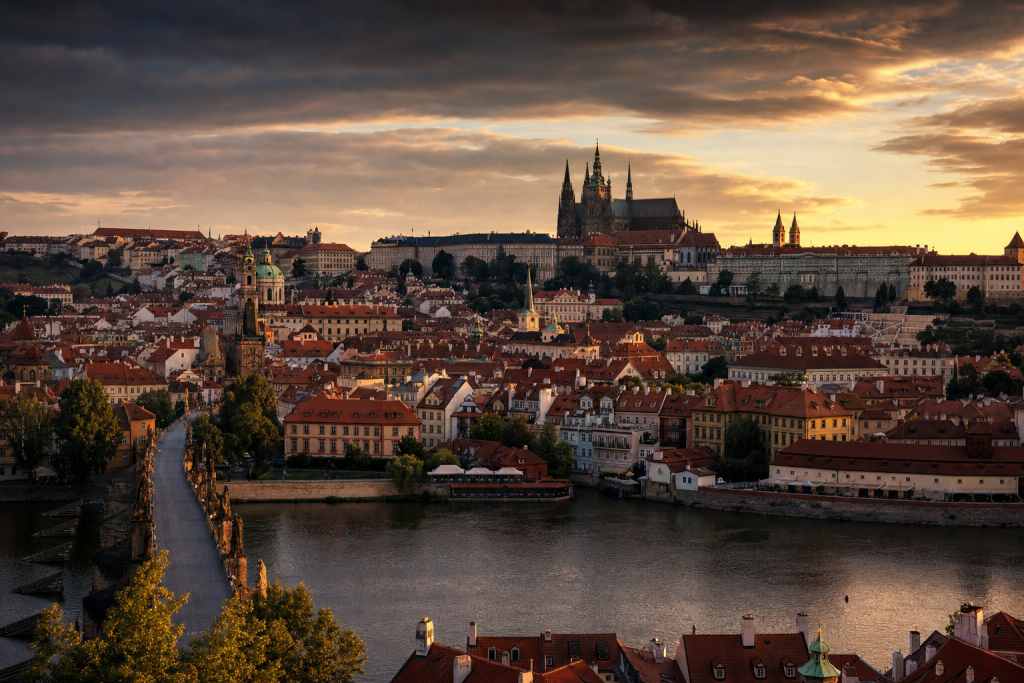
Most European capitals have a couple of genuinely photogenic neighborhoods and then a lot of modern sprawl. Prague is different. The historic core — from Josefov in the north to Vyšehrad in the south, from the Old Town east bank to Hradčany on the west hill — is almost entirely intact Gothic, Baroque, and Art Nouveau architecture. There are very few visual breaks. That density means every corner turn produces something worth shooting, but it also means you need to choose: the wide establishing shot, or the compressed telephoto view that makes the spires stack up behind each other.
The seasons do real work here. Winter brings the lowest crowds and the best chance of fog and snow, but sunrise is after 7:30 a.m. in December (which means Charles Bridge doesn’t clear of people before golden hour). Spring — late March through May — is arguably the peak season for photography, with blossoms, long golden hours, and manageable crowds. Summer gives you extreme golden hours (sunrise before 5 a.m.) but maximum tourist density. Autumn is the sleeper pick: October crowds drop sharply, the light turns golden-orange, and the city takes on a melancholy quality that suits the architecture perfectly.
14 Photography Spots in Prague, Ranked by Shooting Depth
Charles Bridge (Karlův most)
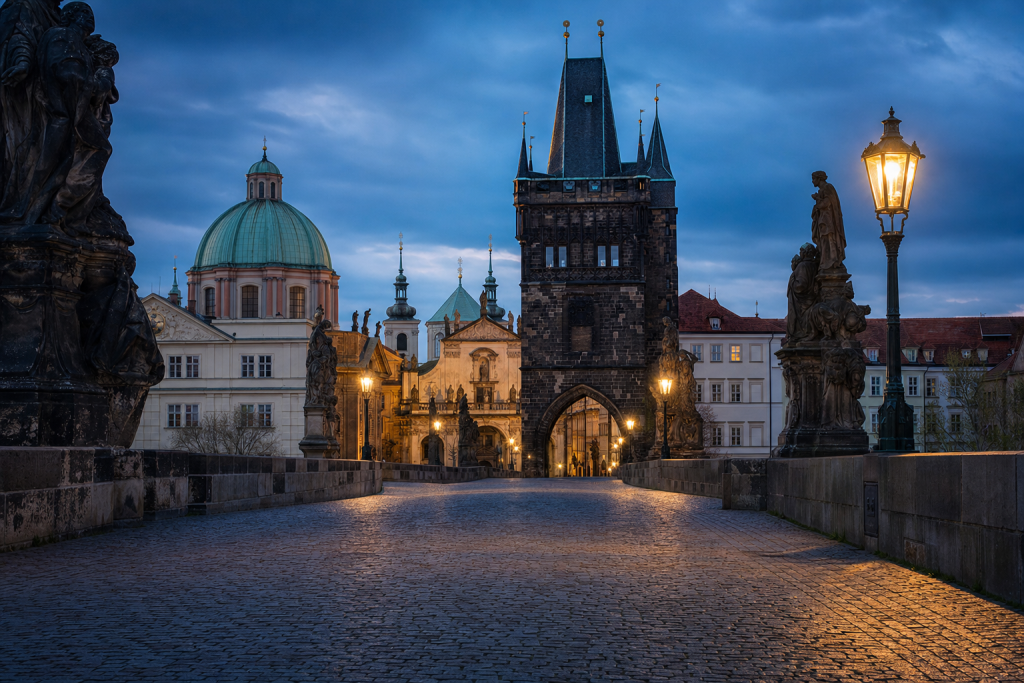
The mistake most photographers make at Charles Bridge is showing up at sunrise expecting solitude. Sunrise is not early enough. By the time the sky goes pink, there are already twenty other photographers on the bridge — and by the time it turns gold, the tour groups have arrived. The window you want is the 45 minutes before civil twilight. Arrive while it’s still full dark, set up on the bridge itself facing west toward the castle, and wait for the blue hour to arrive. At that point the floodlit castle glows warm orange against a deep blue sky, and the sodium lamps along the bridge throw long amber reflections on the wet cobblestones.
Plan it: Compare sunrise photography walks.
For the classic two-tower composition, stand roughly one-third of the way across from the Old Town side and use a 24–35mm lens to get both towers in frame with a statue in the foreground. For a tighter, more atmospheric shot, go long (85–135mm) from the embankment below the Malá Strana side to compress the towers and saints into a flat silhouette against the sky.
The underrated angle: walk down the stairs from the Malá Strana end to the Na Kampě riverside and shoot the bridge from below with a wide-angle. At predawn the reflection of the lit-up towers in the Čertovka canal is outstanding.
 Save
SaveOld Town Square (Staroměstské náměstí)
At 5:30 a.m. in May, the Old Town Square is completely empty except for the pigeons and the street cleaners. The Týn Church’s twin Gothic spires catch the first warm light while the square’s cobblestones are still dark and wet. This is the shot — and it’s yours for maybe thirty minutes before the first tour groups arrive.
The Astronomical Clock (Orloj) on the Old Town Hall draws crowds every hour for the mechanical procession. The clock face itself is a beautiful subject: use a 50–85mm to isolate the astronomical dial’s gold and blue detailing against the stonework. At dusk, when the square fills with warm artificial light, the Týn Church towers glow and the whole square takes on a theatrical quality that’s impossible to replicate at midday.
December Christmas market: the wooden stalls, mulled wine steam, and the lit-up Týn Church behind them produce one of Prague’s most genuinely atmospheric scenes. Come just after dark, around 5–6 p.m., and shoot with a moderate telephoto to compress the market density. The elevated view from the Old Town Hall tower (when open) looking down across the market is exceptional.
Prague Castle — Exterior Views
The castle complex dominates Prague’s western skyline, and how you shoot it depends entirely on where you’re standing. From Letná Park, you get the classic panoramic view across the river — multiple Vltava bridges receding into the frame, the castle sitting high on the hill behind them. The GPS coordinates photographers return to are around 50.0939°N, 14.4140°E, just west of the red metronome, where you can set up a tripod on a patch of open ground with a clean sight line down the river.
Plan it: Check Prague Castle access tours.
From the Hradčany side — the narrow cobblestoned streets directly below the castle walls — you can get extremely tight architectural compositions where the castle seems to loom overhead. Early morning, when the tourist coaches haven’t arrived yet, the streets of Hradčany feel like a film set.
From Vyšehrad (covered in full below), the castle appears across the river as part of a broader skyline — more subtle, more context-rich. This is the view that gives you Prague as a whole rather than just the castle as a monument.
St. Vitus Cathedral (Katedrála sv. Víta)
The cathedral interior is one of the finest Gothic spaces in central Europe, and the Alfons Mucha rose window — a massive circular stained-glass installation at the west end — is genuinely spectacular when backlit by morning sun. Arrive when the cathedral opens, typically 9 a.m. (check seasonally), and head immediately to the nave to catch the sun coming through the south-facing windows. By midday the direct backlight on the Mucha window is gone.
Plan it: Plan cathedral and castle access.
Tripods are not permitted inside. You’ll be shooting handheld, which means a fast lens is essential — f/1.8 or faster if you want to avoid ISO noise in the vaulted interior. A 20–24mm wide-angle will let you capture the full height of the nave without having to stitch. Expect shutter speeds around 1/60–1/100s handheld; brace against a column when you can.
The exterior south tower — with its Gothic spire against the sky — photographs well from the second courtyard of the castle complex. The southwest face catches late afternoon light. The cathedral’s scale is best captured from the castle’s first courtyard looking up and slightly east.
Letná Park & the Metronome
Letná is where Prague goes to drink beer at sunset. The park occupies a long plateau above the Vltava’s north bank, and the terrace near the giant red metronome offers a sweeping view across the Old Town and castle. In summer, local families, cyclists, and groups of young Praguers spread out along the terrace — which is actually great for people photography if you’re paying attention to what’s happening behind your tripod as well as in front of it.
The metronome itself — a massive kinetic sculpture sitting on a plinth that once held a Stalin statue — is an unusual graphic element. Include it in the foreground as a visual anchor with the city spread behind, or use it to frame the castle in the middle distance. Its red paintwork photographs well in late afternoon light.
The GPS coordinates for the classic multi-bridge shot are about 100 meters west of the metronome, on a dirt clearing where photographers habitually set up. From here you can see four or five Vltava bridges lined up in perspective — a composition that’s essentially impossible to get from anywhere else in the city.
Vyšehrad
Vyšehrad sits on a rock outcropping two kilometers south of the Old Town, and most tourists don’t bother. That’s your opportunity. The fortified park is quiet, the views across the Vltava toward Prague Castle are expansive, and at sunset the castle complex appears as a warm silhouette above the city — a more considered composition than anything you’ll get from the tourist overlooks on the north bank.
The SS. Peter and Paul Basilica at Vyšehrad is a striking Neo-Gothic structure with twin spires that photograph well from the cemetery side in late afternoon light. The adjacent Vyšehrad Cemetery — resting place of Dvořák and Smetana among others — has extraordinary ornamental stonework and a sepulchral atmosphere that suits a longer focal length and a quieter kind of documentation.
Walk to the ramparts on the north side for the river view. In winter, when the trees are bare, you can see across to Charles Bridge. On a clear day in any season, the castle is perfectly positioned on the horizon directly across the river — shoot it at blue hour with the floodlights on.
Jewish Quarter (Josefov)
The Old-New Synagogue (Staronová synagoga) on Červená street is the oldest functioning synagogue in Europe — built in 1270 — and its distinctive Gothic stepped gable roof and red brick are architecturally striking. The synagogue photographs well from across the street in the late morning when the north face catches reasonable light. Wide-angle will get the full building; a 50–85mm will isolate the roof gable against the sky.
The Old Jewish Cemetery (Starý židovský hřbitov) is the location that rewards patience most in Josefov. Thousands of gravestones are layered and tilted against each other, the ground beneath them built up over centuries of burials. In autumn, when the trees inside the cemetery walls are turning, the light filters through the canopy and falls across the worn Hebrew inscriptions in a way that’s genuinely difficult to do justice to. A Jewish Museum ticket is required for entry.
The wider Josefov neighborhood — squeezed between the Old Town and the river — has beautiful Art Nouveau apartment buildings along Pařížská street. This wide boulevard is Prague’s version of a Haussmann avenue and photographs well in early morning before the shops open and the street fills with foot traffic.
Wallenstein Garden (Valdštejnská zahrada)
Wallenstein Garden is tucked behind the Senate building in Malá Strana, and a significant number of visitors to Prague never find it. That’s a failure of curiosity. The garden is one of the city’s first Baroque palace gardens, built in the 1620s, and its formal geometry — long reflecting pool, bronze copies of classical statues, perfectly clipped hedges — photographs with an almost stage-set formality.
The Dripstone Wall (sometimes called the Grotto) is the highlight from a photographic standpoint. It’s a 40-foot artificial stalactite wall running the length of one side of the garden, its surface crusted with organic-looking protrusions that conceal grotesque carved faces. Shoot it with a 50–85mm to isolate sections of texture; the contrast between the wall’s chaotic surface and the garden’s geometric order is the compositional tension that makes the shot work. Overcast light is actually better than direct sun here — it reduces harsh shadows in the deep relief.
The resident peacocks roam freely and will occasionally sit still long enough for a frame. Patience, a fast lens at moderate telephoto, and low approach angles work best — get below the bird’s eyeline and shoot upward slightly to separate it from the ground.
Strahov Monastery & Viewpoint
Strahov Monastery sits at the western edge of Hradčany, just above the castle complex, and the terrace of the monastery brewery offers a panoramic view east over the city’s red-roofed skyline toward the Vltava and beyond. This is a less-visited viewpoint than Letná or Petřín, and the sight line is different — you’re looking slightly down across the castle and into the Old Town, which gives you a sense of the city’s topography that flat embankment views don’t provide.
The Strahov Library is one of the most photographed interiors in Prague — the Philosophical Hall and Theological Hall are Baroque masterpieces. But be prepared: tripods are strictly banned, the doorways to each hall are narrow and crowded, and you’ll be shooting over other visitors’ heads into the room. The practical solution is a wide-angle at 16–20mm, ISO 1600–3200, braced against the doorframe. The barrel distortion of an ultra-wide actually complements the curved ceiling frescoes.
The Dancing House (Tančící dům)
Frank Gehry and Vlado Milunič’s 1996 Deconstructivist building — colloquially “Fred and Ginger” after Astaire and Rogers — stands on the riverbank south of the Old Town, looking slightly offended by its Baroque and neo-Renaissance neighbors, which is exactly the point. The building’s organic, undulating form is best photographed from across the street with a moderate wide-angle (28–35mm), using the conventional neighboring buildings as a contrast element.
At blue hour, the internal lighting turns the glass tower a warm amber-gold that reads beautifully against a deep blue sky. This is genuinely one of the cleaner architectural shots in Prague because there’s no foreground clutter — the building sits right on a quiet side street, and you can set up a tripod on the opposite pavement without any real interference.
Wenceslas Square (Václavské náměstí)
Wenceslas Square is not actually a square — it’s a long boulevard about 750 meters from the National Museum at the top to the pedestrian zone at the bottom, lined with Art Nouveau and Functionalist buildings. From the foot of the equestrian statue of St. Wenceslas outside the National Museum, looking down the length of the boulevard at dusk, you get a classic compressed-perspective urban shot with tram lines, light trails, and the dense building frontages converging toward the distant Old Town.
The National Museum at the top end of the square is an imposing Neo-Renaissance building that’s been recently restored. It photographs well head-on in the late afternoon when the facade catches warm west-facing light, and at night when it’s floodlit.
Riegrovy Sady
Riegrovy Sady is a hillside park in Vinohrady, east of the Old Town, with a terrace beer garden that looks west across the city toward Prague Castle. The sunset view from here — Prague Castle’s silhouette, the dome of St. Nicholas in Malá Strana, and the spires of St. Vitus floating above the city in the warm evening light — is genuinely stunning, and you’ll be sharing it with Czech families, dog walkers, and groups of university students rather than tour groups.
This is one of the best people photography situations in Prague. The beer garden terrace fills with locals in late afternoon from May through September. The combination of the dramatic background view, the warm light, and people who are actually relaxed and present (not checking maps, not performing for Instagram) gives you opportunities for environmental portraiture that don’t exist in the tourist-saturated center.
Náplavka Riverside
Náplavka is the stone embankment along the east bank of the Vltava, just south of the New Town, and on Saturday mornings it hosts a farmers’ market that’s one of the best street photography situations in the city. Produce vendors, cheese stalls, food trucks, dogs, families, cyclists, Czech grandmothers — it’s chaotic and completely photogenic. A 35mm or 50mm prime and a willingness to get within a meter of your subjects is all you need.
The houseboats moored along the embankment are colorful and eccentric, and at dusk their reflections in the dark river water make excellent long-exposure subjects. The embankment itself — granite steps running down to the water, old iron mooring rings, barges — has a texture and material quality that rewards close detail work.
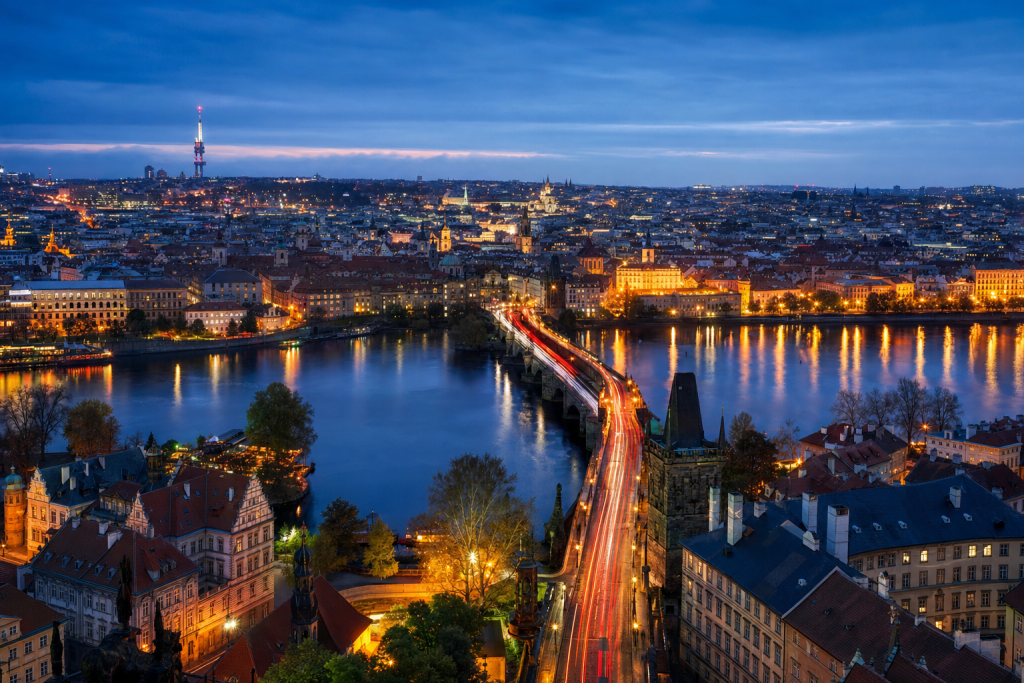
From Náplavka you can also shoot north toward Charles Bridge with the castle behind it — a view that includes the river, multiple bridges, and the castle hill in a single frame. At blue hour with a neutral-density filter, a 30-second exposure will smooth the water to glass and blur any passing river traffic to near-invisible.
Náměstí Míru & Vinohrady
Vinohrady is the residential neighborhood east of Wenceslas Square, and Náměstí Míru is its central square. The square features the Church of St. Ludmila — a Neo-Gothic twin-spire church that would be mobbed with tourists if it were in the Old Town, but here attracts barely a glance from the locals passing by on their way to the metro. The square is lined with Art Nouveau apartment buildings and has a quality of ordinary, dignified urban life that the tourist center has entirely lost.
Vinohrady’s residential streets — lined with fin-de-siècle apartment buildings, chestnut trees, and corner cafes — offer a version of Prague that most visitors never see. In April, the blossoming chestnut and cherry trees along streets like Mánesova or Blanická frame the architecture in pink and white. This is documentary photography at its most rewarding: a city that’s not performing for the camera.
Gear for Shooting Prague
Prague’s photographic challenges are consistent: narrow streets, low-light interiors, long-distance city views that reward compression, and blue-hour shooting where you’d prefer to work without a tripod. Your kit decisions should be driven by those four scenarios, not by what looks impressive on a camera strap.
| Use Case | Recommended | Why |
|---|---|---|
| Narrow streets & interiors | Sony FE 20mm f/1.8 G or equivalent fast wide prime | The f/1.8 aperture buys you 3+ stops over a slow zoom — critical for handheld cathedral interiors. The 20mm field of view captures full facades in tight Malá Strana lanes without extreme distortion. |
| City panoramas & compression | 85mm or 100mm prime, or 70–200mm f/4 | Compresses the spire stacking you see from Letná and Riegrovy Sady into graphic architectural layers. The 70–200 range gives you flexibility; a prime gives you sharpness. |
| Long-exposure riverscapes | Peak Design Travel Tripod + 6-stop ND filter | The Peak Design Travel Tripod folds to 40cm and weighs under 2kg — manageable in Prague’s cobbled streets and compact enough to fit inside a day bag. The ND filter opens up 30-second smooth-water exposures in daylight. |
| Storage | Fast UHS-II SD cards | A week of shooting Prague will generate 500–1,500 RAW files if you’re working seriously. Bring at least two cards and back up to a portable drive each evening. Prague’s accommodation has reliable power — use it. |
| Polarizer | Circular polarizer, any quality brand | Essential for the Vltava reflections. Cuts glare on the water surface and deepens the sky in midday shots when you’re stuck shooting at off-hours. The effect on autumn foliage in Letná and Riegrovy Sady is significant. |
Best Months & Golden-Hour Timing
| Month | Sunrise | Sunset | Photography Conditions |
|---|---|---|---|
| January | ~7:55 a.m. | ~4:05 p.m. | Snow possible, very low crowds, short shooting day, frequent overcast |
| February | ~7:15 a.m. | ~4:50 p.m. | Occasional snow, low crowds, light improving |
| March | ~6:20 a.m. | ~5:45 p.m. | Variable; early month still winter; late month hints of spring |
| April | ~6:15 a.m.* | ~7:50 p.m.* | Cherry and chestnut blossom, manageable crowds, excellent light quality |
| May | ~5:20 a.m. | ~8:45 p.m. | Long golden hours, lush greenery, moderate crowds — peak photography season |
| June | ~4:55 a.m. | ~9:15 p.m. | Extremely long days, maximum tourist density, beautiful light |
| July–August | ~5:05 a.m. | ~8:55 p.m. | Peak tourist season — crowded at all iconic spots; early rising essential |
| September–October | ~6:20–7:15 a.m. | ~7:30–6:15 p.m. | Autumn colour, dramatically falling crowds, warm light, occasional fog — second peak for photography |
| November | ~7:05 a.m. | ~4:30 p.m. | River fog, very low crowds, bare trees, Christmas market starts late month |
| December | ~7:55 a.m. | ~3:55 p.m. | Christmas market (Nov–Jan), possible snow, low crowds outside market areas |
*April times shift by ~1 hour at DST change. Always verify exact times via PhotoPills or The Photographer’s Ephemeris before travel.
Tripod & Permit Reality
The short version: Prague is a photographer-friendly city. Almost all public outdoor spaces — parks, bridges, squares, embankments, streets — allow tripods with no permit required. The complications are mostly practical rather than legal.
Charles Bridge: Tripods are technically allowed but become problematic the moment foot traffic builds (roughly after 8 a.m. in summer). In the predawn window they’re fine. The bridge surface is uneven cobblestone, so bring leg spikes or rubber feet — the Peak Design Travel Tripod handles this well.
Church interiors: Tripods are universally banned inside churches and synagogues. St. Vitus Cathedral, the Old-New Synagogue, and all Strahov library rooms enforce this consistently. Monopods are sometimes tolerated — ask at the entrance.
Museum and gallery interiors: Policies vary. Photography without flash is usually permitted; tripods are usually not. Check the specific venue’s website or enquire at the ticket desk.
Prague Castle complex: The outdoor courtyards and gardens are fine for tripods. Interior buildings follow the same rule as churches above.
Commercial photography: If you’re shooting for editorial or commercial use with professional equipment (models, lighting, assistants), you’ll need to contact Prague City Hall and potentially the National Monument Preservation Office for permits, depending on the location. For individual photographers without commercial intent, no permit is needed anywhere covered in this guide.
Drones: Broadly prohibited over Prague’s historic center and strictly forbidden near Prague Castle. The Czech Civil Aviation Authority’s geofencing rules apply; check the CAA’s digital map before flying anywhere in the city. Getting caught flying without authorization near the castle carries significant fines.
Getting Around — Public Transport is Your Friend
Prague’s public transport network is one of the best in Europe for photographers specifically because it runs through the night and reaches every location in this guide. Metro lines A (green), B (yellow), and C (red) cover the core; trams fill in the rest.
For predawn Charles Bridge shoots, trams run from around 4 a.m. Line 22 runs through Malá Strana and up to Hradčany and is the single most useful tram for photography — it connects Charles Bridge, Malá Strana, Prague Castle, and Strahov in one continuous route. Take it uphill in the afternoon for the castle area and walk back down through Hradčany toward the river at golden hour.
For Vyšehrad: Metro Line C to Vyšehrad station, then a 10-minute walk across the park to the ramparts. For Riegrovy Sady and Náměstí Míru: Metro Line A to Náměstí Míru. For Letná: Metro Line A to Hradčanská, then walk across the Čechův Bridge and up the stairs to the plateau.
A 24-hour transport pass costs around 120 CZK (roughly €5). For a week-long photography trip, a 3-day or 5-day pass is more economical and removes the friction of buying tickets when you’re trying to get to a location before sunrise. Validate your ticket at the machine when you first use it — inspectors operate on trams and metros, and fines for unpunched tickets are immediate and non-negotiable.
Taxis and rideshares are worth it for one specific scenario: loading gear in and out after a long dawn shoot when your feet are done. Bolt is the reliable option in Prague; avoid unmarked taxis at tourist spots.
See our guide to best photography spots by city for how other European capitals compare for transport-accessible shooting.
More from Shut Your Aperture
- All Travel Photography Guides — Our full library of destination-specific shooting guides, updated regularly.
- Best Photography Spots by City — How Prague compares to other European capitals and beyond.
- Understanding Aperture — If the f/1.8 vs. f/8 decision still feels uncertain, this is worth 10 minutes of your time before your trip.
More city photography guides
Planning another city shoot? Use our GPS photography guides for Santorini, Istanbul, and Sydney.
Plan a Prague outing with Klook
Check the route, meeting point and included access before booking. This is sightseeing, not photography instruction.
Some links on this page are affiliate links. If you book through them, Shut Your Aperture may earn a commission at no extra cost to you.
Klook links are affiliate links. If you book through them, Shut Your Aperture may earn a commission at no extra cost to you.
What to Pack
A landscape kit built around wide views, steady support, and changing light is a useful starting point. Compare the gear and choose what fits your camera, budget, and conditions. These links lead to B&H Photo Video and Amazon.
| What & Why | B&H | Amazon |
|---|---|---|
Sony 16-35mm f/2.8 GM Check the camera mount before buying. Choose a focal length that fits the photos you plan to make. | Shop B&H → | Shop Amazon → |
Peak Design Travel Tripod Check the load rating, packed size and local tripod rules before buying. | Shop B&H → | Shop Amazon → |
Breakthrough X4 CPL Check the filter type and lens thread size before buying. Use a filter only when the effect fits your photo. | Shop B&H → | Shop Amazon → |
Breakthrough X4 10-stop ND Check the filter type and lens thread size before buying. Use a filter only when the effect fits your photo. | Shop B&H → | Shop Amazon → |
Sony NP-FZ100 battery Use the battery type specified for your camera. Bring a spare if your shooting plan calls for one. | Shop B&H → | Shop Amazon → |
SanDisk Extreme Pro 128GB Check the card format and speed requirements specified for your camera. | Shop B&H → | Shop Amazon → |
Koh microfiber cloths Compare this option with your current kit. Check compatibility and the product details before buying. | Shop B&H → | Shop Amazon → |
B&H and Amazon links are affiliate links. We earn a small commission on purchases at no extra cost to you.