Best Photography Spots in Berlin: 12 Locations With GPS
edinchavez01-20). Buying through these links costs you nothing extra and helps fund our free guides.
Berlin, Germany is one of the most photogenic cities in the world. If you have a camera and the patience to show up before dawn, Berlin will give you images that last a career — but only if you know where and when to point it.
This is the definitive field guide to the 12 best photography spots in Berlin, with GPS coordinates you can drop straight into Google Maps, exact camera settings tuned to Berlin’s unique light, precise timing for every location, and the access notes nobody else bothers to document. It mirrors the intel inside our Berlin Ultimate Photographer’s Guide ($47 PDF) — a downloadable field guide with full-page hero images, GPS maps, seasonal tables, a city safety briefing, and a complete photographer’s packing list. Get the guide →
Planning multi-city travel? See also: U.S. cities photography hub and the National Parks Photography Guides.
12 GPS-mapped locations · Exact camera settings · Multi-season shooting calendar · Free annual updates
Download the PDF guide →
Get the Berlin Ultimate Photographer’s Guide
Every location below — pre-mapped with GPS, golden-hour timing, gear recommendations, cultural rules, and a 14-day itinerary. Downloaded by 200+ working photographers.
Quick jump to the 12 spots
- Brandenburg Gate — Pariser Platz
- Reichstag Building — Dome & Rooftop Terrace
- East Side Gallery — Mühlenstraße Wall
- Berlin Cathedral & Museum Island — Lustgarten & Spree Embankment
- TV Tower — Alexanderplatz Perspectives
- Memorial to the Murdered Jews of Europe — Field of Stelae
- Oberbaum Bridge — Spree River Viewpoints
- Tempelhof Field — Former Airport Runways
- Tiergarten & Victory Column — Großer Stern
- Charlottenburg Palace — Schloss & Gardens
- Sony Center — Potsdamer Platz Atrium
- Hackescher Markt & Hackesche Höfe — Courtyards
A look inside the Berlin Photographer’s Guide
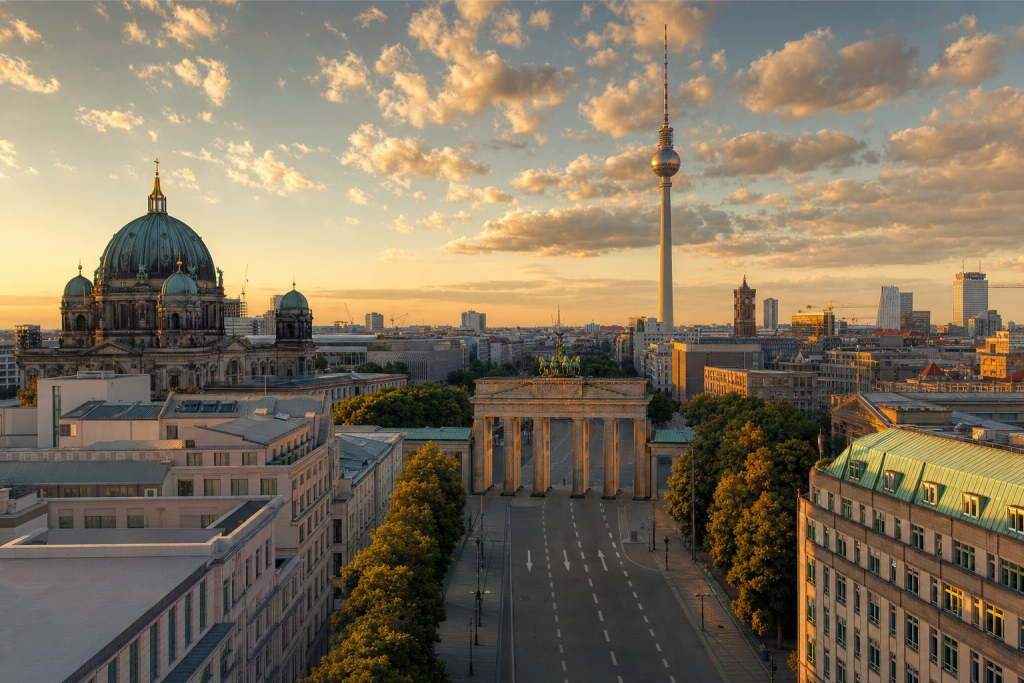
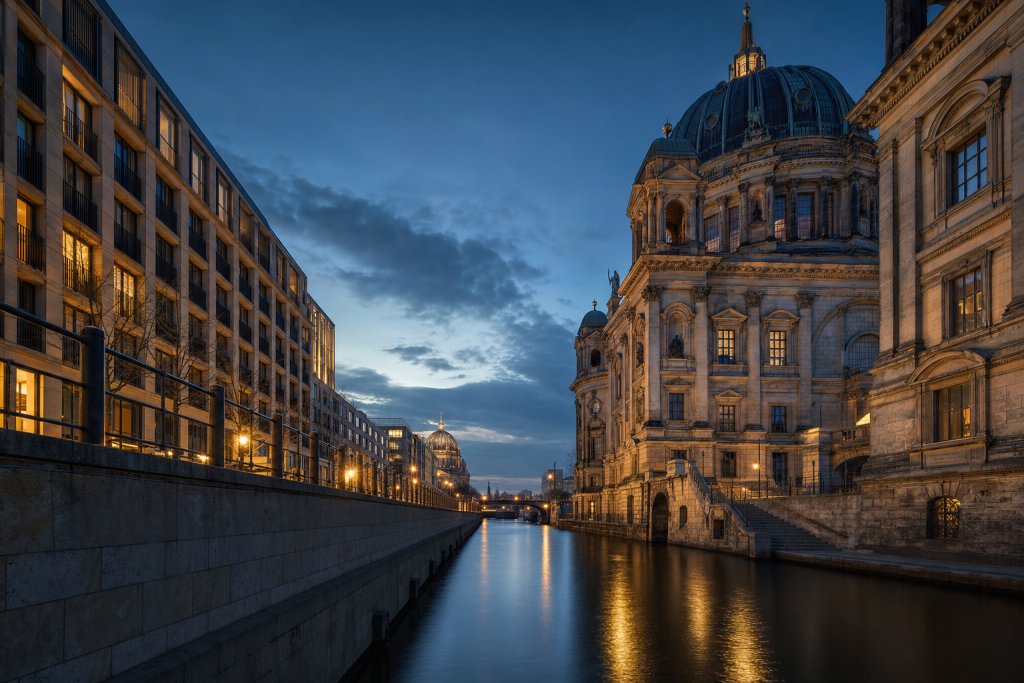
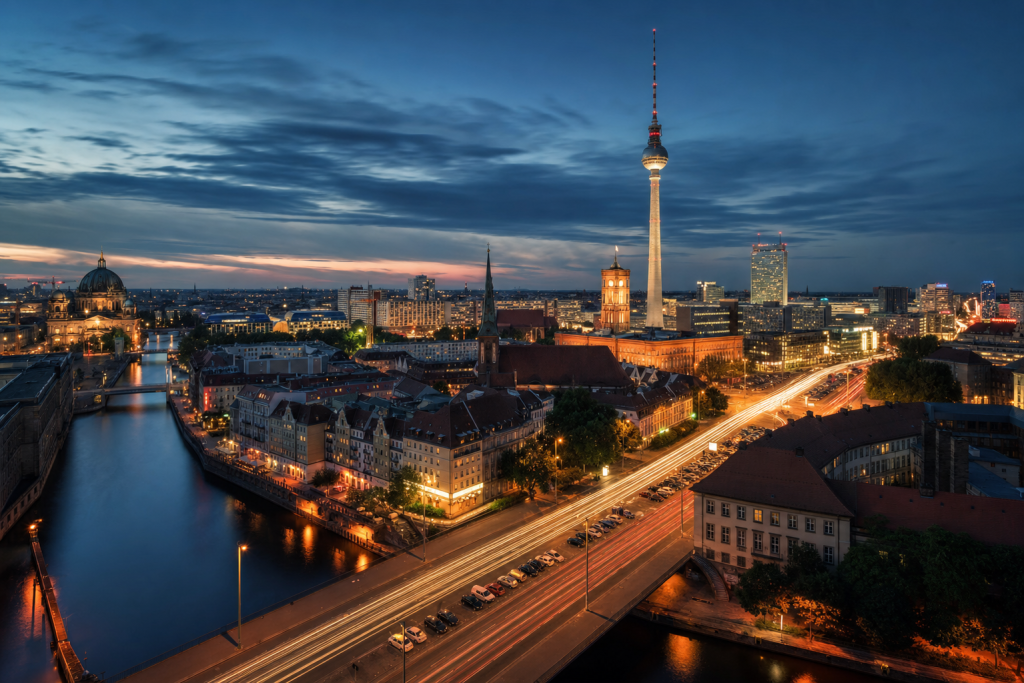
Here are three of the actual shots you’ll find inside the PDF — cinematic full-page references for the exact spots, lenses, and lighting conditions documented in the guide. The full guide includes 12 locations, each with a hero image, GPS map, settings table, and a five-shot list.
Save
Before you shoot Berlin: the essentials
- Free public access: Brandenburg Gate (exterior), East Side Gallery, Memorial to Murdered Jews of Europe (field of stelae), Tiergarten park, Tempelhof Field, Hackescher Markt area, and Oberbaum Bridge are all free and accessible 24/7. Reichstag Dome and rooftop terrace are free but require advance registration at bundestag.de. Victory Column viewing platform €4.50 (cash only). Berlin Cathedral €9 including dome climb. Charlottenburg Palace gardens free; palace interior €12–€19 (Charlottenburg+ ticket). Sony Center/Center Potsdamer Platz atrium free. TV Tower observation deck €26–€32/adult; advance booking at tv-turm.de recommended.
- Commercial permits: Personal and tourist photography in all public spaces is unrestricted. Commercial shoots require permits from Bezirksamt (district office) of the relevant borough; fees and timelines vary by district. Shoots on federal government property (Reichstag forecourt, Tiergarten around government quarter) require separate authorization from the Bundestag administration. Drone use is heavily restricted across central Berlin — controlled airspace (CTR) covers Tegel, Schönefeld, and a large inner-city zone; additional restrictions apply over federal buildings, memorials, and crowded public spaces under LuftVO §21h. Photography at the Memorial to the Murdered Jews of Europe is permitted for personal use; commercial photography requires prior written consent from the Stiftung Denkmal. No photography of the Quadriga on top of Brandenburg Gate by drone without permit.
- Best photography seasons: April–May (cherry blossoms, mild light, moderate crowds) and September–October (golden Tiergarten foliage, dramatic skies, fewer tourists than summer peak)
- Blue hour notes: Berlin sits at 52.52°N — one of the highest latitudes of any major European capital. Blue hour lasts 25–45 minutes after sunset (longer than at southern European latitudes), giving photographers more time for tripod setup. In summer, sunset comes as late as 9:35 PM (late June); in winter, as early as 3:55 PM (late December). The northern latitude means the sun arc is low and southerly year-round, producing long shadows and warm directional light even at midday in winter — a major advantage for architectural photography. Summer mornings see the sun rising as early as 4:45 AM from the north-northeast (azimuth ~50°), creating spectacular backlit and sidelit opportunities for east-facing landmarks.
- Drone policy: Drone laws vary widely by country and city — many capital and tourist zones are no-fly. Verify the local civil aviation authority’s current rules before launching.
- Local resource: Official visitor information
The full-resolution version of every map below — plus seasonal calendars, gear notes per location, sun-angle diagrams, and a complete photographer’s packing checklist — is inside the Berlin Photographer’s Guide PDF ($47).
1. Brandenburg Gate — Pariser Platz
Berlin’s most iconic symbol, the only surviving gate of 14 historic city gates, and the physical embodiment of German reunification. The gate’s perfect Doric symmetry — five passage arches, twelve columns, and the Quadriga chariot on top — is designed to be photographed head-on from either side. Its alignment on the Tiergarten axis (west) and Unter den Linden (east) creates powerful leading-line compositions in both directions. The plaza’s polished cobblestones create superb wet-weather reflections. The gate is illuminated nightly and hosts Berlin’s Festival of Lights each autumn, transforming it into a living light-art canvas.
- GPS: 52.5163, 13.3778
- Elevation: 112 ft
- Best time of day: blue hour — 20–30 minutes after sunset when the gate’s floodlights ignite and the cobblestones reflect the warm illumination; early morning on weekdays (before 7 AM) for crowd-free compositions; and in early March and early October when the sun sets directly in alignment behind the Quadriga from the east, creating dramatic silhouette and backlit sky
- Sun direction: Brandenburg Gate faces east (the Quadriga points east toward Unter den Linden). Berlin’s latitude of 52.5°N means the sun rises north-northeast in summer (azimuth ~50°) and far south-southeast in winter (azimuth ~130°). In early March and early October the sun sets almost due west (~270°), aligning directly behind the gate when photographed from the east — creating the classic backlit silhouette shot with a glowing sky filling the columns. From the west (Tiergarten side) the morning sun rises behind the gate from the east, producing the most dramatic silhouette. From Pariser Platz (east side), the gate is lit frontally by western afternoon and evening light. The gold Quadriga catches the setting sun beautifully from the east in late afternoon.
- Access: Pariser Platz, 10117 Berlin. S-Bahn lines S1, S2, S25 and U-Bahn line U55 to Brandenburger Tor station (1-minute walk). Bus 100 stops directly at the gate. The plaza is a public pedestrian space open 24 hours, no fee. Tripods are permitted on the plaza. US Embassy is to the south — security personnel patrol; photography is permitted but keep bags on your person. The gate passage (Durchfahrt) is closed to vehicles.
- Difficulty: easy
- Recommended settings: Blue Hour Long Exposure: f/11, 6 sec, ISO 100, 24mm, tripod on Pariser Platz cobblestones · Golden Hour Backlit Silhouette: f/8, 1/500 sec, ISO 100, 35mm, from Tiergarten side at sunset · Night Illuminated Columns: f/8, 2 sec, ISO 400, 50mm, tripod · Overcast Detail Shot: f/8, 1/200 sec, ISO 400, 70–200mm telephoto for Quadriga detail
Shots to chase:
- Classic symmetrical long-exposure composition from Pariser Platz after blue hour with cobblestone reflections in the foreground and illuminated Quadriga at top
- Silhouette shot from the Tiergarten side in early March when the sun sets directly west, burning behind the gate and rimming each column in orange light
- Puddle reflection from the path through Tiergarten immediately west of the gate — after rain, a large puddle forms between the trees and mirrors the entire gate
- Quadriga telephoto detail from 150m away on Unter den Linden — a 200mm focal length compresses the chariot against a dramatic sky
- Festival of Lights composition (October each year) using a tripod and long exposure to capture projected light art on the gate against a deep blue-hour sky
Pro tip: Arrive at least 30 minutes before sunrise on a weekday — the gate is almost empty and bathed in warm street lighting against a navy blue sky before dawn. Wet cobblestones dramatically improve reflection shots; carry a small spray bottle if needed for a light mist effect. The Straße des 17 Juni side (west) is less frequented by tourists; the puddle reflection spot at the start of the tree-lined path requires getting low (prone or with a small gorilla-pod). In early March and October, arrive for sunset from the east to catch the sun dropping directly behind the Quadriga.
Common mistake to avoid: Shooting only from the classic east-facing Pariser Platz position and never exploring the Tiergarten (west) side, which offers the most dramatic backlit sunset compositions. Using a very wide lens from close range distorts the gate’s symmetrical columns. Visiting at midday when the light is flat and the plaza is packed with tour groups. Forgetting that the fountains on either side of the gate operate only in summer and only until 10 PM — plan accordingly if they are a desired compositional element.
2. Reichstag Building — Dome & Rooftop Terrace
Norman Foster’s 1999 glass dome is one of the most celebrated works of contemporary architecture in Europe — a 23.5m diameter sphere of steel and glass that sits atop the original 1894 Wilhelmine parliament building, symbolizing governmental transparency. The interior’s mirrored conical funnel (the ‘Lichtspiegel’) reflects daylight into the plenary chamber below while visitors spiral upward on twin ramps to a 360° viewing platform. The rooftop terrace offers one of the best unobstructed panoramas in central Berlin — completely free, with no netting or glass impeding photography.
- GPS: 52.5187, 13.3763
- Elevation: 112 ft
- Best time of day: golden hour before sunset for the interior dome spiral ramps lit by fading natural light through the glass; from the rooftop terrace, arrive 1–2 hours before sunset to photograph Brandenburg Gate, the TV Tower, and Potsdamer Platz in warm directional light, then stay for blue hour when the city illuminates
- Sun direction: The Reichstag faces west — its main entrance is on the western side. The Norman Foster glass dome sits atop the neoclassical stone building and is fully transparent, allowing directional light inside at all hours. At Berlin’s latitude, the interior dome is lit from the east in the morning (the mirrors catch sunrise light and distribute it downward into the plenary chamber) and transitions to west-lit afternoon light. From the rooftop terrace looking east, the TV Tower and Museum Island are visible; looking south, Potsdamer Platz. Looking west, the dome catches the last warm light before sunset. Evening visits see the dome illuminated from within, creating a glowing lantern visible across the Tiergarten.
- Access: Platz der Republik 1, 10557 Berlin. S-Bahn and U-Bahn Brandenburger Tor (10-minute walk) or bus 100 to Reichstag/Bundestag. FREE entry but mandatory advance registration at bundestag.de — bring passport or national ID. No tripods inside the dome. Flash permitted. Open daily; hours vary seasonally (typically 8 AM–midnight, last admission 10 PM). Registration must be completed at least 2–3 days in advance (often weeks during tourist season). Visitors can stay on the terrace as long as they wish.
- Difficulty: easy
- Recommended settings: Dome Interior Spiral Ramp: f/8, 1/60 sec, ISO 800, 14–16mm ultra-wide, handheld (tripods prohibited inside) · Rooftop Golden Hour City: f/8, 1/250 sec, ISO 100, 24–70mm zoom · Rooftop Blue Hour Long Exposure: f/11, 8 sec, ISO 100, 24mm, tripod (allowed on terrace) · Dome Upward Abstract: f/8, 1/125 sec, ISO 400, 14mm fisheye or ultra-wide for geometric pattern of steel ribs
Shots to chase:
- Ultra-wide looking straight up at the dome’s mirrored cone from the base of the spiral ramp — a geometric abstraction of steel ribs and glass panels converging at the apex
- From the rooftop terrace at blue hour looking east: the illuminated TV Tower framed between the dome’s metal rim and the river bend, with light trails from traffic on Unter den Linden
- Rooftop view south toward Potsdamer Platz at golden hour with the Sony Center’s tent roof catching low warm light amid the glass towers
- From the Spree’s north bank (Paul-Löbe-Haus side) at dawn — the Reichstag building reflected in the calm river with the dome glowing against an indigo sky
- Looking down through the dome’s glass floor onto the plenary chamber in session — a unique transparency-of-democracy composition available from inside
Pro tip: Book your registration slot for early morning (8–9 AM first entry) on a weekday — the terrace is nearly empty and you can spend unlimited time on it. Afternoon slots fill quickly with tour groups. Bring a telephoto lens (100–200mm) to isolate specific landmarks from the terrace. A standard wide-angle (16–24mm) works best for dome interior shots. The conical mirror column in the dome center, photographed looking straight up, yields striking abstract geometric images even without a tripod.
Common mistake to avoid: Not booking far enough in advance — registration fills weeks ahead during summer and holiday seasons. Arriving at registration with an expired ID (passport must be valid). Using flash inappropriately in the dome (it is permitted technically but reflects blindingly off the glass and is rarely useful). Trying to use a tripod inside the dome — they are not allowed; rent a mini gorilla-pod that can press against the railing instead.
3. East Side Gallery — Mühlenstraße Wall
At 1,316 meters, the East Side Gallery is the longest continuously preserved section of the Berlin Wall still standing, and the world’s largest open-air gallery. In 1990, 118 artists from 21 countries painted 101 works directly onto the Wall’s eastern (inner) surface. The most iconic image — Dmitri Vrubel’s ‘My God, Help Me to Survive This Deadly Love’ (the Brezhnev-Honecker fraternal kiss) — has become one of the most reproduced political artworks in history. The contrast between the now-colorful murals and the raw concrete’s scars of history creates a profound layered narrative unique in world photography.
- GPS: 52.5053, 13.4398
- Elevation: 112 ft
- Best time of day: early morning (before 9 AM) for soft, diffused directional light from the east illuminating the murals with minimal shadows; or golden hour late afternoon/evening when the light warms the colors; overcast days eliminate harsh shadows that fragment mural details and allow accurate color reproduction
- Sun direction: The East Side Gallery wall runs roughly north-south along the west bank of the Spree on Mühlenstraße. The painted (inner) face of the wall faces west, meaning it receives afternoon and evening light from the west-southwest. Morning sun illuminates the opposite (Spree river) side of the wall but creates harsh contrast on the painted face. The most photographically useful light falls on the murals from mid-afternoon onward, peaking at golden hour ~1 hour before sunset when warm light rakes across the textured concrete and saturates the paint colors. Overcast days work equally well by eliminating all harsh shadows.
- Access: Mühlenstraße, 10243 Berlin (between Ostbahnhof and Oberbaumbrücke). S-Bahn Ostbahnhof (5-minute walk west along the Spree) or S-Bahn/U-Bahn Warschauer Straße (8-minute walk). The gallery is an open-air public monument accessible free 24 hours a day. No admission fee, no tickets required. Tripods permitted. The 1.3 km stretch from Ostbahnhof to Oberbaum Bridge takes 30–60 minutes to walk. A visitor information center opened in the former gatehouse at the Ostbahnhof end in January 2025.
- Difficulty: easy
- Recommended settings: Mural Detail Overcast: f/8, 1/250 sec, ISO 200, 35–50mm · Wide Mural Section: f/8, 1/125 sec, ISO 200, 16–24mm with polarizing filter to reduce glare · Golden Hour Warm Colors: f/8, 1/400 sec, ISO 100, 35mm · Blue Hour Atmospheric: f/4, 1/30 sec, ISO 1600, 35mm, handheld
Shots to chase:
- Classic head-on composition of Vrubel’s fraternal kiss mural (‘My God, Help Me to Survive This Deadly Love’) at even morning or evening light when the colors are rich and no sun glare breaks the image
- Wide-angle shot showing 100+ meters of wall continuity with murals receding into the distance — this communicates the scale of the original barrier in a way individual mural shots cannot
- Detail study of Birgit Kinder’s ‘Test the Rest’ Trabant car crashing through the wall — telephoto compression removes sky distractions and focuses on the car’s torn sheet metal and the concrete rubble
- Dusk shot with the distant TV Tower visible above the wall’s top edge — combining the painted history with Berlin’s current skyline in one frame
- Environmental portrait using a person at the wall’s scale to convey the 3.6-meter height that once divided a city — position them near the Spree-side end where the original border installations are partially preserved
Pro tip: Walk the entire length from Ostbahnhof to Oberbaumbrücke rather than stopping at the first few famous murals — the less-visited southern sections contain abstract and symbolic works that photograph as pure art compositions without crowds. The concrete wall surface itself, with its pits, paint layers, and inscriptions, is a compelling photographic subject independent of the murals. Polarizing filter reduces glare on the painted concrete dramatically. Visit on a weekday before noon for the thinnest crowds.
Common mistake to avoid: Visiting only the north end near Ostbahnhof (where tour groups disembark) and missing the quieter, artistically diverse southern sections near Oberbaumbrücke. Shooting only at midday when the painted west face is in harsh overhead shadow/light contrast that breaks up mural compositions. Standing too close to wide murals and using an ultra-wide lens — distortion at 14mm fragments the compositions; 24–35mm from 10–15 meters gives better proportions. Forgetting a polarizing filter on sunny days.
4. Berlin Cathedral & Museum Island — Lustgarten & Spree Embankment
The Berliner Dom (1905) is Germany’s largest Protestant church and one of Berlin’s most visually complex buildings — its Italian High Renaissance-inspired exterior features four corner towers, a massive central dome reaching 98 meters, richly carved stone ornament, and elaborate copper cupolas now patinated green. Museum Island, a UNESCO World Heritage Site since 1999, clusters five major neoclassical museums on a Spree island with the cathedral, creating one of the highest-density photographic compositions in Europe. The Spree’s northern bank at Monbijou Park offers the classic unobstructed view of multiple museums and the cathedral simultaneously.
- GPS: 52.5192, 13.4014
- Elevation: 112 ft
- Best time of day: blue hour after sunset when the cathedral’s Baroque dome and cupolas are floodlit gold against a deep blue sky and the Spree reflects the illumination; or morning golden hour from the Spree’s north bank for front-lit warm light on the cathedral’s ornate stone facade
- Sun direction: The Berliner Dom (Berlin Cathedral) faces west toward the Lustgarten plaza. The main dome sits at the island’s northeast end. At Berlin’s latitude, morning sun rises from the east-northeast in summer, striking the cathedral’s east apse and side apses first. The west facade and main entrance receive afternoon and evening light. From the Monbijou Park vantage point on the Spree’s north bank, the camera faces south; morning sun from the east falls directly on the northern (Spree-facing) façade — ideal for front-lit morning shots. The TV Tower at Alexanderplatz is visible to the east, creating multi-landmark compositions using a 200mm telephoto.
- Access: Am Lustgarten 1, 10178 Berlin. S-Bahn Hackescher Markt (8-minute walk) or Alexanderplatz (10-minute walk). The Lustgarten plaza is a free public space open around the clock. Cathedral interior admission: €9 (includes dome climb to viewing gallery); open Mon–Sat 10 AM–7 PM, Sun 12–7 PM. The Spree embankment (Bodestraße and Karl-Liebknecht-Straße) is free public space. Museum Island day pass (all 5 museums): €18; individual museum tickets €12–€14. Photographing the exterior from the Lustgarten, bridges, or riverside requires no fee.
- Difficulty: easy
- Recommended settings: Blue Hour Spree Reflection: f/11, 10 sec, ISO 100, 24mm, tripod on embankment · Golden Hour Facade Detail: f/8, 1/400 sec, ISO 100, 70–200mm telephoto for dome ornament · Interior Nave Handheld: f/2.8, 1/60 sec, ISO 3200, 24mm (no flash, no tripods inside) · Museum Island Panorama: f/11, 1/60 sec, ISO 200, 24mm from Monbijou Park bank
Shots to chase:
- Blue-hour long exposure from the Karl-Liebknecht-Straße bridge or Ebertsbrücke, capturing the illuminated cathedral reflected in the still Spree with the TV Tower rising in the background east
- Detail telephoto (200mm) of the cathedral’s green copper dome and ornamental lantern against a dramatic cloud sky — compression makes the dome appear monumental
- Wide Monbijou Park morning composition incorporating multiple Museum Island buildings, the cathedral, and the Spree in a single horizontal frame
- Interior shot looking upward through the cathedral’s nave to the coffered dome ceiling decorated with mosaic — position on the central axis with a 14mm ultra-wide lens
- Lustgarten plaza composition using the fountain (active in summer) as a reflective foreground element with the cathedral’s symmetric west facade as the background
Pro tip: The best single vantage point for a multi-building Museum Island composition is on the west bank of the Spree at Monbijou Park — walk to the riverside grass directly opposite the Bode-Museum’s pointed bow and you’ll see the cathedral, Alte Nationalgalerie, and Altes Museum in a single wide shot. For cathedral reflections, arrive before 7 AM when the Spree is calm before tourist boats start churning the surface. The Friedrichsbrücke (bridge between the cathedral and the Humboldt Forum) provides a slightly elevated angle looking east toward the cathedral.
Common mistake to avoid: Trying to photograph the cathedral only from the Lustgarten directly in front — this is the most crowded vantage and produces the least interesting composition due to the flat facade. Missing the magnificent east apse view from behind the cathedral (Vera-Brittain-Ufer), which shows the building’s complex sculptural silhouette against the sky. Not visiting for a second time at blue hour after photographing in daytime — the floodlit cathedral is a completely different (and arguably superior) subject.
Want this in your pocket on the street?
The full-resolution version of every spot above — with full-page hero photography, GPS maps with gold location pins, sun direction diagrams, multi-season tables, and a complete safety + packing checklist — is inside the Berlin Ultimate Photographer’s Guide PDF ($47). Print it, save it offline, take it on the walk. Get the guide →
5. TV Tower — Alexanderplatz Perspectives
Save
Built 1965–1969 as a symbol of East German technological achievement, the Fernsehturm at 368 meters is Germany’s tallest structure and the third-tallest in the EU. Its sleek futuristic profile — a needle rising to a metallic sphere with the observation deck and rotating restaurant — is the defining element of Berlin’s skyline. Unlike the Eiffel Tower (self-contained), the Berlin TV Tower creates compositional opportunities across the entire city, integrating naturally with U-Bahn trains, tram lines, river bridges, and historic architecture in ways no other Berlin landmark can match.
- GPS: 52.5208, 13.4094
- Elevation: 116 ft
- Best time of day: golden hour from street level — the sphere’s glass panels reflect the setting sun in a cross-shaped pattern (the ‘Pope’s Cross’) visible to telephoto lenses; or from the observation deck at sunset and blue hour for 360° panoramic views of Berlin from 203 meters; for street photography compositions, evening when tram light trails and the tower’s floodlighting combine
- Sun direction: The TV Tower (Fernsehturm) stands at 368 meters at Alexanderplatz in central Berlin. Due to its extreme height, it dominates the skyline from virtually every Berlin district. At Berlin’s latitude, morning sun from the east-northeast lights the sphere’s eastern quadrant; at sunset the western glass panels glow orange and, on clear days, the cross-shaped reflection pattern (‘Papst’s Kreuz’) appears. The tower is visible from 70+ kilometers on clear days and can be incorporated as a background element from dozens of vantage points across the city. Best close-up ground views are from the south (Schlossplatz, looking north) or from Georgenstraße (looking east with tram tracks as leading lines).
- Access: Panoramastraße 1A, 10178 Berlin. S-Bahn and U-Bahn Alexanderplatz (2-minute walk). Observation deck tickets: €26–€32 adult depending on time slot; advance booking at tv-turm.de highly recommended. The ground-level plaza around the tower is public space, free 24/7. The Park Inn Hotel rooftop terrace at Alexanderplatz (separate) charges €6 for a closer elevated view of the tower. The Berliner Dom square and Schlossplatz offer free ground-level compositions incorporating the tower.
- Difficulty: easy
- Recommended settings: Tram Light Trail Foreground: f/16, 20 sec, ISO 50, 24mm, tripod on Georgenstraße or Prenzlauer Allee · Cross Reflection Telephoto: f/8, 1/500 sec, ISO 100, 200–400mm for sphere cross detail at golden hour · Observation Deck Cityscape: f/11, 1/60 sec, ISO 400, 24mm (hand-held near window to minimize reflections) · Blue Hour From Ebertsbruecke: f/11, 8 sec, ISO 100, 50mm, tripod for Spree reflection composition
Shots to chase:
- Georgenstraße long exposure at dusk with tram light trails framing the tower in the background — the graffiti-covered brick arches create gritty urban foreground texture
- Sphere cross reflection: on a clear day at golden hour, the sphere’s windows reflect sunlight in a cross pattern visible from the south — telephoto shot from Schlossplatz at 200mm
- Ebertsbrücke dawn composition: the Spree’s glassy surface reflects both the illuminated Bode Museum (left foreground) and the TV Tower (distant right) in a single long-exposure frame
- From the Park Inn Hotel rooftop terrace looking west — the tower fills the center of the frame at close range against an orange sky, surrounded by the city’s rooftops
- Prenzlauer Allee looking south: position in the tram tracks at the ‘Metzer Straße’ stop and use the parallel rails as leading lines converging toward the tower, with a passing tram adding motion
Pro tip: The Park Inn Hotel rooftop (€6) is the single best vantage for close-up tower photography with a tripod and is often overlooked in favor of the more expensive tower interior. For the sphere’s cross reflection, the optimal angle is from Schlossplatz or Breite Straße to the south-southwest, on a clear afternoon when the sun azimuth aligns with the sphere’s windows (~200–230°). The Ebertsbrücke over the Spree near Hackescher Markt gives a wide river composition framing the tower without obstruction — arrive before 7 AM for calm water.
Common mistake to avoid: Photographing the tower from the base with an ultra-wide lens — this creates extreme vertical distortion and the sphere appears tiny and distorted at the top. Paying for the observation deck expecting better photography than from surrounding free or cheap viewpoints — the glass creates reflections and the narrow platform limits angle options. Not exploring more creative distant viewpoints where the tower integrates with trams, rivers, and historic architecture rather than simply standing alone.
6. Memorial to the Murdered Jews of Europe — Field of Stelae
Designed by architect Peter Eisenman and opened in 2005, the memorial consists of 2,711 dark gray concrete stelae of varying heights (0.2 m to 4.7 m) arranged in a grid on undulating ground — the wavelike terrain creates a disorienting, immersive experience as visitors descend into corridors flanked by stelae rising above eye level. The deliberate abstraction (no names, plaques, or religious symbols) forces personal interpretation, and the photographic possibilities — shadow play, convergence, framing within stelae corridors, geometric abstraction — are virtually limitless. The memorial’s location one block from Brandenburg Gate makes it the most resonant historical counterpoint in Berlin.
- GPS: 52.5138, 13.3783
- Elevation: 112 ft
- Best time of day: early morning (before 8 AM) or early evening when low-angle directional light casts long shadows between the stelae — the shadows are a crucial compositional element that communicates depth and disorientation; winter mornings when the sun barely crests the horizon are the most dramatically lit; avoid midday when flat overhead light flattens all depth
- Sun direction: The memorial occupies a 4.7-acre site oriented roughly north-south between Behrenstraße (north) and Hannah-Arendt-Straße (south), one block south of Brandenburg Gate. The stelae rows run north-south and east-west. At Berlin’s latitude, the winter sun never rises above ~14° at noon, meaning even midday light is quite directional in winter — a major advantage for stelae photography from October to February. Morning sun from the east-northeast in summer enters the northern stelae avenues first, creating illuminated corridors with dark flanks. Afternoon sun from the southwest illuminates the western faces of the eastern stelae rows.
- Access: Cora-Berliner-Straße 1, 10117 Berlin (corner of Hannah-Arendt-Straße). S-Bahn and U-Bahn Brandenburger Tor (5-minute walk south). Bus 100, M41 stop at Behrenstraße/Wilhelmstraße. The field of stelae is publicly accessible free of charge, 24 hours a day. The underground Information Centre (Ort der Information) is free, open Tue–Sun 10 AM–6 PM; closed Mondays, Nov 16–23, Dec 24–26. Photography inside the Information Centre is permitted without flash. Tripods are permitted in the field of stelae. No sitting, standing, or climbing on the stelae; security personnel enforce this at all times.
- Difficulty: easy
- Recommended settings: Stelae Shadow Corridor: f/11, 1/125 sec, ISO 200, 24mm, low-angle from inside a corridor · Aerial Style Abstract: f/8, 1/500 sec, ISO 100, 50mm from the memorial’s perimeter edge looking down at the grid · Foggy Morning Atmospheric: f/5.6, 1/60 sec, ISO 800, 35mm, handheld · Winter Long Shadow Geometry: f/11, 1/250 sec, ISO 100, 24mm at low winter sun angle
Shots to chase:
- Low-angle composition from inside a deep corridor of tall stelae looking upward toward the sky — at 4.7 meters tall, the stelae create a canyon effect with a narrow strip of sky above
- Standing at the memorial’s perimeter looking down into the undulating grid from the elevated edge — the wave pattern of the ground becomes visible, communicating the sea-of-graves feeling Eisenman intended
- Long shadow composition in winter or early morning: position the camera so a single slant of sunlight creates a sharp shadow line dividing illuminated and dark stelae faces across the grid
- Human scale shot: a single person walking a corridor between stelae taller than themselves, dwarfed by the concrete blocks — communicates the memorial’s emotional scale without voyeurism
- Blue hour from the Behrenstraße perimeter wall looking south across the entire field, with the illuminated Quadriga of Brandenburg Gate visible above the stelae skyline in the background
Pro tip: The memorial’s most interesting photography is achieved by working the geometry — find a position where the receding perspective of multiple corridor axes creates overlapping vanishing points. Early morning in autumn and winter, when mist sometimes rises from the undulating ground between the cold stelae, creates atmospheric conditions impossible to replicate artificially. Move to the perimeter elevation at the north (Behrenstraße) side to shoot downward into the grid — this reveals the wave topography invisible from within. Always approach this site with the solemnity it deserves: no singing, shouting, or disrespectful behavior.
Common mistake to avoid: Photographing only from the perimeter and not entering the interior corridors where the most powerful spatial compositions exist. Visiting at midday in summer when shadows are absent and the gray concrete appears flat. Using only wide-angle perspectives and missing the powerful telephoto compression shots looking down a long stelae row — 50–100mm isolates the receding geometry powerfully. Violating the visitor rules by sitting or climbing on stelae, which creates an atmosphere of disrespect and may result in removal by security.
7. Oberbaum Bridge — Spree River Viewpoints
Built 1894–1896 to a design by architect Otto Stahn in North German Brick Gothic style, the Oberbaumbrücke is Berlin’s most photogenic bridge and the only major bridge in the city to carry both road traffic (lower deck) and U-Bahn trains (upper deck). Its seven brick arches span 154 meters, with two central octagonal towers topped with battlements and spires. The bridge served as the border crossing between East and West Berlin from 1961 to 1989 and was extensively restored in the 1990s. It has featured in numerous films including Run Lola Run, The Bourne Supremacy, and Unknown — its cinematic quality is unrivaled among Berlin’s 900+ bridges.
- GPS: 52.5015, 13.4451
- Elevation: 112 ft
- Best time of day: late afternoon golden hour — warm evening light amplifies the rich red-orange brick color of the bridge; blue hour 20–30 minutes after sunset when the bridge is floodlit and U-Bahn trains on the upper deck add light trails; river boat services are more frequent in summer, adding dynamic foreground elements
- Sun direction: The Oberbaumbrücke runs east-west across the Spree, connecting Friedrichshain (north bank) to Kreuzberg (south bank). The best photography positions are from either bank looking across the river at the bridge’s dual towers. From the Friedrichshain (north) bank, the camera faces south: afternoon and evening sun from the southwest lights the bridge’s south-facing facade. From the Kreuzberg (south) bank, morning sun from the east lights the northern face. The sun sets northwest in summer (~300°), creating warm side-light on the bridge from the west in the late afternoon. The TV Tower is visible 3 km to the east, providing an iconic background element at 200mm compression.
- Access: Am Oberbaum, 10243 Berlin. U-Bahn Schlesisches Tor (U1/U3, south/Kreuzberg side, 4-minute walk) or S-Bahn/U-Bahn Warschauer Straße (north/Friedrichshain side, 6-minute walk). The bridge and both riverbanks are free, public, and accessible 24/7. The small outcrop on the Friedrichshain bank between the bridge and The Wall Museum (adjacent to the East Side Gallery’s southern end) provides the best unobstructed photography position. Cherry blossom trees between the bridge and the East Side Gallery create spectacular framing in late March–early April.
- Difficulty: easy
- Recommended settings: Golden Hour Brick Texture: f/8, 1/250 sec, ISO 100, 50mm from south bank · Blue Hour Long Exposure Water: f/11, 15 sec, ISO 100, 24mm, tripod on south bank outcrop · Ubahn Light Trail: f/11, 2 sec, ISO 100, 35mm, tripod — time the exposure to catch a U-Bahn train crossing the upper deck · Sunset Silhouette River: f/8, 1/500 sec, ISO 100, 24mm from within the East Side Gallery looking toward the bridge
Shots to chase:
- Blue-hour long exposure from the small stone outcrop on the Friedrichshain (north) bank, with the illuminated bridge centered in the frame, its reflection stretching across the dark Spree, and a U-Bahn train’s light trail visible on the upper deck
- Sunset shot from the East Side Gallery path looking southwest: the TV Tower rises above the bridge’s east tower in the far background at 200mm compression
- Cherry blossom season (late March–April) composition: pink blossom branches in the foreground, the bridge’s red-brick towers in the middle ground, and the Kreuzberg skyline behind
- Looking straight down the bridge’s pedestrian walkway through the series of Gothic arches — the receding arches create a natural leading line toward the far bank
- From a Spree boat tour: the bridge photographed from the water level as the vessel passes beneath the central arch, looking up through the stone vault
Pro tip: The small concrete outcrop between the bridge and the Wall Museum building on the north (Friedrichshain) bank is the best photography position — it provides an elevated angle slightly above river level without interfering with pedestrian flow. Arrive for blue hour on a weekday when boat traffic on the Spree is minimal and the water surface is calmer for reflections. An ND filter (6-stop) at golden hour allows long exposures that smooth the water surface and extend U-Bahn exposure time to capture full train crossing light trails. In spring, the cherry trees between the gallery and bridge create an exceptional foreground frame.
Common mistake to avoid: Shooting only from the bridge itself looking outward rather than photographing the bridge as subject from the riverbank — the bridge is the subject. Visiting at midday when the warm brick color is washed out by overhead light. Forgetting that the U-Bahn on the upper deck (lines U1 and U3) runs frequently — time a 2–4 second exposure to capture the train’s light trail crossing the upper arch. Missing the blue-hour window by arriving too early or too late.
8. Tempelhof Field — Former Airport Runways
Tempelhofer Feld is one of the most surreal and distinctive public spaces in the world — a 386-hectare former international airport (decommissioned 2008) where the original WWII-era runways, taxiways, and apron have been opened as a public park. The sheer scale of open space within a dense European capital is extraordinary — nothing else like it exists in Berlin or any comparable city. The flat expanse creates panoramic sky compositions impossible elsewhere in central Berlin, while the runways, taxiways, and terminal building provide brutalist architectural subjects. Culturally, the field is where Berliners come to skate, kite, garden, and watch sunsets together.
- GPS: 52.4733, 13.401
- Elevation: 164 ft
- Best time of day: golden hour before sunset — the vast flat expanse creates unobstructed 360° sunset panoramas from anywhere on the field; western edges of the park near the Luftbrücke entrance are favored for dramatic west-facing sky; summer evenings fill with skaters, kiteboarders, cyclists, and picnickers providing natural human elements for silhouette work
- Sun direction: Tempelhof Field is essentially flat and open in all directions, making it exceptional for unobstructed sun tracking at all times of day. The old terminal building (designed by Ernst Sagebiel, 1939) runs along the northern edge, facing south onto the field. In the afternoon, the sun moves to the west-southwest, and from the central runway looking west, the sky opens completely to the horizon with no buildings to obstruct the sunset view. The terminal building itself faces south and is frontally lit by afternoon light from the south. The Berlin TV Tower is visible to the northeast, creating a compositional anchor for wide-angle horizon shots.
- Access: Tempelhofer Damm / Columbiadamm, 12101 Berlin. U-Bahn Tempelhof (U6) or Paradestraße (U6) for the north entrance; U-Bahn Boddinstraße (U8) for the south entrance. The park is free to enter and is open every day from sunrise to dusk (summer closing can be as late as 11 PM). No admission fee. Tripods and commercial photography (without crew) are generally permitted on the park grounds. The former terminal building interior is accessible on scheduled tours only.
- Difficulty: easy
- Recommended settings: Sunset Silhouette Wide: f/8, 1/500 sec, ISO 100, 24mm from the central runway looking west · Terminal Building Golden: f/8, 1/250 sec, ISO 100, 35mm from the runway looking north at the terminal facade · Long Exposure Runway: f/11, 30 sec, ISO 50, 16mm, tripod for light trail streaks and star trails · Documentary Portrait: f/2.8, 1/500 sec, ISO 100, 85mm to isolate kite flyers or skaters against the open sky
Shots to chase:
- West-facing sunset panorama from the central runway: a lone kite flying above the silhouetted terminal outline against a gradient orange-to-navy sky, with a small figure below as scale reference
- Terminal building frontage in afternoon light: the 1.2 km long Sagebiel facade photographed at full length from the runway apron — a jaw-dropping example of Third Reich Neoclassicism that stretches to the edge of the frame
- Star trails long exposure from the runway at night: the extraordinary darkness (by Berlin standards) and the flat unobstructed 360° sky make this the best in-city location for a star trail composition
- Human interest: roller-skaters or kiteboarders at golden hour creating motion blur silhouettes against the warm sky — position the terminal or TV Tower in the background
- Minimalist drone-eye (no drone required) composition: the abandoned runway lane markings (white stripes, arrows, distance marks) in converging perspective toward the horizon at dawn
Pro tip: The western edges of the park, accessed from the Luftbrücke or Columbiadamm entrance, provide the cleanest unobstructed western horizon — arrive 45 minutes before sunset to claim a position without obstructions. The terminal building is best photographed from the runway’s northern side in the afternoon; walking 200–300 meters south from the terminal gives the best perspective to capture the entire 1.2 km length in a single ultra-wide frame. In summer, the ‘Stadtacker’ community garden areas near the Columbiadamm entrance provide colorful foreground vegetation against the open field.
Common mistake to avoid: Arriving too late (after sunset) and missing the golden hour color palette that makes the flat expanse visually interesting. Standing too close to the terminal building and missing its extraordinary horizontal scale. Not returning in different seasons — winter mornings with frost on the runways and clear cold air produce completely different images from the summer festival atmosphere. Underestimating the wind on the exposed field — even on mild Berlin days, the open runway funnels strong gusts that make tripod use challenging without ballast.
Want this in your pocket on the street?
The full-resolution version of every spot above — with full-page hero photography, GPS maps with gold location pins, sun direction diagrams, multi-season tables, and a complete safety + packing checklist — is inside the Berlin Ultimate Photographer’s Guide PDF ($47). Print it, save it offline, take it on the walk. Get the guide →
9. Tiergarten & Victory Column — Großer Stern
Save
The 69-meter Victory Column (1873, relocated to Großer Stern in 1939 by Albert Speer) is Berlin’s most symbolically loaded monument — originally a Prussian military trophy, later moved to anchor the Nazi Welthauptstadt Germania east-west axis, now a beloved civic landmark and the finale of the Love Parade. The viewing platform at 51 meters provides a unique perspective looking east along the perfectly straight Strasse des 17. Juni to Brandenburg Gate, with 200,000 Tiergarten trees forming a forest canopy on both sides. In autumn, this view becomes one of the most spectacular urban vistas in Europe.
- GPS: 52.5145, 13.3501
- Elevation: 115 ft
- Best time of day: late afternoon and golden hour from the Strasse des 17. Juni axis looking east toward Brandenburg Gate; autumn (October–November) for peak foliage when the Tiergarten’s 200,000+ trees turn gold and red; from the viewing platform, best light is late afternoon when the column’s gilded Victoria statue catches the warm sun from the west
- Sun direction: The Victory Column (Siegessäule) stands at the Großer Stern roundabout in the center of Tiergarten, on an east-west axis with Brandenburg Gate (2 km to the east) and Ernst-Reuter-Platz (1 km to the west). The column faces east. The 8-meter gilded Victoria statue at the top catches the afternoon and evening sun from the west-southwest beautifully, glowing gold in late afternoon light. From the platform looking east along Strasse des 17. Juni, the sun rises directly behind the camera in winter mornings, frontally illuminating the Brandenburg Gate view. In autumn, the tree canopy along this avenue changes color spectacularly, and the low autumn sun from the south casts warm raking light across the foliage.
- Access: Großer Stern 1, 10785 Berlin. Bus 100 stops at Großer Stern. The closest U-Bahn is Hansaplatz (U9, ~1 km). Easiest approach on foot: walk west 2 km from Brandenburg Gate along Strasse des 17. Juni. DO NOT attempt to cross the multi-lane roundabout; use the underground tunnel (Tunnel zur Siegessäule) accessed from the exterior of the Großer Stern — signposted. Victoria viewing platform: €4.50 adult (cash only, reduced €3.50); open Mon–Fri 9:30 AM–6:30 PM, Sat–Sun 9:30 AM–7 PM (summer); Mon–Sun 9:30 AM–5:30 PM (November–March). No tripods on the viewing platform (too narrow). Tiergarten paths are free and open 24 hours.
- Difficulty: easy
- Recommended settings: Autumn Avenue Golden: f/11, 1/125 sec, ISO 100, 50–70mm from the column base looking east · Victoria Statue Telephoto: f/8, 1/500 sec, ISO 100, 200mm from 150m away to compress the gilded figure against sky · Platform Panorama East: f/8, 1/250 sec, ISO 200, 24mm (no tripod; lean against the railing) · Mosaic Interior Detail: f/4, 1/60 sec, ISO 1600, 24mm handheld in the colonnaded base
Shots to chase:
- Autumn avenue composition: from street level on Strasse des 17. Juni looking east, the column framed by an arch of gold and red canopy trees on both sides, with Brandenburg Gate a tiny silhouette 2 km away
- Looking up the column from its base with a 14mm ultra-wide — the four carved relief drums recede into the Victoria statue at the top against a blue sky
- From the viewing platform looking east at blue hour: Brandenburg Gate visible at the end of the illuminated avenue, framed by the platform’s stone balustrade in the foreground
- Golden victoria detail: 200mm telephoto from the Strasse des 17. Juni approach road, compressing the gilded bronze Victoria against a dramatic cloud sky
- Ground-level shot through the tunnel entrance framing the column against a strip of blue sky — the concrete tunnel arch creates a natural leading frame
Pro tip: The absolutely canonical Tiergarten/Victory Column shot is achieved in mid-to-late October when the entire avenue of Strasse des 17. Juni is ablaze with autumn color — come on a clear sunny day in the afternoon when the low sun illuminates the yellow and orange foliage from the southwest. The column’s gold Victoria is best photographed at telephoto (200mm) from the avenue’s straight approach. The interior colonnaded base features a stunning Anton von Werner mosaic (1876) documenting German imperial unification — photographing this with a 24mm requires high ISO as natural light is limited.
Common mistake to avoid: Visiting in summer when the dense tree canopy obscures the column from the avenue and the foliage is uniformly green — the iconic Tiergarten shots are inherently autumnal. Trying to use a tripod on the narrow viewing platform (not allowed due to space). Forgetting cash for the entrance fee (card readers are not available). Arriving at the roundabout and attempting to cross on foot without using the underground tunnel — the multi-lane traffic circle is dangerous.
10. Charlottenburg Palace — Schloss & Gardens
Built as a summer residence for Queen Sophie Charlotte, wife of Elector Friedrich III, from 1695 onward, Schloss Charlottenburg is Berlin’s largest and most opulent palace — the only royal residence that survived WWII intact (it was damaged but restored). The long Baroque facade (505 meters total) with its central copper dome topped by the gilded Fortuna figure creates one of the most classically composed architectural subjects in Germany. The formal French garden behind the palace, with its parterre flower beds, trimmed hedges, fountains, and the circular pond, offers structured geometric compositions unavailable in Berlin’s other parks.
- GPS: 52.5206, 13.2958
- Elevation: 115 ft
- Best time of day: golden hour in the late afternoon when the western sun illuminates the pale yellow Baroque facade from the south-southwest, catching the copper dome’s green patina and the gilded Fortuna weather vane at the top; autumn for the ornamental garden’s formal geometry juxtaposed with colorful foliage; the carp pond in the formal garden provides foreground reflection opportunities
- Sun direction: The Charlottenburg Palace main facade faces south onto the forecourt (Ehrenhof). The sun in Berlin’s afternoon (south to southwest arc from approximately 1–6 PM) lights the palace facade directly and warmly. The long southern facade runs east-west, so afternoon-to-evening light from the south-southwest rakes across the ornamental reliefs and pilasters, creating three-dimensional shadows that bring the Baroque stonework to life. The large carp pond in the formal garden behind the palace (north side) faces the palace’s north facade — morning sun from the east-northeast lights this north elevation, though it tends to be in shadow much of the day. The formal French garden is best captured in early morning with long shadows across the parterre geometry.
- Access: Spandauer Damm 10-22, 14059 Berlin (Charlottenburg district). U-Bahn Richard-Wagner-Platz (U7) or Sophie-Charlotte-Platz (U2), then 20-minute walk; or Bus M45 directly to the palace. Palace grounds (Schlossgarten) are free to enter, open dawn to dusk daily. Old Palace (Altes Schloss) admission: €12; New Wing (Neuer Flügel): €6; Charlottenburg+ ticket (all buildings): €19; booked online at spsg.de. Open Tue–Sun 10 AM–6 PM (Apr–Oct), 10 AM–5 PM (Nov–Mar); CLOSED MONDAYS. No flash photography inside. Gardens free 24/7.
- Difficulty: easy
- Recommended settings: South Facade Golden Hour: f/8, 1/400 sec, ISO 100, 35mm from the Ehrenhof forecourt center · Garden Parterre Wide: f/11, 1/125 sec, ISO 100, 16mm from elevated garden path edges · Copper Dome Telephoto: f/8, 1/500 sec, ISO 100, 200mm for dome detail and Fortuna figure · Interior Baroque Room: f/2.8, 1/30 sec, ISO 3200, 24mm handheld (no flash, no tripods)
Shots to chase:
- Classic symmetric frontal composition from the center of the forecourt (Ehrenhof) in the late afternoon: the full facade fills the frame with the Cour d’honneur side wings and the central dome perfectly centered
- Formal garden aerial-perspective composition from the top of the garden terrace steps looking south toward the palace — the parterre patterns, sculpted hedges, and central water feature create a formal geometric foreground
- Copper dome and Fortuna detail at 200mm: the green-patinated dome, white lantern, and gilded Fortuna weather vane compressed against a blue sky on a clear afternoon
- Interior Porcelain Cabinet or Golden Gallery with ultra-wide (14mm) looking upward — the gilded stucco, painted ceilings, and mirrored panels create a Baroque visual overload
- December Christmas market composition (seasonal): the traditional market in the forecourt with the illuminated palace facade behind — tripod long exposure captures both market lights and palace illumination at blue hour
Pro tip: Arrive as close to the palace opening time (10 AM) as possible on a weekday — the ornamental gardens are almost empty in the morning and the facade is still in shadow from the east, giving you time to scout positions before the afternoon golden light arrives. The absolute best exterior light on the south facade falls between 3 PM and 6 PM (summer) or 1 PM and 4 PM (winter) — plan accordingly. The carp pond in the English landscape garden to the northwest provides calm-water reflection opportunities best exploited at dawn before the gardens open.
Common mistake to avoid: Visiting on a Monday (the palace buildings are closed). Using flash inside the palace rooms — it is strictly prohibited and the guards are vigilant. Arriving only in summer when the formal garden’s geometric structure is sometimes obscured by full foliage — the early spring or late autumn garden, when trees are bare and the formal parterre geometry is fully revealed, makes for cleaner architectural garden compositions.
11. Sony Center — Potsdamer Platz Atrium
The Sony Center’s elliptical atrium is one of the most photographed interior public spaces in Berlin — Helmut Jahn’s 2000 design features eight glass and steel towers arranged in a horseshoe around a central space covered by the iconic tensile roof. The roof’s radiating steel cables, silk-like fabric sails, and color-changing LED system create a visual experience that transforms completely between daytime (natural light diffusion through fabric) and night (artificial chromatic illumination). The surrounding towers reflect in each other’s glass facades, creating infinite layered reflections. Berlin’s film and media history is embedded in the space — the Deutsche Kinemathek museum is housed here.
- GPS: 52.5096, 13.3742
- Elevation: 112 ft
- Best time of day: evening blue hour and night — the LED color-changing lighting system beneath the tent roof activates after dusk and illuminates the atrium in cycling colors (red, blue, purple, orange); the roof becomes most visually dramatic at night when the surrounding towers are dark and the tent structure glows; daytime offers cleaner architectural shots with natural light diffused through the tent panels
- Sun direction: The Sony Center (now officially ‘The Center Potsdamer Platz’) occupies the northern part of Potsdamer Platz. Architect Helmut Jahn’s iconic tent-like roof (designed 1998, opened 2000) is a 4,000 m² elliptical tensile structure of glass, steel, and fabric panels that opens at the top. Daytime photography: direct sunlight enters through the open top and the translucent fabric sails, creating complex patterns of shadow and light on the atrium floor and the glass tower facades. The sunlight position shifts through the day, providing constantly changing patterns — afternoon light from the southwest creates the most dramatic shadow geometry. At night, the LED system underneath the roof canopy illuminates the entire structure.
- Access: Potsdamer Platz 1–4 (multiple entrances), 10785 Berlin. S-Bahn and U-Bahn Potsdamer Platz (2-minute walk to atrium). The atrium is free to enter and is open during restaurant and cinema operating hours (approximately 7 AM–midnight daily). No admission fee for the atrium itself. Tripods are permitted in the atrium but be aware of pedestrian flow. The Panoramapunkt observation deck atop the adjacent Kollhoff Tower offers views over the entire Potsdamer Platz complex for €8.
- Difficulty: easy
- Recommended settings: Night Wide Angle Roof: f/8, 8 sec, ISO 100, 14mm ultra-wide, tripod at atrium center · Day Structural Abstract: f/11, 1/500 sec, ISO 100, 16–24mm for cable and panel geometry · Evening Led Color Cycle: f/8, 2 sec, ISO 200, 14mm, tripod — bracket across different LED colors · Tower Glass Reflection: f/8, 1/250 sec, ISO 200, 50–100mm for curved glass reflection details
Shots to chase:
- Central atrium looking straight up at the tensile roof at night when the LED system is active — an ultra-wide (14mm) from the center point produces a geometric mandala of steel cables and colored light
- Daytime structural detail: the silk fabric sails backlit by diffused sunlight create luminous geometric shapes when photographed from below with a 24mm lens and an f/11 aperture
- Long exposure at blue hour capturing both the illuminated roof above and the reflections of the towers’ glass facades in the wet atrium paving stones below
- From outside the atrium looking north along Potsdamer Platz — the Kollhoff Tower’s dark red brick contrasting with the Sony Center’s glass and steel sets up a study in architectural material contrast
- DB Tower reflection composition: the curved glass facade of the Deutsche Bahn Tower reflects the entire Potsdamer Platz plaza in a single curved mirror — a wide shot captures the entire distorted reflection
Pro tip: Position your tripod at the geometric center of the atrium floor (look for the circular pattern in the paving) for the most symmetrical roof composition. The LED cycle takes several minutes to complete a full color rotation — bracket exposures across the cycle to capture multiple color states and choose the most dramatic in post. An ultra-wide lens (14mm or fisheye) is almost mandatory for the roof shot; at 16mm you still can’t fit the entire structure. Visit both in late afternoon (for fabric-sail light patterns) and after dark (for LED colors) — they are completely different subjects.
Common mistake to avoid: Using only a standard focal length (35–50mm) that cannot capture the roof’s full span from inside the atrium. Visiting only at daytime and missing the dramatic night LED transformation. Shooting the atrium from the perimeter rather than from the central position below the roof apex — off-center compositions destroy the symmetry that makes this shot work. Forgetting that the Sony Center was rebranded as ‘The Center Potsdamer Platz’ in 2023 — helpful for navigation, though photographers still call it the Sony Center.
12. Hackescher Markt & Hackesche Höfe — Courtyards
Built in 1906 by architects August Endell and Kurt Berndt, the Hackesche Höfe is the largest connected courtyard complex in Berlin — eight interlinked courtyards (Höfe I–VIII) of wildly different character, from the spectacular Jugendstil tile facade of Hof I (2,400 square meters of colorful ceramic tile by Endell) to the more intimate bricked-in later courtyards housing theaters, galleries, cinemas, and boutiques. The complex survived WWII, fell into decay under the GDR, and was comprehensively restored in the 1990s. The S-Bahn viaduct at Hackescher Markt station, covered with spray-painted murals on its brick arches and visible in countless Berlin photographs with the TV Tower rising above, is one of the city’s most recognizable urban textures.
- GPS: 52.524, 13.4023
- Elevation: 115 ft
- Best time of day: early morning on weekdays (before 9 AM) for empty courtyard compositions with soft raking light on the Art Nouveau tile facades; or evening golden hour when the Jugendstil tilework glows in warm light and the shops and restaurants are active; the S-Bahn viaduct at the adjacent station creates excellent blue-hour compositions with light trails from passing trains
- Sun direction: Hackescher Markt station sits on a S-Bahn viaduct running roughly east-west along Am Hackeschen Markt. The Hackesche Höfe complex (8 interconnected courtyards) extends north of the square. The first courtyard (Hof I) faces south toward the street, meaning the main Jugendstil facade designed by August Endell gets afternoon sun from the south-southwest — ideal for golden hour when the colorful mosaic tile cladding is at its most vibrant. The S-Bahn viaduct runs east-west; the arches below are lit by south sun from mid-morning onward and photographed effectively from Dircksenstraße looking west toward the TV Tower.
- Access: Am Hackeschen Markt, 10178 Berlin. S-Bahn Hackescher Markt (lines S3, S5, S7, S9, S75) — directly at the location. Tram lines M1, M4, M5, M6 also stop here. The square and public street areas are free and accessible 24 hours. The Hackesche Höfe courtyards are accessible during business hours (approximately 8 AM–8 PM); individual shops and restaurants set their own hours. No admission fee for the courtyards. Photography is allowed in all public areas; some individual shops may have restrictions — ask before photographing interiors.
- Difficulty: easy
- Recommended settings: Jugendstil Tile Golden Hour: f/8, 1/250 sec, ISO 100, 24mm in Hof I for wide facade composition · Courtyard Architectural Detail: f/8, 1/125 sec, ISO 200, 50mm for tile pattern and ornament detail · Sbahn Viaduct Light Trail: f/16, 15 sec, ISO 50, 24mm, tripod on Dircksenstraße for train light trail with TV Tower behind · Evening Courtyard Atmosphere: f/2.8, 1/60 sec, ISO 1600, 35mm handheld in low evening light
Shots to chase:
- Symmetrical frontal composition of Hof I’s Jugendstil tile facade at golden hour — the entire courtyard wall covered in Endell’s geometric mosaic pattern glows in warm late-afternoon light in ochres, reds, and greens
- S-Bahn viaduct at dusk from Dircksenstraße looking west: the brick arches, coated in graffiti murals, frame the pedestrian walkway below while a passing S-Bahn creates a light trail overhead and the TV Tower rises in the background
- Passage between two courtyards: a long narrow tunnel connecting Höfe connects with warm interior light glowing at the far end — backlit environmental portrait with selective focus
- Rosenthaler Platz tram intersection at golden hour: the elevated S-Bahn tracks, yellow tram, and the first arch of the Höfe complex create a layered composition of historic and contemporary Berlin transport
- Wide-angle night shot from within Hof I looking up at the courtyard walls under illumination — the tile catches warm light and the surrounding building facades create a contained urban universe
Pro tip: The eight courtyards of Hackesche Höfe each have completely different architectural character — spend at least 45 minutes exploring all of them rather than only photographing the first. Höfe II–IV are less visited and have a more intimate, worn quality. The graffiti-covered S-Bahn arches on Dircksenstraße (between Hackescher Markt station and Alexanderplatz) are best photographed at blue hour with a 20–30 second exposure capturing both the arch murals and passing train light trails, with the TV Tower in the frame. Early weekday mornings allow courtyard photography with essentially no people.
Common mistake to avoid: Visiting only on weekends when the courtyards are packed and individual mural/tile compositions are impossible without crowds. Photographing only the famous first courtyard tile facade and missing the seven other distinctly different Höfe behind it. Using only a wide-angle lens and missing the extraordinary mosaic tile detail in Hof I that rewards a 50–85mm lens at close range. Missing the S-Bahn viaduct arch compositions on Dircksenstraße that are among Berlin’s most recognizable gritty-urban photography subjects.
When to photograph Berlin: a year-round breakdown
Berlin is photogenic every month of the year — but the conditions differ radically by season. Here is what to expect:
April–May (cherry blossoms, mild light, moderate crowds) and September–October (golden Tiergarten foliage, dramatic skies, fewer tourists than summer peak)
Photographer safety in Berlin: read this
City photography has its own risks: gear visibility, neighborhood timing, traffic, weather. Read the briefing before you go.
- Gear visibility: Use a discreet bag with no obvious camera branding. Keep a body strapped under a jacket on transit.
- Neighborhood timing: Pre-dawn and post-sunset shoots reward early scouting. Cross-reference each location with current local guidance and choose well-lit transit routes.
- Situational awareness: Headphones out. One eye in the viewfinder, one on the street.
- Traffic: Bridges, medians, and bike lanes are not setup zones. Shoot from sidewalks and pedestrian areas only.
- Weather: Summer storms move quickly; winter cold drains batteries. Layer up, keep gear dry, watch for ice on cobblestones at blue hour.
The complete safety briefing is inside the Berlin Photographer’s Guide PDF.
Take this guide into the city
This post is the complete field reference. The Berlin Ultimate Photographer’s Guide PDF is the field-deployable version: full-page resolution hero photography, GPS maps with gold pins for every location, multi-season shooting calendars, gear notes per location, sun-angle diagrams, the full city safety briefing, and a print-ready editorial layout in Framehaus black and gold. Save it offline. Print it. Take it on the walk.
Berlin Ultimate Photographer’s Guide
Downloadable PDF · 12 GPS-mapped locations · Multi-season calendar · City safety briefing · Packing checklist
Get the Berlin guide — $47
Get the Berlin Guide + Preset Pack
Photograph it. Edit it. Done.
All links go to Viator (a TripAdvisor company), the world’s largest marketplace for guided experiences. Tagged as affiliate per FTC.
Quick Amazon shortcuts to the gear most useful for this kind of shot. Use them if Prime shipping or Amazon credit makes more sense than B&H. As an Amazon Associate ShutYourAperture earns from qualifying purchases.
Take Berlin home in your pocket.
Every shot location, every angle, every time of day worth shooting. Printable PDF + GPS-tagged map.
Instant download. Works on phone, tablet, and printed.
Continue reading
- International Cities Photography Guides — every city, mapped
- U.S. Cities Photography Hub
- National Parks Photography Guides
- Travel photography destinations
- Travel photography pillar
- How to shoot golden hour like a pro
- Blue hour photography settings and locations
← Back to International Cities Photography Guides
Related guides nearby
Three more photography guides within striking distance — perfect for combining into one trip.
The complete Berlin guide is $47
All vantage points above + 5 bonus secret spots, printable map, gear pack list, and editing recipes. One-time payment, instant download, lifetime updates.
Common questions about the Berlin guide
Is the Berlin photography guide worth $47?
For most photographers, yes. The guide saves 8-12 hours of trip-planning research and prevents the most common mistake of Berlin photography: shooting at the wrong time of day. If a single better frame is worth $47 to you, the guide pays for itself on day one. Buyers get every GPS coordinate, every golden-hour window, every cultural rule, and a printable shot list.
Does the Berlin guide include GPS coordinates?
Yes — every vantage point in the guide has Google Maps-ready GPS coordinates so you can pin them before you fly. The guide also includes a printable map showing all locations clustered by walking distance, so you can build efficient half-day routes.
What's in the Berlin PDF that isn't in this article?
The article shows the highlights. The PDF includes: 5 additional secret spots not published online, a 14-day itinerary with daily routes, the full camera-settings cheat sheet for every scenario in Berlin, a printable gear packing list, post-processing recipes with screenshot examples, and a list of local guides we trust for portrait commissions.
Do I get the Lightroom presets too?
The $47 guide is the PDF only. The matching Berlin preset pack is a separate $19 download — most buyers grab both as a bundle and save the editing time. Both are instant download, both work on Lightroom Classic and Lightroom Mobile.
Will the guide work for a Berlin trip in 2026?
Yes. The guide is updated annually as fees, restrictions, and new vantage points change. All buyers get free lifetime updates. The 2026 edition includes the latest drone rules, museum photography policies, and seasonal light data for the year.
Visiting more than Berlin?
Bundle multiple destination guides and save planning time across the trip:
- Paris Photographer’s Guide ($47)
- London Photographer’s Guide ($47)
- Rome Photographer’s Guide ($47)
- Barcelona Photographer’s Guide ($47)
- Amsterdam Photographer’s Guide ($47)
Or get all 60+ destinations in one bundle: Photo Atlas — every guide, every map, $97.