Best Photography Spots in Amsterdam: 11 Locations With GPS

Tours & experiences disclosure: This guide includes affiliate links to Viator, the world’s largest tour and experiences marketplace. If you book through these links, ShutYourAperture may earn a small commission at no extra cost to you.

Amsterdam photography guide hero imageSave

Amazon Associates disclosure: ShutYourAperture is a participant in the Amazon Services LLC Associates Program. As an Amazon Associate we earn from qualifying purchases. Some links below go to Amazon (Store ID edinchavez01-20). Buying through these links costs you nothing extra and helps fund our free guides.
Skip the planning. Get the Amsterdam PDF. All locations, GPS coordinates, golden-hour times, gear tips. Instant download.

Amsterdam, Netherlands is one of the most photogenic cities in the world. If you have a camera and the patience to show up before dawn, Amsterdam will give you images that last a career — but only if you know where and when to point it.

This is the definitive field guide to the 11 best photography spots in Amsterdam, with GPS coordinates you can drop straight into Google Maps, exact camera settings tuned to Amsterdam’s unique light, precise timing for every location, and the access notes nobody else bothers to document. It mirrors the intel inside our Amsterdam Ultimate Photographer’s Guide ($47 PDF) — a downloadable field guide with full-page hero images, GPS maps, seasonal tables, a city safety briefing, and a complete photographer’s packing list. Get the guide →

Planning multi-city travel? See also: U.S. cities photography hub and the National Parks Photography Guides.

Amsterdam Ultimate Photographer’s Guide — $47
11 GPS-mapped locations · Exact camera settings · Multi-season shooting calendar · Free annual updates

Download the PDF guide →
Skip the planning

Get the Amsterdam Ultimate Photographer’s Guide

Every location below — pre-mapped with GPS, golden-hour timing, gear recommendations, cultural rules, and a 14-day itinerary. Downloaded by 200+ working photographers.

Get the PDF · $47
Instant download · Lifetime updates

Quick jump to the 11 spots

  1. Magere Brug (Skinny Bridge) over Amstel
  2. Bloemenmarkt + Singel Canal
  3. Jordaan Canals — Brouwersgracht
  4. Anne Frank House + Westerkerk Exterior
  5. Rijksmuseum + I Amsterdam Sign View (Rear Courtyard)
  6. Vondelpark
  7. Dam Square + Royal Palace
  8. Begijnhof Courtyard
  9. Damrak Waterfront Row Houses
  10. NEMO Science Museum Rooftop (Free Panoramic View)
  11. A’DAM Lookout (Amsterdam-Noord Ferry Side)

A look inside the Amsterdam Photographer’s Guide

Here are three of the actual shots you’ll find inside the PDF — cinematic full-page references for the exact spots, lenses, and lighting conditions documented in the guide. The full guide includes 11 locations, each with a hero image, GPS map, settings table, and a five-shot list.

Magere Brug (Skinny Bridge) over Amstel — from the Amsterdam Photographer's GuideSave
Magere Brug (Skinny Bridge) over Amstel — sample reference photo from the Amsterdam Photographer’s Guide PDF

Before you shoot Amsterdam: the essentials

  • Free public access: Magere Brug, Brouwersgracht/Jordaan canals, Bloemenmarkt exterior, Begijnhof courtyard (free daily 9:00–17:00), Vondelpark, Dam Square, Damrak waterfront, and NEMO rooftop square (free daily 10:00–17:30) are all free or free-access photography locations; Anne Frank House exterior (Prinsengracht) free from street; Rijksmuseum/Museumplein rear courtyard and I amsterdam sign are free; A’DAM Lookout observation deck €16.50/adult (online), €18.50 walk-in; Anne Frank House interior €16.50/adult (online only, advance booking required); Royal Palace interior €12.50/adult
  • Commercial permits: Personal and tourist photography in all public streets, canals, bridges, and parks is unrestricted under Dutch law (Article 10 ECHR). Tripods are permitted outdoors on public pavements and canal banks — avoid blocking cycle paths or bridge traffic. Commercial shoots (advertising, film crews) on public land require a filming permit from Gemeente Amsterdam (amsterdam.nl/en/permits-products/filming-permit). Photography strictly prohibited in the Red Light District (De Wallen) to protect privacy of residents and workers — violation risks camera confiscation. Drones are heavily restricted across central Amsterdam; most of the historic centre is a no-fly zone. Photography is allowed inside the Rijksmuseum (no flash). Tripods are not permitted inside the Anne Frank House.
  • Best photography seasons: April–May (tulip season, canal reflections, soft spring light, moderate crowds) and September–October (golden autumn foliage along canals, warm low light, fewer tourists than summer peak)
  • Blue hour notes: Amsterdam sits at 52.37°N — one of the highest latitudes of any major photography city. Blue hour lasts 25–40 minutes after sunset (longer than at lower latitudes), giving generous time for tripod setup along the canals. In summer, sunset is as late as 22:00 (10 PM) and golden hour extends dramatically. In winter, sunset arrives by 16:30 and the canal lights activate early, creating atmospheric long-exposure conditions. The canal belt’s east-west orientation means bridges and rows of gabled houses catch warm lateral light at sunrise and sunset, with reflections amplified by still canal water.
  • Drone policy: Drone laws vary widely by country and city — many capital and tourist zones are no-fly. Verify the local civil aviation authority’s current rules before launching.
  • Local resource: Official visitor information

The full-resolution version of every map below — plus seasonal calendars, gear notes per location, sun-angle diagrams, and a complete photographer’s packing checklist — is inside the Amsterdam Photographer’s Guide PDF ($47).

1. Magere Brug (Skinny Bridge) over Amstel

Originally built in 1691 and rebuilt in its current form in 1871, Magere Brug is Amsterdam’s most beloved drawbridge — a slender white wooden arch of just 5 metres width spanning 43 metres across the Amstel. Its 1,800 small bulbs illuminate at dusk, creating one of Europe’s most photographed night reflections. The bridge’s symmetry, the lantern lines, and the slow drift of canal cruisers combine to produce endlessly varied long-exposure compositions.

  • GPS: 52.3636, 4.9024
  • Elevation: 3 ft
  • Best time of day: blue hour and night — the bridge’s 1,800 bulb illumination creates a glowing arc reflected in the Amstel from approximately 20 minutes after sunset; early morning (6–8 AM) for mirror-still reflections with no boat traffic
  • Sun direction: The Amstel runs roughly north-south at Magere Brug; the bridge spans east-west. Morning sun rises to the east-northeast and side-lights the bridge’s white-painted wooden structure and lanterns. Evening sun descends to the west-northwest, backlighting the bridge when shooting from the west bank. Blue hour is optimal from either bank — the east bank gives slightly warmer reflected bridge light from the city glow behind
  • Access: Magere Brug, Kerkstraat crossing, Amsterdam 1018. Free to access 24/7; pedestrians and cyclists cross freely (drawbridge opens for tall vessels, typically early morning). Nearest tram: lines 7/19 to Rembrandtplein (5-minute walk south). No parking on bridge approach. For river-level compositions, scout the lower mooring docks on the east bank of the Amstel near Amstel 216. No entry fee.
  • Difficulty: easy
  • Recommended settings: Blue Hour Bridge Reflection: f/11, 15–30 sec, ISO 100, 24mm, tripod on east bank  ·  Night Long Exposure Traffic: f/8, 20 sec, ISO 100, 16mm, tripod — captures boat light trails  ·  Morning Still Water: f/8, 1/250 sec, ISO 200, 35mm — handheld golden-hour  ·  Detail Lantern Arch: f/5.6, 1/60 sec, ISO 800, 85mm — tight telephoto of bridge ironwork

Shots to chase:

  • Symmetrical head-on long exposure from the east bank with bridge illumination reflected as a perfect arc in the Amstel
  • Passing canal cruiser during blue hour with blurred light trail beneath the arch and city glow behind
  • Low-angle wide shot from the canal mooring dock incorporating moored houseboats and the bridge as mid-frame subject
  • Telephoto compression of cyclists crossing the bridge from the south bank, lanterns framing the figures
  • Morning mist shot: soft pre-dawn light, still Amstel surface, no foot traffic, bridge white against grey sky

Pro tip: Position yourself on the east bank at water level, about 40 metres south of the bridge, for the most complete reflection. The bridge illumination activates automatically at dusk — watch for the moment lights snap on during blue hour for a transitional frame mixing sky colour and warm lamp glow. Avoid Saturday evenings when the Rembrandtplein nightlife crowds spill toward the bridge and create unwanted foreground clutter.

Common mistake to avoid: Shooting from the bridge itself rather than from the bank, which eliminates the reflection. Arriving at full dark — the sweet spot is during blue hour when sky and bridge light are balanced, not when the sky is black. Forgetting that bicycle traffic is heavy: place your tripod well to the side of the pedestrian/cycle lane.

2. Bloemenmarkt + Singel Canal

The Bloemenmarkt is the world’s only floating flower market, established in 1862 on permanently moored barges along the Singel canal. Its 15 stalls sell fresh tulips, exotic bulbs, Dutch souvenirs, and seasonal flowers against a backdrop of 17th-century canal houses, tram lines, and bridge arches — a uniquely Dutch layered composition combining flora, water, architecture, and city life.

  • GPS: 52.367, 4.8914
  • Elevation: 5 ft
  • Best time of day: morning (9–11 AM) — vendors arrange fresh tulips, dahlias, and bulbs; soft southerly light illuminates the canal-facing stalls without harsh overhead shadows; market is active Mon–Sat 9:00–17:30, Sun 11:30–17:30
  • Sun direction: The Bloemenmarkt occupies the south bank of the Singel canal, with stalls facing north toward the water. Morning sun from the east-southeast provides low-angle side lighting on the colourful flower displays and the historic canal houses across Singel. By midday, overhead light bleaches the saturated tulip colours. Overcast or lightly cloudy days provide even diffused light that works especially well for close-up macro flower shots
  • Access: Singel canal between Muntplein and Koningsplein, Amsterdam 1017. Open Mon–Sat 9:00–17:30, Sun 11:30–17:30. Free to browse and photograph. Nearest tram: lines 2/12 to Koningsplein (30 seconds). No dedicated parking; bicycle parking on Koningsplein. The market’s floating pontoon sections are accessible from Singel street on the south side.
  • Difficulty: easy
  • Recommended settings: Macro Tulip Detail: f/2.8, 1/500 sec, ISO 100, 100mm macro — water droplets on petals  ·  Market Wide Environmental: f/8, 1/400 sec, ISO 100, 24mm — stalls and Singel canal in frame  ·  Backlit Tulip Translucent: f/4, 1/2000 sec, ISO 100, 85mm — shoot toward east sun through petals  ·  Canal Reflection Morning: f/11, 1/400 sec, ISO 100, 35mm — canal houses reflected in still Singel

Shots to chase:

  • Low-angle macro of tulip bundles in buckets with Singel canal and canal houses blurred in background
  • Wide environmental shot from the Koningsplein bridge showing the floating stalls stretching along the canal with trams passing
  • Backlit translucent tulip petals shot toward the morning sun for stained-glass colour effect
  • Over-the-shoulder vendor portrait framing colourful flower arrangements against the canal
  • Canal reflection from the Muntplein end: entire market row and historic gabled houses mirrored in still morning water

Pro tip: Visit on a weekday morning — weekends bring heavy tourist crowds that obscure the flower stalls and canal background. For the cleanest canal reflection, stand on the Muntplein bridge just east of the market and shoot westward along the canal at opening time when boats have not yet disturbed the water. A polariser filter dramatically enhances flower colour saturation and reduces glare off the canal.

Common mistake to avoid: Shooting only the stall interiors and missing the wider context — include the canal, the bridges, and the historic houses across Singel for a distinctly Amsterdam composition. Arriving Sunday before 11:30 when the market is closed. Midday harsh overhead light washes out the saturated reds and yellows of tulips — come in the morning or on overcast days.

3. Jordaan Canals — Brouwersgracht

Voted the most beautiful canal in Amsterdam by Het Parool newspaper readers in 2007, Brouwersgracht (Brewers’ Canal) retains its original 17th-century character — converted brewery warehouses with hoisting beams, colourful houseboats, wooden bascule bridges, and narrow gabled houses line both banks. Unlike the busy Herengracht tourist circuit, Brouwersgracht remains neighbourhood-scale and intimate, with locals cycling past and houseboats with window-box gardens providing authentic foreground elements.

  • GPS: 52.3814, 4.8868
  • Elevation: 3 ft
  • Best time of day: golden hour and blue hour — the westward-facing canal catches warm evening light on the brick warehouse facades; early morning (6–8 AM) for mist, still reflections, and no cyclists
  • Sun direction: Brouwersgracht runs roughly east-west at the northern edge of the Jordaan district. Morning sun from the east-northeast rakes across the brick warehouse facades and illuminates the canal from behind when shooting westward. Evening sun descends over the Haarlemmerpoort quarter to the west, casting warm light directly on the south-facing facades and reflecting orange and amber tones in the canal. At blue hour, the small canal-side lanterns activate and create intimate warm reflections on the dark water
  • Access: Brouwersgracht canal, Jordaan district, Amsterdam 1013/1015. Free public canal street, accessible 24/7. Nearest tram: lines 2/12 to Haarlemmerplein or line 3 to Marnixstraat (~5-minute walk). Bicycle-friendly; ample bike parking on Brouwersgracht itself. The most photogenic section spans from the Prinsengracht crossing westward to Haarlemmerplein (~300 metres). No entry fees anywhere.
  • Difficulty: easy
  • Recommended settings: Golden Hour Canal Wide: f/8, 1/250 sec, ISO 100, 24mm — warm evening light on facades  ·  Blue Hour Long Exposure: f/11, 20 sec, ISO 100, 16mm, tripod — canal lights reflected in still water  ·  Houseboat Portrait Detail: f/5.6, 1/250 sec, ISO 200, 50mm — houseboat window boxes and facades  ·  Bridge Leading Line: f/8, 1/500 sec, ISO 100, 35mm — shoot along canal with wooden bridge as frame

Shots to chase:

  • Classic blue-hour long exposure from the Prinsengracht bridge looking west: canal lights, warehouse facades, and houseboats reflected in mirror-still water
  • Morning mist golden-hour shot with a lone cyclist crossing the wooden bascule bridge, blur of motion across the still canal
  • Tight compositions of houseboat window boxes and flower-decorated gangplanks with reflections below
  • Looking east from Haarlemmerplein bridge: layers of bridges receding into the canal with church towers and rooflines as backdrop
  • Autumn foliage: canal-side trees reflected in Brouwersgracht water with amber-lit warehouses — October light

Pro tip: The Prinsengracht/Brouwersgracht bridge is the best single vantage point — shooting westward gives the full canal depth with converted warehouses on both banks. Arrive before 7 AM on weekdays for empty towpaths and still canal water before morning boat traffic begins. In December, the Amsterdam Light Festival installations sometimes extend to Brouwersgracht, adding spectacular illuminated art pieces for long-exposure night photography.

Common mistake to avoid: Shooting at midday when harsh overhead light flattens the brick texture of the warehouses and the canal is filled with tourist boat traffic. Visiting without a tripod for the blue-hour reflections — handheld shots at the required 10–30 second exposures will be unusable. Forgetting to check cycling traffic before placing a tripod on the towpath — cyclists rarely yield.

Want this in your pocket on the street?
The full-resolution version of every spot above — with full-page hero photography, GPS maps with gold location pins, sun direction diagrams, multi-season tables, and a complete safety + packing checklist — is inside the Amsterdam Ultimate Photographer’s Guide PDF ($47). Print it, save it offline, take it on the walk. Get the guide →

4. Anne Frank House + Westerkerk Exterior

The Anne Frank House is one of the most emotionally significant sites in the world — the 17th-century canal house where Anne Frank and her family hid from Nazi persecution from 1942–1944. The exterior on Prinsengracht, paired with the soaring 85-metre Westerkerk tower rising behind it, creates one of Amsterdam’s most layered and historically resonant architectural compositions. The canal in front offers reflections; the church tower provides vertical drama; the narrow gabled facades give authentic Dutch Golden Age scale.

  • GPS: 52.3753, 4.8843
  • Elevation: 3 ft
  • Best time of day: early morning (7–9 AM) before museum opening crowds; evening blue hour for Westerkerk tower illumination; Prinsengracht canal reflects both subjects in still morning water
  • Sun direction: The Anne Frank House and Westerkerk face roughly east onto Prinsengracht. Morning sun from the east-northeast illuminates the canal-house facades directly, ideal for architectural detail shots. The Westerkerk tower (85 m) faces southwest on Westermarkt and is best side-lit in early afternoon. At blue hour, the tower’s blue clock and imperial crown illumination contrasts with the warm canal-lamp reflections in Prinsengracht
  • Access: Anne Frank House: Prinsengracht 263–267, Amsterdam 1016. Museum interior tickets €16.50/adult (online only, advance booking essential at annefrank.org — no door sales ever). Children 10–17: €7.00. Open daily 9:00–22:00 (last entry varies). Exterior and canal are free to photograph from Prinsengracht at all hours. Westerkerk tower: Prinsengracht 279, open Apr–Oct Mon–Fri 10:00–18:00, Sat 10:00–16:00; guided tower climbs ~€10. Tram lines 13/17 to Westermarkt stop.
  • Difficulty: easy
  • Recommended settings: Exterior Facade Morning: f/8, 1/400 sec, ISO 100, 24mm — Prinsengracht canal in foreground  ·  Westerkerk Tower Blue Hour: f/11, 15 sec, ISO 100, 24mm, tripod — tower illumination reflected in canal  ·  Canal House Detail: f/5.6, 1/250 sec, ISO 200, 85mm — hoisting beam and gable step details  ·  Wide Streetscape: f/8, 1/500 sec, ISO 100, 16mm — full Prinsengracht with cyclists and trams

Shots to chase:

  • Wide-angle view from the opposite (west) bank of Prinsengracht: Anne Frank House facade and Westerkerk tower together in a single frame at golden hour
  • Blue-hour long exposure from Prinsengracht bridge showing tower illumination reflected in the canal with canal-house lamp reflections
  • Detail shot of the historic gabled staircase facade and the iconic ‘Anne Frank Huis’ entrance plaque
  • Looking south along Prinsengracht with the Westerkerk tower as a backdrop and the canal leading the eye
  • The Westermarkt square at early morning: empty cobblestones, church portal, Anne Frank statue, and the beginnings of soft light on the tower

Pro tip: The best exterior angle is from the east bank of Prinsengracht looking west — include both the museum facade (left) and the Westerkerk tower (right) in a 24mm wide frame. Arrive before 8 AM to shoot without the queue that typically forms 30+ minutes before opening. Photography inside the museum is not permitted (no cameras allowed). The Westerkerk carillon plays on the quarter-hour and can be heard in audio recordings for any video content.

Common mistake to avoid: Attempting walk-in museum entry — Anne Frank House has enforced online-only ticketing and turns away all walk-ins; a photo trip to the exterior does not require booking. Shooting the facade head-on from directly across the narrow canal loses depth; angle slightly south to include the canal perspective and the tower. Midday is the worst time due to tour group crowds blocking the Prinsengracht pavement.

5. Rijksmuseum + I Amsterdam Sign View (Rear Courtyard)

Rijksmuseum + I Amsterdam Sign View (Rear Courtyard) Amsterdam photography sampleSave
Rijksmuseum + I Amsterdam Sign View (Rear Courtyard) — cinematic reference from the Amsterdam Photographer’s Guide PDF

The Rijksmuseum (1885) is Amsterdam’s greatest neo-Gothic building — a red-brick cathedral of Dutch art with ornate gable sculptures, a 105-metre tower pair, and a public passage arch that frames cycle traffic and visitors. The 150-metre garden fountain at the rear creates exceptional long-exposure reflections of the south facade. The I amsterdam letters sculpture (1.75m tall red-and-white steel) sits beside the fountain, offering both scale reference and crowd-friendly compositions. Photography is allowed inside the museum including the dramatic Eregalerij (Gallery of Honour) and Research Library.

  • GPS: 52.36, 4.8853
  • Elevation: 6 ft
  • Best time of day: early morning (8–10 AM) — soft eastern light on the south facade and fountain; blue hour for the rear museum facade lit from behind the central archway; avoid summer midday when Museumplein is densely crowded
  • Sun direction: The Rijksmuseum faces north (main entrance) and south (rear garden, I amsterdam sign). Morning sun from the east-northeast side-lights the rear facade and the long fountain pool in front of it. The building’s neo-Gothic silhouette is backlit from the south in mornings — position on the north side for the best light. The central passage (arch) is illuminated internally and glows warmly at blue hour regardless of direction
  • Access: Museumstraat 1, Amsterdam 1071. Museum exterior, Museumplein park, fountain, and rear garden are free at all times. Museum interior €22.50/adult (book online at rijksmuseum.nl for timed entry). I amsterdam letters sculpture at Museumplein (rear of building): free, 24/7. Tram lines 2/5/12 to Rijksmuseum stop. Bicycle parking at museum’s dedicated racks. The arch passageway through the building is a free public cycle route open daily.
  • Difficulty: easy
  • Recommended settings: Rear Facade Long Exposure: f/11, 20 sec, ISO 100, 24mm, tripod — fountain and museum at blue hour  ·  Arch Cycle Blur: f/8, 1/15 sec, ISO 400, 24mm — cyclists blurred through the arch  ·  I Amsterdam Letters Wide: f/8, 1/400 sec, ISO 100, 16mm — letters with museum facade behind  ·  Interior Gallery Honour: f/2.8, 1/60 sec, ISO 3200, 24mm — no flash, handheld

Shots to chase:

  • Long-exposure blue-hour shot from the south end of the fountain: the 150m pool reflecting the rear facade, centred on the arch, at 24mm
  • Cyclists and pedestrians blurred through the central archway passage — slow shutter from inside the arch looking north
  • I amsterdam letters with the full museum facade at golden hour — wide angle with letters in mid-ground and museum spires rising behind
  • Interior Eregalerij (Gallery of Honour) with Rembrandt’s Night Watch at the far end — classic long corridor shot at high ISO
  • Detail of the building’s ornate terracotta facade sculptures and heraldic gables at 85–200mm compression

Pro tip: The 150-metre fountain is only running in warmer months (roughly April–October) and is switched off in winter — verify before planning a reflection shot. For a crowd-free I amsterdam letters shot, arrive before 8:30 AM on weekdays. The public arch is a major cycling thoroughfare — stepping into the lane for a composition risks collision; stay on the footway edge. Inside the museum, the Research Library on the upper floor is one of the most photogenic rooms in Amsterdam (photography permitted, tripods not allowed indoors).

Common mistake to avoid: Shooting only from the north (main entrance) side and missing the superior rear-fountain composition. Shooting the I amsterdam letters at midday when the plaza is impossibly crowded. Not checking museum opening times before planning interior photography — the museum opens at 9 AM and early timed-entry slots fill weeks in advance.

6. Vondelpark

Amsterdam’s most beloved park — 47 hectares of English landscape garden with meandering ponds, rose gardens, willow-fringed waterways, and century-old plane trees. The iconic Blauwe Theehuis (1937) — a flying-saucer shaped Art Deco café — is one of Amsterdam’s most architecturally distinctive structures. The park hosts free open-air theatre performances summer-long and is a hub of Amsterdam social life: rollerbladers, musicians, families, and dogs provide endless candid photography subjects.

  • GPS: 52.358, 4.8686
  • Elevation: 4 ft
  • Best time of day: golden hour (evening, April–September) — the open lawns catch long warm light; spring (April–May) for tulip and blossom colours; autumn (October–November) for amber foliage and canal reflections
  • Sun direction: Vondelpark is oriented roughly northwest-southeast. The main open meadows face southwest, catching afternoon and evening sun most productively. The central rose garden and Blauwe Theehuis (Blue Teahouse) pavilion face south-southeast — early afternoon light is strongest here. The long park ponds run east-west, reflecting sky and trees in morning when wind is calm
  • Access: Multiple entrances; main entrance at Stadhouderskade / Vondelstraat, Amsterdam 1071. Free public park, open 24 hours. Tram lines 2/5/12 to Leidseplein (5-minute walk) or lines 3/12 to Overtoom. Large park requires comfortable footwear; walking distances 1–3 km between key spots. Bicycle rental available nearby; cycling allowed on the main paths. No permit required for personal photography; commercial shoots require Gemeente Amsterdam permit.
  • Difficulty: easy
  • Recommended settings: Golden Hour Meadow Wide: f/8, 1/400 sec, ISO 100, 24mm — warm light over open lawns  ·  Blauwe Theehuis Architecture: f/8, 1/500 sec, ISO 100, 35mm — circular teahouse facade  ·  Pond Reflection Still: f/11, 1/200 sec, ISO 100, 35mm — trees reflected in morning water  ·  Street Candid Cyclists: f/5.6, 1/500 sec, ISO 400, 85mm — people in the park, compressed

Shots to chase:

  • Golden-hour wide shot across the main meadow with long shadows and cyclists silhouetted against warm amber light
  • The Blauwe Theehuis circular pavilion from the main path at blue hour with terrace lights on
  • Autumn reflection shot from the central pond: amber foliage and weeping willows inverted in still water
  • Candid street-style portrait of skaters or musicians in the open-air performance space on a summer afternoon
  • Spring detail: rose garden in bloom (June) with English landscape trees and Vondelpark pond beyond

Pro tip: The Blauwe Theehuis terrace operates April–October — arrive just after opening (10 AM) for an empty terrace and clean facade shots. The eastern rose garden (near the Amstelveenseweg entrance) peaks in June and provides rare floral colour in an urban park setting. In autumn, the plane tree avenue along the southern edge (Vondelstraat side) produces superb dappled light corridors in the 9–11 AM window.

Common mistake to avoid: Shooting on overcast weekdays when the park feels empty and grey — Vondelpark is at its best on sunny days with crowds that become props for candid photography. Ignoring the park’s interior ponds and focusing only on the perimeter paths, which miss the best reflection and canopy compositions. Forgetting a telephoto for the abundant wildlife — herons, parakeets, and coots frequent the water features.

7. Dam Square + Royal Palace

Dam Square is the historic and symbolic heart of Amsterdam — built on the original dam across the Amstel River (c. 1270) from which the city takes its name. The Royal Palace (1655), a masterpiece of Dutch Baroque architecture by Jacob van Campen, dominates the west side; the Gothic Nieuwe Kerk (New Church) flanks the north; the National Monument (1956) war memorial stands at the east. The square is perpetually animated with street performers, pigeons, trams, tourists, and political demonstrations — ideal for dynamic urban documentary photography.

  • GPS: 52.3731, 4.8924
  • Elevation: 6 ft
  • Best time of day: early morning (6:30–8:30 AM) — the square is virtually empty and the white-and-grey sandstone Royal Palace facade is evenly lit from the east; blue hour for 30-second exposures that ghost-out pedestrian crowds; King’s Day (April 27) for orange-clad festivity photography
  • Sun direction: Dam Square faces open to the sky from all sides. The Royal Palace’s main east-facing facade on Nieuwezijds Voorburgwal is lit from behind (west) at sunrise — shoot from the east side for front-lit compositions. The palace’s north face (De Dam itself) receives morning sun from the northeast in summer. The white sandstone exterior reflects light in all directions and benefits from overcast skies for even shadow-free architectural photography
  • Access: Dam Square, Amsterdam 1012. Free public square, open 24/7. Royal Palace interior: €12.50/adult, open Mon–Fri 10:00–17:00, Sat–Sun 12:00–17:00 (closed during state functions — check paleisamsterdam.nl). National Monument (war memorial obelisk): free, 24/7. Tram lines 4/9/14/16/24 to Dam stop (all converge here). Note: Dam Square is Amsterdam’s busiest tourist junction — expect dense foot traffic 9 AM–10 PM year-round.
  • Difficulty: easy
  • Recommended settings: Palace Facade Long Exposure: f/11, 30 sec, ISO 100, 24mm, tripod — ghosts crowds at night/blue hour  ·  Street Photography Candid: f/5.6, 1/500 sec, ISO 800, 50mm — pedestrians and street performers  ·  Morning Empty Square: f/8, 1/400 sec, ISO 100, 16mm — full square with tram lines at 6:30 AM  ·  Kings Day Colour: f/8, 1/1000 sec, ISO 400, 35mm — orange-clad crowd in morning light

Shots to chase:

  • 30-second long exposure from the east side of the square at 3 AM: Royal Palace fully illuminated, ghosted pedestrians, tram lines visible
  • Early morning wide shot with tram tracks as leading lines converging on the Royal Palace portal
  • Looking south down Kalverstraat from Dam Square: the shopping street with gabled buildings receding into the distance
  • Pigeons-in-flight burst with the National Monument obelisk and Royal Palace as backdrop — mid-afternoon when birds are active
  • King’s Day (April 27): street-level wide shot of orange crowd, boats on Damrak behind, and Royal Palace facade draped in orange banners

Pro tip: A 30-second long exposure from the National Monument steps at blue hour will ghost all pedestrians, leaving the Royal Palace and Nieuwe Kerk as clean architectural subjects. The square is paved with white-painted granite tram tracks that become elegant leading-line elements in wide compositions. For interior Royal Palace photography, book the first entry slot at 10 AM on a weekday — the Citizen’s Hall (Burgerzaal) with its marble floor and painted sky ceiling is the primary architectural subject.

Common mistake to avoid: Attempting sharp architectural shots of the Palace during peak hours (11 AM–7 PM) when the square is too crowded to set up a tripod. Forgetting that the Palace is closed for state visits on irregular dates — check the schedule at paleisamsterdam.nl before planning. Shooting from inside the square rather than stepping back to Nieuwezijds Voorburgwal for a wider view that includes both the Palace and the Nieuwe Kerk together.

Want this in your pocket on the street?
The full-resolution version of every spot above — with full-page hero photography, GPS maps with gold location pins, sun direction diagrams, multi-season tables, and a complete safety + packing checklist — is inside the Amsterdam Ultimate Photographer’s Guide PDF ($47). Print it, save it offline, take it on the walk. Get the guide →

8. Begijnhof Courtyard

One of Amsterdam’s oldest surviving inner courtyards, the Begijnhof (Beguine Court) dates from the 14th century and provides one of the city’s most extraordinary quiet sanctuaries — hidden behind an unmarked gateway, the cobbled courtyard with its central garden, Gothic chapel, English Reformed Church, and rows of 17th-century almshouses feels entirely removed from the busy city surrounding it. The Houten Huys (Wooden House) at no. 34, dating from c. 1528, is the oldest surviving wooden house in Amsterdam. The walled garden with lime trees and flower beds changes character with every season.

  • GPS: 52.3694, 4.8896
  • Elevation: 5 ft
  • Best time of day: morning (9–11 AM) — dappled light falls through the lime trees into the courtyard; spring (April–May) for garden blooms and tulips; quiet weekday mornings before tourist foot traffic builds
  • Sun direction: The Begijnhof is an enclosed courtyard oriented roughly north-south with a central garden. The English Reformed Church (south side) faces north, receiving morning light on its facade. The 15th-century wooden house (Houten Huys, Begijnhof 34) faces east and is best lit in morning. The courtyard garden’s central tree is backlit attractively at sunrise from the east. High surrounding walls create soft, sheltered light that avoids harsh shadows at all times of day
  • Access: Entry via Gedempte Begijnensloot (small gateway off Spui/Kalverstraat), Amsterdam 1012. Open daily 9:00–17:00; free entry. The courtyard is a private residential area — photography of current residents and their private windows is not appropriate. Chapel interior (Begijnhofkapel, no. 30) open Mon 13:00–18:30, Tue–Fri 9:00–18:30, Sat–Sun 9:00–18:00. Nearest tram: lines 1/2/5 to Spui (1-minute walk). No bicycle access inside the courtyard.
  • Difficulty: easy
  • Recommended settings: Courtyard Garden Wide: f/8, 1/400 sec, ISO 100, 16mm — full courtyard sweep with chapel and wooden house  ·  Chapel Facade Morning: f/8, 1/300 sec, ISO 200, 35mm — soft light on whitewashed chapel  ·  Houten Huys Detail: f/5.6, 1/250 sec, ISO 200, 50mm — timber frame and historic facade  ·  Dappled Garden Spring: f/4, 1/400 sec, ISO 200, 85mm — bokeh through lime trees

Shots to chase:

  • Wide-angle courtyard overview from the north gateway: the garden path leading to the chapel with almshouses flanking both sides
  • Morning dappled light on the Houten Huys (Amsterdam’s oldest wooden house) at Begijnhof 34
  • The English Reformed Church portal with ivy and garden details in spring afternoon light
  • Looking up through the lime tree canopy at the clear sky — architectural abstraction with warm tones
  • Autumn leaves covering the cobbled courtyard path with the chapel door in the background

Pro tip: The courtyard is a residential area — photography of house interiors, residents, or private spaces is inappropriate and may prompt requests to leave. Arrive at the 9 AM opening time for an uncrowded courtyard; by 11 AM tour groups have discovered the entry. The gateway is easy to miss — look for a small unadorned wooden door just off the Spui/Voetboogstraat corner. Tripods are permitted in the courtyard but be considerate of residents. The courtyard closes at 17:00 sharp (gates locked).

Common mistake to avoid: Photographing through the windows of occupied almshouses — this is intrusive and unwelcome. Visiting after 14:00 in summer when multiple tour groups fill the small courtyard (56m × 60m) simultaneously. Missing the hidden garden nook on the south side of the courtyard behind the chapel, which offers a quiet green alcove shot with no foot traffic.

9. Damrak Waterfront Row Houses

Damrak Waterfront Row Houses Amsterdam photography sampleSave
Damrak Waterfront Row Houses — cinematic reference from the Amsterdam Photographer’s Guide PDF

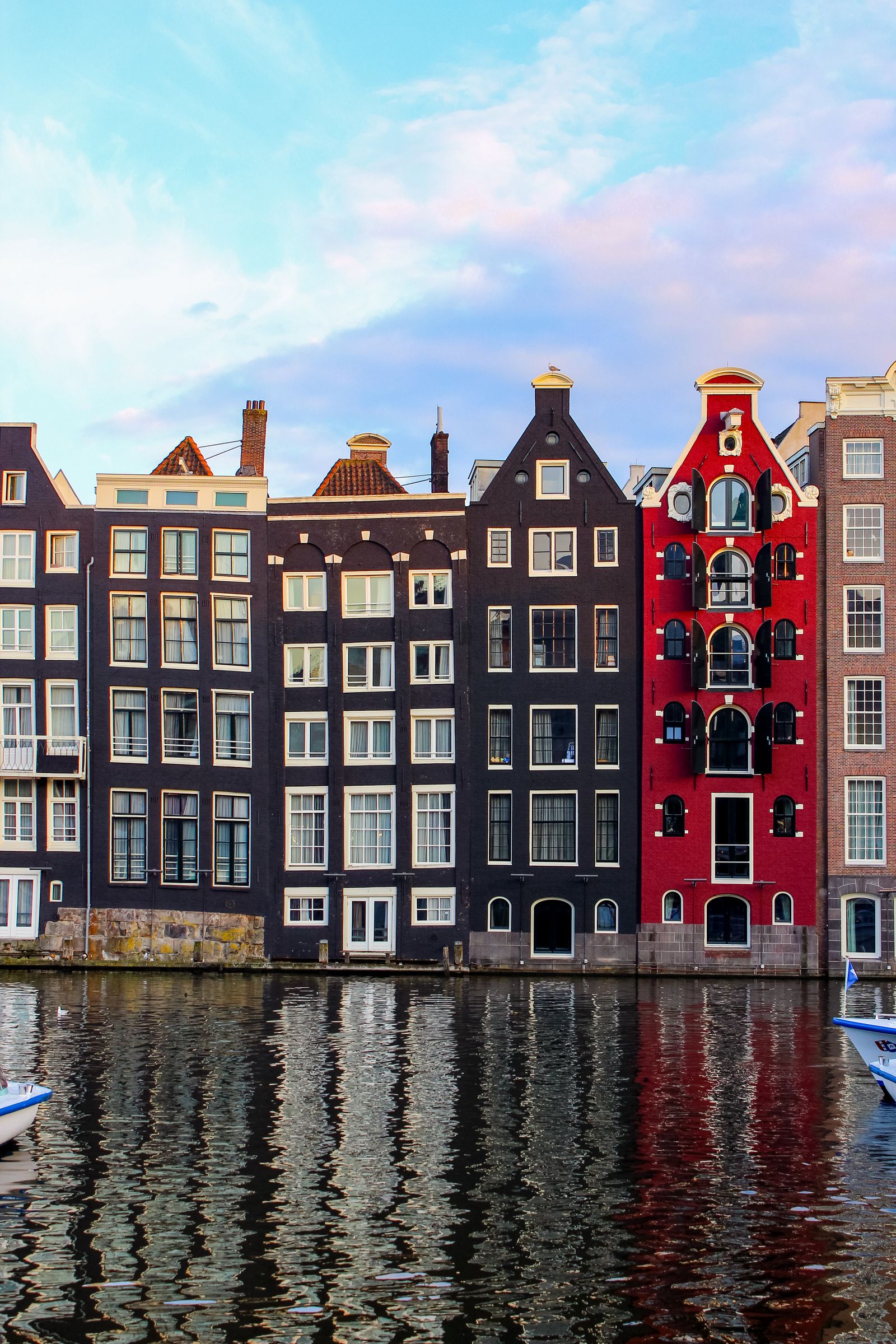
The Damrak row houses — a tight terrace of 17th-century gabled merchant houses leaning at varied angles along the Damrak canal waterfront — are Amsterdam’s most iconic ‘postcard’ image and the city’s most-photographed building cluster. Each house has a distinct gable style (step gable, neck gable, bell gable) and the ensemble of slightly tilted facades and reflected colours in the basin constitutes Amsterdam’s ultimate visual summary. The row includes the distinctive multi-coloured facades that have been photographed by virtually every visitor to Amsterdam.

  • GPS: 52.3751, 4.8957
  • Elevation: 4 ft
  • Best time of day: blue hour at sunrise — the canal-facing facades are lit from within and the still Damrak basin provides perfect long-exposure reflections; arrive 30 minutes before sunrise for the critical 15-minute window
  • Sun direction: The Damrak row houses face west over the Damrak basin (partially filled-in canal). The sun sets behind these buildings in the west, creating silhouette conditions at sunset when photographing from the water side. The optimal light comes at sunrise (east): the first golden rays illuminate the distant city and create warm colour behind the photographer’s position on the Prins Hendrikkade side. Blue hour at sunrise (roughly 30 minutes before sun-up) is the prime window: the houses’ interior window lights are still active, creating a warm honeycomb of lit windows against deep blue sky
  • Access: Prins Hendrikkade side of the Damrak basin, near Amsterdam Centraal station, Amsterdam 1012. Free public street/quayside, accessible 24/7. Best shooting position is from the Prins Hendrikkade promenade opposite the houses, or from the stone bridge at Oudebrugsteeg. Tram lines 2/4/9/13/16/17/26 to Centraal Station (90-second walk). High pedestrian and bicycle traffic throughout the day. The open-air terrace boats (canal cruise departure point) are moored in the Damrak basin — these can be incorporated as foreground elements.
  • Difficulty: easy
  • Recommended settings: Blue Hour Long Exposure Reflection: f/11, 20–30 sec, ISO 100, 24–35mm, tripod — from Prins Hendrikkade  ·  Morning Sunrise Window Lit: f/8, 1/30 sec, ISO 400, 35mm — warm window lights against blue sky  ·  Facade Detail Telephoto: f/8, 1/500 sec, ISO 100, 200mm — gable compression and leaning effect  ·  Canal Boat Foreground: f/8, 1/250 sec, ISO 100, 24mm — tour boats as compositional foreground

Shots to chase:

  • Classic blue-hour long exposure from Prins Hendrikkade: the entire row of coloured gabled houses reflected in the Damrak basin, shot at 24–35mm
  • Pre-dawn shot with warm interior window lights creating a chessboard pattern against deep blue sky above the canal
  • Telephoto compression from the Oudebrugsteeg bridge: gables layered with the Beurs van Berlage dome visible behind
  • Looking south down Damrak from Central Station with the row houses on the left, tram lines, and the National Monument as distant landmark
  • Detail shot of the most distinctively leaning house at 200mm to exaggerate the subsidence tilt visible in the original masonry

Pro tip: The Oudebrugsteeg side-street bridge provides an alternative angle showing the houses from a slight south-facing perspective that reveals the full depth of the row. Time your tripod shots for 4–6 AM (summer) to avoid the dense canal cruise boat traffic that begins by 9 AM and clutters the basin reflections. The most complete reflection requires a very low tide and calm morning winds — check the weather forecast for wind conditions the evening before.

Common mistake to avoid: Shooting in the afternoon when the sun is behind the houses, creating heavy shadows and poor facade colour rendering. Arriving too late in the morning when canal traffic has already broken up the Damrak reflection. Setting up a tripod on the main Damrak road during the day — heavy tram and bicycle traffic makes this dangerous; the Prins Hendrikkade promenade opposite is the safe and legal tripod position.

10. NEMO Science Museum Rooftop (Free Panoramic View)

NEMO’s copper-green ship-shaped building (Renzo Piano, 1997) has a dramatic sloped rooftop terrace that functions as Amsterdam’s best free elevated viewpoint. The stepped terrace — redesigned and reopened as a public rooftop square in May 2025 with gardens, seating, and a café — provides unobstructed 270° views: south to the Canal Belt UNESCO World Heritage skyline, west to Central Station, east to the Eastern Docklands, and north toward Amsterdam-Noord. No entry charge, no queues — a hidden gem avoided by most tourists.

  • GPS: 52.3742, 4.9123
  • Elevation: 52 ft
  • Best time of day: late afternoon to golden hour (April–October) — the rooftop faces south-southwest over the Oosterdok harbour and city centre; summer Thursdays and Fridays open until 21:00 for sunset and blue hour; also excellent mid-morning for sharp clear light
  • Sun direction: The NEMO rooftop is a broad south-facing stepped terrace at approximately 16m elevation. The view opens south over the Oosterdok basin, west toward Amsterdam city centre, and east toward the KNSM island modern architecture. Morning sun from the east illuminates the Scheepvaartmuseum (National Maritime Museum) across the water. Afternoon sun descends over the city centre to the southwest, backfilling the historic roofline with warm light. On extended summer evenings (June–August), sunset occurs at 21:30–22:00 and golden hour paints the canal belt a deep amber from this elevated vantage
  • Access: Oosterdok 2, Amsterdam 1011. Free rooftop access via exterior stairs on the east side of the building; open daily 10:00–17:30, extended to 21:00 on Thursdays and Fridays in summer. Museum interior entry is separate (€17.50/adult) and not required to access the rooftop. Nearest bus: GVB bus 22 to Kattenburgerstraat; 10-minute walk from Centraal Station along the IJ waterfront or via the cycle path. Free bicycle parking at the base of the building.
  • Difficulty: easy
  • Recommended settings: Golden Hour City Panorama: f/11, 1/250 sec, ISO 100, 16–24mm — south-facing city roofline  ·  Blue Hour Harbourscape: f/11, 15 sec, ISO 100, 24mm, tripod — city lights over Oosterdok  ·  Midday Architecture Detail: f/8, 1/800 sec, ISO 100, 35mm — copper-green facade detail and city beyond  ·  Harbour Boat Traffic: f/8, 1/1000 sec, ISO 200, 70mm — vessels in Oosterdok basin from above

Shots to chase:

  • South-facing panorama stitch (3–4 frames at 24mm) showing the full Canal Belt roofline and church towers from this elevated free viewpoint
  • Renzo Piano’s copper-green sloped rooftop stairs as compositional foreground with the city skyline rising behind
  • Blue-hour long exposure looking west: Central Station dome and IJ river lit against deep blue sky, Scheepvaartmuseum in middle ground
  • Tourists and locals relaxing on the terraced steps — documentary-style environmental portrait with the Amsterdam skyline
  • Telephoto compression shot of historic canal-house gable rooflines from above, layered in receding planes across the city

Pro tip: The rooftop is least known to tourists, making it one of the best free panoramic spots in Amsterdam with far shorter waits than the A’DAM Lookout. On extended summer evenings, the Thursday/Friday 21:00 closing aligns with golden hour in June–August — plan these sessions specifically. Bring a wide-angle lens (16–24mm) for the panorama and a telephoto (70–200mm) for compressing the historic roofline layers. The rooftop café serves drinks; a coffee-and-sunset combination session is recommended.

Common mistake to avoid: Visiting in winter when the shorter hours (closing at 17:30) miss golden hour by an hour or more — check sunset time before visiting October–March. Photographing only south-facing views and missing the east-facing view of the Scheepvaartmuseum and Eastern Docklands, which is especially dramatic in morning light. Not bringing a tripod for the blue-hour session — the terrace surface is stable and tripods are not restricted.

11. A’DAM Lookout (Amsterdam-Noord Ferry Side)

The A’DAM Lookout occupies the 20th floor (100m) of the A’DAM Tower — the tallest viewpoint in central Amsterdam, offering a 360° panorama that encompasses the entire Canal Belt UNESCO World Heritage Site, the IJ river, Amsterdam Centraal Station, the port, and the open Dutch polder to the north. The ‘Over The Edge’ swing extends over the building edge for a unique action/vertiginous perspective. The south-facing view at golden hour is the definitive aerial image of Amsterdam — the concentric canal rings, church towers, and historic gable rooflines laid out in precise Dutch order.

  • GPS: 52.3843, 4.8986
  • Elevation: 328 ft
  • Best time of day: golden hour / sunset — 30–60 minutes before sunset the warm light floods the canal belt from above at ~100m; also excellent at blue hour (20 minutes after sunset) when the city lights activate and the IJ river reflects the sky
  • Sun direction: The A’DAM Lookout sits on the north bank of the IJ river in Amsterdam-Noord, looking south over the entire historic city. At sunset (west-northwest), the low sun illuminates the Canal Belt gabled roofline from the side, revealing the texture and geometry of the city. The observation deck faces all four directions: south for the canal belt skyline, west for the port and IJ river, east for the Eastern Docklands, north for the Dutch polder landscape. Blue hour from the south side offers the definitive Amsterdam rooftop panorama
  • Access: Overhoeksplein 5, Amsterdam-Noord 1031. Entry €16.50/adult online (advance recommended), €18.50 walk-in; children (4–12) €10.50; I amsterdam Card: free. Open daily 10:00–22:00 (last entry 21:00). Take the free F3 ferry from Amsterdam Centraal (IJ-side, pier behind station) — 2-minute crossing, pedestrians and cyclists free. Short walk north from ferry terminal. ‘Over The Edge’ rooftop swing: €7.50 extra. Audio tour and digital photos included in standard ticket.
  • Difficulty: easy
  • Recommended settings: Golden Hour Panorama South: f/11, 1/250 sec, ISO 100, 16mm — full canal belt sweep at sunset  ·  Blue Hour City Lights: f/11, 15–20 sec, ISO 100, 24mm, tripod — IJ river and city lights  ·  Telephoto Canal Belt Compression: f/8, 1/500 sec, ISO 100, 200mm — compress the canal ring geometry  ·  Over The Edge Swing Portrait: f/5.6, 1/2000 sec, ISO 400, 35mm — action portrait on the swing with city below

Shots to chase:

  • Golden-hour wide panorama from the south-facing observation deck: the full Canal Belt UNESCO World Heritage Site in warm amber light at 16mm
  • Blue-hour IJ river and city lights long exposure: the water reflecting the pink-to-indigo sky transition with Central Station lit below
  • Telephoto compression of the canal ring from above: the curved Herengracht and Keizersgracht rings appearing as geometric bands through the city
  • Aerial-perspective shot of ferry boats crossing the IJ, seen from 100m above, with long wakes and the waterfront below
  • The ‘Over The Edge’ swing from the building exterior — ask a companion to photograph you suspended 100m above the city with the roofline below

Pro tip: Book tickets online at adamlookout.com to save €2 per person vs walk-in. Arrive 45 minutes before sunset for the full progression from golden hour through blue hour — plan for a minimum 90-minute visit to capture both light phases. The outdoor terrace wraps the full building perimeter: the south side is the most photographed but the north side reveals the distinctive Dutch polder landscape and windmill silhouettes visible on clear days. Glass barriers are frameless — bring a lens hood to minimize reflections when shooting through them.

Common mistake to avoid: Arriving only for a daytime visit and missing the golden hour and blue hour windows when the view is most dramatic. Forgetting that the ferry terminal is behind (north side of) Centraal Station — first-time visitors often spend 10–15 minutes finding the right departure pier, risking late arrival. Not bringing a tripod for the blue-hour long exposures — handheld shots at 15+ seconds are unworkable at any ISO.

When to photograph Amsterdam: a year-round breakdown

Amsterdam is photogenic every month of the year — but the conditions differ radically by season. Here is what to expect:

April–May (tulip season, canal reflections, soft spring light, moderate crowds) and September–October (golden autumn foliage along canals, warm low light, fewer tourists than summer peak)

Photographer safety in Amsterdam: read this

City photography has its own risks: gear visibility, neighborhood timing, traffic, weather. Read the briefing before you go.

  • Gear visibility: Use a discreet bag with no obvious camera branding. Keep a body strapped under a jacket on transit.
  • Neighborhood timing: Pre-dawn and post-sunset shoots reward early scouting. Cross-reference each location with current local guidance and choose well-lit transit routes.
  • Situational awareness: Headphones out. One eye in the viewfinder, one on the street.
  • Traffic: Bridges, medians, and bike lanes are not setup zones. Shoot from sidewalks and pedestrian areas only.
  • Weather: Summer storms move quickly; winter cold drains batteries. Layer up, keep gear dry, watch for ice on cobblestones at blue hour.

The complete safety briefing is inside the Amsterdam Photographer’s Guide PDF.

Take this guide into the city

This post is the complete field reference. The Amsterdam Ultimate Photographer’s Guide PDF is the field-deployable version: full-page resolution hero photography, GPS maps with gold pins for every location, multi-season shooting calendars, gear notes per location, sun-angle diagrams, the full city safety briefing, and a print-ready editorial layout in Framehaus black and gold. Save it offline. Print it. Take it on the walk.

Amsterdam Ultimate Photographer’s Guide
Downloadable PDF · 11 GPS-mapped locations · Multi-season calendar · City safety briefing · Packing checklist

Get the Amsterdam guide — $47

Combo Deal

Get the Amsterdam Guide + Preset Pack

Photograph it. Edit it. Done.

$66
$54
Save $12
PDF Guide Every spot, GPS, golden hour
Preset Pack 20 Lightroom presets
Book your tours & experiences in Amsterdam

All links go to Viator (a TripAdvisor company), the world’s largest marketplace for guided experiences. Tagged as affiliate per FTC.

Also on Amazon: gear that helps with this technique

Quick Amazon shortcuts to the gear most useful for this kind of shot. Use them if Prime shipping or Amazon credit makes more sense than B&H. As an Amazon Associate ShutYourAperture earns from qualifying purchases.

Take Amsterdam home in your pocket.

Every shot location, every angle, every time of day worth shooting. Printable PDF + GPS-tagged map.

Instant download. Works on phone, tablet, and printed.

Continue reading

← Back to International Cities Photography Guides

Related guides nearby

Three more photography guides within striking distance — perfect for combining into one trip.

Browse all 78 guides → · Open the map

Save your trip-planning hours

The complete Amsterdam guide is $47

All vantage points above + 5 bonus secret spots, printable map, gear pack list, and editing recipes. One-time payment, instant download, lifetime updates.

Buy Amsterdam PDF →

Common questions about the Amsterdam guide

Is the Amsterdam photography guide worth $47?

For most photographers, yes. The guide saves 8-12 hours of trip-planning research and prevents the most common mistake of Amsterdam photography: shooting at the wrong time of day. If a single better frame is worth $47 to you, the guide pays for itself on day one. Buyers get every GPS coordinate, every golden-hour window, every cultural rule, and a printable shot list.

Does the Amsterdam guide include GPS coordinates?

Yes — every vantage point in the guide has Google Maps-ready GPS coordinates so you can pin them before you fly. The guide also includes a printable map showing all locations clustered by walking distance, so you can build efficient half-day routes.

What's in the Amsterdam PDF that isn't in this article?

The article shows the highlights. The PDF includes: 5 additional secret spots not published online, a 14-day itinerary with daily routes, the full camera-settings cheat sheet for every scenario in Amsterdam, a printable gear packing list, post-processing recipes with screenshot examples, and a list of local guides we trust for portrait commissions.

Do I get the Lightroom presets too?

The $47 guide is the PDF only. The matching Amsterdam preset pack is a separate $19 download — most buyers grab both as a bundle and save the editing time. Both are instant download, both work on Lightroom Classic and Lightroom Mobile.

Will the guide work for a Amsterdam trip in 2026?

Yes. The guide is updated annually as fees, restrictions, and new vantage points change. All buyers get free lifetime updates. The 2026 edition includes the latest drone rules, museum photography policies, and seasonal light data for the year.

Get the Amsterdam guide · $47