Best Photography Spots in Edinburgh: 11 Locations With GPS
edinchavez01-20). Buying through these links costs you nothing extra and helps fund our free guides.
Edinburgh, United Kingdom is one of the most photogenic cities in the world. If you have a camera and the patience to show up before dawn, Edinburgh will give you images that last a career — but only if you know where and when to point it.
This is the definitive field guide to the 11 best photography spots in Edinburgh, with GPS coordinates you can drop straight into Google Maps, exact camera settings tuned to Edinburgh’s unique light, precise timing for every location, and the access notes nobody else bothers to document. It mirrors the intel inside our Edinburgh Ultimate Photographer’s Guide ($47 PDF) — a downloadable field guide with full-page hero images, GPS maps, seasonal tables, a city safety briefing, and a complete photographer’s packing list. Get the guide →
Planning multi-city travel? See also: U.S. cities photography hub and the National Parks Photography Guides.
11 GPS-mapped locations · Exact camera settings · Multi-season shooting calendar · Free annual updates
Download the PDF guide →
Get the Edinburgh Ultimate Photographer’s Guide
Every location below — pre-mapped with GPS, golden-hour timing, gear recommendations, cultural rules, and a 14-day itinerary. Downloaded by 200+ working photographers.
Quick jump to the 11 spots
- Edinburgh Castle — Princes Street Gardens Viewpoint
- Calton Hill
- Arthur’s Seat — Summit & Holyrood Park
- Victoria Street
- Dean Village — Bell’s Brae Bridge
- Greyfriars Kirkyard
- Scott Monument
- Palace of Holyroodhouse — Holyrood Park
- The Royal Mile — Cockburn Street & Old Town Closes
- Camera Obscura Rooftop Terrace
- Cramond Island — Tidal Causeway
A look inside the Edinburgh Photographer’s Guide
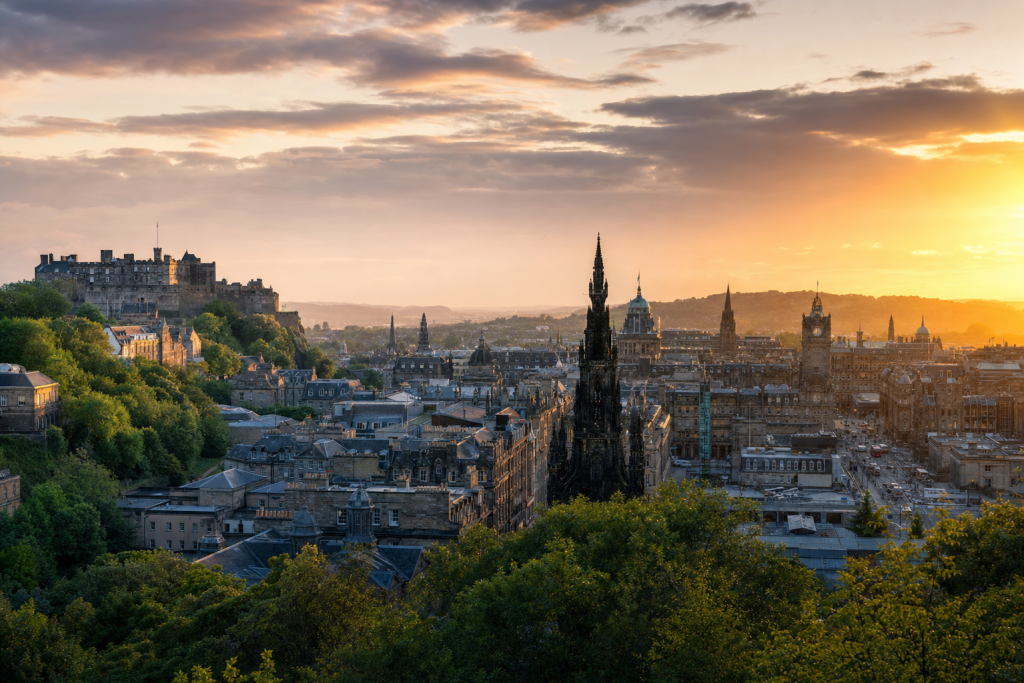
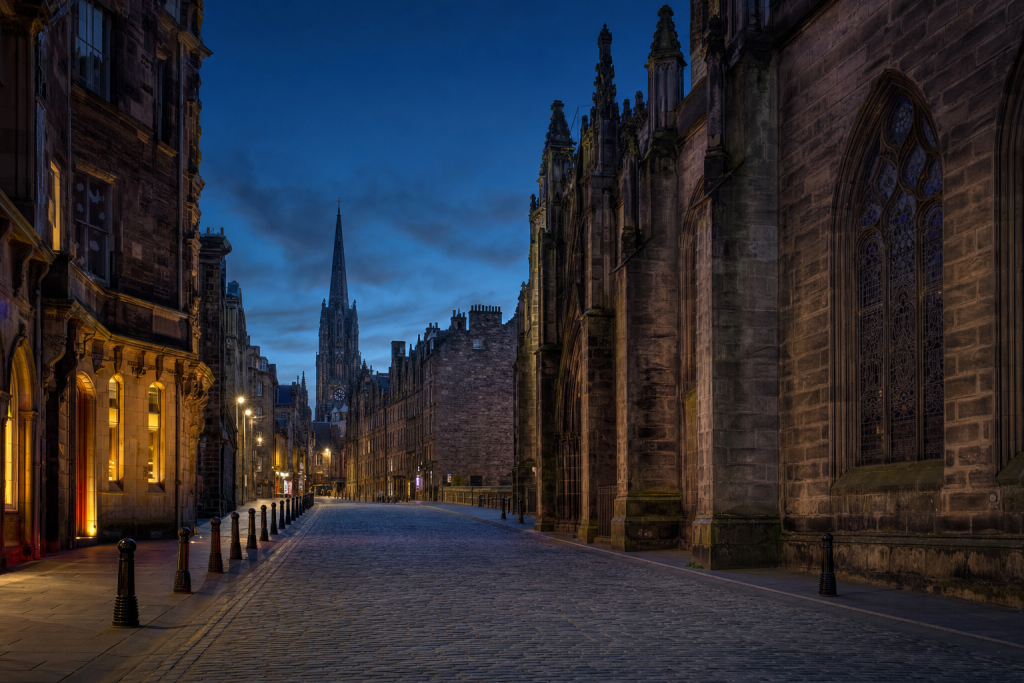
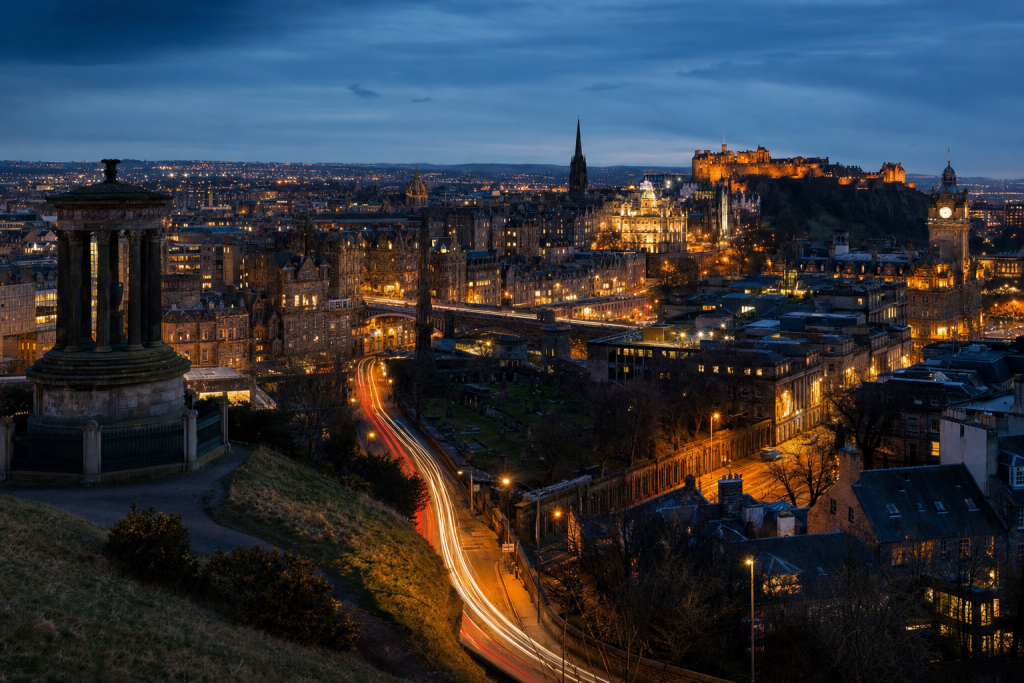
Here are three of the actual shots you’ll find inside the PDF — cinematic full-page references for the exact spots, lenses, and lighting conditions documented in the guide. The full guide includes 11 locations, each with a hero image, GPS map, settings table, and a five-shot list.
Save
Before you shoot Edinburgh: the essentials
- Free public access: Calton Hill, Arthur’s Seat / Holyrood Park, Princes Street Gardens, Royal Mile, Victoria Street, Dean Village, Greyfriars Kirkyard, and Cramond causeway are all free. Paid attractions: Edinburgh Castle (adult £19.50–£26 depending on online/walk-up and season); Palace of Holyroodhouse (adult £21–£25); Scott Monument (adult £8, child £6); Camera Obscura rooftop (adult £23.95 online 2025). Historic Scotland members receive free castle entry.
- Commercial permits: Personal and tourist photography in all public spaces is unrestricted. Commercial or professional shoots (advertising, film, large productions) in Holyrood Park require a permit from Historic Environment Scotland. Photography inside Holyroodhouse Palace and Edinburgh Castle interiors is prohibited; exterior grounds shooting is freely permitted. Drones require CAA authorisation and are prohibited over the castle and Old Town conservation area without special clearance.
- Best photography seasons: April–May (golden spring light, blossoms, manageable crowds) and September–October (dramatic storm skies, warm autumn tones, lower visitor numbers than August Fringe peak)
- Blue hour notes: Edinburgh sits at 55.95°N — one of Europe’s most northerly capital cities. Blue hour after sunset is exceptionally long (30–45 minutes) in summer, giving ample time for tripod work. In midsummer, sunset does not occur until 10:10 PM and the sky never fully darkens to full night. In winter, sunset can fall as early as 3:40 PM. The combination of floodlit castle rock, warm street lamps on cobbled closes, and deep cobalt skies creates world-class blue hour opportunities at the Vennel Steps, Dean Village, and Calton Hill.
- Drone policy: Drone laws vary widely by country and city — many capital and tourist zones are no-fly. Verify the local civil aviation authority’s current rules before launching.
- Local resource: Official visitor information
The full-resolution version of every map below — plus seasonal calendars, gear notes per location, sun-angle diagrams, and a complete photographer’s packing checklist — is inside the Edinburgh Photographer’s Guide PDF ($47).
1. Edinburgh Castle — Princes Street Gardens Viewpoint
The view from West Princes Street Gardens is Edinburgh’s defining postcard image — the Ross Fountain (an ornate Victorian cast-iron piece in mint green and gold, restored 2018) in the foreground, with Castle Rock rising 130 ft above the garden floor topped by the castle’s medieval battlements. No other viewpoint compresses so many layers of Edinburgh history into a single frame: Georgian park, Victorian fountain, and a 12th-century fortress on an extinct volcano. The rock itself glows in warm light at sunset and is dramatically floodlit at night.
- GPS: 55.9486, -3.2008
- Elevation: 383 ft
- Best time of day: blue hour — 20–30 minutes after sunset when the castle is floodlit in warm amber against a deep cobalt sky and the gardens below are softly illuminated; also superb at golden hour before sunset when the west-facing rock face catches warm directional light
- Sun direction: Edinburgh Castle sits on volcanic Castle Rock at azimuth ~270° (due west) from Calton Hill and ~230° from Princes Street Gardens. From the gardens (camera pointing northwest), the castle faces southeast in the morning, receiving warm eastern light on its main facade at sunrise. By afternoon and sunset, the western faces of the rock glow in warm golden light. The sun sets northwest in summer (azimuth ~310°), side-lighting the castle battlements dramatically. In winter the sun tracks lower and more southerly, setting around azimuth ~230°, still illuminating the south face of Castle Rock. Overcast days produce even, moody light that suits the dark medieval stonework particularly well.
- Access: West Princes Street Gardens, Edinburgh EH1 2YT. Multiple entrances from Princes Street (north side). Free public park open 7 am to dusk (seasonal). No admission required for garden viewpoints. Entry to the castle itself: adult £19.50 online / £22.00 walk-up (2025 prices, April 2025 onwards); advance booking strongly recommended at edinburghcastle.scot. Castle open daily Apr–Sep 09:30–18:00, Oct–Mar 09:30–17:00. Nearest train: Edinburgh Waverley (10-min walk). Trams: Princes Street stop.
- Difficulty: easy
- Recommended settings: Blue Hour Long Exposure: f/11, 15 sec, ISO 100, 24mm, tripod · Golden Hour Fountain Foreground: f/8, 1/250 sec, ISO 200, 35mm · Overcast Moody Rock: f/8, 1/125 sec, ISO 400, 70mm · Night Floodlit Castle: f/8, 8 sec, ISO 200, 50mm, tripod
Shots to chase:
- Classic wide composition using the Ross Fountain as a foreground element with Castle Rock rising behind — best at blue hour when the fountain’s LED lighting activates
- Long exposure from the garden path at blue hour: 15–20 second exposure smooths out any pedestrian movement while the illuminated castle glows against a cobalt sky
- Telephoto compression (135–200mm) from the eastern end of West Gardens looking west, compressing the castle over the autumn tree canopy for a layered landscape
- Spring cherry blossom foreground (late April) combined with the castle backdrop — the pink blossoms near the gardens’ central path create a striking contrast with the dark volcanic rock
- Wide vertical composition from the foot of Castle Rock itself (Ross Fountain area) shooting upward at f/11 to keep both fountain detail and castle battlements sharp
Pro tip: Arrive 30–40 minutes before sunset on a weekday to secure a tripod position near the Ross Fountain before crowds gather. The fountain is illuminated after dark with LED lighting — time your visit to capture both the last natural light and the illuminated fountain in a single frame. In autumn and winter, haar (coastal sea fog) occasionally rolls in over the gardens at dawn, submerging the lower park while leaving the castle illuminated above — a rare and spectacular effect. The Scott Monument (on the east side of the gardens) can be included as a second subject in a wider composition looking east.
Common mistake to avoid: Shooting exclusively at midday when the castle is strongly backlit from the south and the gardens are full of people. Forgetting to include foreground interest — the Ross Fountain, garden paths, or seasonal flowers turn a standard castle shot into a fully composed landscape image. Using a very wide lens (14mm) too close to the fountain distorts the fountain’s proportions; 24–35mm at a moderate distance renders it more naturally.
2. Calton Hill
Calton Hill is Edinburgh’s premier panoramic viewpoint and arguably Scotland’s finest urban photography location. The summit is crowned with the Dugald Stewart Monument (a circular Athenian choragic monument, modelled on the Monument of Lysicrates in Athens), the unfinished National Monument (modelled on the Parthenon, giving Edinburgh its ‘Athens of the North’ sobriquet), and the Nelson Monument. These neoclassical structures act as natural foreground frames for the Old Town skyline, Arthur’s Seat, and the Firth of Forth behind. The view down Princes Street with the Scott Monument and castle is one of the most photographed urban vistas in the United Kingdom.
- GPS: 55.9559, -3.1826
- Elevation: 338 ft
- Best time of day: sunset and golden hour — the sun sets to the northwest in summer, casting warm light directly along Princes Street and the Old Town skyline; sunrise is excellent for atmospheric mist over the city with the Dugald Stewart Monument silhouetted against an orange eastern sky
- Sun direction: From Calton Hill’s summit at 55.96°N, Edinburgh’s Old Town and castle lie to the southwest (azimuth ~225°). The sun sets toward the northwest in summer (azimuth ~310–320°), illuminating the castle and Princes Street below in warm golden tones from behind the camera when shooting southwest. In autumn (September–October), the sun tracks further south at sunset (azimuth ~255–270°), aligning almost perfectly with Princes Street for a straight-down-the-street shot. Sunrise is from the east-northeast in summer (azimuth ~40–50°), catching the Dugald Stewart Monument and National Monument in warm backlight. The Nelson Monument on the hill points north — useful for composing leading-line shots toward the Firth of Forth.
- Access: Calton Hill, Edinburgh EH7 5AA. Free public park open year-round, 24 hours. Three access routes: (1) Regent Road southern steps — steep stone staircase, 5 min, most direct; (2) Waterloo Place (east end of Princes Street) — paved path, gentle incline, 10 min; (3) Royal Terrace — gentle ascent from top of Leith Walk. No admission fee. On-street parking on Regent Road; no dedicated car park. Nearest bus: multiple routes on Princes Street / Regent Road.
- Difficulty: easy
- Recommended settings: Sunset Wide Panorama: f/11, 1/60 sec, ISO 200, 24mm · Blue Hour Dugald Monument Foreground: f/8, 8 sec, ISO 100, 35mm, tripod · Telephoto Princes Street Compression: f/8, 1/250 sec, ISO 200, 200mm · Sunrise Monument Silhouette: f/11, 1/500 sec, ISO 200, 50mm
Shots to chase:
- Classic composition: Dugald Stewart Monument columns in the foreground right, Old Town skyline with castle and Princes Street stretching to the left — best at golden hour in autumn when the sun aligns with Princes Street
- Telephoto shot (150–200mm) from behind the National Monument columns pointing west, compressing the layers of rooftops, Arthur’s Seat, and the castle into a dense layered scene
- Long exposure from the hill’s east edge at blue hour looking north toward the Firth of Forth, capturing the port of Leith lights reflecting on the water
- Sunrise silhouette of the National Monument columns against a warm orange or purple eastern sky with the first light catching the Firth of Forth in the background
- Wide-angle composition from the summit incorporating the Nelson Monument, the city below, and a dramatic cloud formation — best in September when Atlantic fronts create theatrical skies
Pro tip: Position your tripod on the south or southwest side of the Dugald Stewart Monument 30 minutes before sunset for the classic Edinburgh shot — other photographers will be there but there is enough space. The best autumn alignment (sun setting along Princes Street) happens around mid-September to mid-October. Avoid the hill after dark alone; it has a poor reputation for personal safety at night. During the Hogmanay (New Year) and Beltane festivals, the hill is used for large events — arrive early to secure positions. The Nelson Monument interior (143 steps, small fee applies) offers elevated shots above the other monuments.
Common mistake to avoid: Arriving at sunset when the light is already too low and the classic composition requires a longer exposure than your tripod can handle — arrive an hour before sunset to scout and compose. Shooting only toward the Old Town and missing the equally beautiful view north over Leith to the Firth of Forth. Underestimating how crowded the hill gets at popular sunset hours in summer — weekday evenings are considerably quieter than weekends.
3. Arthur’s Seat — Summit & Holyrood Park
Arthur’s Seat is an extinct volcano rising 250.5 m (822 ft) from the heart of the city — the highest point in Edinburgh and one of the most dramatically situated urban summits in Europe. The summit provides a complete 360° panorama encompassing the Old Town, New Town, Edinburgh Castle, Holyrood Palace, Salisbury Crags, the Firth of Forth, the Pentland Hills, and on clear days the Highlands beyond. St Margaret’s Loch, Dunsapie Loch, and the ruins of St Anthony’s Chapel in the park below add foreground interest at every level of the climb.
- GPS: 55.9443, -3.1616
- Elevation: 822 ft
- Best time of day: sunrise — arrive 45–60 minutes before sunrise to ascend in darkness; the first light from the northeast in summer illuminates the Firth of Forth and the city simultaneously with Edinburgh Castle lit from the east; late October through March offers dramatic low-sun panoramas from the summit
- Sun direction: From Arthur’s Seat summit, the city lies to the northwest and west. The sun rises to the northeast in summer (azimuth ~40–55°), casting long shadows across the volcanic landscape and rim-lighting the castle from behind when viewed from the summit. At sunrise, warm light strikes the east-facing sides of the Old Town tenements, creating a golden cityscape. Sunset in summer is to the northwest (azimuth ~310°), silhouetting the castle and Old Town against an orange horizon when viewed from the summit. St Margaret’s Loch below the summit reflects sunrise light beautifully for foreground interest. The summit is fully exposed — wind and light change rapidly.
- Access: Arthur’s Seat, Holyrood Park, Edinburgh EH8 8HG. Free public park, open 24 hours year-round. Nearest car park: Dunsapie Loch car park (GPS 55.944, -3.156) — shortest summit route, 15–20 min via easy grassy slope. Main entrance from Queen’s Drive near Holyrood Palace (GPS 55.9509, -3.1704). Footpath from Holyrood Palace to summit approx. 45–60 min. No admission fee for the park. Bus route 35 runs along the Queen’s Drive. Photography permit required for commercial/wedding shoots — contact Historic Environment Scotland.
- Difficulty: moderate
- Recommended settings: Sunrise Wide Panorama: f/11, 1/125 sec, ISO 200, 16mm · Telephoto City Detail: f/8, 1/500 sec, ISO 200, 200mm · Loch Reflection Long Exposure: f/11, 1 sec, ISO 100, 24mm, tripod · Stormy Sky Drama: f/8, 1/500 sec, ISO 400, 35mm
Shots to chase:
- Summit panorama at sunrise: wide-angle (16–24mm) looking northwest over the Old Town with the castle catching the first warm rays — the city still partially in darkness below creates spectacular tonal contrast
- St Margaret’s Loch reflection shot in still pre-dawn conditions with the chapel ruins and Arthur’s Seat peak reflected in the glassy water
- Salisbury Crags ridgeline compositions using the dramatic basalt escarpment as a leading line toward the city below — especially powerful in late afternoon side-light
- St Anthony’s Chapel ruins silhouetted against a colourful dawn sky — the roofless walls create natural framing for the Firth of Forth beyond
- From Dunsapie Loch, telephoto (100–200mm) composition across the loch surface with Dunsapie Hill reflected and the city visible in the background distance
Pro tip: For sunrise shoots, park at Dunsapie Loch and take the northeast grassy slope to the summit — 15–20 minutes, manageable in the dark with a headtorch. In summer, sunrise can be before 4:30 AM; budget for an early alarm. The summit is extremely exposed to wind — bring a windproof jacket even in summer. Check weather forecasts the evening before; cloud cover ruins the panorama entirely. The Dunsapie Loch route also gives you access to loch reflection shots en route to the summit. Cell service is available at the top for PhotoPills / Photopills sun planning.
Common mistake to avoid: Starting the ascent too late — by the time you reach the summit at full daylight, the dramatic early light has gone and the city views are flat and hazy. Underestimating the cold at the summit — wind chill at 822 ft even on mild days can be severe. Using only a wide lens and missing the powerful telephoto compression shots of the city available from the summit. Attempting the summit in icy or wet conditions without appropriate footwear — the rocky scramble near the top is slippery.
Want this in your pocket on the street?
The full-resolution version of every spot above — with full-page hero photography, GPS maps with gold location pins, sun direction diagrams, multi-season tables, and a complete safety + packing checklist — is inside the Edinburgh Ultimate Photographer’s Guide PDF ($47). Print it, save it offline, take it on the walk. Get the guide →
4. Victoria Street
Victoria Street is a crescent-shaped, two-level cobbled street built in the 1830s as part of Old Town improvement works. The lower level features a continuous arc of shops painted in bold emerald green, royal blue, deep red, and burnt orange — a colour palette unique in Edinburgh. Above these shops runs Victoria Terrace, an elevated pedestrian promenade with cast-iron railings offering a bird’s-eye view back down the curving street. Widely said to have inspired J.K. Rowling’s Diagon Alley, the street combines architecture, colour, and human scale into one of the UK’s most photogenic urban compositions.
- GPS: 55.9488, -3.1932
- Elevation: 252 ft
- Best time of day: early morning (07:00–09:00) on a weekday — the street is deserted, the cobblestones glisten from overnight moisture, and soft directional light catches the coloured facades; golden hour at sunset also works when warm light streams down the curve of the street from the west
- Sun direction: Victoria Street runs roughly southwest to northeast. In the morning, eastern sunlight falls on the curved row of shop fronts (which face northeast) from azimuth ~70–80°, providing warm directional light on the coloured facades. By afternoon, the street is largely in shadow from the buildings above. In summer, sunset from the northwest (azimuth ~300–310°) sends warm light down the street from the upper Victoria Terrace end, creating a luminous glow on the cobblestones below. Overcast light works exceptionally well here — diffuse grey skies make the bold shop colours pop without harsh shadows.
- Access: Victoria Street, Edinburgh EH1 2JW. Free public street, open 24 hours. Located in the Old Town, off Grassmarket, approximately 800m from Edinburgh Waverley Station. On foot: 10 min from Grassmarket, 15 min from the Royal Mile. No car access for photography — street is narrow with deliveries in early morning. Nearest parking: Grassmarket area or Castle Terrace car park. Victoria Terrace (the upper balcony level) is accessed via a stone staircase from the Grassmarket end.
- Difficulty: easy
- Recommended settings: Morning Street Scene: f/8, 1/250 sec, ISO 400, 35mm · Coloured Facades Detail: f/8, 1/125 sec, ISO 200, 50mm · Rainy Cobblestone Reflection: f/8, 1/60 sec, ISO 800, 24mm · Blue Hour Lit Shops: f/8, 4 sec, ISO 100, 24mm, tripod
Shots to chase:
- Standing at the Grassmarket end of the street looking up the curve: shoot the full crescent of coloured shopfronts with cobblestones leading the eye upward — best with a person or two for scale
- From Victoria Terrace above, shoot down through the cast-iron railings at the street below, framing the curve of the coloured shops with the balcony ironwork in the foreground
- After rain: puddles on the cobblestones reflect the coloured facades — a low-angle shot at f/2.8 with the reflection in sharp focus and buildings slightly soft creates a painterly effect
- Blue hour after shop lights activate: long exposure (4–8 sec) with the street empty, shop window illumination providing warm pools of light on the wet cobblestones
- Telephoto (85–100mm) from the top of the street looking back down the curve toward Grassmarket, compressing the shopfronts into a dense wall of colour with pedestrians creating human scale
Pro tip: Arrive before 08:00 on a weekday to get the street without cars, delivery vans, or tourist crowds. The street is at its most atmospheric after light overnight rain when the cobblestones are wet and reflective. For the classic look-up-the-curve shot, position yourself at the bottom of the curve near the junction with West Bow and use a 24–35mm lens. Victoria Terrace above is always less crowded than the street itself and provides a distinct and often-overlooked elevated angle. Christmas lights (December) make this street exceptionally photogenic after dark.
Common mistake to avoid: Arriving at midday or during Edinburgh Fringe (August) when the street is impassably crowded. Shooting only from the bottom of the street and missing the elevated Victoria Terrace view. Forgetting to look for reflections in wet cobblestones — some of the most compelling Victoria Street images are shot at near-ground level after rain. Including parked cars or delivery vans in the frame — a cropped composition or very early morning visit avoids this.
5. Dean Village — Bell’s Brae Bridge
Save
Dean Village is an astonishing hidden enclave: a medieval grain-milling village that has existed in this gorge for over 800 years, completely invisible from the streets above, less than a mile from Princes Street. The village clusters around the Water of Leith at the foot of the gorge, with 17th-century mill buildings, the ornate Well Court Victorian housing complex, stone bridges, and weeping willows creating a scene of extraordinary rural tranquillity within a capital city. Bell’s Brae Bridge provides the classic view — the old stone arch, the mill buildings and Well Court beyond, and the river below all combining into a timeless composition.
- GPS: 55.9524, -3.2167
- Elevation: 115 ft
- Best time of day: blue hour and overcast days — the deep valley location means direct sunlight only reaches the village floor around midday; soft overcast light reveals the texture in the stone buildings most effectively; blue hour after sunset activates the bridge and building illumination for atmospheric shots
- Sun direction: Dean Village sits in a deep gorge carved by the Water of Leith, running roughly north–south through the valley. The valley walls block direct sunlight for much of the day. In summer, the sun tracks high enough to illuminate the valley floor between approximately 11:00 and 14:00. In winter, the valley receives only glancing light. The best photography light comes from overcast skies which provide even, directionless illumination that flatters the dark-sandstone mill buildings. At blue hour, the bridge arch and windows of the old buildings reflect warm interior lights against the dusky sky. The river runs from southwest to northeast — early morning, the east-facing walls catch the first light.
- Access: Bell’s Brae, Dean Village, Edinburgh EH4 3BT. Free public area, open 24 hours. Located 1.5 km northwest of Princes Street. Walk: 20 min from Princes Street via Queensferry Street. No public car park in the village; limited on-street parking on Bell’s Brae. Bus route 36, 37, 47 (Dean Path stop). The Water of Leith Walkway runs through the village connecting to Stockbridge (east) and the Dean Cemetery (west).
- Difficulty: easy
- Recommended settings: Overcast Stone Detail: f/8, 1/125 sec, ISO 400, 35mm · Blue Hour Bridge Reflection: f/11, 8 sec, ISO 100, 24mm, tripod · Water Motion Long Exposure: f/16, 2 sec, ISO 100, 24mm, ND filter, tripod · Telephoto Well Court: f/8, 1/250 sec, ISO 400, 70mm
Shots to chase:
- Bell’s Brae Bridge arch framing the cluster of old mill buildings and the gothic Well Court beyond — classic view looking upstream at the curve in the river
- Long exposure (2–4 sec) on the Water of Leith with a 6-stop ND filter smoothing the river into a silky flow past the old stone walls, with sharp foreground stonework
- Autumn reflections from the water level: descend to the riverbank and shoot the sandstone buildings and colourful trees reflected in the calm water surface on a still overcast morning
- Evening blue hour looking back at the stone archways and windows of Well Court, the warm interior lights activating against the blue-grey sky above the valley rim
- Water of Leith Walkway perspective: follow the path east from Dean Village toward Stockbridge, shooting the succession of stone bridges and overhanging willows along the river corridor
Pro tip: Visit on an overcast day or at blue hour — direct midday sunlight creates deep shadows and blown-out highlights that are difficult to manage in the narrow valley. Arrive early morning on a weekday for the best chance of a people-free shot at Bell’s Brae Bridge; the village gets busier with walkers and tourists by mid-morning. A tripod is essential for the long-exposure river shots and for blue hour work. Combine with the Water of Leith Walkway for a half-day photography walk continuing to Stockbridge and the Royal Botanic Garden.
Common mistake to avoid: Visiting on a bright sunny day expecting dramatic light — the valley’s depth means direct sun only briefly illuminates the scene and creates harsh contrast. Shooting only from the bridge and missing the downstream views looking toward the weir. Forgetting a tripod and missing the long-exposure river images that define this location’s best work.
6. Greyfriars Kirkyard
Greyfriars Kirkyard is one of Edinburgh’s oldest burial grounds (in use since 1562) and one of the most atmospheric. The headstones span four centuries of Edinburgh history — from elaborately carved 17th-century Baroque monuments to Georgian and Victorian memorials — surrounded by ancient yew trees and ivy-covered walls. The kirkyard is famous as the burial place of Greyfriars Bobby (the loyal Skye Terrier who guarded his master’s grave for 14 years), the resting place of many notable Scots, and — more recently — as a Harry Potter landmark (the grave of Thomas Riddell Esq.). The Covenanters’ Prison in the south corner has some of Edinburgh’s most dramatic monumental sculptures.
- GPS: 55.9467, -3.1922
- Elevation: 230 ft
- Best time of day: early morning on overcast days — the cemetery is at its most atmospheric in soft grey light with mist; autumn and winter when bare trees and wet gravestones add texture; also atmospheric at dusk when the light falls low and the kirkyard empties of tourists
- Sun direction: Greyfriars Kirkyard is located in Edinburgh’s Old Town, facing roughly southwest. The sun rises to the east, and in morning (approx 08:00–10:00) eastern light filters through the trees at the cemetery’s east end, creating atmospheric shafts of light between the gravestones. The towering George Heriot’s School south wall casts a large shadow over the southern part of the kirkyard. Midday sun from the south illuminates the kirk’s facade most fully. Overcast light is generally best here — it softens the contrast between bright sky and dark headstones and creates a uniform moody tone throughout. In autumn and winter, bare tree branches create intricate skeletal patterns against pale skies.
- Access: Greyfriars Place, Edinburgh EH1 2QQ. Free public access during daylight hours; general opening approximately 10:00–16:30. Located at the south end of George IV Bridge, a 5-minute walk from the Royal Mile. No admission charge for the kirkyard; a £2 donation sticker from the kirk office is required to photograph inside the church interior. No parking in the immediate area — Edinburgh Old Town is pedestrianised. Nearest bus: multiple routes on George IV Bridge.
- Difficulty: easy
- Recommended settings: Overcast Headstone Detail: f/8, 1/125 sec, ISO 400, 50mm · Misty Morning Atmosphere: f/5.6, 1/60 sec, ISO 800, 35mm · Gothic Architecture Detail: f/8, 1/250 sec, ISO 200, 85mm · Dusk Moody Landscape: f/8, 2 sec, ISO 400, 24mm, tripod
Shots to chase:
- Atmospheric wide-angle (24mm) composition looking along a row of 17th-century carved headstones toward the kirk, with misty light diffusing through the yew trees
- Detail photography of the ornate Baroque carvings on the most elaborate 17th-century monuments — skull and crossbones motifs, angels, and cherubs carved in local sandstone
- Greyfriars Bobby bronze statue (just outside the main gate on Candlemaker Row) at blue hour when the bronze catches ambient street light against the dark kirk silhouette behind
- Looking from the Covenanters’ Prison section south through the wrought-iron gates toward George Heriot’s School — the school’s Renaissance towers make an atmospheric backdrop to the crowded graves
- Long exposure from inside the kirkyard at dusk: 2–4 sec with tripod to capture the soft amber glow of the street lights filtering over the kirkyard wall onto the moss-covered stones
Pro tip: Visit midweek in autumn or winter when tourists are fewer and the light is at its most atmospheric. The Covenanters’ Prison section in the south corner (where a large number of Covenanters were imprisoned in 1679) has some of the most dramatic monumental architecture and is often overlooked by visitors who stay near the main path. Bring a 50mm or 85mm prime lens for isolated headstone detail shots — the carved symbolism on 17th-century stones is extraordinary. The kirkyard closes in the late afternoon; check current hours on greyfriarskirk.com before visiting for dusk shots.
Common mistake to avoid: Visiting on a bright sunny day when harsh contrast between sunlit patches and deep shadows makes balanced exposure nearly impossible. Missing the Covenanters’ Prison area at the south end, which contains some of the most photogenic and historically significant monuments. Photographing the Tom Riddle headstone with other tourists in the frame — arrive early for a clean shot. Neglecting the detailing on the Mackenzie Mausoleum, one of the finest carved monuments in the kirkyard.
7. Scott Monument
The Scott Monument is the largest monument to a writer anywhere in the world — a 61-metre Gothic rocket of blackened Victorian stone dedicated to Sir Walter Scott. Designed by George Meikle Kemp and completed in 1846, the spire is elaborately decorated with 64 carved sandstone figures representing characters from Scott’s novels, and 16 Scottish poets are also commemorated in niches. The view from the summit (287 narrow, winding steps, progressively tighter near the top) is one of Edinburgh’s best — sweeping views of the Old Town, castle, Calton Hill, and Princes Street. The monument’s dark, sooty stone gives it an almost otherworldly, Gothic quality unlike any other European monument.
- GPS: 55.9525, -3.1933
- Elevation: 158 ft
- Best time of day: blue hour and overcast dramatic skies — the monument’s black Victorian Gothic spire reads best against pale grey storm skies; blue hour after sunset when the monument is lit and the sky retains colour; also striking in low winter sun which rakes across the 64 carved figures
- Sun direction: The Scott Monument stands on the south side of Princes Street oriented north–south, with its main decorated faces pointing east and west. Morning sun from the east (azimuth ~70–90°) illuminates the east face of the monument, revealing the 64 carved niches and figures in strong relief. Afternoon sun from the southwest illuminates the west face. The monument is famously dark — its Binney sandstone has turned black from 19th-century coal soot — which means it reads best against a pale or dramatic sky. Overcast or stormy skies provide the highest contrast. The monument is partly backlit when shooting east from the Balmoral Hotel direction. Best frontal light is in the morning from the east gardens.
- Access: East Princes Street Gardens, Edinburgh EH2 2EJ. Exterior viewing from Princes Street or East Gardens: free, open 24 hours. Monument interior (climbing 287 steps to four viewing levels): adult £8, child (5–15 yrs) £6, family (2 adults + 2 children) £20. Open daily Apr–Oct 10:00–17:00, Nov–Mar 10:00–15:30 (last entry 30 min before close). Closed during high winds — check @EdinCulture on social media before visiting. No advance booking required for tower admission.
- Difficulty: easy (exterior); moderate (climbing 287 steps)
- Recommended settings: Dramatic Sky Gothic Spire: f/11, 1/500 sec, ISO 200, 24mm · Morning Carved Detail: f/8, 1/250 sec, ISO 200, 85mm · Blue Hour Illuminated Monument: f/8, 4 sec, ISO 200, 35mm, tripod · Summit View Panorama: f/11, 1/250 sec, ISO 200, 16mm
Shots to chase:
- Low-angle wide shot (16–20mm) from the East Gardens looking directly up the spire with dramatic cloud formations in the background — the dark spire against a bright turbulent sky is iconic
- From the summit platform: wide panoramic shot looking west over Princes Street toward Edinburgh Castle with the city spread below at the four cardinal points
- Composite or telephoto shot from the North Bridge or Waverley Bridge looking west, using the monument as a mid-ground element with the castle beyond
- Detail photography of the carved niches and figures (best in morning sidelighting from the east) using a 100–200mm telephoto to isolate individual stone characters
- Blue hour from the East Gardens at f/8, 4–6 sec exposure: the monument illuminated, the Scott figure at its base lit, and the cobalt sky above creating dramatic tonal contrast
Pro tip: For exterior shots, the East Gardens directly south of the monument provides the clearest unobstructed angles at ground level. The northern side (Princes Street pavement) offers shots of the monument with the Balmoral Hotel clock tower visible to the east — a strong second subject. Interior climbers should know the staircase narrows significantly near the top and the final section requires squeezing sideways — budget 30–40 min for the ascent. Close the monument during high winds — always check before visiting in winter. The monument is not illuminated to the same degree as Edinburgh Castle at night, so exterior night shots work best at blue hour rather than full darkness.
Common mistake to avoid: Shooting the monument in flat midday light when the dark stone blends into a bright sky without contrast. Underestimating the staircase — 287 steps are more physically demanding than they sound, particularly as the stairs become very narrow in the final sections. Missing the carved figures because of shooting only wide — a telephoto reveals extraordinary craftsmanship in the stone characters.
Want this in your pocket on the street?
The full-resolution version of every spot above — with full-page hero photography, GPS maps with gold location pins, sun direction diagrams, multi-season tables, and a complete safety + packing checklist — is inside the Edinburgh Ultimate Photographer’s Guide PDF ($47). Print it, save it offline, take it on the walk. Get the guide →
8. Palace of Holyroodhouse — Holyrood Park
The Palace of Holyroodhouse is the official Scottish residence of the British monarch, set at the foot of Arthur’s Seat against one of the most dramatic natural backdrops of any royal palace in the world. The building combines a 16th-century royal tower (home of Mary Queen of Scots) with a 17th-century Baroque palace designed by Sir William Bruce. The foreground fountain, forecourt iron gates, and the looming volcanic crags behind create an irreplaceable composition. The ruins of Holyrood Abbey alongside the palace add a further layer of architectural drama. The wider Holyrood Park surroundings — St Margaret’s Loch, Salisbury Crags, Dunsapie Hill — offer elevated views looking back down onto the palace.
- GPS: 55.9523, -3.1717
- Elevation: 112 ft
- Best time of day: morning golden hour — eastern light illuminates the main baroque facade of the palace most directly; also compelling on overcast days when the dark volcanic Arthur’s Seat backdrop and the pale palace create strong tonal contrast
- Sun direction: Holyroodhouse’s main facade faces northwest. In the morning, eastern sunrise light (azimuth ~55–80°) catches the palace’s east wing most strongly, providing warm directional illumination on the medieval tower — James V Tower — which anchors the northwestern corner. The main baroque courtyard facade receives direct light from the south-southwest in the afternoon (azimuth ~210–230°). The palace is most dramatically photographed from Salisbury Crags above (where it appears as a toy palace set beneath the volcanic amphitheatre of Holyrood Park) — the crags receive morning light that illuminates the palace below. Overcast soft light works well for the main entrance front.
- Access: Canongate, Edinburgh EH8 8DX. Palace grounds (including forecourt and immediate exterior): free to view from public pavement. Palace interior admission: adult £21 online / £25 walk-up (2024–25 prices); student £13.50 / £16.50; child (5–17 yrs) £10.50 / £12.50; under 5 free. Open April–October daily 09:30–18:00 (last entry 16:30); November–March Thursday–Monday 09:30–16:30 (last entry 15:15). Closed during royal visits and 25–26 December. Photography inside the palace is not permitted. Bus 35 from Princes Street. Pay-and-display parking nearby on Horse Wynd.
- Difficulty: easy
- Recommended settings: Morning Facade Golden Light: f/11, 1/250 sec, ISO 200, 24mm · Crags Elevated Palace View: f/11, 1/500 sec, ISO 200, 70mm · Abbey Ruins Detail: f/8, 1/125 sec, ISO 400, 50mm · Overcast Dramatic Backdrop: f/8, 1/250 sec, ISO 400, 35mm
Shots to chase:
- Classic shot from the main entrance on Canongate: wide (24mm) composition including the forecourt iron gates, the Baroque facade, and Arthur’s Seat looming behind in one frame
- From Salisbury Crags above: telephoto (100–200mm) looking down at the palace as a small formal structure set against the vast scale of Holyrood Park and Arthur’s Seat — the contrast of order and wilderness is powerful
- Holyrood Abbey ruins alongside the palace: the roofless nave with its Gothic window tracery lit from behind by evening sky creates a compelling architectural ruin composition
- St Margaret’s Loch reflection shot (within Holyrood Park, 10-min walk from the palace): the loch reflects Arthur’s Seat and the park in a foreground that can be combined with a telephoto view back toward the palace
- Early morning misty shot from Queen’s Drive: the palace and crags often catch low cloud or haar (sea fog) on still mornings — a long telephoto captures the fog rolling between the crags and the palace towers
Pro tip: The exterior of the palace and the foreground forecourt area is fully accessible and free to photograph from the pavement at all times. The best elevated view of the palace is from Salisbury Crags — follow the Radical Road path up from the Holyrood car park (20 min) and look back northwest over the palace. Photography inside the palace is strictly prohibited — plan all shots as exterior work. The Holyrood Abbey ruins are freely accessible when the palace is open and offer some of the most dramatic architectural photography in Edinburgh. Combining a visit to the palace exterior with Holyrood Park (Arthur’s Seat, Salisbury Crags, St Margaret’s Loch) makes for a full half-day photography excursion.
Common mistake to avoid: Attempting interior photography and being turned back at the entrance — all Holyroodhouse photography is exterior only. Overlooking the ruined Holyrood Abbey alongside the palace, which is architecturally remarkable and less photographed. Missing the elevated Salisbury Crags viewpoint which provides the most dramatic and least-seen perspective on the palace and its volcanic setting.
9. The Royal Mile — Cockburn Street & Old Town Closes
Save
The Royal Mile is a continuous 1.13-mile (Scottish mile) medieval street connecting Edinburgh’s two most important buildings — castle and palace — along the spine of the Old Town volcanic ridge. It is lined with six centuries of architecture: medieval tower houses, 17th-century tenements up to 12 storeys high, 18th-century Georgian improvements, and Victorian commercial buildings. The narrow closes branching north and south are some of the most atmospheric urban photography subjects in Britain — stone-flagged passages between dark tenement walls, often with a sliver of sky above and framed views of the city below. Cockburn Street, a Victorian curved street off the Mile, is lined with independent shops in an arc of ornate stonework.
- GPS: 55.9502, -3.188
- Elevation: 262 ft
- Best time of day: early morning (06:30–09:00) before shops open and tourists arrive; blue hour when the street lamps activate on the cobbles and the closes become atmospherically lit; rain enhances the reflective cobblestone effect at any hour
- Sun direction: The Royal Mile runs roughly east–west from Edinburgh Castle (west) to Holyrood Palace (east). Morning sun rises broadly from the east, meaning sunrise light travels directly along the street axis, illuminating the north-facing facades of the south side of the Mile and backlighting anything viewed from the castle end eastward. The narrow closes (wynds) that branch off the Mile run north–south and catch light only at solar noon or on overcast days. Cockburn Street, which spirals down from the Mile to Waverley Bridge on the north side, faces broadly east — it catches gorgeous morning light on its ornate Victorian shopfronts. In summer, sunset light from the northwest angles into the closes briefly before dusk.
- Access: The Royal Mile, Edinburgh EH1 (from Castle Esplanade to Canongate). Free public street, open 24 hours. Edinburgh Waverley Station is at the foot of Cockburn Street (3-min walk). Multiple bus routes on the Mile. Parking is extremely limited in the Old Town; all access is best on foot or by public transport. Closes (narrow alleys off the Mile) are public rights of way, open 24 hours.
- Difficulty: easy
- Recommended settings: Early Morning Empty Street: f/8, 1/60 sec, ISO 800, 24mm · Close Atmospheric Detail: f/5.6, 1/30 sec, ISO 1600, 35mm · Wet Cobblestone Reflection: f/8, 1/125 sec, ISO 800, 24mm · Telephoto Castle End Compression: f/8, 1/500 sec, ISO 200, 200mm
Shots to chase:
- Dawn on the Royal Mile: empty cobbled street receding toward the castle with the first light silhouetting the castle rock at the top — shoot from near St Giles’ Cathedral looking west for the classic composition
- Narrow close composition: enter one of the many wynds off the Mile (Lady Stair’s Close, Advocates’ Close, or Mary King’s Close) and shoot upward through the stone channel toward the sky above — an abstract architectural shot
- Cockburn Street spiral: from the Waverley Bridge level, look up Cockburn Street’s Victorian curve with the ornate shopfronts receding upward — best in morning light with warm directional illumination on the stonework
- Wet cobblestone reflections at blue hour: after light rain, the Royal Mile cobbles reflect the orange street lights and the illuminated castle at the top — long exposure (4–8 sec) from a low angle on a tripod
- St Giles’ Cathedral Crown Spire: from the Lawnmarket section of the Mile, frame the medieval cathedral spire (the ‘Crown of St Giles’) against a dramatic sky with the Mile’s historic buildings in the foreground
Pro tip: The Royal Mile is one of Europe’s busiest tourist streets from 10:00 to 19:00 — for any clean architectural or street photography, early morning (before 09:00) is essentially mandatory. The closes branching off the Mile are much quieter and accessible at all hours. Mary King’s Close (a buried 17th-century street beneath the Mile) offers paid underground photography tours. Look for the red phone boxes along the lower Mile — though increasingly rare, they make a classically British foreground element. Advocates’ Close on the north side of the Mile offers a view straight down the close with the Firth of Forth visible at the foot of the hill on clear days.
Common mistake to avoid: Arriving at midday and attempting to photograph the Mile with thousands of tourists in every frame — even in post-processing, crowds this dense are very difficult to remove. Missing the closes and photographing only the main street. Shooting only toward the castle and missing the equally photogenic lower Mile with Holyrood, the Scottish Parliament, and the abbey as subjects to the east.
10. Camera Obscura Rooftop Terrace
The Camera Obscura rooftop is arguably the most immersive viewpoint in Edinburgh — a 360° open terrace perched at near-castle elevation on the ridge of the Old Town, with Edinburgh Castle’s walls looming just metres to the west, the full Old Town panorama spreading east, the New Town grid spreading north, and Arthur’s Seat rising dramatically to the southeast. Unlike Calton Hill or Arthur’s Seat, this elevated position shows the city and castle in intimate proximity rather than from a distance. The terrace includes free-use telescopes and binoculars. The Camera Obscura itself (an 1853 optical instrument projecting a live moving image of the city onto a table in a darkened chamber) is one of Edinburgh’s most extraordinary photographic curiosities.
- GPS: 55.9498, -3.198
- Elevation: 410 ft
- Best time of day: sunset and blue hour — the 360° open rooftop terrace positions you directly adjacent to Edinburgh Castle at near-equal elevation; sunset from the west catches the castle rock in warm golden light while the city below is lit from the side; blue hour brings the castle floodlighting into play
- Sun direction: The Camera Obscura is located at the very top of Castlehill on the Royal Mile, immediately adjacent to and slightly below the castle esplanade. The rooftop terrace sits at approximately 125 m elevation, providing clear sightlines in all directions. Castle Rock and the castle itself lie to the immediate west (azimuth ~270–280°). In the morning, the eastern horizon (Calton Hill, Firth of Forth) is fully visible for sunrise. At sunset in summer, the sun sets to the northwest (azimuth ~305–315°) directly behind and above the castle, creating a dramatic backlit silhouette. The terrace provides unobstructed views north over the New Town to the Firth of Forth, south to the Pentland Hills, east to Calton Hill and Arthur’s Seat, and west along the Royal Mile.
- Access: Camera Obscura and World of Illusions, Castlehill, The Royal Mile, Edinburgh EH1 2ND. Admission required for rooftop access: adult £23.95 online (2025); student £20.95; senior (65+) £20.95; child (5–15 yrs) £17.95; under 5 free. Early entry (8:00–8:45 AM slots) get £4 discount making adult £19.95. Open daily: Monday–Thursday 09:00–21:00; Friday–Sunday 09:00–22:00. Free binoculars and telescopes available on the terrace. Only stairs to access — no lift. Book at camera-obscura.co.uk.
- Difficulty: easy (stairs only; no lift)
- Recommended settings: Sunset Castle Silhouette: f/11, 1/500 sec, ISO 200, 24mm · Blue Hour City Panorama: f/8, 8 sec, ISO 200, 24mm, tripod or railing brace · Telephoto Firth Of Forth: f/8, 1/250 sec, ISO 200, 200mm · Wide 360 Panorama Stitch: f/11, 1/250 sec, ISO 200, 16mm
Shots to chase:
- Western silhouette shot at sunset: shoot the castle from the rooftop terrace looking west — the castle is just metres away at this elevation, creating an unusually intimate skyline composition
- 360° panorama stitch (5–7 overlapping frames at 16mm): the full Edinburgh panorama from the rooftop — castle, Royal Mile, New Town, Firth of Forth, Arthur’s Seat, and Pentland Hills all visible in one stitched image
- Looking east from the terrace at golden hour: the Royal Mile receding below, Calton Hill and Arthur’s Seat on the horizon, the city spreads in layers of rooftops and spires under warm evening light
- Night telephoto (200mm) pointing north from the terrace over the New Town grid: the Georgian street pattern illuminated at night, with the Firth of Forth as a dark line in the distance and Fife beyond
- Blue hour with the castle: the floodlit castle at near-equal elevation from the terrace creates an unusual side-on perspective showing the castle ramparts at eye level rather than looking up
Pro tip: Book the early morning (08:00–08:45 AM) slot to get both the £4 discount and the terrace to yourself before the general crowds arrive — this slot is best for clean architectural shots without other visitors in the frame. A tripod may be used on the terrace but brace carefully against the iron railings for stability in wind. The Camera Obscura experience itself (a 20-minute presenter-led session in the darkened camera chamber) should not be missed — it produces a live projected moving image of the city that is itself a unique photographic subject. Book tickets online in advance, especially during August (Edinburgh Fringe), when the attraction is extremely busy.
Common mistake to avoid: Arriving only for the camera obscura show and neglecting to spend significant time on the rooftop — budget at least 45–60 minutes on the terrace. Not bracing the camera properly on a windy day — the rooftop is exposed and wind shake at longer focal lengths degrades image quality. Visiting only during opening hours in winter (when days are very short) and missing the blue hour window — plan for the last admission of the day in winter to maximise the sunset and dusk lighting.
11. Cramond Island — Tidal Causeway
Cramond Island is one of Edinburgh’s best-kept photography secrets — a 19-acre tidal island in the Firth of Forth, accessible only across a 1.5 km causeway flanked by a remarkable series of WWII anti-submarine concrete pillars. These pyramid-shaped bollards, built in 1939 to prevent enemy submarines from navigating up the Forth to attack the rail bridge and Rosyth Naval Yard, form a dramatic receding line across the exposed sand flats at low tide — one of the most unusual and photogenic coastal subjects in Scotland. At high tide, the pillars are almost completely submerged. When the tide is turning, the water rushing between the pillars creates beautiful long-exposure opportunities. The island itself has ruined WWII fortifications, open heathland, and unobstructed views of the Forth bridges.
- GPS: 55.9894, -3.29
- Elevation: 10 ft
- Best time of day: low tide — access restricted to approximately 2 hours either side of low tide; sunset on clear evenings when warm light rakes along the causeway and reflects on the exposed sand flats; dawn with incoming tide for dramatic long exposure with the WWII anti-submarine pillars silhouetted
- Sun direction: Cramond Island lies to the northwest of Edinburgh in the Firth of Forth. The causeway runs broadly west–east from Cramond village to the island. In the evening, the sun sets to the northwest (azimuth ~295–315° in summer), which means it sets directly beyond and behind the island — creating spectacular backlit silhouette opportunities of the WWII concrete pillars along the causeway. Morning sunrise is from the east (azimuth ~55–65°), illuminating the pillars from the east and providing warm front-lighting on any seaward compositions. At sunrise, the Forth Road Bridge and Forth Rail Bridge are visible to the northwest on clear days. The causeway sand flats catch golden reflections at low tide with either sunrise or sunset light.
- Access: Cramond, Edinburgh EH4 6NS. Cramond village is 6 miles northwest of Edinburgh city centre. Free car park at Cramond foreshore (large, pay-and-display, approximately £3–4/2 hrs). Bus route 41 from Edinburgh city centre to Cramond (approximately 30 min). The causeway crossing is free but tidal — only safe approximately 2 hours either side of low tide. Safe crossing times are posted on a notice board at the causeway entrance and available online at tides.net or similar tide table apps. Coastguard assistance (RNLI Queensferry) covers rescues. No facilities on the island itself.
- Difficulty: moderate
- Recommended settings: Low Tide Pillars Long Exposure: f/11, 30 sec, ISO 100, 24mm, tripod, 6-stop ND filter · Sunset Silhouette Pillars: f/11, 1/500 sec, ISO 200, 35mm · Incoming Tide Drama: f/11, 15 sec, ISO 100, 24mm, tripod · Island View Firth Of Forth: f/8, 1/500 sec, ISO 200, 70mm
Shots to chase:
- Classic low-tide composition along the causeway: line of receding WWII concrete pillars stretching toward the island, sand flats reflecting the sky on either side — wide angle (16–24mm) for maximum leading-line impact
- Long exposure (20–30 sec, ND filter) at incoming tide: the water flowing between the pillars blurs into silky streaks while the sharp pillars create a strong static–dynamic contrast
- Sunset silhouette: the western sun drops toward the Ochil Hills in the distance; the pillars and island are backlit, creating a powerful silhouetted seascape with warm reflections on the sand flats
- Telephoto (200mm) from the elevated Cramond esplanade looking along the full length of the causeway toward the island — compression makes the pillars appear densely packed
- From the island looking back toward the Edinburgh skyline: on clear days, a 200mm shot from Cramond Island’s west shore shows the Forth Rail Bridge and Forth Road Bridge with Edinburgh visible on the southern horizon
Pro tip: Always check the tide times before visiting — the causeway floods rapidly and rescues by the coastguard are common. Aim to be on the causeway approximately 2.5 hours before low tide for the clearest sand flats and the most interesting ‘water beginning to reveal the pillars’ effect. Bring a 6-stop or 10-stop ND filter for the best long-exposure pillar shots — the reflected sand flats are very bright even on overcast days. Wear waterproof boots as the near-mainland section of the causeway can have shallow water even near low tide. The best sunset pillar silhouettes happen when the sun sets directly beyond the island (late May to late July). Drive or bus from Edinburgh and start from Cramond foreshore car park.
Common mistake to avoid: Misjudging the tide and getting stranded on the island — always cross back with at least 1.5 hours before high tide, earlier if the tide is rising fast. Visiting only at low tide in overcast midday light and missing the golden-hour or blue-hour opportunities that make the location truly spectacular. Forgetting an ND filter and attempting long exposures in daylight without one — results in blown highlights on the reflective sand flats. Not checking weather — the Firth of Forth is fully exposed to North Sea wind and swell; rough conditions make tripod work very difficult.
When to photograph Edinburgh: a year-round breakdown
Edinburgh is photogenic every month of the year — but the conditions differ radically by season. Here is what to expect:
April–May (golden spring light, blossoms, manageable crowds) and September–October (dramatic storm skies, warm autumn tones, lower visitor numbers than August Fringe peak)
Photographer safety in Edinburgh: read this
City photography has its own risks: gear visibility, neighborhood timing, traffic, weather. Read the briefing before you go.
- Gear visibility: Use a discreet bag with no obvious camera branding. Keep a body strapped under a jacket on transit.
- Neighborhood timing: Pre-dawn and post-sunset shoots reward early scouting. Cross-reference each location with current local guidance and choose well-lit transit routes.
- Situational awareness: Headphones out. One eye in the viewfinder, one on the street.
- Traffic: Bridges, medians, and bike lanes are not setup zones. Shoot from sidewalks and pedestrian areas only.
- Weather: Summer storms move quickly; winter cold drains batteries. Layer up, keep gear dry, watch for ice on cobblestones at blue hour.
The complete safety briefing is inside the Edinburgh Photographer’s Guide PDF.
Take this guide into the city
This post is the complete field reference. The Edinburgh Ultimate Photographer’s Guide PDF is the field-deployable version: full-page resolution hero photography, GPS maps with gold pins for every location, multi-season shooting calendars, gear notes per location, sun-angle diagrams, the full city safety briefing, and a print-ready editorial layout in Framehaus black and gold. Save it offline. Print it. Take it on the walk.
Edinburgh Ultimate Photographer’s Guide
Downloadable PDF · 11 GPS-mapped locations · Multi-season calendar · City safety briefing · Packing checklist
Get the Edinburgh guide — $47
Get the Edinburgh Guide + Preset Pack
Photograph it. Edit it. Done.
All links go to Viator (a TripAdvisor company), the world’s largest marketplace for guided experiences. Tagged as affiliate per FTC.
Quick Amazon shortcuts to the gear most useful for this kind of shot. Use them if Prime shipping or Amazon credit makes more sense than B&H. As an Amazon Associate ShutYourAperture earns from qualifying purchases.
Take Edinburgh home in your pocket.
Every shot location, every angle, every time of day worth shooting. Printable PDF + GPS-tagged map.
Instant download. Works on phone, tablet, and printed.
Continue reading
- International Cities Photography Guides — every city, mapped
- U.S. Cities Photography Hub
- National Parks Photography Guides
- Travel photography destinations
- Travel photography pillar
- How to shoot golden hour like a pro
- Blue hour photography settings and locations
← Back to International Cities Photography Guides
Related guides nearby
Three more photography guides within striking distance — perfect for combining into one trip.
- London 534 km away · city · United Kingdom
- Tower Bridge London 535 km away · landmark · Unknown
- Amsterdam 659 km away · city · Netherlands
The complete Edinburgh guide is $47
All vantage points above + 5 bonus secret spots, printable map, gear pack list, and editing recipes. One-time payment, instant download, lifetime updates.
Common questions about the Edinburgh guide
Is the Edinburgh photography guide worth $47?
For most photographers, yes. The guide saves 8-12 hours of trip-planning research and prevents the most common mistake of Edinburgh photography: shooting at the wrong time of day. If a single better frame is worth $47 to you, the guide pays for itself on day one. Buyers get every GPS coordinate, every golden-hour window, every cultural rule, and a printable shot list.
Does the Edinburgh guide include GPS coordinates?
Yes — every vantage point in the guide has Google Maps-ready GPS coordinates so you can pin them before you fly. The guide also includes a printable map showing all locations clustered by walking distance, so you can build efficient half-day routes.
What's in the Edinburgh PDF that isn't in this article?
The article shows the highlights. The PDF includes: 5 additional secret spots not published online, a 14-day itinerary with daily routes, the full camera-settings cheat sheet for every scenario in Edinburgh, a printable gear packing list, post-processing recipes with screenshot examples, and a list of local guides we trust for portrait commissions.
Do I get the Lightroom presets too?
The $47 guide is the PDF only. The matching Edinburgh preset pack is a separate $19 download — most buyers grab both as a bundle and save the editing time. Both are instant download, both work on Lightroom Classic and Lightroom Mobile.
Will the guide work for a Edinburgh trip in 2026?
Yes. The guide is updated annually as fees, restrictions, and new vantage points change. All buyers get free lifetime updates. The 2026 edition includes the latest drone rules, museum photography policies, and seasonal light data for the year.
Visiting more than Edinburgh?
Bundle multiple destination guides and save planning time across the trip:
- Paris Photographer’s Guide ($47)
- London Photographer’s Guide ($47)
- Rome Photographer’s Guide ($47)
- Barcelona Photographer’s Guide ($47)
- Amsterdam Photographer’s Guide ($47)
Or get all 60+ destinations in one bundle: Photo Atlas — every guide, every map, $97.