Best Photography Spots in Buenos Aires: 11 Locations With GPS
edinchavez01-20). Buying through these links costs you nothing extra and helps fund our free guides.
Buenos Aires, Argentina is one of the most photogenic cities in the world. If you have a camera and the patience to show up before dawn, Buenos Aires will give you images that last a career — but only if you know where and when to point it.
This is the definitive field guide to the 11 best photography spots in Buenos Aires, with GPS coordinates you can drop straight into Google Maps, exact camera settings tuned to Buenos Aires’s unique light, precise timing for every location, and the access notes nobody else bothers to document. It mirrors the intel inside our Buenos Aires Ultimate Photographer’s Guide ($47 PDF) — a downloadable field guide with full-page hero images, GPS maps, seasonal tables, a city safety briefing, and a complete photographer’s packing list. Get the guide →
Planning multi-city travel? See also: U.S. cities photography hub and the National Parks Photography Guides.
11 GPS-mapped locations · Exact camera settings · Multi-season shooting calendar · Free annual updates
Download the PDF guide →
Get the Buenos Aires Ultimate Photographer’s Guide
Every location below — pre-mapped with GPS, golden-hour timing, gear recommendations, cultural rules, and a 14-day itinerary. Downloaded by 200+ working photographers.
Quick jump to the 11 spots
- La Boca — Caminito Street Museum
- Plaza de Mayo & Casa Rosada
- Recoleta Cemetery
- Palermo Bosques — Parque Tres de Febrero
- Puerto Madero & Puente de la Mujer
- Teatro Colón
- Café Tortoni
- San Telmo Sunday Market — Feria de San Telmo
- Floralis Genérica
- Obelisco — Avenida 9 de Julio
- El Ateneo Grand Splendid
A look inside the Buenos Aires Photographer’s Guide
Here are three of the actual shots you’ll find inside the PDF — cinematic full-page references for the exact spots, lenses, and lighting conditions documented in the guide. The full guide includes 11 locations, each with a hero image, GPS map, settings table, and a five-shot list.
Save
Before you shoot Buenos Aires: the essentials
- Free public access: Plaza de Mayo, Casa Rosada exterior, Obelisco/Plaza de la República, Puerto Madero waterfront and Puente de la Mujer, Recoleta Cemetery (free admission daily 8 AM–6 PM), Floralis Genérica/Plaza de las Naciones Unidas, Palermo Bosques/Parque Tres de Febrero, San Telmo Sunday street fair (Calle Defensa), and Caminito open-air street are all free. Teatro Colón guided tours ~ARS 10,000–15,000/adult (approx. USD 10–15); book at teatrocolon.org.ar. El Ateneo Grand Splendid free to enter as a bookstore. Café Tortoni: pay for food/drinks, no entry fee.
- Commercial permits: Personal and tourist photography in all public spaces in Buenos Aires is unrestricted. Commercial shoots and film productions require authorization from the Buenos Aires Film Commission (BAFICI/Ministerio de Cultura GCBA) at buenosaires.gob.ar. Drone flights are regulated by ANAC (Administración Nacional de Aviación Civil): drones must be registered, flights in the CABA urban core are restricted and require prior ANAC authorization; drones under 10 kg flown in non-restricted rural or suburban areas do not require a pilot license but do require registration. The historic center, airport approach corridors, and riverside Costanera zones are all controlled airspace — plan well in advance via anac.gob.ar.
- Best photography seasons: October–November (jacaranda bloom, warm spring light, moderate crowds) and March–May (golden autumn tones, mild temperatures, clear skies with less humidity than summer)
- Blue hour notes: Buenos Aires sits at 34.6°S — the Southern Hemisphere mid-latitude gives a sun arc that travels through the northern sky. Blue hour lasts 20–30 minutes after sunset. In summer (December–January) sunset falls as late as 8:05–8:10 PM; in winter (June–July) as early as 5:49–5:53 PM. The Río de la Plata waterfront (Puerto Madero, Costanera Sur) and Plaza de la República catch the most spectacular twilight gradients as the sky fades behind the river’s western horizon.
- Drone policy: Drone laws vary widely by country and city — many capital and tourist zones are no-fly. Verify the local civil aviation authority’s current rules before launching.
- Local resource: Official visitor information
The full-resolution version of every map below — plus seasonal calendars, gear notes per location, sun-angle diagrams, and a complete photographer’s packing checklist — is inside the Buenos Aires Photographer’s Guide PDF ($47).
1. La Boca — Caminito Street Museum
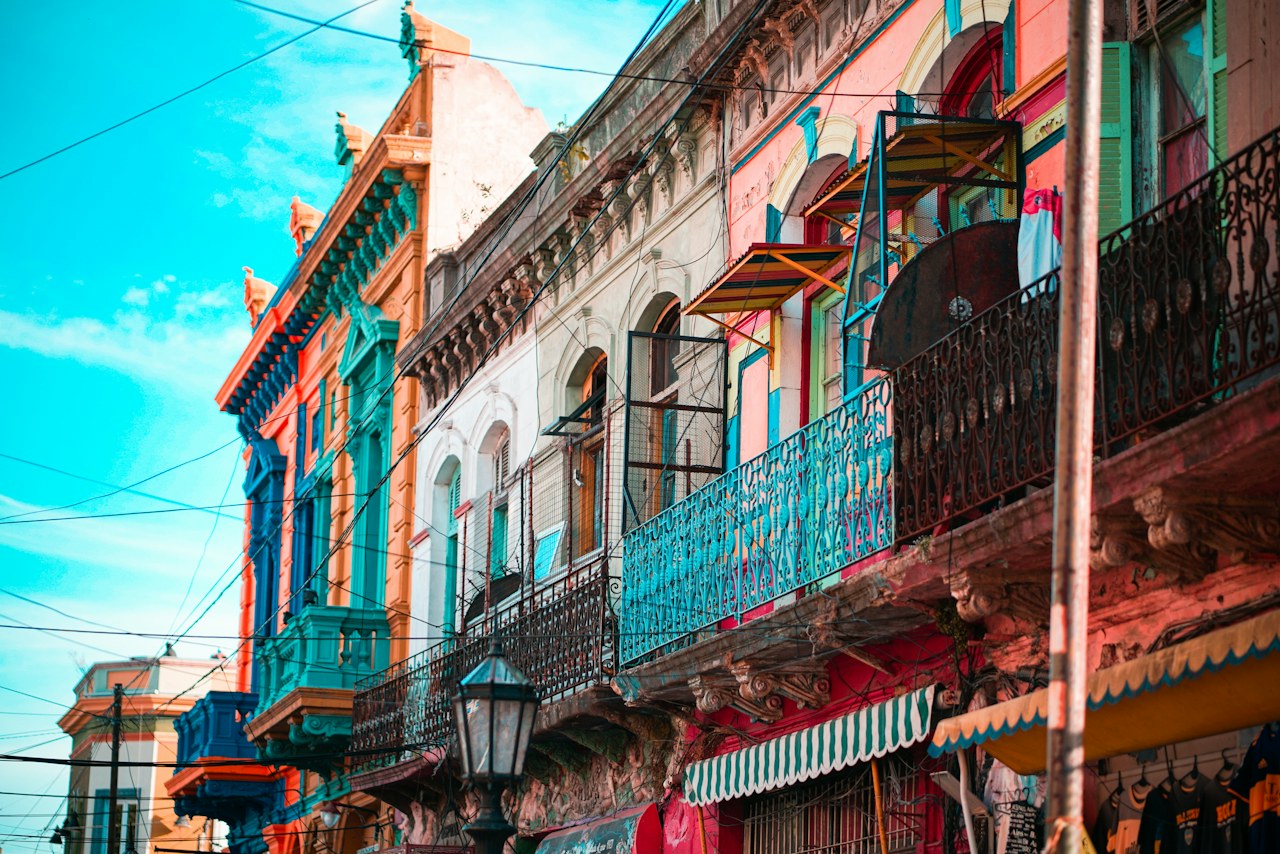
Caminito is the most concentrated burst of color in South America — corrugated zinc tenements (conventillos) painted in every hue by early Genoese port workers are layered with street art, draped laundry, and tango performers. The 100-meter pedestrian alley named after a 1926 tango song by Juan de Dios Filiberto is the single most reproduced street image in Argentina. The combination of flat painted surfaces, balcony sculptures, and live tango dancers creates a layered compositional environment unavailable anywhere else in Buenos Aires.
- GPS: -34.6393, -58.3628
- Elevation: 10 ft
- Best time of day: 10–11 AM on weekday mornings — east-facing facades are warmly lit, tango performers are setting up, and tour-group crush has not yet peaked; late afternoon (4–5 PM) golden hour warms the zinc-clad walls to a rich amber before the area empties
- Sun direction: Buenos Aires is at 34.6°S so the sun arc sweeps through the northern sky. Caminito runs roughly northwest–southeast; in the morning the sun rises in the northeast and lights the south-facing walls first, then tracks north during the day. The iconic painted façades on the northern side of the passage receive direct warm light from mid-morning through early afternoon. Afternoon from 3 PM onward the sun descends toward the northwest, casting warm raking light on both sides of the narrow passage and creating deep shadows on balconies. In austral winter (June–July) the lower sun angle exaggerates texture and saturates the painted zinc even at midday.
- Access: Caminito, La Boca, Buenos Aires. No subway reaches La Boca — take Bus 29 from Retiro or Corrientes Avenue directly to Caminito, or a taxi/Cabify. From San Telmo it is a 25–35-minute walk through transitional neighborhoods; most visitors take transport directly. Caminito is a pedestrian street open 24 hours as public space; meaningful activity runs 10 AM–6 PM when galleries, artists, and performers operate. No entry fee. Nearest parking at Av. Pedro de Mendoza near Caminito.
- Difficulty: easy
- Recommended settings: Morning Warm Light: f/8, 1/250 sec, ISO 200, 35mm · Golden Hour Facades: f/8, 1/125 sec, ISO 400, 24mm · Street Candid Tango: f/2.8, 1/500 sec, ISO 800, 85mm · Overcast Flat Light: f/8, 1/100 sec, ISO 400, 16mm
Shots to chase:
- Symmetrical wide-angle shot from the center of the alley toward the far end, with the painted balconies converging as leading lines and a tango couple framed in the middle ground
- Close-up telephoto compression of layers of colored zinc walls, flaking paint textures, and hanging laundry — look for color contrasts (vivid yellow next to cerulean blue)
- Low-angle shot from street level with a tango dancer’s feet and legs as foreground and the iconic balcony with painted figures visible above
- Shoot across the Riachuelo waterfront from the dock near the Proa Foundation for a wider establishing shot of the neighborhood with the old Transporter Bridge (Puente Nicolás Avellaneda) in the background
- Early morning before 10 AM: the street is nearly empty and the overhead light gives clean, shadow-free rendition of the façade colors — ideal for architecture purists
Pro tip: Arrive by 10:30 AM on a Tuesday or Wednesday for minimum tour-group presence — by noon the alley is packed. Photograph from the center of the street at around knee height: this eliminates the crowds at eye level while keeping the painted walls and sky cleanly composed. The most photogenic block is the intersection of Caminito and Magallanes Street (corner of Dr. Del Valle Iberlucea and Magallanes) where the most famous balcony with figures stands. Keep equipment discreet and do not wander beyond the tourist zone — the surrounding blocks are not tourist-safe.
Common mistake to avoid: Coming in the middle of the day during peak summer (January–February) when the heat is intense, the crowd overwhelming, and harsh overhead sun creates ugly shadows on the facades. Using a very wide lens (14mm) which distorts the flat painted buildings into trapezoids. Leaving immediately after photographing the painted walls — the Riachuelo waterfront two blocks south offers wider, less crowded compositions.
2. Plaza de Mayo & Casa Rosada
Plaza de Mayo is the symbolic heart of Argentina — the site of the country’s founding, Evita’s most famous balcony speeches, and the Mothers of the Plaza de Mayo protests. The Casa Rosada (Pink House), with its distinctive baby-pink Eclectic style, is both the seat of executive power and one of the most photographed buildings in South America. The plaza also frames the Cabildo (Baroque, 1725) and the neoclassical Buenos Aires Metropolitan Cathedral — three centuries of Argentine history composable in a single wide-angle frame.
- GPS: -34.6084, -58.3724
- Elevation: 49 ft
- Best time of day: blue hour — 20–25 minutes after sunset when the Casa Rosada’s baby-pink Eclectic Neoclassical facade is floodlit against a deep cobalt sky; early morning for empty-square compositions before the political crowds and security barriers change the space
- Sun direction: Plaza de Mayo is oriented east–west. The Casa Rosada faces east, toward the Río de la Plata. At sunrise the facade is frontally lit by the rising sun from the east-northeast, producing warm golden light directly on the pink stone — the single best natural-light window of the day, roughly 20 minutes after sunrise from October through March. By mid-morning, the sun has tracked north and the facade transitions to flat, even northern light. At sunset in summer the sun sets well to the northwest (~310°), casting warm sidelight on the Casa Rosada’s lateral elevations. In winter the sun arcs far to the north, and the facade receives low-angle northern light all day.
- Access: Plaza de Mayo, Monserrat neighborhood, Buenos Aires. Subte (subway) Line A to Plaza de Mayo station (Hipólito Yrigoyen and Defensa intersection) or Line D/E to various nearby stops. Multiple bus lines (29, 64, 86, 91, 130) run to Plaza de Mayo. Plaza is a public open space, open 24 hours. Casa Rosada exterior free to photograph; guided interior tours bookable at casarosada.gob.ar (free, by appointment).
- Difficulty: easy
- Recommended settings: Blue Hour Tripod: f/11, 6 sec, ISO 100, 24mm · Sunrise Golden Facade: f/8, 1/250 sec, ISO 200, 50mm · Overcast Wide Angle: f/8, 1/125 sec, ISO 400, 16mm · Telephoto Detail Pink: f/5.6, 1/500 sec, ISO 200, 200mm
Shots to chase:
- Blue-hour long exposure from the pyramid in the center of the plaza with the Casa Rosada floodlit behind and the white Pirámide de Mayo as a foreground anchor
- Sunrise front-on shot of the Casa Rosada with warm golden light saturating the pink facade — use a 50mm at about 80 meters distance for natural perspective
- Wide-angle including all three historic buildings: Cabildo on the left, Cathedral on the right, Casa Rosada at the far east — only possible from the western edge of the plaza
- Mothers of the Plaza de Mayo protest circles painted on the ground with Casa Rosada in the background — a documentary/symbolic composition unique to this square
- At night during special events (national holidays, elections), the Casa Rosada is spectacularly illuminated in the Argentine flag colors of light blue and white — wide-angle tripod shot from the opposite (western) end of the plaza
Pro tip: Arrive 30 minutes before sunrise for empty-plaza compositions — by 8 AM there are tour groups and commuters. The best blue-hour position is approximately 100 meters west of the Casa Rosada along the central axis of the plaza, framing the entire pink facade with the pyramid in the foreground. Security fencing is occasionally installed for political events; check news before visiting. On national holidays (May 25, July 9) the plaza fills with flag-waving crowds — excellent street photography but difficult architecture compositions.
Common mistake to avoid: Photographing the Casa Rosada exclusively from the east (from the waterfront/Puerto Madero direction) — the rear façade is less photogenic. Arriving at midday when the plaza is flooded with overhead light that washes the pink color to near-white. Forgetting that the Cabildo is only a few steps to the west and the Cathedral a few steps to the north, and that combining all three in one frame is only possible from specific positions.
3. Recoleta Cemetery
Recoleta Cemetery is one of the world’s great necropolises — 4,691 elaborate vaults and mausoleums in French Beaux-Arts, Art Nouveau, Art Deco, Neo-Gothic, and Neoclassical styles crowd narrow cobblestone alleys over 5.5 hectares. The resting place of Eva Perón (Duarte family vault) draws pilgrims and tourists alike, but the photographic richness is in the decaying grandeur of the surrounding mausoleums: bronze doors with green patina, weeping marble angels, stained-glass rose windows, and dense layering of ornament over 200 years of construction.
- GPS: -34.5881, -58.3931
- Elevation: 82 ft
- Best time of day: morning 8–10 AM for soft raking light through the narrow passages and minimal crowds; late autumn/winter afternoons (3–5 PM) for long directional shadows that emphasize the carved stone textures of the mausoleums
- Sun direction: The cemetery is oriented with its main entrance on Junín Street (eastern side). The sun rises to the east-northeast in summer and tracks through the northern sky — because of the 34.6°S latitude, noon sun sits due north and well overhead. In winter, the low northern arc gives dramatically raking light that cuts deep into the passage alleys and throws sharp shadows from the ornate finials and crosses. The narrow internal passages run in multiple orientations; the north–south alleys catch the most dramatic directional light in winter mornings. Summer sun is near-vertical at noon; early morning and late afternoon are essential for textured, three-dimensional rendition of the carved marble.
- Access: Junín 1760, Recoleta, Buenos Aires. Subte Line H to Las Heras station (short walk) or Line D to Facultad de Medicina. Buses 17, 110, 124 serve the area. Free admission, open daily 8 AM–6 PM (extended to 7 PM in summer). Free guided tours in English on Tuesdays and Thursdays at 11 AM; in Spanish multiple times daily. No tripod prohibition but should not obstruct narrow passages. Photography of mourning families or active funerals is discouraged.
- Difficulty: easy
- Recommended settings: Morning Passage Light: f/8, 1/250 sec, ISO 400, 24mm · Close Up Stone Texture: f/4, 1/500 sec, ISO 200, 100mm macro · Wide Alley Compression: f/11, 1/125 sec, ISO 400, 16mm · Low Light Interior Mausoleum: f/2.8, 1/60 sec, ISO 1600, 24mm
Shots to chase:
- Wide-angle shot down one of the narrow main alleys toward a monumental gateway with the mausoleums stacked on both sides creating an architectural canyon — best with winter morning light raking across the facades
- Detail shot of a weeping angel with deeply eroded marble face, using a telephoto lens at f/4 to separate the sculpture from the ornate background
- Tight frame on the green bronze door of a mausoleum with the reflection of sky or neighboring tombs visible in the tarnished metal
- Classic Eva Perón grave composition: the small engraved name ‘Eva Perón’ on the black marble of the Duarte family vault with flowers left by visitors — 85mm portrait lens
- Shoot upward from a passage intersection with tombs and crosses against the sky — use a 24mm tilted slightly up for drama
Pro tip: Arrive exactly at 8 AM when the gates open on weekday mornings for near-complete solitude — by 10 AM tour groups dominate the main alleys. The Eva Perón vault is on a side alley roughly in the center of the cemetery; staff will direct you. Spend at least 90 minutes — the back sections of the cemetery receive few visitors and contain some of the most atmospheric decaying 19th-century mausoleums. A fisheye or 14mm lens used carefully can capture the full height of the taller mausoleums from within the narrow passages. Overcast days produce excellent even light that reveals carved stone textures without harsh shadows.
Common mistake to avoid: Spending all time at the Eva Perón vault (a modest tomb photographically) and missing the far interior where the most dramatic and decayed architecture is concentrated. Leaving before 5 PM on a winter afternoon — late-afternoon light in the western passages is particularly golden. Underexposing because auto-metering averages the bright white marble, which should be checked against a histogram.
Want this in your pocket on the street?
The full-resolution version of every spot above — with full-page hero photography, GPS maps with gold location pins, sun direction diagrams, multi-season tables, and a complete safety + packing checklist — is inside the Buenos Aires Ultimate Photographer’s Guide PDF ($47). Print it, save it offline, take it on the walk. Get the guide →
4. Palermo Bosques — Parque Tres de Febrero
Buenos Aires’ answer to New York’s Central Park, Palermo Bosques covers 400 hectares with inter-connected lakes, the famous Rosedal rose garden (over 18,000 rosebushes in 1,000+ varieties), the Planetarium Galileo Galilei, and the Japanese Garden. During October–November, the jacaranda trees that line the avenues and cluster throughout the park burst into full violet bloom — a seasonal transformation so dramatic it has made Buenos Aires internationally famous as the ‘City of Jacarandas.’ The artificial lakes provide glassy reflections of the surrounding trees and the Italianate pavilions.
- GPS: -34.5733, -58.4147
- Elevation: 49 ft
- Best time of day: October–November for jacaranda bloom — the entire park is carpeted in fallen violet blossoms and the canopies glow purple-blue; early morning (7–9 AM) for mirror-calm lake reflections before wind disturbs the water
- Sun direction: The park lies in the northern Palermo neighborhood; the main rose garden (Rosedal) and lakes face open sky with no large obstructions. At 34.6°S the sun tracks through the northern sky, so the southern shores of the lakes have clear unobstructed views north — light on open water is good for reflections throughout the day. The Planetarium Galileo Galilei at the park’s east edge is best photographed from the west to catch the northern sun arc on its dome face. In October–November jacaranda season, backlit trees at golden hour are particularly spectacular against violet-carpet foregrounds.
- Access: Av. Infanta Isabel, Palermo, Buenos Aires. Subte Line D to Plaza Italia station (5-minute walk to park entrance). Buses 10, 37, 64, 67 serve the park perimeter. Park open daily, free access. Rosedal (Rose Garden) open Tuesday–Sunday. Planetarium: inside the park at Av. Sarmiento and B. Roldán; nighttime events bookable at planetario@buenosaires.gob.ar.
- Difficulty: easy
- Recommended settings: Jacaranda Bloom Wide: f/8, 1/250 sec, ISO 200, 24mm · Lake Reflection Morning: f/11, 1/125 sec, ISO 100, 35mm, tripod · Rose Garden Macro: f/2.8, 1/1000 sec, ISO 200, 100mm macro · Planetarium Night: f/8, 15 sec, ISO 200, 24mm, tripod
Shots to chase:
- Jacaranda avenue shot in October–November: low angle on Av. Figueroa Alcorta or Av. Libertador with fallen violet petals carpeting the road and arching canopies creating a violet tunnel overhead
- Lake reflection at 7–8 AM before wind — a 35mm lens at the southern shore captures the northern treeline reflected perfectly in still black water
- Rosedal garden at golden hour in late November/December when the roses are in peak bloom alongside lingering jacarandas — use a 100mm macro wide open for isolated petal shots
- The Galileo Galilei Planetarium dome against a dramatic sunset or moonrise, shot from the approach walkway with the reflecting pool as foreground
- Couples boating on the lake framed through overhanging willow branches — a classic romantic Buenos Aires composition
Pro tip: The jacaranda peak is typically between late October and mid-November — it varies year to year by 2–3 weeks; check Instagram hashtag #jacarandasBuenosAires for current bloom status. The Rosedal holds its peak rose bloom in November and again in March–April. Early weekend mornings (6:30–8 AM) are ideal: runners and dog walkers are present but tourist groups have not arrived, and the light on the lakes is spectacular. The Japanese Garden (Jardín Japonés, Av. Casares 2966) adjacent to the park charges a small entry fee but provides excellent composed photography with the red bridge, stone lanterns, and koi-filled ponds.
Common mistake to avoid: Coming at midday in summer when the park is crowded and the overhead sun flattens the lake reflections and bleaches the jacaranda colors. Forgetting to check jacaranda bloom timing — arriving in September (too early) or December (petals largely fallen). Missing the Planetarium, which is photogenic from its south approach particularly at twilight when it is illuminated.
5. Puerto Madero & Puente de la Mujer
Save
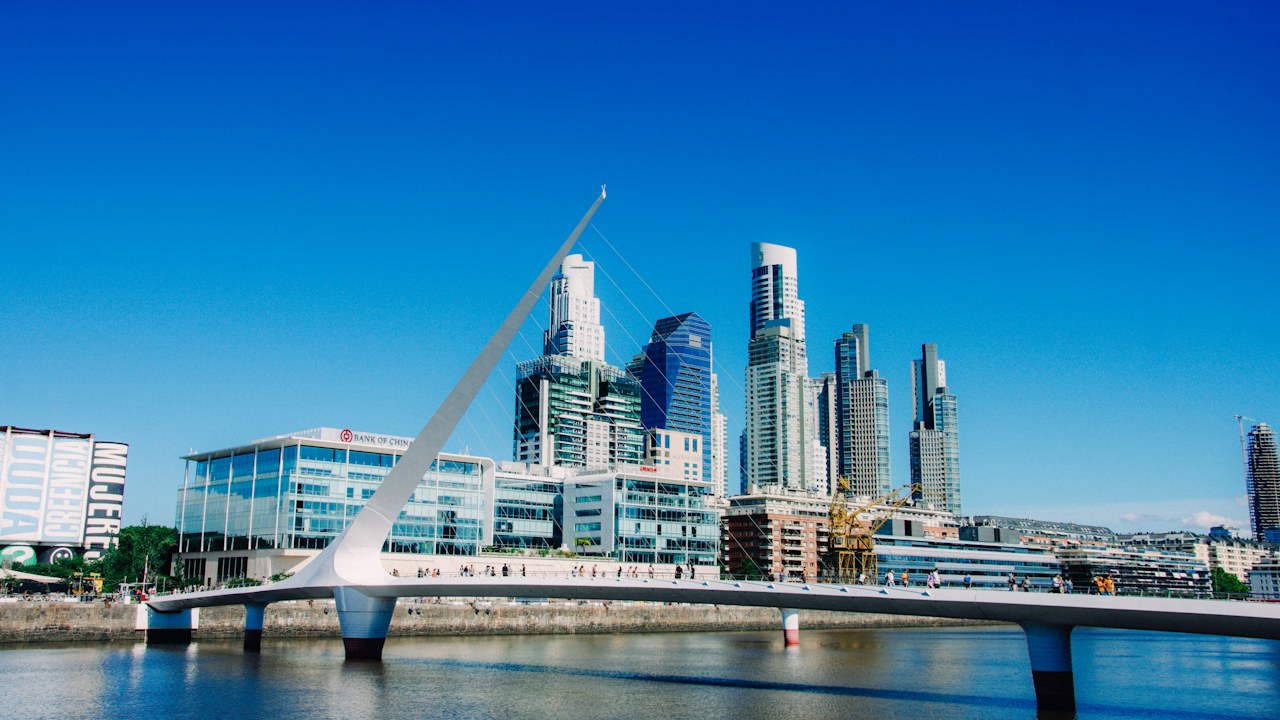
Designed by Santiago Calatrava and opened in December 2001, the Puente de la Mujer is Buenos Aires’s most architectural landmark since the Obelisco. The 170-meter cable-stayed pedestrian bridge with its single 39-meter tilted mast represents a dancing tango couple — the tilted mast as the male, the tensioned walkway as the female. At blue hour, with the Calatrava-white structure reflected in the still dock water and framed by the converted 19th-century red-brick port warehouses and modern skyscraper towers, it produces some of the most technically accomplished cityscape photography in all of South America.
- GPS: -34.6079, -58.3649
- Elevation: 10 ft
- Best time of day: blue hour — 15–25 minutes after sunset when the Puente de la Mujer’s white mast and cable-stayed span glows against deep cobalt, the dock buildings light up, and the modern skyscraper towers of Puerto Madero reflect in Dock 3; cloud-diffused sunsets amplify the drama dramatically
- Sun direction: Puerto Madero’s docks run north–south along the eastern waterfront of Buenos Aires. The Puente de la Mujer spans Dock 3 (east–west orientation) with the mast leaning toward the northwest. At sunset in summer the sun descends toward the northwest (~315°) and casts warm directional light directly onto the white bridge structure from a favorable angle. In winter, the sun sets closer to due west (~270°), still producing warm sidelight. Blue hour comes quickly at this latitude; the transition from warm golden sunset to deep cobalt blue takes only 10–15 minutes — have your tripod set before sunset begins. The skyscrapers to the south of Dock 3 reflect in the still dock water for the classic double-image shot.
- Access: Dock 3, Puerto Madero, Buenos Aires. Puente de la Mujer GPS: -34.607964, -58.365307. Walking distance (15 minutes) from Plaza de Mayo or Microcentro. No subway stops in Puerto Madero directly; take any downtown bus or taxi to the docks. The Puente de la Mujer is a public pedestrian bridge, free and open 24 hours. Parking along Av. Alicia Moreau de Justo. The rotating mechanism allows the bridge to swing 90° for boat traffic — it may be closed to pedestrians briefly when rotating.
- Difficulty: easy
- Recommended settings: Blue Hour Tripod: f/11, 8 sec, ISO 100, 24mm · Golden Hour Ambient: f/8, 1/250 sec, ISO 200, 35mm · Night Long Exposure: f/11, 20 sec, ISO 100, 16mm, tripod · Overcast Day: f/8, 1/125 sec, ISO 400, 50mm
Shots to chase:
- Blue-hour long exposure from the north end of Dock 3 with the Puente de la Mujer’s reflection stretching toward the camera on the still water, skyscrapers lit up on the right
- Symmetrical reflection shot from exactly below the mast, shooting directly south along the bridge axis so the curved walkway and its reflection form a perfect ellipse in the dock
- Wide-angle including one of the converted red-brick dock warehouses on the left and the modern Alvear Icon tower on the right, with the bridge connecting the two eras
- Shoot from across the dock on the eastern side (Reserva Ecológica side) with a telephoto lens to compress the bridge against the glowing Buenos Aires skyline at dusk
- Long exposure of car light trails on Av. Alicia Moreau de Justo with the bridge structure as a static bright element — use a 6-stop ND filter in daylight
Pro tip: Wait for a night when the forecast shows scattered clouds — an all-clear blue-sky dusk is far less dramatic than a sky with cloud formations catching the last pink light above the white bridge. Arrive 45 minutes before sunset to scout positions and set up the tripod before the light fades quickly. The best reflections are from the wooden dock boardwalk on the north side of Dock 3, where the still water is protected from wind by the dock walls. Check the tide — the dock water level affects reflection quality but is generally stable in the enclosed basins.
Common mistake to avoid: Arriving only at golden hour and leaving before blue hour — the best light at Puente de la Mujer comes after the sun has set, not during it. Using a standard zoom lens handheld at night and getting blurry results; a tripod is absolutely required. Shooting only from the pedestrian bridge level itself rather than from the dock level below, which gives the full reflection composition.
6. Teatro Colón
Inaugurated in 1908, Teatro Colón is considered one of the five greatest opera houses in the world, with acoustics ranked equal to La Scala and the Vienna State Opera. The building is an Eclectic palazzo of Italian Renaissance, French Baroque, and Greek Revival elements with a 1,740-seat horseshoe auditorium in crimson and gold. For photography, the interior is extraordinary: a magnificent main auditorium with seven tiers of balconies, a 20-meter dome ceiling with allegorical frescoes by Argentine painter Raúl Soldi, and the ‘Golden Room’ (Salón Dorado) with gilded neoclassical detailing.
- GPS: -34.6011, -58.3831
- Elevation: 62 ft
- Best time of day: interior guided tours 9 AM–5 PM daily — the early morning tours (9–11 AM) have fewest participants for interior shots; exterior facade at blue hour when the Eclectic facade with its Ionic colonnade is beautifully floodlit against the evening sky
- Sun direction: Teatro Colón faces east on Tucumán Street, between Cerrito and Libertad. At Buenos Aires’s latitude the morning sun rises to the northeast and by mid-morning tracks north, providing good light on the east-facing main façade for approximately 2 hours after sunrise. By noon the facade is in shade from the sun’s northern position. The western side on Cerrito Street catches afternoon light. The exterior is floodlit every night; the best exterior photography is at blue hour when the warm floodlighting contrasts with the cooling cobalt sky — typically 20 minutes after sunset.
- Access: Cerrito 628 (main entrance) / Tucumán 1171, San Nicolás, Buenos Aires. Subte Line D to Tribunales station (one block away). Buses 99, 132 pass directly. Guided tours run daily 9 AM–5 PM; tour tickets ~ARS 10,000–15,000/adult (~USD 10–15); book at teatrocolon.org.ar. Photography is permitted on guided tours; tripods are generally not permitted inside during group tours. Professional photo tours are offered on the second Saturday of every month at 11 AM (advance booking required).
- Difficulty: easy
- Recommended settings: Auditorium Interior: f/4, 1/60 sec, ISO 3200, 16mm (fisheye for full dome) · Golden Room: f/4, 1/80 sec, ISO 2000, 24mm · Facade Blue Hour: f/11, 5 sec, ISO 100, 24mm, tripod · Facade Morning Sun: f/8, 1/250 sec, ISO 200, 35mm
Shots to chase:
- Full-dome shot from the center of the auditorium floor looking up: the Raúl Soldi ceiling frescoes and the 7-tier balconies converging toward the central chandelier — use a fisheye or 14mm tilted directly vertical
- From the highest balcony tier looking down into the crimson-and-gold horseshoe of the auditorium — shows the scale and perfect acoustic curvature
- Salón Dorado (Golden Room) wide-angle including the full gilded ceiling, mirrored walls, and chandeliers — works beautifully at ISO 1600 without a tripod
- Exterior facade at blue hour from the Plaza Lavalle side: the full Eclectic colonnade and dome lit against deep cobalt with the plaza fountain and trees as foreground
- Detail shot of the atlante (male caryatid) sculptures by Troiano Troiani flanking the main entrance — dramatic low-angle upward view with a 35mm
Pro tip: Book the dedicated photography tour held the second Saturday of each month at 11 AM (palaciobarolotours.com.ar for crossover; Teatro Colón directly at teatrocolon.org.ar) — this provides access to otherwise-restricted areas and allows tripods. For standard guided tours, arrive at the 9 AM opening for the smallest groups. Bring a fast wide-angle lens (f/2.8 or faster) and raise ISO to 3200–6400 for interior shots — tripods are generally not permitted during group tours. The exterior is freely photographable 24 hours from the surrounding streets; the Libertad Street east-facing facade receives the best morning light.
Common mistake to avoid: Relying on a kit zoom lens (f/3.5–5.6) for interior shots — the combination of high ceilings, dim lighting, and no-tripod rules makes fast glass essential. Photographing only the auditorium dome and missing the Salón Dorado, the Petit Salon, and the backstage areas, which have distinctive architectural character. Missing the exterior at blue hour by leaving the area before sunset.
7. Café Tortoni
Established in 1858 by a French immigrant named Touan, Café Tortoni is the oldest coffeehouse in Argentina and a UNESCO Intangible Cultural Heritage candidate. The interior has barely changed in 165 years: dark carved mahogany paneling, antique mirrors, Belle Époque stained-glass ceiling panels, marble-topped tables, and walls covered with photographs and charcoal portraits of the writers, artists, and politicians who gathered here — Jorge Luis Borges, Carlos Gardel, Albert Einstein, Federico García Lorca, and Benito Mussolini among them. The basement boasts a secret tango milonga venue.
- GPS: -34.6087, -58.3781
- Elevation: 49 ft
- Best time of day: 8–9 AM on weekday mornings — the café opens at 8 AM, there is almost no queue, the interior light is warm and atmospheric, and the historic stained-glass ceiling is softly illuminated; avoid after 11 AM when tourist queues extend down the street
- Sun direction: Café Tortoni is an interior location. The café fronts Avenida de Mayo, running east–west; the main entrance faces south onto the avenue. Natural light enters through the stained-glass art nouveau skylights in the ceiling, diffused and warm throughout the day. The side windows along Avenida de Mayo facing north admit directional morning light in summer and winter alike. For the best atmospheric interior light, early morning (8–9 AM) before the overhead electric lights are fully compensated by service activity gives the most photogenic warm-toned ambient look.
- Access: Avenida de Mayo 825, Monserrat, Buenos Aires. Subte Line A to Perú station (2-minute walk) or Piedras station. Buses 2, 24, 50, 56 run along Avenida de Mayo. Open daily 8 AM–10 PM. Entry is free but you must purchase food/drinks; espresso from ARS 1,000. Long queues form after 10 AM; reservations recommended for peak hours. The downstairs tango venue (peña/milonga) requires separate ticket booking.
- Difficulty: easy
- Recommended settings: Interior Ambient Handheld: f/2.0, 1/80 sec, ISO 1600, 35mm · Stained Glass Ceiling: f/4, 1/125 sec, ISO 800, 24mm (tilted up) · Table Detail Still Life: f/2.8, 1/200 sec, ISO 400, 50mm · Facade Exterior: f/8, 1/250 sec, ISO 200, 35mm
Shots to chase:
- Shoot straight up from below the stained-glass ceiling panels: the geometric art-nouveau leaded glass catches the overhead light beautifully and frames the ornate carved moldings
- Long shot from the far end of the main room toward the bar, with the mahogany panels, mirrors, and tables receding in perspective — use 35mm at f/2 to capture the warm ambient atmosphere
- Portrait of a waiter in traditional black-and-white uniform framed in one of the antique beveled mirrors with the marble bar behind
- Still-life composition: a cortado coffee in a porcelain cup on a marble tabletop with a stack of literary books and the blurred warm interior light behind
- Exterior facade on Avenida de Mayo at night when the ornate Neo-Baroque facade is lit and the blue street-level awning glows — shoot from across the avenue at 50mm
Pro tip: Arrive at 8 AM sharp when the café opens — the first 45 minutes are the quietest and most photogenic. Request a table in the main salon rather than the side rooms to access the stained-glass ceiling and mirrors. Bring a fast 35mm or 50mm prime at f/1.8 or f/2 — the interior light is atmospheric but low, and flash is both disruptive and aesthetically inappropriate here. The basement tango shows are only bookable in advance; they run Thursday–Sunday evenings and provide a dramatically lit performance space for tango photography.
Common mistake to avoid: Arriving after 11 AM and facing a 40-minute queue on the sidewalk. Using flash, which destroys the warm incandescent patina of the interior and produces flat, touristic-looking images. Staying only 15 minutes — the interior rewards slow exploration; the back rooms and side areas have different character from the main salon.
Want this in your pocket on the street?
The full-resolution version of every spot above — with full-page hero photography, GPS maps with gold location pins, sun direction diagrams, multi-season tables, and a complete safety + packing checklist — is inside the Buenos Aires Ultimate Photographer’s Guide PDF ($47). Print it, save it offline, take it on the walk. Get the guide →
8. San Telmo Sunday Market — Feria de San Telmo
The Feria de San Telmo is the largest and most atmospheric Sunday market in Buenos Aires — approximately 300 stalls stretch over 10 blocks of cobblestoned Calle Defensa, selling antiques, leather goods, mate cups, jewelry, and art, while street performers (tango dancers, tumblers, musicians) animate every intersection. The Colonial and 19th-century architecture of San Telmo — iron-balconied town houses, converted conventillos, and the 1897 Mercado de San Telmo — provides an incomparable backdrop. Plaza Dorrego, the market’s heart, fills with antique dealers and becomes the best tango street-performance venue in the city on Sunday afternoons.
- GPS: -34.6213, -58.3699
- Elevation: 49 ft
- Best time of day: Sundays 10 AM–2 PM — vendors are fully set up, street performers are active, and the cobblestone light on Calle Defensa is at its most directional; by 1 PM the crowd energy peaks and antique hunters gather at Plaza Dorrego
- Sun direction: Calle Defensa runs north–south through San Telmo, beginning at Plaza de Mayo in the north and ending at Plaza Dorrego (the antiques hub) approximately 10 blocks south. At 34.6°S the sun tracks through the northern sky, so on a sunny Sunday morning the eastern (right-hand) side of Defensa is lit and the western side is in shadow — this gives natural chiaroscuro framing for market stalls. By midday the sun is due north and relatively overhead, giving flatter light. Golden hour (4–6 PM) from late autumn to spring gives warm angled light down the length of the north–south avenue, ideal for long-perspective market shots. Plaza Dorrego is open and south-facing, so it receives good northern sun all day.
- Access: Calle Defensa from Plaza de Mayo to Plaza Dorrego (approx. Defensa 400–1400), San Telmo, Buenos Aires. Subte Line D to Catedral station (Plaza de Mayo end) then walk south along Defensa. Buses 22, 24, 29, 126 run along nearby streets. The street fair runs Sundays only, 10 AM–5 PM (full activity 11 AM–4 PM; vendors begin dismantling after 5 PM). Free, outdoor, public street event — no entry fee. Cash preferred; most vendors do not accept tourist credit cards.
- Difficulty: easy
- Recommended settings: Street Candid Market: f/2.8, 1/500 sec, ISO 400, 50mm · Tango Performers: f/2.8, 1/1000 sec, ISO 800, 85mm · Market Stall Detail: f/4, 1/250 sec, ISO 200, 35mm · Cobblestone Wide Perspective: f/8, 1/250 sec, ISO 200, 24mm
Shots to chase:
- Wide-angle perspective shot down the full length of Calle Defensa from the north, with market stalls lining both sides of the cobblestones and the crowd receding into the distance — best from an elevated position on a balcony or stepstool
- Tango dancer pair at Plaza Dorrego: use an 85mm at f/2.8 to isolate the dancers against the blurred market crowd, freezing the dip pose at 1/1000 sec
- Close-up still-life composition of an antique stall: old photographs, mate cups, pocket watches, and tango records arranged naturally — 50mm at f/2.8
- Street performer portrait with the 19th-century San Telmo architecture as background — shoot at eye level at 85mm for a clean environmental portrait
- Aerial-style perspective (if you can access a building balcony on Defensa) of the crowd density at peak noon, showing the sheer scale of the market across 10 cobblestone blocks
Pro tip: The best antiques and the best tango performances both concentrate in and around Plaza Dorrego (approximately Defensa 1100–1200) — head there early to stake out a position by 11 AM. A 50mm prime at f/1.8 is the ideal market lens: fast enough for low-light covered stalls, focal length long enough to separate subjects, compact enough not to intimidate vendors. Ask permission before closely photographing individual vendor faces — most are happy to pose, especially if you show genuine interest in their goods. Avoid the northern blocks close to Plaza de Mayo (uninspiring stalls) and push deep south to Plaza Dorrego for the most character.
Common mistake to avoid: Arriving at 10 AM before the market has fully set up (vendors are still unloading) — 11 AM to 1 PM is the peak window. Using a wide-angle zoom in a crowded market without considering background clutter; a short telephoto (50–85mm) gives much cleaner separations. Ignoring the interior of the Mercado de San Telmo building (Defensa 963) which has its own beautifully atmospheric iron-and-glass structure perfect for food and still-life photography.
9. Floralis Genérica
Save
Floralis Genérica is the most technically ambitious public sculpture in Buenos Aires — a 20-meter-tall, 18-tonne aluminum and stainless steel flower whose six petals open each morning and close each evening via a hydraulic photosensor system, making it the world’s largest kinetic sculpture of its type. Gifted to the city in 2002 by Argentine architect Eduardo Catalano, its mirror-polished metallic surfaces reflect the changing Buenos Aires sky with extraordinary visual dynamism. The surrounding Plaza de las Naciones Unidas and its large reflecting pool create the composition.
- GPS: -34.5815, -58.3936
- Elevation: 82 ft
- Best time of day: sunrise — the steel petals open at 8 AM (controlled by a hydraulic photosensor) in a slow, dramatic unfurling that takes about 45 minutes; the chrome-and-aluminum surface catches the first light of day and the reflecting pool mirrors the brightening sky; also strong at sunset when petals begin closing
- Sun direction: Floralis Genérica stands in Plaza de las Naciones Unidas facing northeast, with the reflecting pool extending south. Buenos Aires sunrise in summer is ~5:33–5:45 AM (northeast, azimuth ~60°); in winter ~7:47–8:01 AM (northeast, azimuth ~70°). The sculpture’s metallic petals catch and reflect early morning light spectacularly because the northeast sunrise direction aligns with the petal opening — the first direct sun hits the reflective steel surfaces within minutes of sunrise. The reflecting pool below the sculpture gives a doubled image when the water is still in the early morning calm. At sunset, the petals begin their slow closure; the low northwest sun lights the underside of the petals golden. At night the sculpture is illuminated in red and the petals remain open until midnight.
- Access: Avenida Presidente Figueroa Alcorta 2301 / Plaza de las Naciones Unidas, Recoleta, Buenos Aires. Buses 17, 67, 92, 93, 130 run along Av. Figueroa Alcorta. 10-minute walk from Recoleta Cemetery or from Subte Line H (Las Heras station). The plaza and sculpture are public space, open 24 hours, free. The sculpture’s petals open at 8 AM and close at midnight daily (hydraulic system may close earlier in high winds). The reflecting pool surrounds the sculpture base.
- Difficulty: easy
- Recommended settings: Sunrise Opening Long Exposure: f/11, 1/15 sec, ISO 100, 35mm, tripod (reflection in pool) · Petals Open Midday: f/11, 1/500 sec, ISO 100, 24mm · Detail Reflection Sky: f/8, 1/250 sec, ISO 200, 100mm · Night Illumination: f/8, 8 sec, ISO 100, 24mm, tripod
Shots to chase:
- Sunrise shot from the south edge of the reflecting pool as the petals begin opening, with the nascent warm light reflected in the still water creating a doubled composition
- From directly below the sculpture looking up through the half-open petals at the sky — the steel interior surfaces show the city and clouds reflected in convex mirror form
- Telephoto shot of one reflective petal surface from 50 meters away at 200mm: the distorted wide-angle reflection of the Facultad de Derecho building and the Buenos Aires skyline visible in the convex steel
- Sunset closing sequence: multiple-exposure or burst series documenting the slow petal closure over 30–40 minutes as the western light turns golden, then orange, then red on the metallic surfaces
- Night shot with the sculpture illuminated red against the dark sky, using a 20-second exposure to smooth the reflecting pool surface to a mirror
Pro tip: Arrive 20 minutes before sunrise and position at the south end of the reflecting pool — you’ll have the opening sequence and reflection shot in the same frame as the sky color intensifies. The petal-opening movement is slow (takes about 40–45 minutes from fully closed to fully open); use a tripod and take sequential exposures every 5 minutes to document the process. On public holidays, the petals remain open all night. Bring insect repellent — the low-lying reflecting pool area has mosquitoes especially in summer evenings. Walk around the sculpture fully — each cardinal direction gives a different framing and sky backdrop.
Common mistake to avoid: Arriving mid-morning when the petals are fully open and the sun is directly overhead — the polished surfaces are blown out by the overhead sun and the reflecting pool loses its magic. Photographing only from the single most-obvious south approach; the eastern and western sides give different and often better reflective surfaces depending on sun direction. Missing the night illumination (the red-lit petals from midnight-close mode are quite distinctive).
10. Obelisco — Avenida 9 de Julio
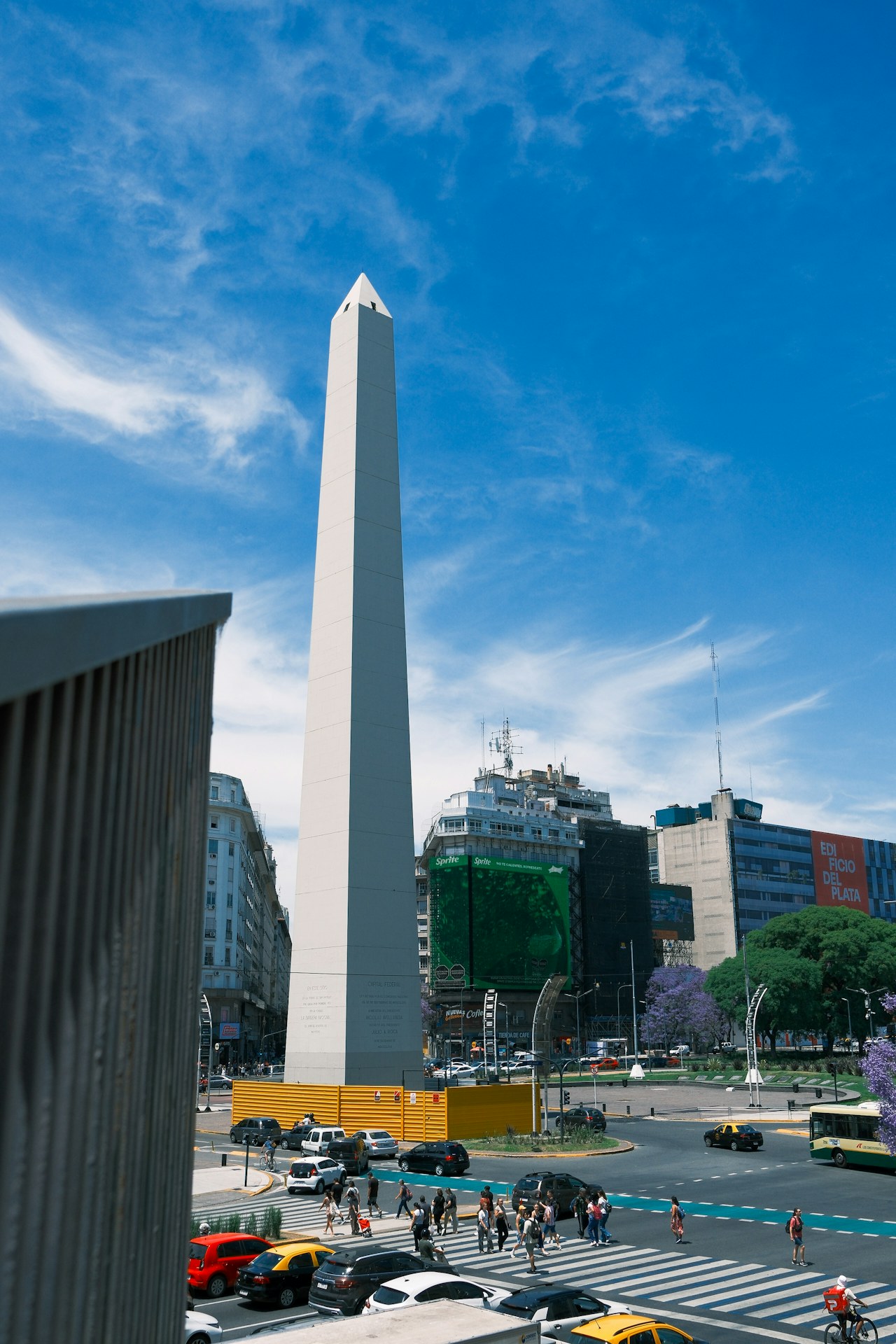
The Obelisco, inaugurated in 1936 to mark the 400th anniversary of the city’s first founding, is the undisputed icon of Buenos Aires — the single structure most associated with the city’s identity. At 67.5 meters it presides over the intersection of the world’s widest avenue and the city’s theater/arts boulevard. For photography, the combination of the white limestone obelisk, the six-lane boulevard creating perspective lines, and the floodlit nocturnal drama makes this the most technically satisfying night-photography subject in the city. October–November jacaranda bloom along Diagonal Norte and Av. Roque Sáenz Peña transforms the entire foreground into violet, making for one of Buenos Aires’s most celebrated seasonal photographs.
- GPS: -34.6038, -58.3818
- Elevation: 59 ft
- Best time of day: blue hour and early night when the Obelisco is dramatically floodlit against the cobalt sky and the boulevard’s six lanes of traffic create red-and-white light trails in long exposure; spring (October–November) when jacaranda trees along adjacent Diagonal Norte bloom in violet
- Sun direction: The Obelisco stands at the intersection of Av. 9 de Julio (running north–south, one of the world’s widest avenues at 140 meters across) and Av. Corrientes. At 34.6°S the sun rises to the northeast and sets to the northwest in summer, tracking through the northern sky. The Obelisco at 67.5 meters is visible from almost every direction. The north-facing view down 9 de Julio toward the Obelisco with its arch of jacarandas is the most photographed perspective from Av. Roque Sáenz Peña. The elevated terrace of Hotel Marriott (former Panamericano), Carlos Pellegrini 551, gives the definitive elevated perspective looking south along the 9 de Julio corridor with the Obelisco and multiple blocks of traffic convergence — best at blue hour. Free elevated viewpoint at the corner of Diagonal Norte and Cerrito (police monitoring building terrace, accessed by asking).
- Access: Plaza de la República, intersection of Av. 9 de Julio and Av. Corrientes, San Nicolás, Buenos Aires. Subte Lines B (Diagonal Norte) and C (Diagonal Norte / 9 de Julio station) both surface within one block. Multiple bus lines serve 9 de Julio and Corrientes. The Obelisco is in a public median plaza; the surrounding sidewalks are open 24 hours. The Obelisco itself is not open for interior climbing. The Hotel Marriott rooftop bar (Carlos Pellegrini 551) requires reservation and/or minimum spend but gives the best elevated view.
- Difficulty: easy
- Recommended settings: Blue Hour Light Trails: f/11, 25 sec, ISO 100, 24mm, tripod · Jacaranda Daytime: f/8, 1/500 sec, ISO 200, 50mm · Telephoto Compression: f/5.6, 1/500 sec, ISO 200, 200mm · Elevated Night Overview: f/11, 15 sec, ISO 200, 35mm, tripod
Shots to chase:
- Blue-hour long exposure from a tripod on the wide median of Av. 9 de Julio looking north: 6 lanes of red/white light trails converging toward the illuminated Obelisco with the cobalt sky behind
- Jacaranda-framed spring shot from Av. Roque Sáenz Peña looking east toward the Obelisco: violet canopy arching overhead as natural leading lines to the white spire
- Elevated view from Hotel Marriott rooftop (Carlos Pellegrini 551) looking south at dusk: the entire 9 de Julio corridor lit up in both directions with the Obelisco at center
- Low-angle abstract looking directly up at the Obelisco from its base: the white limestone tapers symmetrically against the blue sky with the four recessed windows as graphic elements
- The BA topiary sign and the Obelisco in the same frame from an eastern approach angle — using the sculptural letter forms as bold foreground graphic elements
Pro tip: For the light-trail long exposure from street level, use a 24mm lens on a tripod set up on the median strip between the lanes — arrive early to claim a position and use a 2-second timer or remote shutter to avoid camera shake. Exposures of 20–30 seconds at f/11 ISO 100 during blue hour give both light trails and the illuminated obelisk properly exposed. In spring (October–November), check the jacaranda bloom on Diagonal Norte (Av. Presidente Roque Sáenz Peña) which meets 9 de Julio just one block north of the Obelisco — the violet canopy creates spectacular leading lines. Do not cross the 9 de Julio lanes casually; use the official crosswalks at Corrientes and Diagonal Norte.
Common mistake to avoid: Photographing the Obelisco only in daylight when it is a relatively flat white form against a blue sky — the true photographic potential is at night and blue hour. Shooting only from street level without exploring the elevated hotel terrace perspective. Missing the jacaranda season entirely because the bloom peaks for only 3–4 weeks.
11. El Ateneo Grand Splendid
Designed in 1919 by architects Peró and Torres Armengol as a 1,000-seat theater for impresario Max Glücksmann, the Grand Splendid hosted tango legend Carlos Gardel and became the city’s premier entertainment venue before being converted into a bookstore in 2000. The conversion left the entire theater shell intact — seven tiers of balconies, ceiling frescoes by Nazareno Orlandi, crimson stage curtains, and ornate bas-relief moldings — but lined every box and the stalls with bookshelves. The stage itself became a café. National Geographic has described it as the world’s most beautiful bookstore. The theatrical architecture in combination with books creates an image that is simultaneously majestic and intimate.
- GPS: -34.5961, -58.3942
- Elevation: 82 ft
- Best time of day: weekday mornings 9–11 AM — the bookstore is open from 9 AM, early visitors are sparse, the theater box tiers are accessible, and the diffused natural light through the stage-roof skylight provides even, soft illumination on the book-lined tiers; avoid Saturday afternoons when it is extremely crowded
- Sun direction: El Ateneo Grand Splendid is an entirely interior location housed within a former 1919 theater. The building faces north on Av. Santa Fe. Natural light enters via a large skylight above what was the stage area (now a café), which faces south — in the Southern Hemisphere this means the skylight receives diffused, indirect light throughout the day rather than direct sun, providing soft and even illumination ideal for photography. The interior has warm electric illumination from period chandeliers and wall sconces on the seven tiers of theater boxes, now lined with books. The best ambient light balance is midday when the skylight and the interior electric lights balance harmoniously.
- Access: Avenida Santa Fe 1860, Recoleta/Barrio Norte, Buenos Aires. Subte Line D to Callao station (3-minute walk). Buses 12, 37, 41, 59, 60, 92, 108, 124 serve Av. Santa Fe. Open daily 9 AM–9 PM (Sundays 12 PM–9 PM). Free entry as a functioning bookstore. The stage café (La Cúpula) serves coffee and light fare. No tripods during business hours (crowds and space restrictions). Fisheye or ultrawide lens highly recommended.
- Difficulty: easy
- Recommended settings: Interior Wide Full Theater: f/8, 1/60 sec, ISO 1600, 10–14mm fisheye · Tier Balcony Detail: f/4, 1/80 sec, ISO 1600, 35mm · Stage Cafe From Balcony: f/5.6, 1/100 sec, ISO 1600, 24mm · Book Spine Close Up: f/2.8, 1/200 sec, ISO 800, 85mm
Shots to chase:
- The signature shot: from the back of the stalls (ground floor) with a 14mm fisheye or 16mm rectilinear lens looking toward the stage-café, capturing all seven tiers of book-lined boxes converging toward the ornate proscenium and crimson curtains
- From the top tier of one of the balconies looking straight down into the stalls and toward the stage: the circular arrangement of tiers creates a vertiginous downward spiral
- Detail shot of one balcony box: books on the shelves, the original theater-box railing with gilded molding, and the soft light from the stage skylight behind — 50mm at f/2.8
- The stage café from a middle-tier balcony with the coffee tables below and the ornate painted ceiling dome above in the same frame — captures the theater-as-bookstore paradox in one image
- Spine-on close-up of a row of Spanish-language classics with the blurred golden balconies in the background — simple but evocative at f/1.8 on 50mm
Pro tip: Arrive at opening (9 AM on weekdays) for the quietest conditions and best tripod-free shots — by 11 AM on weekends the narrow tiers are full and composing clean shots without strangers is nearly impossible. Bring a fisheye or ultrawide (14mm equivalent) — the theater’s height-to-width ratio makes a 24mm insufficient to capture the full scope of the tiers. Increase ISO to 1600–3200 and shoot at f/4–5.6 to get sufficient depth of field across all seven tiers with a handheld exposure. The stage café requires a food/drink purchase but gives the best elevated view of the entire theater interior from the raised former-stage level.
Common mistake to avoid: Using a 24–70mm zoom and being unable to capture more than 3 tiers in a single frame — the fisheye or 10–14mm range is essential for the full iconic shot. Shooting in JPEG rather than RAW; the high-ISO interior light requires careful post-processing of the warm highlights and shadow details. Coming on a Saturday afternoon when the bookstore is so crowded it is impossible to stop and compose.
When to photograph Buenos Aires: a year-round breakdown
Buenos Aires is photogenic every month of the year — but the conditions differ radically by season. Here is what to expect:
October–November (jacaranda bloom, warm spring light, moderate crowds) and March–May (golden autumn tones, mild temperatures, clear skies with less humidity than summer)
Photographer safety in Buenos Aires: read this
City photography has its own risks: gear visibility, neighborhood timing, traffic, weather. Read the briefing before you go.
- Gear visibility: Use a discreet bag with no obvious camera branding. Keep a body strapped under a jacket on transit.
- Neighborhood timing: Pre-dawn and post-sunset shoots reward early scouting. Cross-reference each location with current local guidance and choose well-lit transit routes.
- Situational awareness: Headphones out. One eye in the viewfinder, one on the street.
- Traffic: Bridges, medians, and bike lanes are not setup zones. Shoot from sidewalks and pedestrian areas only.
- Weather: Summer storms move quickly; winter cold drains batteries. Layer up, keep gear dry, watch for ice on cobblestones at blue hour.
The complete safety briefing is inside the Buenos Aires Photographer’s Guide PDF.
Take this guide into the city
This post is the complete field reference. The Buenos Aires Ultimate Photographer’s Guide PDF is the field-deployable version: full-page resolution hero photography, GPS maps with gold pins for every location, multi-season shooting calendars, gear notes per location, sun-angle diagrams, the full city safety briefing, and a print-ready editorial layout in Framehaus black and gold. Save it offline. Print it. Take it on the walk.
Buenos Aires Ultimate Photographer’s Guide
Downloadable PDF · 11 GPS-mapped locations · Multi-season calendar · City safety briefing · Packing checklist
Get the Buenos Aires guide — $47
Get the Buenos Aires Guide + Preset Pack
Photograph it. Edit it. Done.
All links go to Viator (a TripAdvisor company), the world’s largest marketplace for guided experiences. Tagged as affiliate per FTC.
Quick Amazon shortcuts to the gear most useful for this kind of shot. Use them if Prime shipping or Amazon credit makes more sense than B&H. As an Amazon Associate ShutYourAperture earns from qualifying purchases.
Take Buenos Aires home in your pocket.
Every shot location, every angle, every time of day worth shooting. Printable PDF + GPS-tagged map.
Instant download. Works on phone, tablet, and printed.
Continue reading
- International Cities Photography Guides — every city, mapped
- U.S. Cities Photography Hub
- National Parks Photography Guides
- Travel photography destinations
- Travel photography pillar
- How to shoot golden hour like a pro
- Blue hour photography settings and locations
← Back to International Cities Photography Guides
Related guides nearby
Three more photography guides within striking distance — perfect for combining into one trip.
- Rio De Janeiro 1962 km away · city · Brazil
- Cusco 2718 km away · city · Peru
- Cartagena 5324 km away · city · Unknown
The complete Buenos Aires guide is $47
All vantage points above + 5 bonus secret spots, printable map, gear pack list, and editing recipes. One-time payment, instant download, lifetime updates.
Common questions about the Buenos Aires guide
Is the Buenos Aires photography guide worth $47?
For most photographers, yes. The guide saves 8-12 hours of trip-planning research and prevents the most common mistake of Buenos Aires photography: shooting at the wrong time of day. If a single better frame is worth $47 to you, the guide pays for itself on day one. Buyers get every GPS coordinate, every golden-hour window, every cultural rule, and a printable shot list.
Does the Buenos Aires guide include GPS coordinates?
Yes — every vantage point in the guide has Google Maps-ready GPS coordinates so you can pin them before you fly. The guide also includes a printable map showing all locations clustered by walking distance, so you can build efficient half-day routes.
What's in the Buenos Aires PDF that isn't in this article?
The article shows the highlights. The PDF includes: 5 additional secret spots not published online, a 14-day itinerary with daily routes, the full camera-settings cheat sheet for every scenario in Buenos Aires, a printable gear packing list, post-processing recipes with screenshot examples, and a list of local guides we trust for portrait commissions.
Do I get the Lightroom presets too?
The $47 guide is the PDF only. The matching Buenos Aires preset pack is a separate $19 download — most buyers grab both as a bundle and save the editing time. Both are instant download, both work on Lightroom Classic and Lightroom Mobile.
Will the guide work for a Buenos Aires trip in 2026?
Yes. The guide is updated annually as fees, restrictions, and new vantage points change. All buyers get free lifetime updates. The 2026 edition includes the latest drone rules, museum photography policies, and seasonal light data for the year.
Visiting more than Buenos Aires?
Bundle multiple destination guides and save planning time across the trip:
- Rio de Janeiro Photographer’s Guide ($47)
- Mexico City Photographer’s Guide ($47)
- Cartagena Photographer’s Guide ($47)
- Cusco Photographer’s Guide ($47)
Or get all 60+ destinations in one bundle: Photo Atlas — every guide, every map, $97.