Best Photography Spots in Marrakech: 11 Locations With GPS
edinchavez01-20). Buying through these links costs you nothing extra and helps fund our free guides.
Marrakech, Morocco is one of the most photogenic cities in the world. If you have a camera and the patience to show up before dawn, Marrakech will give you images that last a career — but only if you know where and when to point it.
This is the definitive field guide to the 11 best photography spots in Marrakech, with GPS coordinates you can drop straight into Google Maps, exact camera settings tuned to Marrakech’s unique light, precise timing for every location, and the access notes nobody else bothers to document. It mirrors the intel inside our Marrakech Ultimate Photographer’s Guide ($47 PDF) — a downloadable field guide with full-page hero images, GPS maps, seasonal tables, a city safety briefing, and a complete photographer’s packing list. Get the guide →
Planning multi-city travel? See also: U.S. cities photography hub and the National Parks Photography Guides.
11 GPS-mapped locations · Exact camera settings · Multi-season shooting calendar · Free annual updates
Download the PDF guide →
Get the Marrakech Ultimate Photographer’s Guide
Every location below — pre-mapped with GPS, golden-hour timing, gear recommendations, cultural rules, and a 14-day itinerary. Downloaded by 200+ working photographers.
Quick jump to the 11 spots
- Jemaa el-Fnaa — Café Glacier Rooftop
- Koutoubia Mosque — Gardens and East Esplanade
- Ben Youssef Madrasa — Courtyard
- Jardin Majorelle + YSL Museum
- Bahia Palace — Grand Courtyard and Harem Garden
- Saadian Tombs
- Souk Semmarine — Covered Market Alleys
- Marrakech Tanneries — Bab Debbagh Quarter
- Menara Gardens — Reflecting Pool and Pavilion
- Le Jardin Secret — Islamic and Exotic Gardens
- Mellah — Jewish Quarter and Place des Ferblantiers
A look inside the Marrakech Photographer’s Guide
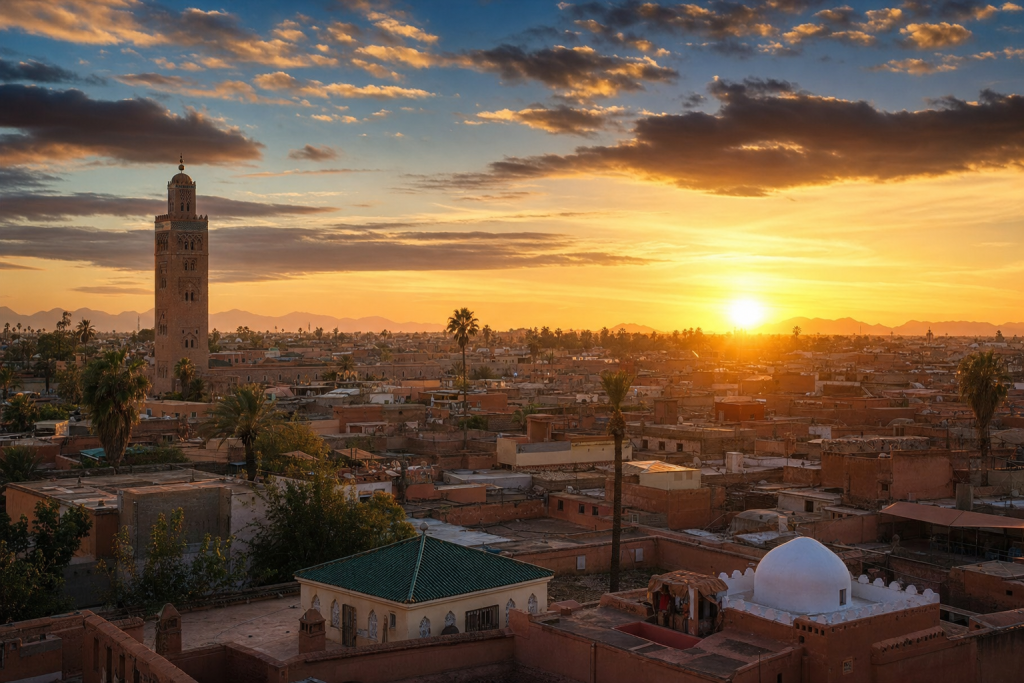
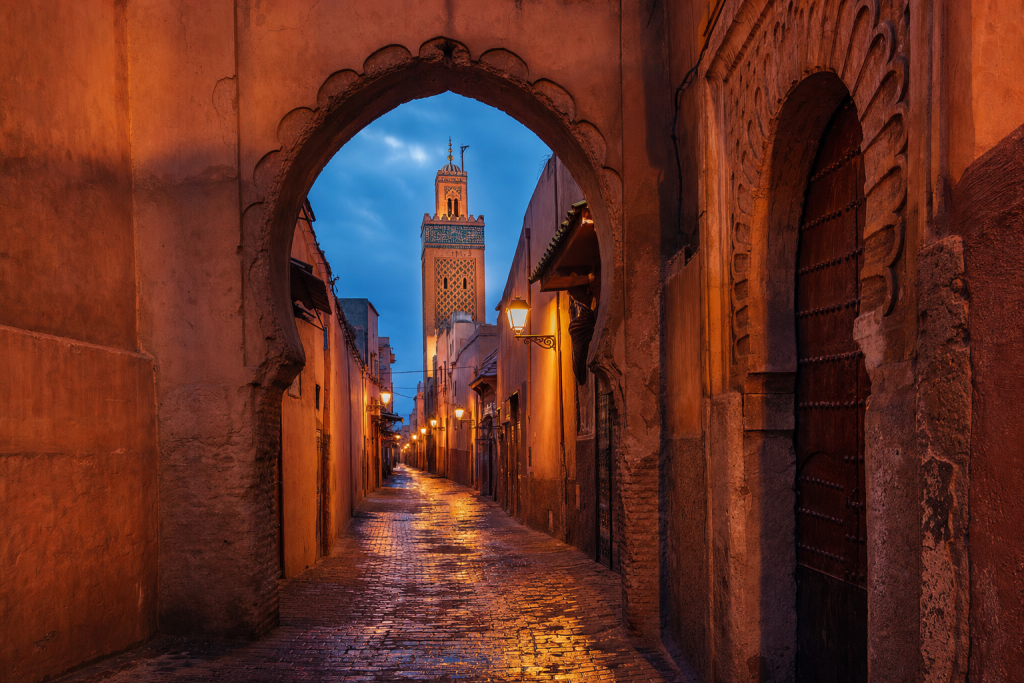
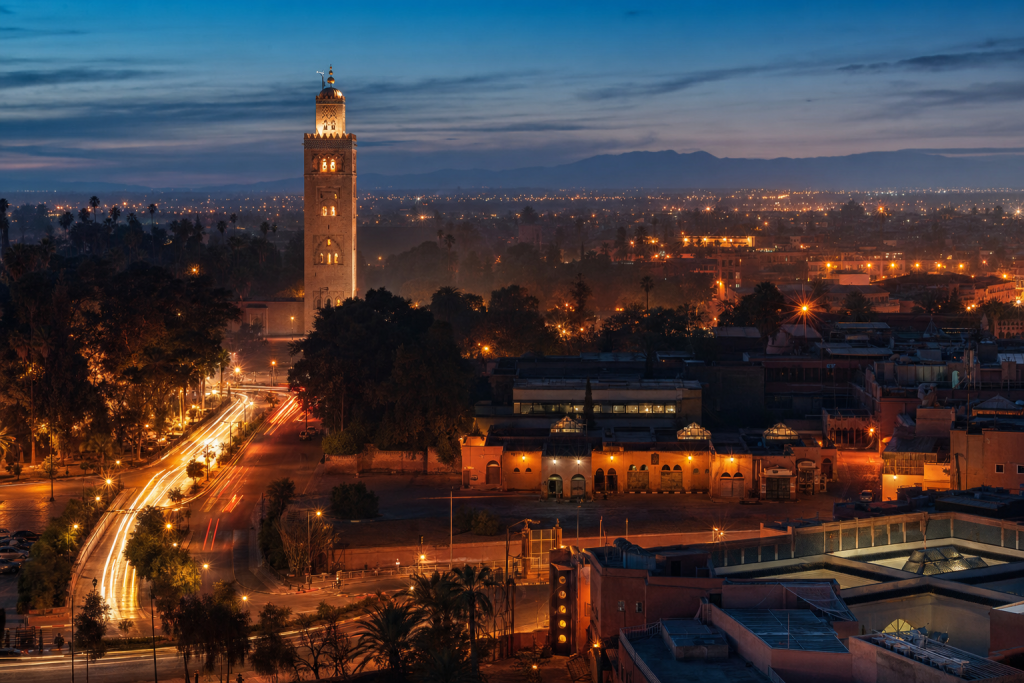
Here are three of the actual shots you’ll find inside the PDF — cinematic full-page references for the exact spots, lenses, and lighting conditions documented in the guide. The full guide includes 11 locations, each with a hero image, GPS map, settings table, and a five-shot list.
Save
Before you shoot Marrakech: the essentials
- Free public access: Jemaa el-Fnaa square, Koutoubia Mosque gardens (exterior), Mellah Jewish Quarter streets, Place des Ferblantiers, and medina walls are free; Souk Semmarine is free to walk through. Bahia Palace 100 MAD/adult; Saadian Tombs 100 MAD/adult; Ben Youssef Madrasa 50 MAD/adult; Majorelle Garden 170 MAD/adult (online advance booking mandatory, no gate sales); YSL Museum 140 MAD/adult; Le Jardin Secret 100 MAD/adult; Menara Pavilion 60 MAD (garden free); Dar el Bacha Museum 60 MAD/adult (free Fridays for all). All fees as of 2025.
- Commercial permits: Personal and tourist photography in all public spaces and souks is unrestricted. Non-Muslims are not permitted to enter the interior of active mosques, including Koutoubia — photograph the exterior, minaret, and surrounding gardens only. Always ask permission before photographing individuals, especially in the medina and souks; a small tip or nominal payment is customary when agreement is given, particularly for performers in Jemaa el-Fnaa. Commercial shoots and tripod use inside Majorelle Garden and Le Jardin Secret require prior written authorization from management. Drones are restricted over the medina and require CAA Morocco (DGAC) authorization.
- Best photography seasons: October–November (clear post-summer skies, Atlas Mountains snow-capped backdrop, mild heat, lower crowds) and March–April (spring light, flowering gardens, moderate temperatures before peak tourist season)
- Blue hour notes: Marrakech sits at 31.63°N — the sun arc is high in summer but still tilts significantly southward compared to Europe. Blue hour lasts 15–25 minutes after sunset. In summer, sunset is around 8:15 PM; in winter, around 5:45 PM. The terracotta and ochre medina walls absorb warm light beautifully at golden hour, then shift to deep amber under blue-hour sky. Jemaa el-Fnaa, Koutoubia Mosque gardens, and Menara Gardens are the most rewarding blue-hour locations.
- Drone policy: Drone laws vary widely by country and city — many capital and tourist zones are no-fly. Verify the local civil aviation authority’s current rules before launching.
- Local resource: Official visitor information
The full-resolution version of every map below — plus seasonal calendars, gear notes per location, sun-angle diagrams, and a complete photographer’s packing checklist — is inside the Marrakech Photographer’s Guide PDF ($47).
1. Jemaa el-Fnaa — Café Glacier Rooftop
Jemaa el-Fnaa is one of the world’s great public squares — a UNESCO-listed Intangible Cultural Heritage site that morphs from a daytime market of snake charmers, acrobats, juice vendors, and henna artists into an enormous open-air restaurant and entertainment arena at night. The visual density is extraordinary: dozens of billowing food tents illuminated by bare bulbs, smoke rising from charcoal grills, and the silhouette of the Koutoubia minaret punctuating the western sky. The rooftop vantage compresses this into a single frame that no ground-level photograph can replicate.
- GPS: 31.6255, -7.9889
- Elevation: 1,520 ft
- Best time of day: Sunset and blue hour — arrive 45 minutes before sunset to claim a table at Le Grand Balcon du Café Glacier; the square transforms as food stall tents go up and lanterns ignite in the dusk; full night shooting captures long-exposure light trails and the chaos of vendors below
- Sun direction: The square is open and roughly circular; shooting from the north-facing rooftop of Café Glacier puts the camera looking south-southwest. In summer the sun sets to the northwest (~300°) and lights the square from the right side of the frame in warm orange; in winter it sets more westerly (~250°), producing side-rim lighting across the stalls. At Marrakech’s latitude of 31.63°N the midday sun is almost directly overhead in summer — avoid midday shooting; golden hour (45 min before sunset) is the sweet spot when the entire square is bathed in pink-amber.
- Access: Jemaa el-Fnaa is the central hub of the medina; walking distance from any riad in the old city. Petit taxis from Gueliz (new town) cost 20–30 MAD. No fee for the square itself. Rooftop cafe access: purchase a drink or tea at Le Grand Balcon du Café Glacier (minimum order ~30–40 MAD); arrive well before sunset (3:30–4 PM) to secure a front-row edge table. Ground level: free access 24 hours.
- Difficulty: easy
- Recommended settings: Blue Hour Rooftop Overview: f/8, 1/60 sec, ISO 800, 24mm, tripod or table stabilization · Night Food Stalls Long Exposure: f/11, 8 sec, ISO 100, 24mm, tripod · Golden Hour Crowd Action: f/5.6, 1/500 sec, ISO 400, 70mm · Street Level Low Light: f/2.8, 1/200 sec, ISO 3200, 35mm, silent shutter
Shots to chase:
- Wide-angle rooftop overview from Café Glacier at blue hour with the square’s illuminated food tents forming a sea of warm light against the cobalt sky, Koutoubia minaret visible on the left horizon
- Long-exposure from the rooftop showing light trails from motorbikes cutting across the square perimeter while food stalls remain sharp in the foreground
- Ground-level candid at waist height using the rear LCD screen — juice stall pyramid of oranges as foreground, crowd activity blurred in the background at 1/30 sec
- Telephoto compression (200mm) from the rooftop pulling the distant Koutoubia minaret into the same focal plane as the nearest food stalls, creating a layered city-within-city composition
- Pre-sunset shot from ground level looking up at the acrobatic performers with the pale blue sky and minaret behind them, shot at f/8 with fast shutter to freeze the action
Pro tip: Arrive at Café Glacier by 3:30 PM on weekdays to guarantee a prime front-edge table — by 5 PM it is standing-room only. The square is most photogenic during the 30-minute transition window when the sky still holds a deep cobalt blue but the food stall lights have come on — approximately 20 minutes after sunset. At ground level, a mirrorless camera with a tilting rear screen lets you shoot at waist height using silent shutter mode without raising suspicion; the 23–35mm equivalent focal length handles the tight lanes best. If you want to photograph performers (snake charmers, musicians, acrobats), approach them directly, agree on a tip before shooting (10–20 MAD per photograph), and shoot quickly — they are practiced at this exchange.
Common mistake to avoid: Shooting from the terrace at midday when the overhead light is flat and crowds are thin — the magic is entirely at sunset and after dark. Raising a DSLR to eye level and pointing at individuals without asking — this creates confrontation; use a discreet smaller camera or ask first. Choosing a table set back from the Café Glacier parapet — the second row loses the foreground square and only sees other tourists. Forgetting that camera screens and viewfinders are bright at night and telegraph your presence to the square below, reducing candid opportunities.
2. Koutoubia Mosque — Gardens and East Esplanade
Koutoubia Mosque, completed in 1199, is the largest mosque in Marrakech and one of the finest examples of Almohad architecture in the Maghreb. Its 77-metre minaret served as the design prototype for the Giralda in Seville and the Hassan Tower in Rabat. Unlike interior mosques in Fes or Meknes, the Koutoubia gardens are fully accessible to all visitors, making the minaret approachable for photography from multiple angles. The rose garden in the south grounds and the contrast of deep terracotta tower against blue Atlas sky are uniquely Moroccan and instantly recognizable worldwide.
- GPS: 31.6238, -7.9934
- Elevation: 1,503 ft
- Best time of day: Sunset from the eastern side of the gardens — the minaret is front-lit by the setting sun and turns a deep rose-orange against the blue sky; also compelling at blue hour when uplighting on the minaret glows gold; sunrise (from the south-east corner) provides rim light on the minaret tower
- Sun direction: The Koutoubia minaret faces roughly north. Shooting from the eastern gardens (camera pointing west-northwest) places the sun setting behind or to the right of the tower from October through February (azimuth ~245°–265°), front-lighting the façade in warm tones. In summer, the sun sets northwest (~300°), creating side-lighting that emphasizes the tower’s vertical relief and decorative ceramic bands. Sunrise to the east provides backlighting from the east gardens — good for silhouette shots. The garden’s rose bushes provide a colorful foreground element from March through May.
- Access: Avenue Mohammed V, Marrakech Medina. The Koutoubia gardens are open to the public from sunrise to sunset at no charge. Non-Muslims are not permitted inside the mosque interior. The esplanade around the mosque is openly accessible from Avenue Mohammed V to the west and the medina entrance to the east. Petit taxis from the Medina drop off on Avenue Mohammed V (5-minute walk). No parking inside the medina; parking available at Place Foucauld (~500m).
- Difficulty: easy
- Recommended settings: Sunset Golden Hour: f/8, 1/250 sec, ISO 200, 50mm · Blue Hour Uplighting: f/8, 4 sec, ISO 100, 24mm, tripod · Rose Garden Foreground: f/5.6, 1/500 sec, ISO 200, 85mm · Wide Minaret Context: f/11, 1/125 sec, ISO 400, 16mm
Shots to chase:
- Classic east-garden composition with rose bushes in the foreground and the full minaret rising against a warm sunset sky — shot at 50mm to maintain proper proportions
- Low-angle shot from ground level in the south gardens looking straight up the minaret with ornamental arches framing the tower against the sky
- Blue-hour long exposure from the north side of the esplanade with the illuminated minaret reflected in a shallow water feature, if conditions allow
- Silhouette shot from the east side at sunrise with the tower’s ornamental merlon crown backlit by the rising sun and the Atlas Mountains faintly visible to the south
- Telephoto shot (200mm) from Jemaa el-Fnaa pulling the minaret through the haze of the busy square, compressing it with the crowd as foreground texture
Pro tip: The single best position is the southeast corner of the gardens where you can frame the minaret’s south face with orange trees and rose bushes in the foreground — arrive 30 minutes before sunset. The northern esplanade along Avenue Mohammed V is wider and allows full-height portraits of the minaret without distortion when using a 35–50mm lens. Avoid photographing worshippers entering or exiting the mosque; direct your lens upward at the architecture rather than at people at the gate. Fridays at noon draw large congregations for Jumu’ah prayer — approach with respect, keep a distance, and do not use flash.
Common mistake to avoid: Using an ultra-wide lens (14mm or shorter) from close range causes the minaret to lean backward severely — 24mm minimum, 35–50mm preferred for the classic composition. Shooting from the western Avenue Mohammed V side puts the camera toward the setting sun, causing severe flare and silhouetting the tower in backlight — the eastern garden is the correct side for sunset shooting. Attempting to enter the mosque interior — non-Muslims are firmly denied entry and should not attempt to photograph through open doorways.
3. Ben Youssef Madrasa — Courtyard
Built in the 14th century and expanded under Sultan Abdallah al-Ghalib in 1565, Ben Youssef Madrasa was once the largest Quranic school in North Africa, housing 900 students. Its central courtyard is arguably the most architecturally photogenic space in all of Morocco: four storeys of hand-carved cedarwood latticework screens, intricate polychrome zellij tilework to shoulder height, and white stucco arabesques above — all reflected in a central rectangular marble pool. The contrast of cool geometric tiling below and warm organic carving above makes virtually every vertical composition compelling.
- GPS: 31.6319, -7.9861
- Elevation: 1,516 ft
- Best time of day: 9 AM opening — the first 15–20 minutes after opening provides near-empty courtyard access; the central pool reflects the carved stucco and cedar-wood screens perfectly when the water surface is undisturbed; mid-morning light enters the open courtyard from above and illuminates the tilework
- Sun direction: The madrasa’s central courtyard has an open roof — it is essentially a sky-lit well surrounded by multi-storey carved stucco walls and an octagonal marble fountain pool. The sun enters the courtyard from directly above as it transits the narrow sky-gap. In the morning (8–10 AM), the eastern walls are lit while the western walls fall in shadow — dramatic contrast for detail shots. By midday (11 AM–1 PM) in summer, the courtyard receives near-overhead light and both sides are evenly lit — ideal for overall courtyard shots. Late afternoon sun lights the upper carved arches from the west.
- Access: Rue Assoul, near Souk el Khemis, Marrakech Medina. Open daily 9:00 AM to 7:00 PM (4:30 PM during Ramadan). Entry fee: 50 MAD for foreign adults; 10 MAD for children 7–13; 20 MAD for Moroccan residents. Tickets sold at the entrance only (online ticketing temporarily unavailable as of 2025). 15-minute walk from Jemaa el-Fnaa or through the souks. Handheld cameras permitted; gimbals and tripods are not allowed inside the madrasa.
- Difficulty: easy
- Recommended settings: Courtyard Reflection Pool: f/8, 1/125 sec, ISO 400, 24mm · Detail Stucco Carving: f/5.6, 1/250 sec, ISO 200, 85mm · Upper Gallery Looking Down: f/8, 1/60 sec, ISO 800, 16mm · Student Cell Interior: f/2.8, 1/30 sec, ISO 1600, 24mm
Shots to chase:
- Symmetrical low-angle composition from one end of the marble pool with the reflection doubling the height of the carved stucco arcade, shot at 24mm close to the water surface
- Detail shot of a single arched doorway with its zellij threshold, carved plaster surround, and dark cedarwood lintel — the triptych of Moroccan craft in one frame
- Looking up from the courtyard center at the open sky framed by the four carved gallery tiers, using a circular fish-eye or 16mm rectilinear for maximum impact
- Student cell corridor — the narrow upper-level gallery with repeating carved wooden doors and dappled light filtering through cedar screens
- Wide-angle shot that includes both the lower mosaic tile wall and the upper stucco tier against the sky, with a single other visitor for scale reference
Pro tip: Arrive at 9 AM opening on weekdays — you may have the courtyard to yourself for the first 5–10 minutes, which is critical for reflection pool shots. Kneel or lie down at the north end of the pool with a 24mm lens pointed south to get a perfectly centered reflection that doubles the arcade height. The upper gallery student cells are open for exploration and offer unusual downward perspective shots into the courtyard through carved wooden screens. Avoid visiting in the midday peak (11 AM–2 PM) when tour groups create unavoidable people congestion.
Common mistake to avoid: Standing at pool height instead of getting close to the water surface — the reflection depth is only visible from very low angles. Using wide apertures (f/2.8) in the courtyard when depth-of-field becomes critical — f/5.6 to f/8 keeps both the near tilework and far carved stucco sharp. Forgetting that gimbals and video stabilizers are explicitly prohibited — a mirrorless with IBIS is the best workaround for smooth video.
Want this in your pocket on the street?
The full-resolution version of every spot above — with full-page hero photography, GPS maps with gold location pins, sun direction diagrams, multi-season tables, and a complete safety + packing checklist — is inside the Marrakech Ultimate Photographer’s Guide PDF ($47). Print it, save it offline, take it on the walk. Get the guide →
4. Jardin Majorelle + YSL Museum
Designed by French painter Jacques Majorelle beginning in 1924 and later rescued and restored by Yves Saint Laurent and Pierre Bergé in 1980, Jardin Majorelle is Marrakech’s single most-photographed location. The Majorelle Blue — a vivid cobalt patented by the painter — covers the Art Deco villa and raised planters against a backdrop of 300+ species of plants from five continents. The adjacent Musée Yves Saint Laurent (opened 2017) is a world-class fashion museum whose undulating brick façade is itself a major photographic subject. The combination of color intensity, architectural geometry, and lush tropical planting is unparalleled in Morocco.
- GPS: 31.639, -8.0018
- Elevation: 1,516 ft
- Best time of day: First entry slot at 8:30 AM — the garden is quietest before 9:30 AM and the low-angle morning sun creates directional light on the Majorelle Blue villa; alternatively the final entry slot (around 5 PM in summer) provides warm evening backlight on the cacti and avoids peak midday crowds
- Sun direction: The garden is a 4.9-hectare enclosed space with mature bamboo groves, palms, and cactus gardens that create varied micro-lighting conditions. The iconic blue villa (Villa Oasis) faces roughly east; morning sun (sunrise azimuth ~75° in summer) front-lights the blue façade from the first hour of opening. By 10 AM the sun is high enough to create specular flare on the glossy blue walls — shade-sheltered angles become important. The bamboo path runs north-south; pointing the camera southward along the bamboo captures a natural tunnel-of-green. The Majorelle Blue is most saturated photographically when the walls are in full shade rather than direct sunlight, as direct sun bleaches the color.
- Access: Rue Yves Saint Laurent, Gueliz, Marrakech (new city, not medina). Open daily 8:00 AM–6:00 PM (Oct–Apr: until 5:30 PM; Ramadan: 9:00 AM–5:00 PM). Entry: 170 MAD/adult for the garden; 140 MAD additional for the YSL Museum; 60 MAD additional for the Berber Arts Museum (combined packages available). Children under 10: free. Tickets must be purchased online in advance at tickets.jardinmajorelle.com — no gate sales. Timed entry slots are strictly enforced. 10-minute taxi from Jemaa el-Fnaa (~30–40 MAD). Tripods not permitted without prior written authorization.
- Difficulty: easy
- Recommended settings: Blue Villa Shaded: f/8, 1/250 sec, ISO 200, 35mm (shoot in shadow for deepest Majorelle Blue) · Cactus Garden Morning Backlight: f/5.6, 1/500 sec, ISO 100, 50mm · Bamboo Path Upward: f/8, 1/125 sec, ISO 400, 16mm (tilt up along bamboo stems) · Ysl Museum Facade: f/11, 1/250 sec, ISO 200, 24mm
Shots to chase:
- Stand slightly off-center at the main blue villa façade and shoot at f/8 with a 35mm lens — avoiding direct symmetry avoids reflections and lets the blue read deeper
- Bamboo path tilted upward: point the camera up along the dense bamboo stems with the blue sky framed at the top — filters out any crowd below
- Yellow ceramic pot as foreground anchor in the lower-right of the frame with the blue wall fully shaded behind it — creates depth and removes faces
- Overhead view of the lily pond from the bridge: looking straight down at the water hyacinth and reflecting sky with just the bridge’s blue railing as frame edge
- YSL Museum exterior at golden hour: the terracotta brick façade with its woven-pattern surface catches the warm evening light in a way the blue garden cannot — juxtapose warm and cool Morocco
Pro tip: Book the earliest available ticket slot (8:30 AM) — crowd density grows rapidly after 10 AM and many desired compositions become impossible to capture without people. The deepest Majorelle Blue appears when the wall is photographed fully in shade, not in direct sun — learn which walls face which direction and plan accordingly. The YSL Museum interior is not photography-friendly (dim lighting, no tripods) but the fashion exhibitions reward the entry fee independently. Bring a 35–85mm range for the garden; ultra-wides tend to distort the villa and make it appear narrower.
Common mistake to avoid: Photographing the blue villa walls in direct morning sun — this creates harsh highlight-shadow contrast and the Majorelle Blue looks washed out; wait for shade or visit north-facing walls first. Arriving without an advance online ticket and expecting gate entry — tickets are frequently sold out days ahead during high season (October–May). Photographing through the garden fence without entering, then finding the reality exceeds the preview — go inside for the intimate angles.
5. Bahia Palace — Grand Courtyard and Harem Garden
Save
Built by grand vizier Si Musa for his son Ba Ahmed, Bahia Palace is the most complete surviving example of late 19th-century Moroccan palatial architecture. Its 150 rooms spread across eight hectares and include some of the finest painted cedarwood ceilings (golden and polychrome geometric patterns) and zellij tilework in the country. The contrast between the intimate tiled corridors, the vast open courtyards paved in marble and mosaic, and the overgrown citrus garden creates visual variety impossible in one location — from abstract architectural geometry to lush garden color.
- GPS: 31.6214, -7.9827
- Elevation: 1,499 ft
- Best time of day: Opening (8:00 AM) or mid-morning on weekdays — the palace is a UNESCO candidate site that fills quickly with tour groups by 10 AM; overcast days produce the most even light inside the painted cedar ceilings and mosaic tile interiors
- Sun direction: Bahia Palace is an enclosed complex of courtyards and apartments built over 1866–1900. The main courtyard (Grand Cour) faces north and is open to the sky; in the morning the southern walls are front-lit while the northern colonnade remains in shadow. The painted cedar ceiling apartments are dim interior spaces — the best natural light enters from roughly 10:30 AM through open doorways on the south-facing side. The harem garden (Jardin du Petit Riad) is a small intimate space that receives direct sun from about 10 AM in spring and summer. Overcast conditions equalize all interior and courtyard light beautifully.
- Access: 5 Rue Riad Zitoun el Jdid, Marrakech Medina. Open daily 8:00 AM–5:00 PM. Entry: 100 MAD/adult foreigners; 30 MAD children 7–13; 30 MAD Moroccan residents. Tickets purchased at the entrance (online booking also available). 10-minute walk from Jemaa el-Fnaa via Rue Riad Zitoun el Jedid. No photography inside rooms with private collections; courtyard, gardens, and arcade photography freely permitted.
- Difficulty: easy
- Recommended settings: Grand Courtyard Overcast: f/8, 1/125 sec, ISO 400, 24mm · Painted Cedar Ceiling Interior: f/2.8, 1/30 sec, ISO 3200, 16mm, handheld · Mosaic Tile Detail: f/8, 1/250 sec, ISO 200, 85mm macro · Garden Corridor Leading Lines: f/8, 1/125 sec, ISO 400, 35mm
Shots to chase:
- The grand colonnade corridor — a repeating sequence of horseshoe arches with tiled floor leading the eye down the length of the arcade, best shot at 35mm with a leading-line composition
- Looking up at a painted cedarwood ceiling in the main reception hall at 16mm ultra-wide — the geometric floral patterns fill the frame and the daylight from opposing windows provides ambient exposure
- Low-angle mosaic tile floor composition with a doorway arch as frame and a shaft of light cutting diagonally across the tilework
- The harem garden from the upper-floor doorway looking down at the orange trees in the small intimate courtyard, shot at 35–50mm
- Detail shot of a single tiled fountain basin surrounded by interlocking star-pattern zellij, using a 85mm lens to isolate the geometric complexity
Pro tip: The painted ceiling halls are dim — raise ISO to 3200 or 6400 and use the widest available lens to avoid camera shake. The marble grand courtyard looks best on overcast days when no harsh shadows cross the patterned floor. Ask the guards at the entrance about the current availability of upper-floor access — the second-storey painted reception room is sometimes opened only for groups but worth requesting. The palace occasionally closes without notice during royal visits; check the day before.
Common mistake to avoid: Using flash inside the painted rooms — it produces flat, glaring images of the ceiling and is often prohibited; rely on high ISO and wide aperture. Spending all time in the famous grand courtyard and missing the smaller more intimate harem garden and tiled corridors in the back section. Visiting on Fridays when many tour groups converge — Tuesday and Wednesday mornings are the quietest.
6. Saadian Tombs
The Saadian Tombs are the royal necropolis of the Saadian dynasty (16th–17th century), sealed by Sultan Moulay Ismail and rediscovered only in 1917. They house 66 members of the Saadian royal family in three chambers and garden graves, decorated with Carrara marble columns, gilded muqarnas ceilings, and intricate stucco carvings. The Hall of Twelve Columns — the mausoleum of Sultan Ahmed al-Mansour — is perhaps the most ornate interior architectural space in Morocco that is freely open to non-Muslims. The combination of Islamic funerary carving, polychrome zellij flooring, and the presence of garden plantings in the external courtyard makes this a uniquely multi-layered photographic subject.
- GPS: 31.6173, -7.9887
- Elevation: 1,499 ft
- Best time of day: Early morning (9:00–9:30 AM opening) — the Hall of Twelve Columns is a semi-open mausoleum chamber that receives raking low-angle morning light through its open roof; midday in summer produces dappling light through the decorative openings that creates dramatic shadow patterns on the marble
- Sun direction: The Saadian Tombs complex is enclosed within the Kasbah quarter south of the medina. The principal Hall of Twelve Columns faces south with an open-sky vault structure that funnels light from above and through ornamental pierced-plaster windows. Morning sun from the east enters laterally through the open courtyards and side chambers, creating dramatic diagonal light shafts in the dim interiors. The exterior garden courtyards receive full sun by mid-morning. Summer midday (11 AM–1 PM) creates near-vertical light shafts through the roof openings — an unusual and compelling effect not found at other times of year.
- Access: Rue de la Kasbah, Marrakech Kasbah district. Accessed via a narrow covered passageway off Rue de la Kasbah — entrance is easily missed; look for signs after Kasbah Mosque. Open daily 9:00 AM–5:00 PM. Entry: 100 MAD/adult foreigners; 30 MAD children 7–13; 30 MAD Moroccan residents. Tickets available at entrance or online. 15-minute walk south from Jemaa el-Fnaa through the southern medina and Kasbah quarter.
- Difficulty: easy
- Recommended settings: Hall Twelve Columns Interior: f/4, 1/60 sec, ISO 1600, 24mm, handheld · Exterior Garden Graves: f/8, 1/250 sec, ISO 200, 35mm · Muqarnas Ceiling Detail: f/5.6, 1/125 sec, ISO 800, 85mm · Midday Light Shaft: f/11, 1/250 sec, ISO 400, 24mm
Shots to chase:
- Looking up from the center of the Hall of Twelve Columns at the gilded muqarnas dome with the carved marble columns framing the sides — 16mm ultra-wide with the camera perfectly level
- Side chamber with dappled light through a carved plaster lattice screen, creating a pattern of shadow squares on the tilework floor — abstract architectural texture
- Exterior courtyard garden with the low white-marble grave slabs in rows between planted shrubs, the ochre city wall as background — simple, calm geometric order
- Detail close-up of a single zellij medallion floor section adjacent to a carved marble column base — 85mm macro with side light emphasizing the relief
- The narrow entrance passageway from the street: a long, dark covered alley that suddenly opens onto the bright white marble of the first courtyard — a classic dark-to-light reveal composition
Pro tip: The site is small — typically 20–30 minutes is enough — but goes very early (9 AM) before the first tour buses arrive at 10 AM. Position yourself in the Hall of Twelve Columns and wait for a moment when visitors clear the frame — the marble columns require clean sightlines. Bring a 16–24mm lens for the ceiling work and an 85mm for exterior detail; switching in the narrow passages is difficult. The garden courtyard outside the main hall has old trees whose roots have lifted some of the grave slabs, creating unusual organic-geometry contrasts worth photographing.
Common mistake to avoid: Photographing the mausoleum interior with auto-white-balance — the warm tungsten-like light mixed with cool daylight from above creates a confusing mixed-color result; use a fixed warm WB (~4500K) or correct in post. Arriving at 11 AM when the site is at maximum visitor density — despite being small, dozens of people in the narrow corridors make clean architecture shots nearly impossible. Using flash, which is prohibited and disrupts other visitors.
7. Souk Semmarine — Covered Market Alleys
Souk Semmarine is the gateway to the largest network of traditional craft markets in North Africa — a UNESCO-protected medina containing distinct artisan quarters for leather, textiles, ceramics, spices, lanterns, and carpets. The covered alley roof creates one of the most painterly natural lighting effects in photography: parallel bars of sunlight and shadow striping across cascading lanterns, bolts of fabric, and the faces of merchants. This is where Morocco’s living craft traditions — silver filigree, zellige repair, hand-dyed silk — can be documented in their authentic working context.
- GPS: 31.6277, -7.9876
- Elevation: 1,516 ft
- Best time of day: Mid-morning (10:00–11:30 AM) when the slatted wooden roof creates dramatic striped light-and-shadow patterns on the ground and merchandise; late afternoon (4:00–6:00 PM) when traders are active and the light turns golden through the roof gaps
- Sun direction: Souk Semmarine runs roughly north-south from Jemaa el-Fnaa into the souk network. The covered slatted roof admits directional sunlight as narrow slats — in the morning the light streams from the east (azimuth ~90°) through the east-facing gaps, creating left-to-right diagonal shadows across the alley floor and merchandise. In the afternoon, the light comes from the west, reversing the shadow pattern. The striped light effect is most dramatic from approximately 9–11 AM and 3–5 PM when the sun angle aligns with the roof slat geometry. Overcast days render the souk evenly lit and minimize the striped shadow effect.
- Access: Enter from Jemaa el-Fnaa at the archway on the north side of the square. Souk Semmarine is the main covered market thoroughfare of the medina — no entry fee. Shops typically open 10:00 AM–8:00 PM with some closing for Friday midday prayer. The souk network is free to walk through. Follow the main covered alley north from the square to find the primary Semmarine corridor. Download an offline map (Maps.me or Google Maps offline) before entering as signals are poor inside.
- Difficulty: moderate (navigation in the narrow alleys; watch for motorcycles and loaded donkeys)
- Recommended settings: Striped Light Alley: f/8, 1/250 sec, ISO 400, 35mm · Lantern Stall Wide: f/5.6, 1/125 sec, ISO 800, 24mm · Craftsman Portrait Permission: f/2.8, 1/200 sec, ISO 1600, 85mm · Spice Market Detail: f/8, 1/250 sec, ISO 200, 85mm
Shots to chase:
- Looking down the length of Souk Semmarine from the Jemaa el-Fnaa entrance: the receding covered alley with its striped light, hanging lanterns, and colorful merchandise forming a deep perspective tunnel
- Low-angle shot of striped light patterns on the tiled floor with a blur of passing shoppers above — 1/15 sec to motion-blur pedestrians while keeping the geometric floor sharp
- A craftsman working at a loom or leather-tooling bench in his tiny workshop alcove — shoot with permission, 85mm from a respectful distance through the doorway arch
- Abstract detail: a wall of stacked copper and brass lanterns with their perforated geometric patterns backlit by the alley sunlight — all texture and pattern
- The spice souk (Souk el Attarine, one street east): conical mounds of saffron, ras el hanout, and turmeric in a single frame with the merchant in the background
Pro tip: Always ask permission before photographing individual vendors or craftspeople — a friendly greeting (‘salaam alaikum’) and asking ‘photo?’ almost always receives a warm response. The best striped light occurs on clear mornings between 9:30 and 11 AM — check the forecast and plan accordingly. Use a small mirrorless camera or compact rather than a large telephoto kit; the alleys are narrow and a protruding lens is a practical hazard. For video, walk through the souk twice — first to scout and establish rapport with vendors, second to record. Keep one hand free at all times in crowds.
Common mistake to avoid: Photographing people without asking — this creates friction and stress in what should be a respectful cultural exchange. Visiting on a Friday morning when many stalls are closed or half-staffed for prayer. Using flash in the covered souk — it destroys the beautiful natural striped-light atmosphere and is unwelcome. Getting so absorbed in photography that you lose your sense of direction — keep the Jemaa el-Fnaa entrance in mental or digital map orientation at all times.
Want this in your pocket on the street?
The full-resolution version of every spot above — with full-page hero photography, GPS maps with gold location pins, sun direction diagrams, multi-season tables, and a complete safety + packing checklist — is inside the Marrakech Ultimate Photographer’s Guide PDF ($47). Print it, save it offline, take it on the walk. Get the guide →
8. Marrakech Tanneries — Bab Debbagh Quarter
Marrakech’s Bab Debbagh tanneries have operated in essentially the same form since the Almoravid period (11th century), using ancient leather-tanning techniques: hides are treated in limed water (traditionally including pigeon droppings and cow urine) to remove hair, then dyed in circular stone vats using natural colorants — saffron, indigo, poppy, and henna. The aerial view of 50–80 circular vats in various colors — yellow, red, blue, white — is one of the most iconic images in travel photography, a living Neolithic craft operation visible from modern rooftops. This is not a museum; it is a working industrial site.
- GPS: 31.634, -7.9785
- Elevation: 1,519 ft
- Best time of day: Morning (9:00–11:00 AM) when the dye vats are most active, workers are dyeing hides, and the light from the east illuminates the colored pits from the correct side for photography; the colorful dye pots are most visually saturated in the hours before noon when activity peaks
- Sun direction: The tannery pits face upward and are visible only from the rooftop terraces of surrounding leather shops. The pits run in an irregular courtyard open to the sky. Morning sun from the east (azimuth ~85°) illuminates the colored dye vats from the east side — this is ideal since the most photogenic vats (yellow saffron, red poppy, blue indigo) face the light and show their true color. By early afternoon the sun moves to overhead, bleaching the pit colors. The rooftop terrace viewing platform typically faces west or southwest — in the morning the shooter is looking toward the west-facing vat wall, with eastern light filling the pits. The Atlas Mountains are faintly visible to the south on clear days.
- Access: Bab Debbagh neighborhood, eastern medina, Marrakech. Walk east from Jemaa el-Fnaa along the Mellah route or navigate via Google Maps to ‘Tanneries Marrakech’ or ‘Bab Debbagh gate’. There is no official single-entry ticket system: visitors access views by walking through the leather shop buildings (each has a rooftop terrace) and are invited upstairs to view the tannery from above. There is no fixed charge — shops expect you to browse the leather goods after viewing, and a small tip of 20–30 MAD to the guide who accompanies you upstairs is the established norm. Ground-level access to the tanning pits themselves requires a shop owner or worker escort and is informal.
- Difficulty: moderate (navigation to location is complex; requires navigating commercial pressure from shop invitations; smell is very strong — bring a sprig of mint or small towel)
- Recommended settings: Rooftop Overview Colorful Vats: f/8, 1/500 sec, ISO 200, 85mm · Worker In Vat Portrait: f/4, 1/400 sec, ISO 400, 200mm (telephoto respectful distance) · Compressed Vat Pattern: f/8, 1/500 sec, ISO 200, 200mm (telephoto compression of pit pattern) · Wide Tannery Context: f/8, 1/500 sec, ISO 200, 35mm
Shots to chase:
- Aerial overview from the highest accessible rooftop: tannery pits fill the entire frame as an abstract color-grid composition — no sky, no horizon, just circles of color and workers
- Telephoto compression (200mm) from the terrace: flatten the three-dimensional pit layout into a two-dimensional color mosaic, eliminating perspective depth
- Worker at the edge of a yellow saffron vat waist-deep in dye with hands and arms completely yellow — environmental portrait from the rooftop at telephoto; always ask permission via the shop guide
- The leather goods hanging to dry on the rooftop level: rows of colored skins backlit by the sky — an abstract textile pattern that captures the process without entering the pit area
- Detail shot of the lime-whitened pit (white vats used for initial hide cleaning) with a wooden plank and hide submerged — the white-on-white texture is subtle and less frequently photographed
Pro tip: Let a shop owner guide you to their rooftop freely — do not resist this; the commercial aspect is the access mechanism and the views are genuinely excellent. Once upstairs, politely but firmly decline to be rushed to the shop floor below until you have taken your shots. The smell is significant — bring fresh mint to hold under your nose. Go on weekday mornings when the pits are in full operation; on Friday afternoons and Sundays activity drops substantially. A 85–200mm telephoto is far more useful than a wide-angle here; you are elevated and distant from the pits. Culturally sensitive: do not photograph individual workers’ faces prominently without asking; a gesture and smile of acknowledgment suffices.
Common mistake to avoid: Using a wide-angle lens from the rooftop — you are 20–40 metres from the pits and will capture mostly cluttered foreground; 85–200mm is the range to use. Being aggressive about not entering leather shops — the shops are the access mechanism; a polite browse is appropriate even if you do not buy. Visiting in the afternoon when workers have gone home and the dye vats are emptied or covered. Arriving without any Moroccan dirhams for the tip — the equivalent of €2–3 is the understood social contract.
9. Menara Gardens — Reflecting Pool and Pavilion
Save
Built in the 12th century during the Almohad dynasty and expanded under the Saadians in the 16th century, the Menara Gardens represent one of Morocco’s oldest hydraulic irrigation systems, channeling Atlas Mountain snowmelt into a 1,500 m² artificial lake for irrigating 100 hectares of olive groves. The iconic image — green-roofed pavilion reflected in the perfectly still pool against a backdrop of snow-dusted High Atlas peaks — is one of the most reproduced photographs of Morocco. Unlike the enclosed medina sites, this is a wide-open landscape with sky and mountains, offering the only Atlas Mountains backdrop within city limits.
- GPS: 31.6133, -8.0219
- Elevation: 1,499 ft
- Best time of day: Golden hour before sunset (October–March) when the Atlas Mountains are snow-capped and visible to the south, the pavilion roof reflects green against the warm sky, and the giant reflecting pool mirrors the entire scene; also worth visiting at sunrise when mist sometimes forms over the pool on cold mornings
- Sun direction: The Menara reflecting pool is a large rectangular basin (~200m × 170m) west of the medina with the green-roofed pavilion on its northern bank. Shooting the classic composition (pavilion + Atlas Mountains) requires standing on the southern bank and pointing north. The sun sets to the northwest in summer (~300°) and more westerly in winter (~255°). At golden hour in October–February, the setting sun is behind and to the left of the camera (southwest), side-lighting the pavilion and the Atlas Mountains to the south — producing the classic warm-toned image. Sunrise is to the east behind the camera (for the south bank position), providing front-lit pavilion shots.
- Access: Avenue de la Menara, Marrakech Gueliz (3 km west of medina). Open daily approximately 8:30 AM–5:00 PM. The gardens (olive groves) are free. Pavilion interior entry: 60 MAD/adult foreigners; 30 MAD children. Pavilion exterior photography from the garden is part of the free garden access. 10-minute petit taxi from Jemaa el-Fnaa (~20–30 MAD). Walking from the medina takes 35–40 minutes. No tripod restrictions in the open garden; tripods permitted.
- Difficulty: easy
- Recommended settings: Pavilion Atlas Mountains Reflection: f/11, 1/250 sec, ISO 200, 50mm · Still Pool Long Exposure: f/16, 30 sec, ISO 100, 24mm, tripod, ND filter · Sunset Warm Side Light: f/8, 1/500 sec, ISO 200, 85mm · Olive Grove Path: f/5.6, 1/250 sec, ISO 200, 35mm
Shots to chase:
- The classic composition from the southern bank: pavilion centered in the upper third, its perfect reflection in the foreground pool, and the Atlas Mountains in the background — shoot at f/11 for full depth-of-field
- Long-exposure (30 sec, ND filter) of the pool surface at sunset to completely smooth the water and create a mirror-perfect reflection of the sky gradient and pavilion
- Olive grove path: looking east through a long corridor of ancient olive trees with the filtered afternoon light creating dappled shadows on the ground
- The pavilion balcony view from inside (additional fee): looking out across the pool toward the city and Atlas Mountains — the pavilion’s green-painted wooden doorframe as the shot boundary
- Pre-dawn shot on a cold November morning when ground mist forms over the pool: pavilion emerging from fog with the white Atlas peaks above the mist layer
Pro tip: Visit on a clear morning in October–February when the Atlas Mountains retain snow — without the mountains visible, the composition loses its most spectacular element. The pool is most still in the early morning before any wind picks up; by early afternoon even light winds create ripples that break the reflection. A tripod is essential for any pool reflection work. The pavilion roof is accessible via a narrow exterior staircase; from the upper balcony you can photograph back across the pool toward the city skyline — a perspective few visitors access. Check weather apps for Atlas Mountain visibility before making the journey.
Common mistake to avoid: Visiting in the hazy summer months (June–August) when the Atlas Mountains are entirely invisible behind heat haze — the garden becomes average without the mountain backdrop. Arriving at midday when the overhead sun flattens the pavilion green roof and creates glare on the water. Forgetting that this is 3 km from the medina and not walkable for most visitors — budget taxi time and cost. Missing the southern bank position: tourists often stop at the east bank entrance and photograph from an angle that shows only the pool edge, not the classical composition.
10. Le Jardin Secret — Islamic and Exotic Gardens
Le Jardin Secret is a fully restored 16th-century palace garden that was private until 2016, making it one of the most recently opened major historic spaces in Marrakech’s medina. The juxtaposition of two distinct garden styles — the geometric Islamic garden with its central riad pavilion and patterned green-and-terracotta parterre — against the lush, overgrown exotic garden creates unusual visual contrasts. The tower, at 17 metres, offers one of only a handful of rooftop panoramas over the medina that includes both the Koutoubia minaret and Atlas Mountains — a rare combination. The taupe plaster walls of the Islamic garden section create a restrained, editorial backdrop unlike the saturated colors of Majorelle.
- GPS: 31.6312, -7.9893
- Elevation: 1,516 ft
- Best time of day: Early morning (9:30–10:30 AM opening) or late afternoon (4:00–6:00 PM) for softer directional light in both garden sections; the tower panorama is best at golden hour for Atlas Mountain views; overcast days suit the Islamic garden’s muted geometric palette
- Sun direction: Le Jardin Secret is a restored 16th-century palace garden in the heart of the medina. The Islamic garden (geometric design with pavilion) occupies the rear portion and faces south — in the afternoon the garden receives full sun from the southwest (summer ~280°; winter ~225°), illuminating the green-tile pavilion and patterned parterre beds. The exotic garden in the front has more shade from mature trees. The tower (additional fee) faces south toward the Atlas Mountains — afternoon light is optimal for both the garden overview and distant mountain views.
- Access: Rue Mouassine 121, Marrakech Medina (a 5-minute walk north of Jemaa el-Fnaa). Open daily 9:30 AM–7:30 PM (last entry 7:00 PM). Entry: 100 MAD/adult; 80 MAD reduced (under-24s); 50 MAD Moroccan residents; children under 12 free. Tower: additional 40 MAD. Tickets purchased at the entrance only (no online booking). Handheld personal photography permitted; professional shoots require prior written authorization (info@lejardinsecretmarrakech.com).
- Difficulty: easy
- Recommended settings: Islamic Garden Wide: f/8, 1/250 sec, ISO 200, 24mm · Pavilion Geometric Detail: f/8, 1/125 sec, ISO 400, 85mm · Tower Panorama Medina: f/11, 1/500 sec, ISO 200, 24mm · Exotic Garden Dappled: f/5.6, 1/250 sec, ISO 400, 50mm
Shots to chase:
- From the garden floor looking up at the Islamic pavilion’s arched colonnades with the parterre geometric tile pattern in the foreground — 24mm, f/8, camera slightly tilted to align the arch peak
- Tower rooftop panorama: medina terracotta rooftops stretching to the horizon with Koutoubia minaret on the left and Atlas Mountains faintly visible — 24mm for maximum coverage
- The exotic garden from the interior balcony looking down: the dense tropical canopy viewed from above, creating an unexpected jungle-in-the-medina abstraction
- Arched doorway of the Islamic garden pavilion: framing the geometric tile floor within the arch opening with deep shadow on the sides and bright natural light on the tiles — classic doorway framing composition
- Detail of the zellij floor pattern in the Islamic garden against the rough plaster wall at its edge — the hard geometry of the tiles against the organic texture of the lime plaster
Pro tip: The tower is limited to small groups for safety — check what time the next entry is immediately upon arriving at the garden entrance, then plan your garden photography around that window. The Islamic garden’s taupe-and-green palette photographs beautifully on slightly overcast days when the colors are saturated without highlights. The rooftop café on the second level of the main riad (near the tower access) allows you to drink tea while waiting for the right light angle — this patience pays off. At 5 PM in late autumn the sun angle is ideal for the Islamic garden parterre from the east side.
Common mistake to avoid: Missing the tower entirely because it requires an additional ticket purchase at a separate counter — it is the single most unique photography asset in the garden. Spending all time in the exotic garden (lush but generic) rather than the more photographically distinctive Islamic garden section. Coming at midday when the overhead sun creates deep shadows in the pavilion colonnades that obscure the carved detail. Assuming the garden is large — it is compact (45-minute visit), so methodical composition pays off more than exploring endlessly.
11. Mellah — Jewish Quarter and Place des Ferblantiers
The Mellah of Marrakech, established in 1558 by Sultan Abdallah al-Ghalib, is one of the oldest Jewish quarters in Morocco and displays an architectural character starkly different from the Muslim medina: wooden balconies project into the street, buildings are taller and narrower, and ironwork details replace the plain plaster of the rest of the medina. Place des Ferblantiers is a working artisan square where tinsmith and metalworkers still hand-hammer lanterns and mirrors from flattened cans — one of the last living craft traditions of this type in North Africa. The Lazama Synagogue (16th century) retains its painted tile and carved stucco interior, and the Miaara Cemetery with its white-marble grave slabs is one of the largest functioning Jewish cemeteries in Morocco.
- GPS: 31.6198, -7.9848
- Elevation: 1,499 ft
- Best time of day: Morning (8:00–11:00 AM) when the narrow streets receive directional light on the upper-storey wrought-iron balconies; the Miaara Jewish Cemetery is most atmospheric at dawn before other visitors arrive; Place des Ferblantiers metalworkers begin their day by 8:30 AM
- Sun direction: The Mellah’s narrow north-south streets receive sunlight mainly from above — morning sun filters down from the east into the eastern-facing alley facades, illuminating the distinctive overhanging wooden balconies and wrought-iron railings (a feature unique among Moroccan medinas, inherited from Sephardic Jewish architectural tradition). The Place des Ferblantiers square is open and receives full light by mid-morning from the south. The Lazama Synagogue interior is lit by small windows — low available light, ISO 1600+ required.
- Access: Enter via Place des Ferblantiers (Tinsmiths’ Square), adjacent to the Bahia Palace in the southeastern medina. 10-minute walk from Jemaa el-Fnaa heading south. The Mellah streets are free and open at all hours. The Lazama Synagogue is open to visitors (suggested donation of 10–20 MAD; a caretaker shows you around). The Miaara Jewish Cemetery is nearby — ask at the synagogue for directions. No photography permit required for street photography.
- Difficulty: easy
- Recommended settings: Mellah Street Balconies: f/8, 1/250 sec, ISO 400, 35mm · Ferblantiers Craftsman: f/4, 1/400 sec, ISO 800, 85mm · Synagogue Interior: f/2.8, 1/30 sec, ISO 3200, 24mm · Cemetery White Graves: f/11, 1/500 sec, ISO 200, 50mm
Shots to chase:
- Looking up a narrow Mellah alley at the projecting wooden balconies with their wrought-iron railings and hanging laundry — the characteristic architectural fingerprint that distinguishes this quarter from all other medina neighborhoods
- Place des Ferblantiers: a metalworker crouched over his bench hammering a punched-tin lantern, the workshop wall covered in hanging finished product — environmental portrait with permission
- The synagogue interior: tiled lower walls, carved plaster upper walls, and ark of the Torah at the far end — a single shaft of window light cutting across the tile floor in the empty space
- The Miaara Cemetery from the entrance gate: white marble slab graves filling the mid-ground with the ochre city walls and Atlas Mountains rising behind in clear weather
- Street-level composition in the Mellah: a doorway with a Hebrew mezuzah still in place next to an Arabic-script house number — the cultural palimpsest of two civilizations in one architectural detail
Pro tip: The Mellah is architecturally and culturally distinct but less visited than the northern souks — mornings are genuinely quiet and you can photograph the balcony streets with minimal people. The Lazama Synagogue caretaker is knowledgeable and welcoming but expects a donation (20–30 MAD is appropriate); ask permission before photographing inside. The Miaara Cemetery requires navigating through narrow residential alleys — ask for directions at the synagogue. Place des Ferblantiers has palm trees, working craftsmen, and café tables that make it a good full-morning base. Cultural note: the Mellah is still a working residential neighborhood, not a museum; photograph respectfully and do not enter private courtyards without invitation.
Common mistake to avoid: Treating the Mellah as an extension of the tourist souk circuit and rushing through — this is one of Marrakech’s most architecturally distinctive neighborhoods and rewards slow, deliberate exploration. Arriving without small dirham notes for the synagogue donation. Photographing individuals in their homes or courtyards without asking — unlike the commercial souk, the Mellah is residential. Missing the wrought-iron balconies (best seen by looking up) because attention is fixed on the street-level shops.
When to photograph Marrakech: a year-round breakdown
Marrakech is photogenic every month of the year — but the conditions differ radically by season. Here is what to expect:
October–November (clear post-summer skies, Atlas Mountains snow-capped backdrop, mild heat, lower crowds) and March–April (spring light, flowering gardens, moderate temperatures before peak tourist season)
Photographer safety in Marrakech: read this
City photography has its own risks: gear visibility, neighborhood timing, traffic, weather. Read the briefing before you go.
- Gear visibility: Use a discreet bag with no obvious camera branding. Keep a body strapped under a jacket on transit.
- Neighborhood timing: Pre-dawn and post-sunset shoots reward early scouting. Cross-reference each location with current local guidance and choose well-lit transit routes.
- Situational awareness: Headphones out. One eye in the viewfinder, one on the street.
- Traffic: Bridges, medians, and bike lanes are not setup zones. Shoot from sidewalks and pedestrian areas only.
- Weather: Summer storms move quickly; winter cold drains batteries. Layer up, keep gear dry, watch for ice on cobblestones at blue hour.
The complete safety briefing is inside the Marrakech Photographer’s Guide PDF.
Take this guide into the city
This post is the complete field reference. The Marrakech Ultimate Photographer’s Guide PDF is the field-deployable version: full-page resolution hero photography, GPS maps with gold pins for every location, multi-season shooting calendars, gear notes per location, sun-angle diagrams, the full city safety briefing, and a print-ready editorial layout in Framehaus black and gold. Save it offline. Print it. Take it on the walk.
Marrakech Ultimate Photographer’s Guide
Downloadable PDF · 11 GPS-mapped locations · Multi-season calendar · City safety briefing · Packing checklist
Get the Marrakech guide — $47
Get the Marrakech Guide + Preset Pack
Photograph it. Edit it. Done.
All links go to Viator (a TripAdvisor company), the world’s largest marketplace for guided experiences. Tagged as affiliate per FTC.
Quick Amazon shortcuts to the gear most useful for this kind of shot. Use them if Prime shipping or Amazon credit makes more sense than B&H. As an Amazon Associate ShutYourAperture earns from qualifying purchases.
Take Marrakech home in your pocket.
Every shot location, every angle, every time of day worth shooting. Printable PDF + GPS-tagged map.
Instant download. Works on phone, tablet, and printed.
Continue reading
- International Cities Photography Guides — every city, mapped
- U.S. Cities Photography Hub
- National Parks Photography Guides
- Travel photography destinations
- Travel photography pillar
- How to shoot golden hour like a pro
- Blue hour photography settings and locations
← Back to International Cities Photography Guides
Related guides nearby
Three more photography guides within striking distance — perfect for combining into one trip.
The complete Marrakech guide is $47
All vantage points above + 5 bonus secret spots, printable map, gear pack list, and editing recipes. One-time payment, instant download, lifetime updates.
Common questions about the Marrakech guide
Is the Marrakech photography guide worth $47?
For most photographers, yes. The guide saves 8-12 hours of trip-planning research and prevents the most common mistake of Marrakech photography: shooting at the wrong time of day. If a single better frame is worth $47 to you, the guide pays for itself on day one. Buyers get every GPS coordinate, every golden-hour window, every cultural rule, and a printable shot list.
Does the Marrakech guide include GPS coordinates?
Yes — every vantage point in the guide has Google Maps-ready GPS coordinates so you can pin them before you fly. The guide also includes a printable map showing all locations clustered by walking distance, so you can build efficient half-day routes.
What's in the Marrakech PDF that isn't in this article?
The article shows the highlights. The PDF includes: 5 additional secret spots not published online, a 14-day itinerary with daily routes, the full camera-settings cheat sheet for every scenario in Marrakech, a printable gear packing list, post-processing recipes with screenshot examples, and a list of local guides we trust for portrait commissions.
Do I get the Lightroom presets too?
The $47 guide is the PDF only. The matching Marrakech preset pack is a separate $19 download — most buyers grab both as a bundle and save the editing time. Both are instant download, both work on Lightroom Classic and Lightroom Mobile.
Will the guide work for a Marrakech trip in 2026?
Yes. The guide is updated annually as fees, restrictions, and new vantage points change. All buyers get free lifetime updates. The 2026 edition includes the latest drone rules, museum photography policies, and seasonal light data for the year.