Best Photography Spots in Black Canyon of the Gunnison National Park: 14 Locations With GPS
Black Canyon of the Gunnison National Park is a masterclass in extreme contrast: jet-black metamorphic walls, a narrow river ribbon, and hard Colorado light that can swing from searing highlights to deep shadow in a single frame. This guide is built for photographers who want reliable compositions, real coordinates, and a plan for managing the canyon’s dynamic range. For practitioners, see our breakdown of aperture and diffraction. For practitioners, see our breakdown of Library module workflow.
shutyouraperture-20). Buying through these links costs you nothing extra and helps fund our free guides.
Notes on accuracy: Entrance fees, reservation requirements, and permit details below are based on National Park Service guidance (NPS fees; NPS basic info; NPS permits). Drone rules cite the NPS national uncrewed aircraft policy page (NPS UAS policy).
Get the Black Canyon of the Gunnison Ultimate Photographer’s Guide
Every location below — pre-mapped with GPS, golden-hour timing, gear recommendations, cultural rules, and a 14-day itinerary. Downloaded by 200+ working photographers.
Quick map: 14 photography viewpoints with GPS
Copy/paste coordinates into Google Maps (or your offline map app) and save each spot before you lose service on the rims.
| Spot | Rim/area | GPS (lat, lon) | Best light |
|---|---|---|---|
| Pulpit Rock Overlook | South Rim | 38.564746, -107.700104 | Sunrise |
| Cross Fissures View | South Rim | 38.566800, -107.694900 | Sunset |
| Rock Point | South Rim | 38.569600, -107.687500 | Golden hour |
| Devils Lookout | South Rim | 38.570900, -107.684200 | Golden hour |
| Chasm View (South Rim) | South Rim | 38.570300, -107.673600 | Golden hour |
| Painted Wall View | South Rim | 38.572300, -107.665600 | Golden hour |
| Cedar Point Nature Trail Overlooks | South Rim | 38.575700, -107.659600 | Golden hour |
| Dragon Point | South Rim | 38.582000, -107.655600 | Sunset |
| Sunset View | South Rim | 38.586400, -107.652900 | Golden hour |
| Warner Point (end of South Rim Drive) | South Rim | 38.555900, -107.722700 | Golden hour |
| Chasm View (North Rim / Big Draw) | North Rim | 38.584987, -107.708923 | Golden hour |
| Chasm View Nature Trail Viewpoint 1 | North Rim | 38.583950, -107.711180 | Golden hour |
| Chasm View Nature Trail Viewpoint 2 | North Rim | 38.582410, -107.709090 | Golden hour |
| East Portal (Gunnison River / Crystal Dam area) | East Portal | 38.534600, -107.693600 | Golden hour |
The complete Black Canyon of the Gunnison guide is $47
All vantage points above + 5 bonus secret spots, printable map, gear pack list, and editing recipes. One-time payment, instant download, lifetime updates.
 Save
SaveWhy Black Canyon is a photographer’s pilgrimage
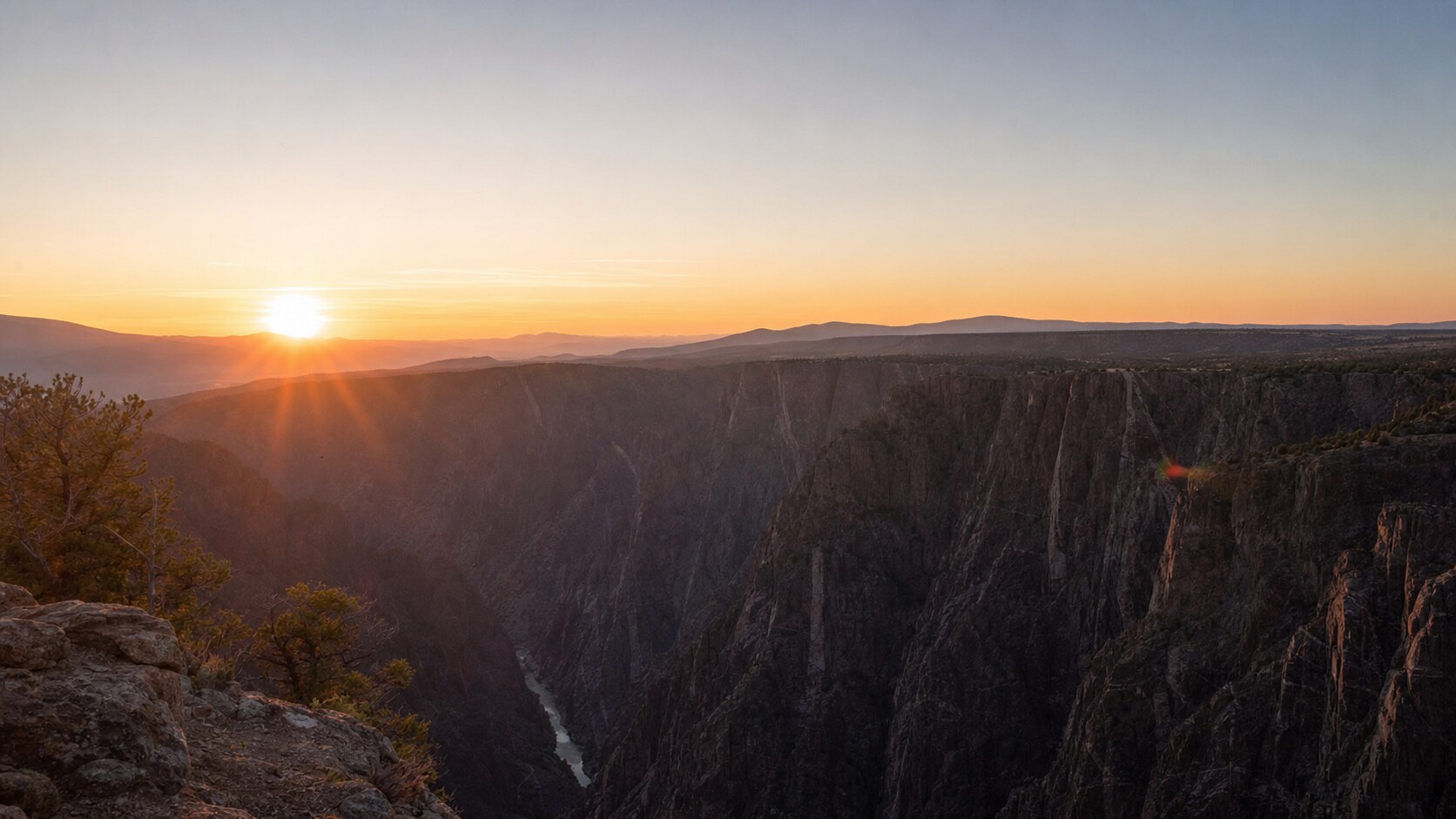
The canyon’s signature look is not just “deep”—it’s narrow, steep, and dark. That geometry creates three things landscape photographers crave: (1) graphic leading lines, (2) repeating cliff texture you can abstract with a telephoto, and (3) a constant chess match between light and shadow that rewards careful timing.
Plan on shooting both rims if you can. The South Rim is more developed and typically easier for sunrise/sunset logistics; the North Rim feels wilder and can deliver cleaner angles toward the Painted Wall from Chasm View.
 Save
SaveWhen to visit: season-by-season + photo conditions
| Season | What it looks like | Light & weather | Photo strategy |
|---|---|---|---|
| Spring | Fresh greens on rims; river often higher | Unstable storms; crisp mornings | Prioritize sunrise, bring microfiber cloths for windblown grit |
| Summer | Big skies; deep shadow in the inner canyon | Harsh midday contrast; afternoon thunderstorms | Shoot early/late; use telephoto to isolate lit cliff bands |
| Fall | Warm rim color; clearer air | Longer golden hour; cooler nights | Best all-around season for panoramas and blue-hour rims |
| Winter | Snow-dusted rims; minimalist palettes | Some roads into the park are limited access or closed entirely in winter (NPS) | Pack traction; look for high-contrast snow + black rock patterns |
 Save
SaveEntrance fees, permits, and reservations (check before you drive)
Reservations: the NPS states that no reservations are required to enter Black Canyon of the Gunnison National Park (NPS basic info).
Entrance fees: NPS lists a 7‑day entrance fee of $30 per vehicle (plus options for other modes) and a $55 annual park pass (NPS fees & passes).
Commercial filming / permit-triggered still photography: Black Canyon notes a non‑refundable $100 application fee for filming, still photography, and audio recording permits, with potential additional location fees/cost recovery depending on the project (NPS permits).
The 14 best photography spots (with GPS, lenses, and safety notes)
1. Pulpit Rock Overlook (South Rim)
Why it works: Quick 0.3 mi walk; strong sunrise side light on inner walls.
Golden hour notes: If the canyon is mostly in shadow, look for “light bands” sliding across the walls and switch to a longer lens to turn chaos into clean geometry. In summer, consider blue-hour rim silhouettes to avoid the harshest contrast.
Lens recommendation: Bring a 16–35mm for sky + rim foregrounds, and a 70–200mm (or longer) for cliff abstractions and compression. A polarizer can help cut rim haze, but use it carefully on ultra-wide skies.
Hike / difficulty: Most rim overlooks are short walks on established paths. Stay behind railings and never step onto unstable edges—wind gusts here are real.
2. Cross Fissures View (South Rim)
Why it works: Jagged cliff geometry; works well in late afternoon to sunset.
Golden hour notes: If the canyon is mostly in shadow, look for “light bands” sliding across the walls and switch to a longer lens to turn chaos into clean geometry. In summer, consider blue-hour rim silhouettes to avoid the harshest contrast.
Lens recommendation: Bring a 16–35mm for sky + rim foregrounds, and a 70–200mm (or longer) for cliff abstractions and compression. A polarizer can help cut rim haze, but use it carefully on ultra-wide skies.
Hike / difficulty: Most rim overlooks are short walks on established paths. Stay behind railings and never step onto unstable edges—wind gusts here are real.
3. Rock Point (South Rim)
Why it works: Classic “narrow canyon” view; good for telephoto compression.
Golden hour notes: If the canyon is mostly in shadow, look for “light bands” sliding across the walls and switch to a longer lens to turn chaos into clean geometry. In summer, consider blue-hour rim silhouettes to avoid the harshest contrast.
Lens recommendation: Bring a 16–35mm for sky + rim foregrounds, and a 70–200mm (or longer) for cliff abstractions and compression. A polarizer can help cut rim haze, but use it carefully on ultra-wide skies.
Hike / difficulty: Most rim overlooks are short walks on established paths. Stay behind railings and never step onto unstable edges—wind gusts here are real.
4. Devils Lookout (South Rim)
Why it works: Dramatic rim-edge perspective; watch wind gusts.
Golden hour notes: If the canyon is mostly in shadow, look for “light bands” sliding across the walls and switch to a longer lens to turn chaos into clean geometry. In summer, consider blue-hour rim silhouettes to avoid the harshest contrast.
Lens recommendation: Bring a 16–35mm for sky + rim foregrounds, and a 70–200mm (or longer) for cliff abstractions and compression. A polarizer can help cut rim haze, but use it carefully on ultra-wide skies.
Hike / difficulty: Most rim overlooks are short walks on established paths. Stay behind railings and never step onto unstable edges—wind gusts here are real.
5. Chasm View (South Rim) (South Rim)
Why it works: Deepest-feeling overlook; excellent for mid-telephoto panoramas.
Golden hour notes: If the canyon is mostly in shadow, look for “light bands” sliding across the walls and switch to a longer lens to turn chaos into clean geometry. In summer, consider blue-hour rim silhouettes to avoid the harshest contrast.
Lens recommendation: Bring a 16–35mm for sky + rim foregrounds, and a 70–200mm (or longer) for cliff abstractions and compression. A polarizer can help cut rim haze, but use it carefully on ultra-wide skies.
Hike / difficulty: Most rim overlooks are short walks on established paths. Stay behind railings and never step onto unstable edges—wind gusts here are real.
6. Painted Wall View (South Rim)
Why it works: Best angle toward Painted Wall; golden hour glow on cliff faces.
Golden hour notes: If the canyon is mostly in shadow, look for “light bands” sliding across the walls and switch to a longer lens to turn chaos into clean geometry. In summer, consider blue-hour rim silhouettes to avoid the harshest contrast.
Lens recommendation: Bring a 16–35mm for sky + rim foregrounds, and a 70–200mm (or longer) for cliff abstractions and compression. A polarizer can help cut rim haze, but use it carefully on ultra-wide skies.
Hike / difficulty: Most rim overlooks are short walks on established paths. Stay behind railings and never step onto unstable edges—wind gusts here are real.
7. Cedar Point Nature Trail Overlooks (South Rim)
Why it works: Short nature trail with multiple framed openings toward canyon.
Golden hour notes: If the canyon is mostly in shadow, look for “light bands” sliding across the walls and switch to a longer lens to turn chaos into clean geometry. In summer, consider blue-hour rim silhouettes to avoid the harshest contrast.
Lens recommendation: Bring a 16–35mm for sky + rim foregrounds, and a 70–200mm (or longer) for cliff abstractions and compression. A polarizer can help cut rim haze, but use it carefully on ultra-wide skies.
Hike / difficulty: Most rim overlooks are short walks on established paths. Stay behind railings and never step onto unstable edges—wind gusts here are real.
8. Dragon Point (South Rim)
Why it works: Big open vista; sunset often delivers layered color in the canyon.
Golden hour notes: If the canyon is mostly in shadow, look for “light bands” sliding across the walls and switch to a longer lens to turn chaos into clean geometry. In summer, consider blue-hour rim silhouettes to avoid the harshest contrast.
Lens recommendation: Bring a 16–35mm for sky + rim foregrounds, and a 70–200mm (or longer) for cliff abstractions and compression. A polarizer can help cut rim haze, but use it carefully on ultra-wide skies.
Hike / difficulty: Most rim overlooks are short walks on established paths. Stay behind railings and never step onto unstable edges—wind gusts here are real.
9. Sunset View (South Rim)
Why it works: Wide compositions; great for fiery skies and long-lens abstracts.
Golden hour notes: If the canyon is mostly in shadow, look for “light bands” sliding across the walls and switch to a longer lens to turn chaos into clean geometry. In summer, consider blue-hour rim silhouettes to avoid the harshest contrast.
Lens recommendation: Bring a 16–35mm for sky + rim foregrounds, and a 70–200mm (or longer) for cliff abstractions and compression. A polarizer can help cut rim haze, but use it carefully on ultra-wide skies.
Hike / difficulty: Most rim overlooks are short walks on established paths. Stay behind railings and never step onto unstable edges—wind gusts here are real.
10. Warner Point (end of South Rim Drive) (South Rim)
Why it works: Deepest canyon section views; best late day into blue hour.
Golden hour notes: If the canyon is mostly in shadow, look for “light bands” sliding across the walls and switch to a longer lens to turn chaos into clean geometry. In summer, consider blue-hour rim silhouettes to avoid the harshest contrast.
Lens recommendation: Bring a 16–35mm for sky + rim foregrounds, and a 70–200mm (or longer) for cliff abstractions and compression. A polarizer can help cut rim haze, but use it carefully on ultra-wide skies.
Hike / difficulty: Most rim overlooks are short walks on established paths. Stay behind railings and never step onto unstable edges—wind gusts here are real.
11. Chasm View (North Rim / Big Draw) (North Rim)
Why it works: Guardrailed rim look with Painted Wall in view; late morning light.
Golden hour notes: If the canyon is mostly in shadow, look for “light bands” sliding across the walls and switch to a longer lens to turn chaos into clean geometry. In summer, consider blue-hour rim silhouettes to avoid the harshest contrast.
Lens recommendation: Bring a 16–35mm for sky + rim foregrounds, and a 70–200mm (or longer) for cliff abstractions and compression. A polarizer can help cut rim haze, but use it carefully on ultra-wide skies.
Hike / difficulty: Most rim overlooks are short walks on established paths. Stay behind railings and never step onto unstable edges—wind gusts here are real.
12. Chasm View Nature Trail Viewpoint 1 (North Rim)
Why it works: First main overlook on loop; bring polarizer for haze control.
Golden hour notes: If the canyon is mostly in shadow, look for “light bands” sliding across the walls and switch to a longer lens to turn chaos into clean geometry. In summer, consider blue-hour rim silhouettes to avoid the harshest contrast.
Lens recommendation: Bring a 16–35mm for sky + rim foregrounds, and a 70–200mm (or longer) for cliff abstractions and compression. A polarizer can help cut rim haze, but use it carefully on ultra-wide skies.
Hike / difficulty: Most rim overlooks are short walks on established paths. Stay behind railings and never step onto unstable edges—wind gusts here are real.
13. Chasm View Nature Trail Viewpoint 2 (North Rim)
Why it works: Second overlook; strong verticals for stitched panoramas.
Golden hour notes: If the canyon is mostly in shadow, look for “light bands” sliding across the walls and switch to a longer lens to turn chaos into clean geometry. In summer, consider blue-hour rim silhouettes to avoid the harshest contrast.
Lens recommendation: Bring a 16–35mm for sky + rim foregrounds, and a 70–200mm (or longer) for cliff abstractions and compression. A polarizer can help cut rim haze, but use it carefully on ultra-wide skies.
Hike / difficulty: Most rim overlooks are short walks on established paths. Stay behind railings and never step onto unstable edges—wind gusts here are real.
14. East Portal (Gunnison River / Crystal Dam area) (East Portal)
Why it works: Lower-elevation river scenes; midday shade helps manage contrast.
Golden hour notes: If the canyon is mostly in shadow, look for “light bands” sliding across the walls and switch to a longer lens to turn chaos into clean geometry. In summer, consider blue-hour rim silhouettes to avoid the harshest contrast.
Lens recommendation: Bring a 16–35mm for sky + rim foregrounds, and a 70–200mm (or longer) for cliff abstractions and compression. A polarizer can help cut rim haze, but use it carefully on ultra-wide skies.
Hike / difficulty: Most rim overlooks are short walks on established paths. Stay behind railings and never step onto unstable edges—wind gusts here are real.
Wildlife photography ethics + safety distances
Use a long lens instead of pushing closer. If an animal changes behavior because of you—stops feeding, looks stressed, moves away—you’re too close. Give extra space during nesting/breeding seasons, and never feed wildlife.
Drone rules (read this before you pack a UAV)
NPS Policy Memorandum 14‑05 (June 2014) directed superintendents to prohibit the launching, landing, or operation of uncrewed aircraft on lands and waters administered by the National Park Service, with limited exceptions (NPS uncrewed aircraft policy). The NPS notes that violating the ban is a misdemeanor with a maximum penalty of six months in jail and a $5,000 fine (NPS).
Backcountry vs roadside shooting (what to expect)
The iconic Black Canyon look is surprisingly accessible from rim overlooks; the tradeoff is you’re usually shooting from above, into shadow. For a very different portfolio, the East Portal area drops you closer to the river for intimate scenes and scale cues (plan ahead using the NPS East Portal guidance: NPS East Portal).
Sample edits: taming canyon contrast
Start with global exposure for highlights, then lift shadows selectively with masks. For many scenes, a 2‑frame bracket (highlight-safe + shadow-safe) blends cleaner than aggressive HDR. Add micro-contrast to rock texture, and consider a subtle warm/cool split: warm highlights, slightly cooler shadows.
Explore next: nearby parks for photographers
All links go to B&H Photo Video, the trusted pro source. Tagged as affiliate per FTC.
All links go to Viator (a TripAdvisor company), the world’s largest marketplace for guided experiences. Tagged as affiliate per FTC.
Luminar Neo’s Sky AI, atmosphere AI and SuperSharp are designed for landscape work — replace flat skies, add depth, and recover detail in seconds. Tagged as affiliate per FTC.
Quick Amazon shortcuts to the gear most useful for this kind of shot. Use them if Prime shipping or Amazon credit makes more sense than B&H. As an Amazon Associate ShutYourAperture earns from qualifying purchases.
Common questions about the Black Canyon of the Gunnison guide
Is the Black Canyon of the Gunnison photography guide worth $47?
For most photographers, yes. The guide saves 8-12 hours of trip-planning research and prevents the most common mistake of Black Canyon of the Gunnison photography: shooting at the wrong time of day. If a single better frame is worth $47 to you, the guide pays for itself on day one. Buyers get every GPS coordinate, every golden-hour window, every cultural rule, and a printable shot list.
Does the Black Canyon of the Gunnison guide include GPS coordinates?
Yes — every vantage point in the guide has Google Maps-ready GPS coordinates so you can pin them before you fly. The guide also includes a printable map showing all locations clustered by walking distance, so you can build efficient half-day routes.
What's in the Black Canyon of the Gunnison PDF that isn't in this article?
The article shows the highlights. The PDF includes: 5 additional secret spots not published online, a 14-day itinerary with daily routes, the full camera-settings cheat sheet for every scenario in Black Canyon of the Gunnison, a printable gear packing list, post-processing recipes with screenshot examples, and a list of local guides we trust for portrait commissions.
Do I get the Lightroom presets too?
The $47 guide is the PDF only. The matching Black Canyon of the Gunnison preset pack is a separate $19 download — most buyers grab both as a bundle and save the editing time. Both are instant download, both work on Lightroom Classic and Lightroom Mobile.
Will the guide work for a Black Canyon of the Gunnison trip in 2026?
Yes. The guide is updated annually as fees, restrictions, and new vantage points change. All buyers get free lifetime updates. The 2026 edition includes the latest drone rules, museum photography policies, and seasonal light data for the year.
Visiting more than Black Canyon of the Gunnison?
Bundle multiple destination guides and save planning time across the trip:
- Yellowstone Photographer’s Guide ($47)
- Yosemite Photographer’s Guide ($47)
- Grand Canyon Photographer’s Guide ($47)
- Zion Photographer’s Guide ($47)
- Glacier Photographer’s Guide ($47)
Or get all 60+ destinations in one bundle: Photo Atlas — every guide, every map, $97.
What to Pack
A focused landscape kit handles every shot at Black Canyon of the Gunnison National Park without breaking your back. Here is the working photographer's pack list — every link goes to B&H Photo Video (our primary supplier) or Amazon (for accessories and same-day delivery in the US).
| What & Why | B&H | Amazon |
|---|---|---|
Wide-angle zoom (14-35mm range) The single most important lens for sweeping vistas. Pair with a circular polarizer for skies and water. | Shop B&H → | Shop Amazon → |
Sturdy travel tripod Carbon fiber, packs to 15 inches, holds steady in wind off the coast. Essential for blue-hour and long-exposure work. | Shop B&H → | Shop Amazon → |
Circular polarizer (77mm or 82mm) Cuts haze, deepens sky, reveals texture in water. Non-negotiable for landscape work. | Shop B&H → | Shop Amazon → |
10-stop ND filter For 30-second exposures that turn moving water and clouds into silk. | Shop B&H → | Shop Amazon → |
Extra batteries (3 minimum) Cold weather and long exposures eat batteries. Carry triple what you think you need. | Shop B&H → | Shop Amazon → |
Fast SD/CFexpress cards V90 or CFexpress depending on your body. Two cards minimum so a failure mid-trip is recoverable. | Shop B&H → | Shop Amazon → |
Microfiber lens cloths Salt spray, mist, and dust will ruin every shot if you don't carry a cloth. | Shop B&H → | Shop Amazon → |
B&H and Amazon links are affiliate links. We earn a small commission on purchases at no extra cost to you. We only recommend gear we use or would buy ourselves.