Best Photography Spots in New Orleans: 12 Locations With GPS

Tours & experiences disclosure: This guide includes affiliate links to Viator, the world’s largest tour and experiences marketplace. If you book through these links, ShutYourAperture may earn a small commission at no extra cost to you.

New Orleans photography guide hero imageSave

Amazon Associates disclosure: ShutYourAperture is a participant in the Amazon Services LLC Associates Program. As an Amazon Associate we earn from qualifying purchases. Some links below go to Amazon (Store ID edinchavez01-20). Buying through these links costs you nothing extra and helps fund our free guides.
Skip the planning. Get the New Orleans PDF. All locations, GPS coordinates, golden-hour times, gear tips. Instant download.

New Orleans, Louisiana is one of the most photogenic cities in the United States. If you have a camera and the patience to show up before dawn, New Orleans will give you images that last a career — but only if you know where and when to point it.

This is the definitive field guide to the 12 best photography spots in New Orleans, with GPS coordinates you can drop straight into Google Maps, exact camera settings tuned to New Orleans’s unique light, precise timing for every location, and the access notes nobody else bothers to document. It mirrors the intel inside our New Orleans Ultimate Photographer’s Guide ($47 PDF) — a downloadable field guide with full-page hero images, GPS maps, seasonal tables, a city safety briefing, and a complete photographer’s packing list. Get the guide →

Planning multi-city travel? See also: U.S. cities photography hub and the National Parks Photography Guides.

New Orleans Ultimate Photographer’s Guide — $47
12 GPS-mapped locations · Exact camera settings · Multi-season shooting calendar · Free annual updates

Download the PDF guide →
Skip the planning

Get the New Orleans Ultimate Photographer’s Guide

Every location below — pre-mapped with GPS, golden-hour timing, gear recommendations, cultural rules, and a 14-day itinerary. Downloaded by 200+ working photographers.

Get the PDF · $47
Instant download · Lifetime updates

Quick jump to the 12 spots

  1. Jackson Square + St. Louis Cathedral
  2. Royal Street Cast-Iron Galleries — 700–1000 Block
  3. Bourbon Street — Night Neon Scene
  4. Frenchmen Street Live Music Scene — Faubourg Marigny
  5. Garden District — St. Charles Avenue Streetcar and Oak Canopy
  6. St. Louis Cemetery No. 1 — Guided Tour Photography
  7. Crescent Park — Piety Wharf Skyline View
  8. Algiers Point — Mississippi Skyline View
  9. Studio Be — Brandan ‘B-Mike’ Odums Warehouse Murals
  10. Steamboat Natchez — Mississippi River Waterfront
  11. Tremé — St. Augustine Church and ‘Treme’ Street
  12. City Park — Couturie Forest and Live Oak Grove

A look inside the New Orleans Photographer’s Guide

Here are three of the actual shots you’ll find inside the PDF — cinematic full-page references for the exact spots, lenses, and lighting conditions documented in the guide. The full guide includes 12 locations, each with a hero image, GPS map, settings table, and a five-shot list.

Jackson Square + St. Louis Cathedral — from the New Orleans Photographer's GuideSave
Jackson Square + St. Louis Cathedral — sample reference photo from the New Orleans Photographer’s Guide PDF

Before you shoot New Orleans: the essentials

  • Free public access: Jackson Square, all French Quarter streets, Royal Street galleries, Bourbon Street, Frenchmen Street, the Moonwalk Riverfront, Crescent Park (free, open 6 AM–7:30 PM daily), Algiers Point (ferry $2 each way, waterfront free), Audubon Park grounds (free, 6 AM–10 PM), St. Charles Avenue streetcar corridor, Garden District streets, Bywater murals including Studio Be exterior, City Park grounds including the New Orleans Museum of Art sculpture garden (exterior free), Couturie Forest (free). The Steamboat Natchez requires a cruise ticket (~$44) for interior access.
  • Commercial permits: Commercial filming and photography in New Orleans is managed by Film New Orleans (filmneworleans.org), the official city film office. A Film Permit is required for all commercial productions that control the city right-of-way, film in city parks or greenspaces, film in Jackson Square, or park production vehicles on city streets. Film Permits are issued at no cost through Film New Orleans; applicants must submit a Filming Application, Certificate of Insurance, and signed copy of Film New Orleans Policies and Procedures at least 4 business days in advance (6 business days for shoots of 6+ days). Location Permits (for controlling streets/sidewalks) carry a $25 application fee plus $25 permit fee plus permitted-parking fees. A free B-roll Film Permit is available for crews of 20 or fewer using handheld cameras without controlling the right-of-way — contact Brittany Chandler at brittany.chandler@nola.gov. Still photography for personal/editorial use does not require a permit in public spaces. City Park requires a $75 commercial photo permit for professional sessions (bridal, family, portraits) — apply at permit@nocp.org. St. Louis Cemetery No. 1 is only accessible on authorized guided tours; photography is encouraged during tours but filming of the tour narration is not permitted. Lafayette Cemetery No. 1 remains closed to the general public as of 2025.
  • Best photography seasons: Late February through May is the prime photography season: Mardi Gras (February/March) delivers unparalleled street spectacle, beads in oak trees, and costumed crowds; March–April brings mild temperatures (60s–70s°F), low humidity, azalea blooms in the Garden District, and the longest golden-hour windows. Fall (October–November) is nearly as good — crisp air, the Voodoo Fest season, and the city’s live oak canopy at its most photogenic without summer’s oppressive humidity. Avoid June–September: heat regularly exceeds 95°F with 90%+ humidity, afternoon thunderstorms disrupt shooting windows, and summer haze flattens the distance. Winter (December–January) is underrated — cool fog on the river, unobstructed cathedral views, and moody blue-hour light in a relatively quiet French Quarter.
  • Blue hour notes: Blue hour in New Orleans is especially magical along the Mississippi riverfront. At Crescent Park and the Moonwalk, the Crescent City Connection twin bridges light up and their reflections shear across the dark water while the CBD towers glow behind the levee — typically peaking 20–30 minutes after sunset. Jackson Square is most atmospheric 30–40 minutes after sunset when the Cathedral’s floodlit white steeple stands against a deep cobalt sky and the gas lampposts warm the cobblestones. Algiers Point faces north-northwest across the river toward the CBD, giving a front-row mirror image of the skyline — the clearest blue-hour window is 15–25 minutes post-sunset. Frenchmen Street blue hour (dusk into darkness) marks the transition when bars illuminate in amber and blue neon and musicians set up on sidewalks — this dusk-to-dark period around 7–8 PM captures the most complete street scene. Sunrise blue hour at Jackson Square is underutilized and ideal: around 25–30 minutes before sunrise the plaza is empty, the Cathedral is lit from within, and the sky turns a smoky lilac above the iron fence.
  • Drone policy: Most major U.S. cities restrict drone flight in airspace and via local ordinances. Check FAA + city rules before launching.
  • Local resource: Official visitor information

The full-resolution version of every map below — plus seasonal calendars, gear notes per location, sun-angle diagrams, and a complete photographer’s packing checklist — is inside the New Orleans Photographer’s Guide PDF ($47).

1. Jackson Square + St. Louis Cathedral

Jackson Square is the founding heart of New Orleans, platted in 1721 as the Place d’Armes in the original city grid. The triple-spired St. Louis Cathedral — the oldest continuously active cathedral in the United States, consecrated in 1794 on foundations from 1718 — dominates the north side, flanked by the symmetrical Pontalba Buildings (1849), the oldest apartment buildings in the United States. The Cabildo and Presbytère flank the Cathedral with matching Spanish Colonial facades. No other American square packs this density of pre-Revolutionary architectural layers into a single viewable composition. At sunrise with zero foot traffic, the scene reads as a 19th-century European plaza, entirely timeless — one of the most reproduced and yet perpetually fresh photography subjects in the American South.

  • GPS: 29.9571, -90.0629
  • Elevation: 3 ft
  • Best time of day: Sunrise (primary) — the Cathedral faces roughly north-northwest from the square, meaning it catches warm eastern light on the flanking towers from around 6:30 AM; pre-dawn blue hour from 5:30–6:00 AM with empty cobblestones is transcendent. Avoid mid-afternoon (1–4 PM) when the main facade falls in deep shadow.
  • Sun direction: New Orleans’ street grid is rotated roughly 45° from true cardinal directions, aligned with the curve of the Mississippi. When standing in Jackson Square looking toward the Cathedral, you are facing roughly northwest, not north. The Cathedral’s famous triple-spired facade therefore faces southeast — toward the river — meaning direct frontal light hits the facade in the afternoon from the southwest. At sunrise (azimuth approximately 80–90° in spring, 65° in summer), the light comes from the eastern river-side, side-lighting the flanking towers and creating dramatic shadow play on the curved steeple. The golden-hour sweet spot is approximately 6:30–7:30 AM year-round, when the risen sun comes from the river direction and warm side-light rakes the white stucco in pink and amber. Pre-dawn is ideal for symmetrical front-lit shots using the Cathedral’s own flood lighting against a cobalt sky. Note that the Andrew Jackson equestrian statue in the plaza center acts as a strong foreground element from the Decatur Street side, but you need to be on the raised iron fence perimeter — not inside the locked plaza — for the classic composition.
  • Access: Jackson Square, French Quarter, New Orleans, LA 70116. The square perimeter is publicly accessible 24/7; the interior garden closes at 6 PM (enforced by security guards). St. Louis Cathedral exterior is freely visible at all times; interior open daily 8 AM–4 PM (free). No dedicated parking — closest paid lot at Decatur Street/North Peters (French Market area); street parking on Decatur Street available before 7 AM. Canal Street streetcar and RTA Bus routes stop 4–6 blocks away. Tripods permitted on public sidewalks and Decatur Street. Commercial filming in Jackson Square requires a Film New Orleans permit (Film Office manages Jackson Square as a filming location). The best angle — from Decatur Street looking across the park fence — is entirely on public right-of-way and requires no permit for personal/editorial photography.
  • Difficulty: Easy — flat cobblestone and brick plaza; ADA accessible via Decatur Street. Note: cobblestones require stable tripod feet.
  • Recommended settings: Pre Dawn Blue Hour: aperture: f/8, shutter: 8s, iso: 400, lens: 24-70mm at 35mm, notes: From Decatur Street, 25–35 minutes before sunrise. The Cathedral’s flood lighting and interior glow create warm windows against a deep cobalt sky. Use a tripod on the sidewalk; cobblestones require a ballhead with firm lock. Bracket ±1 EV for the bright steeple against dark sky. This is the only time the plaza is empty — street performers begin arriving around 7 AM.  ·  Sunrise Side Light: aperture: f/11, shutter: 1/60s, iso: 200, lens: 16-35mm or 24-70mm, notes: From the iron fence perimeter on the river-side (eastern) edge of the square, looking northwest at the Cathedral at roughly 6:45–7:30 AM in spring/fall. The rising sun from the river direction creates warm raking side-light on the curved central steeple and lit stucco against a clear sky. A polarizer deepens the blue sky without affecting the white facade adversely.  ·  Telephoto Steeple Isolation: aperture: f/8, shutter: 1/500s, iso: 200, lens: 70-200mm at 150-200mm, notes: From the Moonwalk (Mississippi River levee side), compress the Cathedral against the sky using a 150–200mm focal length — this eliminates the plaza clutter and lets the triple spires dominate the frame. Works well with dramatic storm clouds building from the south in afternoon. Avoid white midday sky.  ·  Dusk Atmosphere: aperture: f/5.6, shutter: 1/60s, iso: 1600, lens: 35mm or 50mm prime, notes: 30–45 minutes after sunset, the gas lampposts activate and street artists have packed up, leaving a warm amber-lit empty square. Switch to a fast prime for handheld shots of the lamppost-framed Cathedral without crowds. ISO 1600 in modern full-frame cameras renders the amber light naturally. Include the iron fence in foreground for framing.

Shots to chase:

  • Classic sunrise symmetry: from Decatur Street center, use a 35mm lens to capture the full Cathedral facade flanked by Pontalba Buildings symmetrically — best in the 10-minute window at 6:30 AM when the rising sun side-lights the steeple and zero pedestrians are present
  • Pre-dawn reflection: after rain, the slate-flagstone sidewalk on Decatur Street creates imperfect reflections of the lit Cathedral — get low with a 24mm for a wet-pavement reflection shot in the 5:45 AM window
  • Jackson equestrian with Cathedral: from the iron fence southeast corner, compose Andrew Jackson’s bronze horse in the foreground with the triple spires behind at golden hour — use f/5.6 to keep both in depth-of-field at 35mm
  • Moonwalk telephoto: from the Mississippi River levee (Moonwalk) 150 yards away, use 200mm to compress the Cathedral above the park’s iron lamp-posts and magnolia trees against the sky
  • Mardi Gras morning chaos: early February, arrive at 7 AM to capture the bizarre juxtaposition of costumed revelers, horse-drawn carriages, and the stately Cathedral white stucco behind — use a 35mm for street coverage with room for the architecture above

Pro tip: The single most important tip: arrive before 6 AM to claim Decatur Street before street artists set up their easels along the fence — by 8 AM, 20–30 artists create a permanent visual clutter blocking the fence line. Weekday mornings in March and November are emptiest. The gas-flame lampposts around the plaza are always lit and create beautiful warm rim-lighting at dusk — shoot at f/4 handheld at dusk for atmospheric street images. The Cafe Du Monde awning (northeast corner) adds a distinctive striped canopy element when included in wide compositions from the southeast.

Common mistake to avoid: Shooting Jackson Square in the afternoon when the Cathedral faces away from the sun and falls into flat shadow — frontal light on the facade only occurs in late afternoon from the southwest, and is rarely as dramatic as the morning side-light. Shooting from inside the plaza garden (which requires being there before 6 PM closing) rather than from Decatur Street, which gives the better distance-and-framing angle. Forgetting that the plaza’s street grid is rotated 45° — compass apps will mislead you; ‘east’ as the grid aligns is actually toward the river (southeast in true direction), so plan sun angles accordingly.

2. Royal Street Cast-Iron Galleries — 700–1000 Block

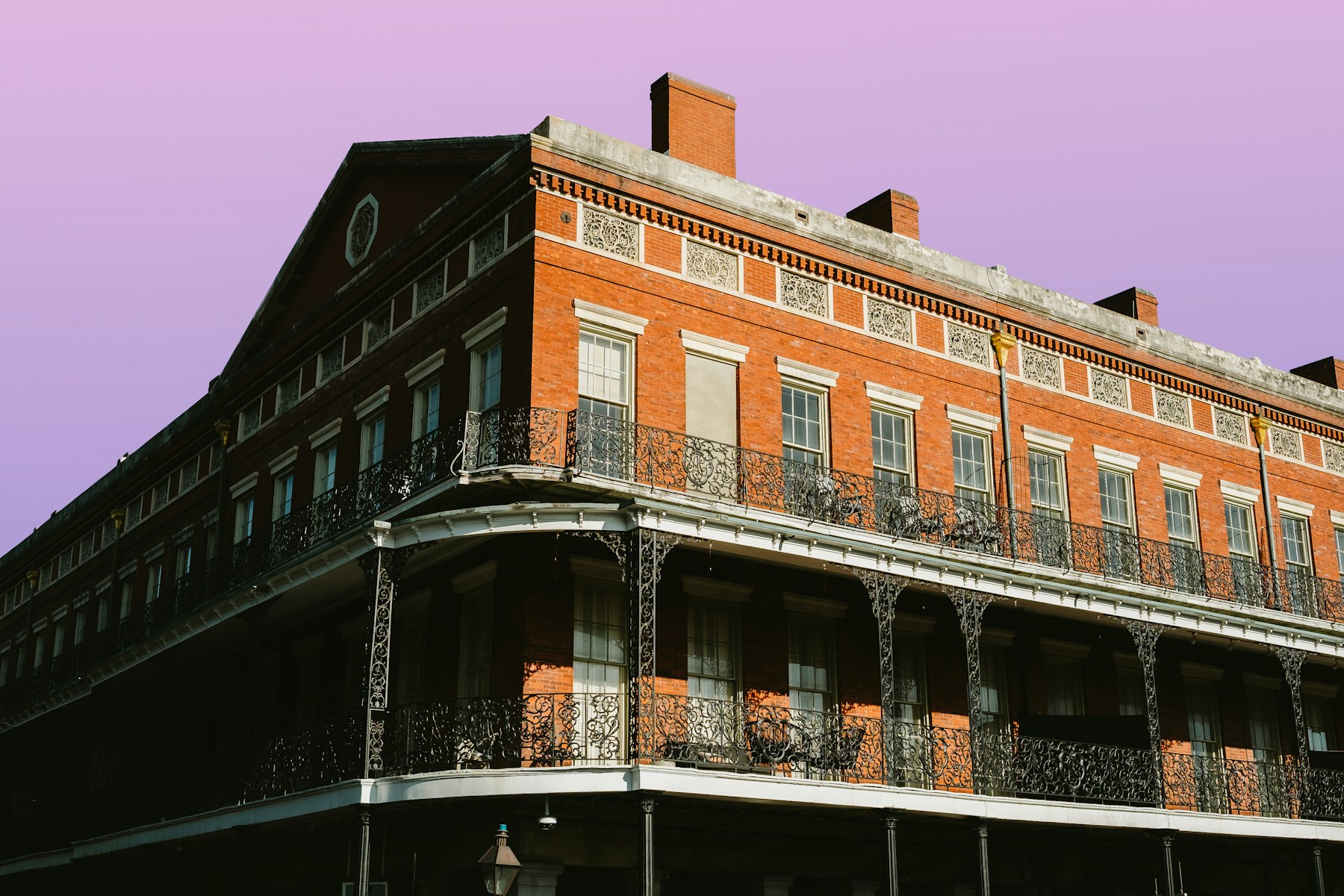
Royal Street is the architectural centerpiece of the French Quarter and arguably the finest single street for cast-iron decorative ironwork in North America. The galleries — technically ‘galleries’ (with roof and posts) rather than cantilevered ‘balconies’ — drape the second and third floors with intricate botanical patterns of morning glories, cornstalks, oak leaves, and grape clusters, all cast in iron in the 1830s–1860s. The 1000 Royal Street Cornstalk Hotel (one of only two cornstalk-fence buildings in New Orleans) and the balconies around the 700 block represent the pinnacle of this style. Unlike Bourbon Street’s neon chaos, Royal Street retains a genuine Creole elegance — art galleries, antique dealers, and residential balconies laden with ferns and hanging plants create a layered visual depth unmatched in any American city. At 7 AM in March, the light-and-shadow play through the ironwork creates a pattern of extraordinary graphic complexity.

  • GPS: 29.9583, -90.0632
  • Elevation: 3 ft
  • Best time of day: Early morning (7–9 AM) in spring and fall when soft directional light rakes the ornate ironwork from low angles and zero foot traffic allows wide compositions. Overcast days also work extremely well — the diffuse light eliminates the harsh shadow-striping created by bright midday sun through cast-iron galleries.
  • Sun direction: Royal Street runs roughly northeast-to-southwest in alignment with the French Quarter grid. The galleries on the uptown (west) side of Royal Street catch direct morning light from the east-southeast, which is the river direction, from approximately 7–10 AM in spring. The east (lake) side facades are lit in afternoon. Given that the most photographed stretch (700–900 blocks) runs roughly parallel to the Cathedral, morning light coming from over the rooftops of the lower (river) side creates beautiful raking illumination on the lacy ironwork, ferns, and hanging baskets that adorn the second-floor galleries. In summer, the sun rises more northerly (azimuth 60–65°) and may not reach the deeper gallery corridors until 8:30 AM. Overcast light is ideal for macro work on the cast-iron botanical patterns and for wide architectural shots where even lighting preserves all ironwork detail.
  • Access: Royal Street, French Quarter, New Orleans, LA 70116. Entirely public right-of-way, accessible 24/7 at no cost. Best access blocks: 700–900 Royal (between St. Ann and Dumaine), and 1000 Royal (Ursulines area). Street parking on Royal is metered 8 AM–10 PM; arrive before 7 AM for free early parking on side streets. Nearest streetcar: Canal Street line (Carondelet stop) is a 5-minute walk. No tripod permit needed for public sidewalk use on personal shoots; commercial productions require Film New Orleans permit. Note: Royal Street between St. Ann and St. Peter closes to vehicle traffic on weekends (10 AM–6 PM), becoming a pedestrian street with artists and musicians — excellent street photography context but more crowded for architectural composition.
  • Difficulty: Easy — flat brick sidewalks; some root-buckled sections require tripod care.
  • Recommended settings: Morning Architecture: aperture: f/11, shutter: 1/125s, iso: 200, lens: 24-70mm at 35–50mm, notes: From the sidewalk opposite a gallery at eye level, use f/11 for maximum depth-of-field across the full gallery face. Morning side-light from 7–9 AM creates the richest shadow patterning in the ironwork. A polarizer deepens the sky visible between balconies and saturates the green fern color.  ·  Ironwork Macro Detail: aperture: f/8, shutter: 1/250s, iso: 400, lens: 70-200mm at 100–150mm, notes: Telephoto from across the street to isolate individual botanical ironwork patterns — morning glory vines, corn motifs, grape clusters — as abstract graphic compositions. Works on overcast days equally well as sunny mornings. Look for aged rust-staining or peeling paint for added texture.  ·  Dusk Lamppost Street: aperture: f/2.8, shutter: 1/60s, iso: 2000, lens: 35mm or 50mm prime, notes: After 7 PM when the gas-style streetlamps illuminate the street and upper balconies glow with apartment lights. Handheld at f/2.8 with ISO 2000 for ambient available-light street photography. The combination of gas-lamp warm light and twilight blue sky creates the classic New Orleans mood.  ·  Weekend Street Scene: aperture: f/5.6, shutter: 1/250s, iso: 400, lens: 35mm or 24-70mm, notes: On weekends 11 AM–5 PM when Royal Street closes to traffic, street performers and musicians fill the pedestrian zone. Use f/5.6 at 1/250s to freeze subject motion while keeping the background ironwork galleries in soft but recognizable focus.

Shots to chase:

  • Gallery corridor compression: stand mid-block on the sidewalk and use a 50mm to frame the gallery posts as a repeating colonnade receding into the distance, with ironwork lace visible overhead — best at 7:30 AM with nobody on the street
  • Cornstalk Hotel fence detail: at 915 Royal Street, the famous cast-iron cornstalk fence wraps the property — use a 100mm macro to isolate individual corn ears, morning glories, and butterflies in the ironwork with shallow depth-of-field
  • Balcony overhang with sky: from the sidewalk below, tilt a wide-angle up at 20mm to capture the underside of a gallery overhead framing a wedge of sky and an upper-floor shuttered window — a graphic abstraction
  • Weekend busker portrait: on Sunday afternoons, musicians play in the Royal Street pedestrian zone with the ironwork galleries as backdrop — a 135mm portrait focal length at f/2.8 separates the subject from the bokeh-rich architectural background
  • Night gas-lamp glow: at 8 PM on a clear evening, the vintage-style lampposts cast amber pools on the brick sidewalk between building facades and iron-lace gallery shadows — use a 5-second exposure on a tripod for saturated amber pavement reflections

Pro tip: The 700–900 blocks of Royal Street have the densest concentration of intact pre–Civil War cast-iron galleries; the single most impressive block for symmetrical architecture is the 900 block between Dumaine and St. Philip, where multiple adjacent buildings have matching gallery heights. The Cornstalk Hotel fence at 915 Royal is best photographed from the Orleans Avenue side on a morning in March when azaleas bloom in the yard behind. On weekends, the pedestrian-only block between St. Ann and St. Peter fills with performers — arrive before 10 AM to shoot empty architecture or stay after 5 PM when crowds thin.

Common mistake to avoid: Shooting in the middle of the day when direct overhead sun creates un-navigable high-contrast stripes of shadow through the ironwork rails. Not including enough context (sky, street) in ironwork detail shots — isolated gallery details without sky or street reference lose the sense of scale. Overlooking the side streets (Dumaine, St. Philip, Gov. Nicholls) where less-visited but equally beautiful galleries appear without tourist foot traffic.

3. Bourbon Street — Night Neon Scene

Bourbon Street is the most concentrated and unrestrained neon corridor in the American South — a 12-block strip where closed-at-dawn dive bars, strip clubs, daiquiri shops, and jazz venues compete in pure light output. Unlike Las Vegas, which is purpose-built for spectacle, Bourbon Street’s neon is layered over 19th-century Creole townhouse architecture with wrought-iron balconies and stucco facades — the contrast of decayed grandeur and garish modernity creates a visual tension that no other American street can replicate. At full throttle on a Saturday night, it is sensory overload; at 6 AM with overflowing plastic cups in the gutter and a lone jazz musician still playing, it is haunting.

  • GPS: 29.9589, -90.0655
  • Elevation: 3 ft
  • Best time of day: 9 PM–midnight for peak neon saturation and crowd energy; 6–7 AM for dawn street photography with abandoned cups, atmospheric haze, and the neon signs still glowing before daytime cleanup — an entirely different and surprisingly poetic scene.
  • Sun direction: Bourbon Street runs in the same northeast-southwest orientation as the rest of the French Quarter grid. As a night photography subject, sun direction is irrelevant — the scene is defined entirely by artificial light: neon signs in cyan, magenta, red, and orange; LED bar marquees; open club doors pouring fluorescent light onto wet pavement; and occasional flare from second-floor balcony strobes. The most powerful compositions use the street’s narrow width (about 40 feet) and two-story facades to create a compressed neon canyon effect. Overcast nights are actually preferable — low cloud cover bounces neon upward into the sky and creates a subtle dome of colored light above the rooflines.
  • Access: Bourbon Street, French Quarter, New Orleans, LA 70116. Entirely public right-of-way, open and active 24/7. No photography permit required for personal or editorial shooting from the public street. Commercial productions controlling the sidewalk or street require a Film New Orleans permit. Bourbon Street is famously pedestrian-heavy on weekends (10 PM–2 AM) — use elbows and a compact kit. A mirrorless camera with a small prime lens is preferable to a large DSLR with an extended tripod in peak crowd conditions. Parking: best to walk from French Quarter accommodations; if driving, Iberville Parking Garage (on Iberville near Bourbon, 24/7) is 1 block away.
  • Difficulty: Easy to reach; moderate for tripod work in crowds. Dawn hours are easy and uncrowded.
  • Recommended settings: Night Neon Canyon: aperture: f/8, shutter: 2s, iso: 400, lens: 24-70mm at 28–35mm, notes: From the center of Bourbon Street during a momentary lull in foot traffic (try 11 PM on a weekday), use a tripod and 2-second exposure to capture the full neon-canyon effect — both sides of the street lighting up the frame. The 2-second exposure blurs pedestrian motion into ghost-streaks while the architecture and signs remain sharp. Use a remote shutter.  ·  Peak Crowd Handheld: aperture: f/2.8, shutter: 1/60s, iso: 3200, lens: 35mm prime, notes: Saturday night peak (10 PM–1 AM). Handheld with stabilization, f/2.8 at 1/60s, ISO 3200 on a modern mirrorless body. The neon-illuminated crowd at this setting produces rich, grainy street images with natural neon color casts — do not use auto white balance; set to 3200K to preserve the warm neon and fluorescent mix.  ·  Dawn Aftermath: aperture: f/11, shutter: 1/30s, iso: 200, lens: 24-70mm or 16-35mm, notes: 6–7 AM when the street cleaners have not yet arrived and neon signs are still lit. Use a tripod and f/11 for the entire street in deep focus — the wet pavement reflections, discarded cups, and still-glowing signs against a pale dawn sky create a uniquely melancholic composition. This is the undershot Bourbon Street image.  ·  Balcony Looking Down: aperture: f/5.6, shutter: 1/125s, iso: 2000, lens: 35mm or 50mm, notes: From a hotel balcony above Bourbon Street (several hotels offer balcony rooms; also try the balcony bars). Looking straight down the street with 35mm at f/5.6, the crowd and neon compression creates an extraordinary top-down perspective. ISO 2000 for available light; no tripod possible from most balconies.

Shots to chase:

  • Neon canyon at 11 PM: from the center of the street looking toward Canal Street, use a 28mm wide angle and 2-second tripod exposure to create motion-blurred crowd trails beneath neon signs on both sides of the frame
  • Dawn emptiness: 6:15 AM in spring, the street is empty and still glowing — use a 24mm to capture the full length of Bourbon with neon reflections in wet flagstones and a pale lavender sky above the rooflines
  • Balcony crowd from above: from a second-floor bar balcony, shoot straight down with a 35mm to compress the crowd into a colorful river of bodies and cups flowing under neon marquees
  • Single neon sign portrait: isolate one iconic sign (Tropical Isle, Lafitte’s Blacksmith Shop candle glow) with a 100mm tight focal length for a study of type, light, and architecture
  • Daiquiri shop window glow: the plastic-cup daiquiri shops have glowing illuminated fronts in acid green and orange — use them as backlit frames for silhouette portraits of passersby at night

Pro tip: The best light combination on Bourbon Street is the 30-minute window after sunset (around 7:30–8 PM) when the remaining sky blue balances the neon warm tones — true night creates harsh contrast. Lafitte’s Blacksmith Shop Bar (941 Bourbon), operating since the 1700s, is lit entirely by candles at night — the exterior glow is one of the most atmospheric architectural subjects in the entire French Quarter. Avoid Mardi Gras weekend unless you want pure crowd-chaos photography — the street is so densely packed that architectural compositions become impossible.

Common mistake to avoid: Shooting only at pure night (black sky) when the neon looks artificially harsh against pure black — the best window is dusk-to-dark when sky color still registers. Over-relying on auto white balance, which will try to neutralize the warm neon and lose the entire color atmosphere — manual WB at 3200–4000K preserves the scene’s character. Not visiting at dawn, which is a completely distinct and underappreciated photographic opportunity.

4. Frenchmen Street Live Music Scene — Faubourg Marigny

Frenchmen Street is the authentic counterpoint to Bourbon Street — where locals actually go for live music in New Orleans. The 500–600 block contains six or seven small live-music venues in a single dense cluster, all operating simultaneously most nights: The Spotted Cat Music Club, d.b.a., the Maison, Café Negril. On any given night, four different genres spill from four open doorways within 200 feet — jazz, funk, brass band, Latin. The Frenchmen Art Market adds local artisan vendors and food to the outdoor scene on weekends. This is the street that inspired Tennessee Williams’ ‘Elysian Fields Avenue’ streetcar; it retains a genuinely local, lived-in character that Bourbon Street abandoned decades ago.

  • GPS: 29.9628, -90.0586
  • Elevation: 3 ft
  • Best time of day: 9 PM–1 AM for peak music energy; dusk (7–8 PM) for the transition from daylight to lit-bar glow with the Frenchmen Art Market active on weekends. Wednesday–Saturday nights are fullest; Sunday nights also excellent with the Spotted Cat and d.b.a. fully live.
  • Sun direction: Frenchmen Street lies one block past Esplanade Avenue from the French Quarter, running parallel to the Quarter in the same rotated grid. As a night photography destination, the relevant light is entirely artificial — the warm incandescent glow of the Spotted Cat Music Club’s open-air front, the blue neon of d.b.a., the string-light canopy of the Marigny outdoor art market, and the amber spill of club doorways onto the pavement. On weekend evenings, the 500 block of Frenchmen between Chartres and Decatur is the most photogenic stretch: three or four live music venues open their doors simultaneously, and the overlapping sounds and lights create a visual and sonic cacophony unlike anything in the French Quarter. The dusk window (7–8 PM) when natural blue sky mixes with club illumination is the optimal balance.
  • Access: 500–700 Frenchmen Street, Faubourg Marigny, New Orleans, LA 70116. Entirely public right-of-way, free, 24/7. The Frenchmen Art Market (at the corner of Frenchmen and Royal) operates most weekend evenings from roughly 7 PM to midnight (weather-dependent). Walk 5 minutes from the end of the French Quarter (Esplanade Avenue); parking on Elysian Fields, Esplanade, or Dauphine before 8 PM. No photography permit required from the public street. Some club owners are fine with photography at the door but may restrict inside photography — always ask before shooting interior live music. Tripods are impractical during peak hours but usable on the street during quieter weekday evenings.
  • Difficulty: Easy — flat neighborhood streets; lively but not as aggressively crowded as Bourbon Street.
  • Recommended settings: Club Doorway Glow: aperture: f/2.8, shutter: 1/60s, iso: 2500, lens: 35mm or 50mm prime, notes: Position at the club doorway with musicians visible inside — the warm interior light frames the musicians while cool blue street light falls on the crowd outside. f/2.8 at 1/60s with image stabilization handles the mixed light well. Avoid flash entirely — it destroys the atmosphere and musicians dislike it.  ·  Dusk Street Scene: aperture: f/5.6, shutter: 1/125s, iso: 1600, lens: 24-70mm at 35mm, notes: 7:30–8:30 PM when the natural blue dusk balances the club amber light. Walk the length of the block with a 35mm and shoot the full street scene at f/5.6 — both the architectural context and the crowd at this middle f-stop. Street lights and neon are fully active; sky retains color.  ·  Art Market Wide: aperture: f/8, shutter: 1/30s, iso: 800, lens: 16-35mm, notes: At the Frenchmen Art Market corner on weekend evenings, use a 16-20mm for the full canopy-and-crowd scene. String-light overhead illumination at ISO 800, 1/30s on a stabilized body. Include near-ground art displays in the foreground for depth.  ·  Musician Portrait: aperture: f/2.8, shutter: 1/250s, iso: 3200, lens: 85mm or 100mm, notes: Street musicians on the sidewalk outside venues — use 85mm at f/2.8 to separate the musician from the background club glow. 1/250s freezes instrument motion (especially horn players and brass drummers). Ask before photographing if shooting close portraits.

Shots to chase:

  • Multi-club overlap: from mid-block on the 500 block looking east, capture 3–4 lit club facades simultaneously with audiences and musicians visible in each doorway — a 28mm wide captures the full ‘music alley’ feel
  • Spotted Cat open door: the Spotted Cat’s open facade on weekend nights frames musicians against golden interior light — shoot from the sidewalk at 7:30 PM when the last blue sky remains for a warm/cool contrast
  • Second-line spontaneous: brass bands frequently form impromptu second lines on Frenchmen Street late night — use 1/500s at f/4 to freeze tuba, snare drum, and crowd in motion against the lit facades
  • Art market bokeh: the Frenchmen Art Market’s string lights create distinctive bokeh spheres — use a 50mm at f/1.8 with a lamp in near background to create dreamy foreground-light abstractions around vendor stalls
  • Night portrait in doorway: position a musician in the doorway of d.b.a. with neon inside and blue street outside — dual-toned portrait at 85mm f/2 shows the complex, layered light that makes Frenchmen Street unique

Pro tip: The Spotted Cat Music Club has no cover and an open facade — it’s the most photogenic single venue on the street for doorway photography because the musicians face the street and the interior is warmly lit. Arrive by 9 PM to claim sidewalk position before the crowd density makes tripod use impossible. On the first Saturday of each month, street traffic is heaviest and music is most diverse. The corner of Frenchmen and Chartres (the art market corner) provides the best all-in-one composition: club facades, market stalls, and passing pedestrians all visible in a 35mm frame.

Common mistake to avoid: Using flash inside or near doorways — it ruins the ambient light scene and alienates musicians. Arriving before 9 PM expecting full energy (venues don’t peak until 10 PM). Sticking only to the 500 block and missing the Maison (600 Frenchmen) which has a wider facade and excellent interior photography opportunity on quieter nights.

Want this in your pocket on the street?
The full-resolution version of every spot above — with full-page hero photography, GPS maps with gold location pins, sun direction diagrams, multi-season tables, and a complete safety + packing checklist — is inside the New Orleans Ultimate Photographer’s Guide PDF ($47). Print it, save it offline, take it on the walk. Get the guide →

5. Garden District — St. Charles Avenue Streetcar and Oak Canopy

Garden District — St. Charles Avenue Streetcar and Oak Canopy New Orleans photography sampleSave
Garden District — St. Charles Avenue Streetcar and Oak Canopy — cinematic reference from the New Orleans Photographer’s Guide PDF

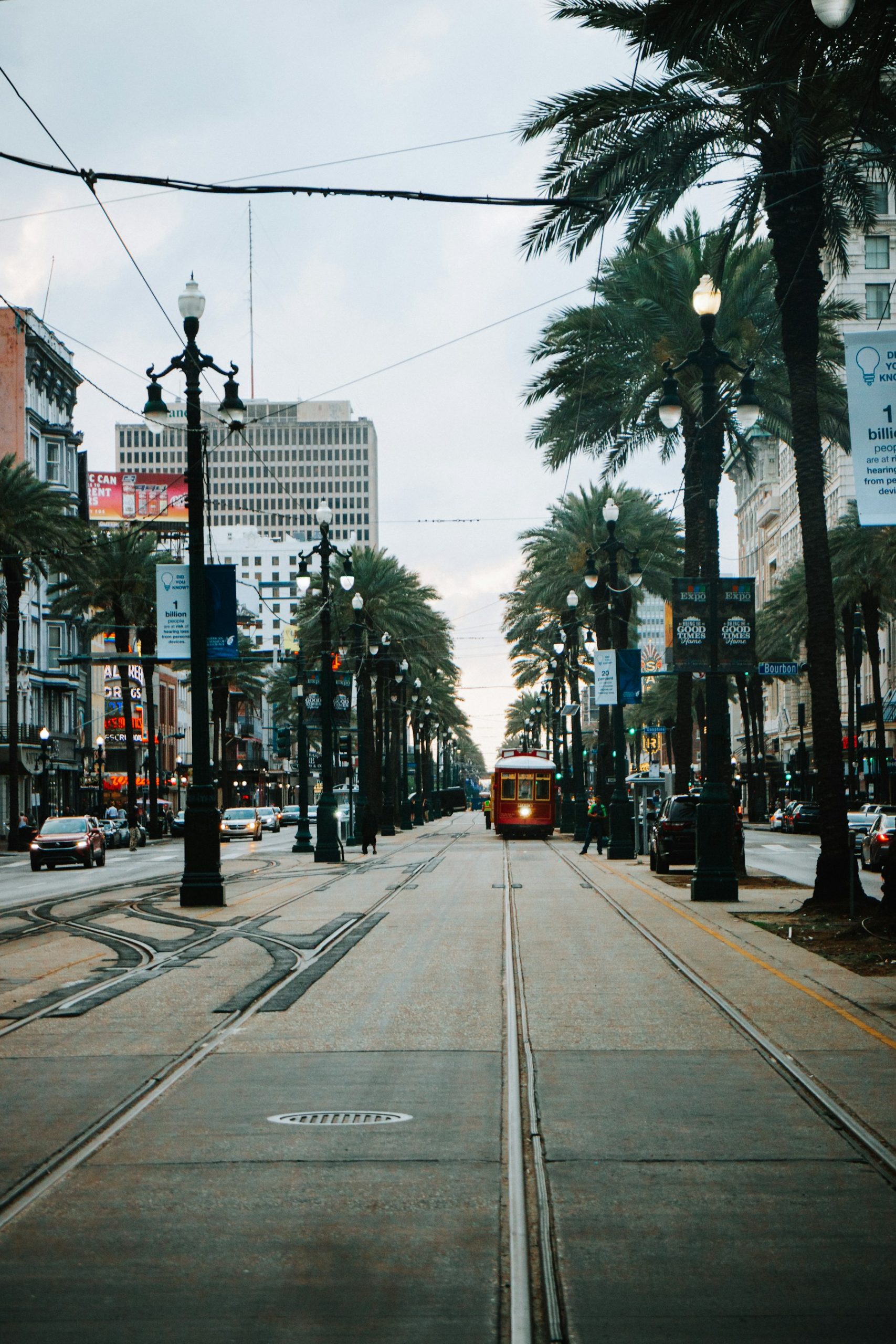
St. Charles Avenue is consistently cited as one of the most beautiful urban boulevards in America — a 5-mile corridor of live oaks, Spanish moss, and antebellum mansions stretching from the Central Business District to Carrollton. The Garden District section (between Jackson and Louisiana Avenues) is the apex: a 19th-century American aristocracy neighborhood of Greek Revival and Italianate mansions with iron lacework, vast verandas, and azalea-lined front gardens. The famous Route 12 streetcar — one of the oldest continuously operating streetcar lines in the world, running since 1835 — rolls down the center neutral ground under the oak canopy, providing the iconic New Orleans combination of historic transportation, botanical grandeur, and architectural showmanship in a single frame.

  • GPS: 29.9282, -90.1011
  • Elevation: 8 ft
  • Best time of day: Early morning (7–9 AM) for soft raking light on the mansion facades and zero car traffic on St. Charles; mid-morning (9–11 AM) for streetcar photography with the live oak canopy backlit; late afternoon golden hour for warm light filtering through the moss-draped live oak tunnel.
  • Sun direction: St. Charles Avenue runs roughly upriver (northwest to southeast) at approximately 45° to true north, following the Mississippi River’s curve. The live oak canopy overhead creates a dappled-light corridor in all directions. Morning light from the river direction (east-southeast, which is ‘downtown’ in the local orientation) slices horizontally through the oak canopy around 7–8 AM and catches the ornate ironwork and painted wood facades of the Greek Revival mansions on the uptown (northwest) side of the avenue. The Garden District’s prime mansion blocks (between Jackson Avenue and Louisiana Avenue) are on the northeast side of the street, receiving warm afternoon light. St. Charles Avenue’s streetcar tracks run down the neutral ground (center median), making the streetcar a natural mid-ground subject with mansions behind. In late afternoon (4–5 PM in fall), golden light streams down the avenue corridor and back-lights the Spanish moss hanging from live oaks.
  • Access: St. Charles Avenue and Garden District, New Orleans, LA (best blocks: 2600–3900 St. Charles; Garden District mansion blocks: Jackson Ave to Louisiana Ave). Public street, no fee. St. Charles Streetcar (RTA Route 12): $1.25 per ride or Jazzy Pass; runs 24/7 (infrequent late night). From Canal Street, board St. Charles streetcar at the Canal/Carondelet stop (~15 min to Garden District). Parking: available on Garden District side streets (Prytania, Coliseum, Chestnut) on weekday mornings. Magazine Street (2 blocks from mansions) has paid lots. No photography permit needed for exterior mansion street photography. For St. Charles Avenue streetcar photography, the neutral ground (median) provides the best angle — it is a public pedestrian/walking path.
  • Difficulty: Easy — flat sidewalks and neutral ground. Streetcar navigation requires timing; best to simply walk a few blocks and wait for the streetcar to pass.
  • Recommended settings: Streetcar Motion Blur: aperture: f/16, shutter: 1/15s, iso: 100, lens: 24-70mm at 50mm, notes: From the neutral ground (median), use a tripod and 1/15s to create controlled motion blur in the approaching streetcar while keeping the oak canopy and mansion facades sharp. Morning or late afternoon with directional light is best. Use mirror lockup or electronic shutter to minimize vibration.  ·  Oak Canopy Tunnel: aperture: f/11, shutter: 1/125s, iso: 200, lens: 16-35mm at 20mm, notes: From the neutral ground looking up the avenue, a 20mm focal length captures the full tunnel effect of the arching live oak canopy converging at a vanishing point. Include the streetcar tracks as leading lines. Golden afternoon light (4–5 PM in spring) back-lights Spanish moss for atmospheric warmth. Slight underexposure (-0.7 EV) preserves the dark green canopy depth.  ·  Mansion Facade Morning: aperture: f/8, shutter: 1/250s, iso: 200, lens: 70-200mm at 85-135mm, notes: From across the street at 7:30–9 AM, use a telephoto to flatten perspective and fill the frame with individual mansion facades — Italianate ironwork, Greek Revival columns, or the purple-azalea gardens of spring. A polarizer enriches painted wood facade colors and deepens the blue sky between columns.  ·  Streetcar Panning: aperture: f/8, shutter: 1/30s, iso: 100, lens: 70-200mm at 100mm, notes: Pan with the approaching streetcar at 1/30s to show motion in the background while the streetcar itself remains relatively sharp. The moving oak canopy behind creates streaks of green and gold. Works best in mid-morning when the green car contrasts against the warm mansion facades.

Shots to chase:

  • Classic streetcar under oaks: neutral ground position on St. Charles near Third Street, 20mm lens, morning light — the green streetcar emerging from the oak tunnel with mansions on both sides is the definitive Garden District image
  • Mansion avenue perspective: 70mm from the Garden District sidewalk looking toward downtown, compress 3–4 consecutive mansion facades with azalea gardens in March bloom against a blue sky
  • Spanish moss backlight: late afternoon, position under a particularly heavy moss-laden live oak and use a 24mm looking up at the backlit moss and sky — the golden light turns the moss from grey to honey-gold
  • Dawn empty avenue: 6:30 AM on a weekday, the streetcar tracks disappear into morning mist on an empty St. Charles Avenue — use a 24mm from the median for the ghost-town version of the classic view
  • Buckner Mansion detail: at 1410 Jackson Avenue, the immense white Greek Revival portico (12 columns across) with a streetcar approaching on St. Charles — use 85mm for a layered composition with the mansion columns framing the streetcar

Pro tip: The single most photogenic stretch for the oak-canopy tunnel shot is approximately between Third and Sixth Streets on St. Charles — the tree canopy here is fullest and the mansion setback is consistent. The streetcar runs on a roughly 15–20 minute cycle; check the RTA live tracker app (rta.org) to anticipate arrivals. In March during azalea season, the front gardens along the Garden District blocks between Prytania and Coliseum Streets explode with pink and white blooms — add these as colorful foreground elements in mansion shots. The Buckner Mansion (1410 Jackson Avenue), reportedly used for the American Horror Story: Coven filming, has one of the most impressive Greek Revival facades in the Garden District — best shot from St. Charles with a 135mm mid-morning.

Common mistake to avoid: Standing on the sidewalk rather than the neutral ground for avenue shots — the neutral ground center position gives the crucial symmetrical canopy-tunnel perspective. Shooting on weekend afternoons when St. Charles is heavily trafficked with cars creating visual clutter. Expecting Lafayette Cemetery No. 1 (at 1427 Washington Street, one block off St. Charles) to be open for photography — it has been closed to the public since 2019 and as of 2025 remains closed, accessible only to families of those interred with prior appointment from the City Cemetery Division (504-658-3781).

6. St. Louis Cemetery No. 1 — Guided Tour Photography

St. Louis Cemetery No. 1 is the oldest and most historically significant cemetery in New Orleans, established in 1789, and the archetype of the city’s above-ground ‘Cities of the Dead’ burial culture. The above-ground tomb tradition emerged not from romantic custom but from harsh necessity — New Orleans’ below-sea-level water table caused coffins to surface after heavy rains. The result is an extraordinary urban landscape of white-plastered family vaults, ornate society tombs, and modest wall vaults packed into a single city block, with alleys so narrow that the tombs tower overhead. Marie Laveau, the legendary 19th-century Voodoo Queen, is interred here (precise location guarded); actor Nicolas Cage has purchased a modern pyramid-shaped tomb in stark stylistic contrast to the 18th-century surroundings. Homer Plessy (of Plessy v. Ferguson) and Ernest ‘Dutch’ Morial (first African American mayor of New Orleans) are also interred here. No other single block in New Orleans contains this density of historically layered narrative.

  • GPS: 29.9609, -90.0793
  • Elevation: 3 ft
  • Best time of day: Morning tours (9–11 AM) for the softest directional light on the white-plastered above-ground tombs; overcast mornings produce the most even detail in the tomb facades. Avoid midday direct sun which creates harsh shadows in the narrow cemetery alleys.
  • Sun direction: St. Louis Cemetery No. 1 occupies a roughly north-south rectangle adjacent to the French Quarter, with the main entrance on Basin Street facing east. The cemetery’s narrow interior lanes run in both N-S and E-W orientations. In morning (9–11 AM), eastern light filters between the tall above-ground vault rows, creating alternating strips of warm light and deep shadow on the plastered tomb faces — graphically compelling but challenging to expose. Overcast light is technically preferable for even illumination of the worn marble inscriptions, flaking plaster, and ironwork details. Afternoon western light (2–4 PM) back-lights the street-facing tomb row on the Basin Street side, creating dramatic silhouettes of cross-topped vaults. The elevated, above-ground tombs create their own micro-lighting environment; the narrow alleys (some barely 3 feet wide) require 20–28mm focal lengths to include full tomb facades.
  • Access: 501 Basin Street (Basin St. Station Visitor Center), New Orleans, LA 70112. ACCESS CRITICAL NOTE: St. Louis Cemetery No. 1 has been closed to independent public visitation since March 1, 2015, when the Archdiocese of New Orleans required all non-family visitors to enter exclusively on authorized guided tours. The only official tour operator is Cemetery Tours NOLA, which operates all tours on behalf of New Orleans Catholic Cemeteries. Tours depart from the Cemetery Tour Desk inside Basin St. Station Visitor Center (Stop 5 on the Hop-On Hop-Off bus). Cost: Adults $29+, Children 3–12 from $22, infants free. Tours depart every 15 minutes, 9 AM–3:45 PM daily (closed Mardi Gras Day). Maximum 20 persons per tour; advance booking strongly recommended at cemeterytourneworleans.com. Tour lasts approximately 55 minutes. Photography is explicitly encouraged on tours; filming of the tour narration is not permitted. Family members with interments may apply for private access via the Archdiocese: NolaCatholicCem@arch-no.org or 504-596-3050. Parking: Park First lot at 1205 St. Louis Street ($5–$10 for 10 hours).
  • Difficulty: Easy to moderate — narrow paths with uneven surfaces and tight alleys; some passages are barely wide enough for two people. Comfortable flat shoes essential. No ADA accessibility guarantee in all areas though pathways are mostly flat.
  • Recommended settings: Tomb Detail Overcast: aperture: f/8, shutter: 1/250s, iso: 400, lens: 24-70mm at 35-50mm, notes: Overcast morning light eliminates the harsh shadow-striping of sunny conditions and reveals the full tonal range of weathered plaster, faded inscriptions, and mossy surfaces. f/8 for complete depth-of-field across a full tomb face. Slightly underexpose (-0.3 EV) to preserve detail in bright white plaster.  ·  Narrow Alley Wide: aperture: f/11, shutter: 1/60s, iso: 800, lens: 16-24mm, notes: In the narrowest cemetery alleys (some under 4 feet wide), a 16–20mm focal length is necessary to include both tomb walls. f/11 keeps both side walls sharp from close range. Shoot straight down the alley for vanishing-point perspective. Morning sun from the east creates a corridor of light through the alley — expose for the lit tomb at the end.  ·  Morning Side Light Tomb: aperture: f/8, shutter: 1/500s, iso: 200, lens: 50mm or 85mm, notes: On sunny mornings, low-raking side light from the east creates dramatic shadow play across the bas-relief inscriptions, plaster decorations, and ironwork grave markers. Use 50–85mm focal length to isolate individual tomb facades and inscriptions. A morning tour around 9:30–10 AM in fall/winter gives the best low-angle side-light quality.  ·  Atmosphere With Silhouette: aperture: f/5.6, shutter: 1/125s, iso: 400, lens: 24-70mm at 28mm, notes: Backlit scenes with a tomb cross silhouetted against bright sky or a tour group silhouetted between the vault rows. Expose for the sky (−1.5 EV from metered) to create deliberate silhouettes. Works best in late-morning when the sun is above the vault rooflines.

Shots to chase:

  • Society tomb close-up: use 85mm to fill the frame with a single ornate society tomb face — the carved inscriptions, plaster flaking in layers, ironwork gate, and moss staining create a rich textural composition
  • Alley vanishing point: from one end of the narrowest cemetery alley, use a 20mm to capture the corridor of tomb walls converging to a single point of light at the far end — works at 9:30 AM when east light illuminates the far end
  • Nicolas Cage pyramid: the modern black granite pyramid tomb at the cemetery’s southern section makes a jarring contemporary-versus-18th-century contrast — use a 35mm to frame it between two weathered plaster vaults
  • Cross silhouette: position a cross-topped tomb against an open sky and expose −2 EV to render it as a pure black silhouette against a white or pastel blue sky
  • Tour group scale: use 16mm from a cemetery intersection to include both the massive society tombs and tiny tour group figures — establishes the overwhelming vertical scale of the above-ground vaults

Pro tip: Book the 9 AM first-departure tour for the softest light and fewest visitors — later tours are more crowded. Photography is encouraged by Cemetery Tours NOLA and guides will often pause at the best-lit tomb faces for composition time. Do not touch the tombs, lean against them, or place your tripod against plaster — the 18th-century plaster is extremely fragile. The iconic ‘Marie Laveau’s tomb’ has been heavily damaged by decades of vandals marking it with Xs — focus on less-visited society tombs for more intact photographic subjects. Bring a lens cloth — the damp enclosed alleys can fog front elements.

Common mistake to avoid: Attempting independent entry without a tour — security is enforced and independent visitors are turned away. Expecting dawn access — the first tour departs at 9 AM. Using a zoom lens that requires more than 10 inches of working room in the narrow alleys — carry a 20mm prime as backup for the tightest passages. Over-photographing the Laveau tomb (which is damaged and often crowded) while ignoring the extraordinary society tombs in the center section.

7. Crescent Park — Piety Wharf Skyline View

Crescent Park is the best unobstructed riverfront viewpoint on the east bank of New Orleans — a 1.4-mile, 20-acre linear park built on former wharf land, opened in 2018, designed by Hargreaves Associates and Eskew+Dumez+Ripple with wharf structures adapted by Adjaye Associates. From the Piety Wharf midpoint, the Mississippi River fills the foreground in an enormous, majestic sweep, the CBD skyline lines up to the west, and the Crescent City Connection bridges arch across the river in both directions. The adaptive reuse of the industrial wharf structure — rusted corrugated metal, old pier pilings emerging from the water — adds extraordinary textural foreground interest unavailable at any other New Orleans viewpoint. This is the only place in the city where you can stand at the water’s edge with both the skyline and the river in a single composition.

  • GPS: 29.9677, -90.0424
  • Elevation: 5 ft
  • Best time of day: Sunrise (primary) — looking upriver, the CBD towers catch the first eastern light while the river reflects the golden sky; blue hour is equally excellent for city lights and bridge illumination. Avoid harsh midday.
  • Sun direction: Crescent Park sits on the east bank of the Mississippi River in the Bywater neighborhood, and the park’s orientation means the key skyline view is looking west and upriver toward the Central Business District. At sunrise (azimuth 80–100° in spring), the sun rises behind you (from the east, over the Bywater rooftops) and illuminates the CBD towers from the front/side — providing warm light on the building faces. The river curves in a crescent shape here, so from the Piety Wharf the CBD appears to the west-northwest, and the Crescent City Connection twin bridge spans appear to the southwest. The Mandeville Street Wharf entrance bridge (designed by Adjaye Associates) is a rust-orange steel structure that itself becomes a photographic subject in the foreground with the skyline behind. The park is oriented perfectly for sunrise shooting: face west, sun rises behind, CBD glows.
  • Access: Enter Crescent Park from the Marigny side at Elysian Fields Avenue and N. Peters Street (Mandeville Crossing elevated bridge entrance) or from the Bywater side at Chartres Street and Desire Street (ground-level entrance with parking lot). 1.4-mile linear park open 6 AM–7:30 PM daily (free). No fee. Street parking on Bartholomew Street near the Bywater entrance; small parking lot at Chartres/Desire entrance. RTA Riverfront Streetcar (Route 47) stops near the Marigny entrance. Tripods freely permitted in the park. Commercial photography in the park requires notification but no specific permit fee for non-managed areas — contact New Orleans Recreation Development Commission (NORDC) for commercial/commercial session confirmation.
  • Difficulty: Easy to moderate — flat park path with a steep pedestrian bridge (Mandeville Crossing) at the Marigny entrance; the bridge stairs can be challenging with a heavy tripod but an elevator is available.
  • Recommended settings: Sunrise Skyline: aperture: f/11, shutter: 1/30s, iso: 200, lens: 24-70mm at 35mm, notes: From the Piety Wharf at 6:15 AM in spring, set up tripod facing west-northwest toward the CBD. The sky behind you turns pink and gold, illuminating the building faces from the east. A 2-stop graduated ND filter (dark end over sky) balances the bright eastern sky reflection in the river with the relatively dark CBD towers. Bracket ±2 EV for HDR options.  ·  Blue Hour City Lights: aperture: f/8, shutter: 15s, iso: 400, lens: 24-70mm, notes: 20–35 minutes after sunset, the CBD and bridge lights activate against the deep cobalt sky. Use 15-second exposure to smooth river surface reflections into glass. The Crescent City Connection bridges’ orange/white lights reflect in long wavy lines in the river. Remote shutter essential.  ·  Bridge Compression: aperture: f/11, shutter: 1/250s, iso: 200, lens: 70-200mm at 150mm, notes: A 150mm focal length from the Piety Wharf end compresses the twin Crescent City Connection bridge towers and the CBD towers behind into a stacked composition. Works best in the morning when haze is minimal. Slightly overexpose (+0.5 EV) to lift the bridge cables from their dark background.  ·  Rusty Foreground Abstract: aperture: f/8, shutter: 1/500s, iso: 200, lens: 24-70mm at 28mm, notes: Get low (tripod at 12-inch height) near the Piety Wharf’s corrugated metal and old pier timber to use the rust and weathered industrial texture as a rich foreground for the skyline. Overcast days work best — bright sky creates blown highlights behind the mid-range building tops.

Shots to chase:

  • Classic sunrise river panorama: from the Piety Wharf platform at 6 AM, use a 24mm to capture the full arc of the river curving toward the CBD with the bridge spans on both ends of the frame
  • Industrial foreground abstraction: get low near the rusted Piety Wharf corrugated metal and old pier timber with a 20mm, making the orange rust texture a dominant foreground element against the blue-hour skyline
  • Mandeville Bridge leading lines: at the park entrance from the Marigny side, the Adjaye-designed rust-orange pedestrian bridge swoops across the rail yard — use it as a dramatic leading line from the near bank to the river and skyline beyond
  • Sunrise reflection panel: when the river is calm (check wind apps for <5 mph), the entire CBD skyline and golden sky reflect in the river — use f/16 at 1/15s for maximum depth-of-field in both sky and reflection
  • Bridge arc at dusk: from the Bywater end of the park, the twin Crescent City Connection bridge towers rise vertically against the darkening sky — silhouette them at f/11 against a colorful dusk sky

Pro tip: The Bywater/Chartres Street entrance (Chartres and Desire Street) provides the easiest access and has a parking lot — ideal for gear-heavy shoots. The Piety Wharf platform (mid-park) is the premium viewpoint and is elevated above the park path by approximately 8 feet, giving a clear downward view of the river surface for reflection shots. Wind is consistently problematic for reflection photography at this exposed riverfront site — check Windy.com for calm-morning windows. The park closes at 7:30 PM daily, so blue hour shooting may require departing before peak dusk if the park security enforces closing.

Common mistake to avoid: Arriving at the Elysian Fields/Marigny entrance expecting easy tripod access — the Mandeville Crossing bridge stairs are steep; use the Chartres/Desire Street entrance instead. Forgetting to check park closing time (7:30 PM) before a blue-hour shoot. Focusing exclusively on the CBD skyline and missing the extraordinary industrial-texture foreground subjects on the wharf structure itself.

8. Algiers Point — Mississippi Skyline View

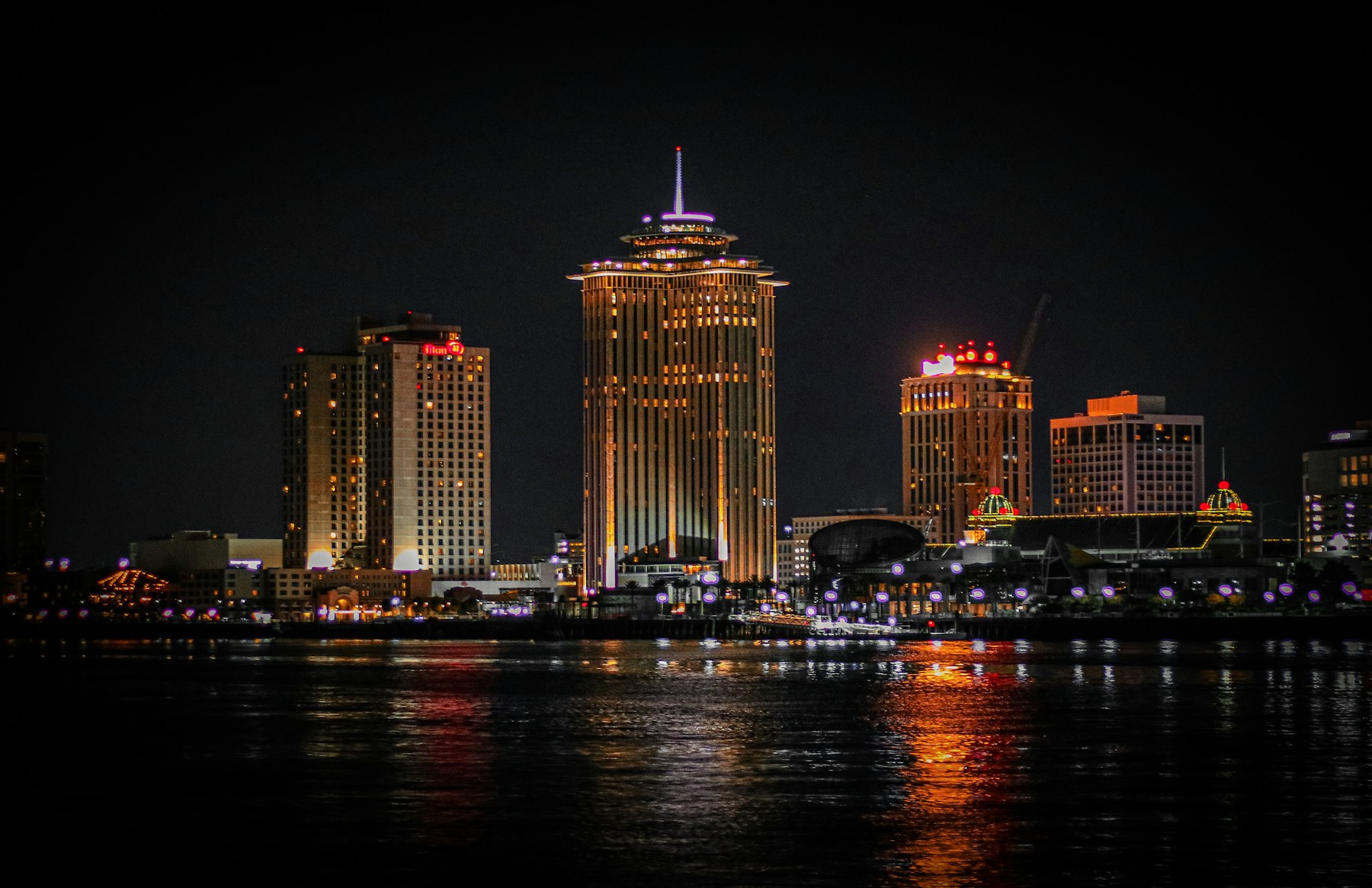
Algiers Point is arguably the single best skyline viewpoint in New Orleans — the widest, most unobstructed west-bank view of the entire CBD, French Quarter riverfront, and Crescent City Connection bridge spans across the Mississippi. From here, the river is at its most majestic — nearly half a mile wide, with massive barges and container ships moving slowly in the foreground. Unlike Crescent Park (which is on the same east bank as the CBD), Algiers Point provides the classic ‘across the water’ perspective that compresses the entire city into a single panoramic band. At sunrise with a calm river surface, the complete CBD reflection creates mirror images that double the visual impact of the skyline.

  • GPS: 29.952, -90.051
  • Elevation: 4 ft
  • Best time of day: Sunrise (primary) — facing north-northeast across the river, the CBD catches first light while you stand in Algiers shadow; also excellent at sunset when the CBD towers catch western golden light. Blue hour (20–30 min after sunset) for city lights reflected in the river.
  • Sun direction: Algiers Point sits on the West Bank of the Mississippi River, directly south of the French Quarter and CBD. The ferry landing on the Algiers side places you facing north across the river toward the CBD. At sunrise (azimuth 80–100° in spring), the sun rises to your right (east) over the river, illuminating the CBD tower fronts from the east-southeast — excellent warm-light facade illumination. The river runs roughly east-west at this point, making the levee at Algiers a textbook example of an ‘across-the-water’ skyline viewpoint with the subject always in front-light during morning hours. At sunset, the golden light from the west back-lights the CBD from behind — but this creates silhouette or dramatic side-lit opportunities from slightly different levee positions. The best sunrise position is at or near the ferry terminal, facing north.
  • Access: Algiers Point, West Bank, New Orleans, LA 70114. Take the Canal Street Ferry from the Canal Street Ferry Terminal (1 Canal Street, at the foot of Canal Street, Downtown NOLA). Ferry operates 24/7 to Algiers Point; fare ~$2 each way (exact change or prepaid RTA card). Ferry ride takes approximately 12 minutes. Once at Algiers, the levee path (free, public) runs along the river for easy access to viewpoints in both directions. Note: walk 1.5 miles south from the ferry terminal along the levee (past the railroad tracks area) for views that include the Crescent City Connection bridge together with the CBD — the panorama widens significantly. Tripods permitted on the public levee. No photography permit needed. No parking on the Algiers ferry side; park in Downtown New Orleans and walk to the ferry.
  • Difficulty: Easy — flat levee path, 12-minute ferry crossing. The walk along the levee is entirely flat with no obstacles.
  • Recommended settings: Sunrise Reflection: aperture: f/11, shutter: 1/30s, iso: 200, lens: 24-70mm at 35mm, notes: At the levee near the ferry landing, face north at sunrise. The CBD is front-lit by the eastern sun. On calm mornings (wind under 5 mph), the river surface reflects the full skyline and golden sky in a near-perfect mirror. f/11 keeps both sky and foreground reflection sharp. Use 2-stop graduated ND over sky to balance the exposure. Bracket ±2 EV for HDR if needed.  ·  Telephoto Skyline Compression: aperture: f/11, shutter: 1/500s, iso: 200, lens: 70-200mm at 150-200mm, notes: A 150–200mm focal length from the levee compresses the CBD towers and One Shell Square against each other, stacking the skyline for maximum visual drama. Works especially well in morning haze when atmospheric depth separates the towers in soft layers.  ·  Blue Hour Long Exposure: aperture: f/8, shutter: 25s, iso: 400, lens: 24-70mm, notes: 20–30 minutes after sunset, the city lights activate and the cobalt sky still holds color. Use a 25-second exposure to smooth the river surface into glass and create elongated light reflections. The bridge cables illuminate in warm amber against the blue sky.  ·  Barge Foreground: aperture: f/8, shutter: 1/500s, iso: 400, lens: 24-70mm, notes: When a tow-barge moves upriver in front of the skyline, use 1/500s to freeze the barge with the CBD beyond — a uniquely New Orleans combination of working-river industry and urban skyline. Shoot from a crouch on the levee to maximize river/barge scale in the foreground.

Shots to chase:

  • Classic sunrise mirror: levee at the Algiers ferry landing at 6:15 AM, 35mm, CBD reflected in calm river with golden sky above and below the waterline
  • Bridge-and-city panorama: walk 1.5 miles south along the levee to the position where both Crescent City Connection spans frame the CBD — use a 24mm for the full panorama width
  • Barge-and-skyline: when a massive Mississippi River tow-barge moves between you and the CBD, use 1/500s to freeze it as an industrial foreground silhouette against the building tops
  • Ferry approach shot: from the top deck of the Canal Street Ferry as it approaches Algiers, the CBD skyline appears to rise above the bow of the ferry — a 24mm captures the frame-within-frame of the bow against the city
  • Blue-hour twin bridge reflection: facing slightly southwest from the levee, the Crescent City Connection’s lit spans reflect in elongated orange trails on the dark river — use 20-second exposure at f/8

Pro tip: Check the ferry schedule carefully — the last regular evening ferry can be as early as 9 PM on weekdays (check nolaferries.com for current hours). For blue-hour photography, plan to take the last ferry or budget for a rideshare back across. The levee walk south of the Algiers ferry landing is entirely public and free, and the views expand dramatically after the first 0.5 miles — most tourists only stand directly at the ferry terminal and miss the wider panoramas further south. Algiers Point has its own historic neighborhood (Victorian cottages, peaceful streets) that provides a compelling contrast to the French Quarter — reserve time for neighborhood photography after the levee shots.

Common mistake to avoid: Missing the ferry return and being stranded in Algiers — check the last ferry time before shooting. Setting up at the ferry terminal only and not walking south along the levee for wider views. Underestimating the wind: the levee is fully exposed and wind-rippled river surfaces destroy reflection shots — use Windy.com before committing to a sunrise shoot.

Want this in your pocket on the street?
The full-resolution version of every spot above — with full-page hero photography, GPS maps with gold location pins, sun direction diagrams, multi-season tables, and a complete safety + packing checklist — is inside the New Orleans Ultimate Photographer’s Guide PDF ($47). Print it, save it offline, take it on the walk. Get the guide →

9. Studio Be — Brandan ‘B-Mike’ Odums Warehouse Murals

Studio Be — Brandan 'B-Mike' Odums Warehouse Murals New Orleans photography sampleSave
Studio Be — Brandan ‘B-Mike’ Odums Warehouse Murals — cinematic reference from the New Orleans Photographer’s Guide PDF

Studio Be is the final installment of Brandan ‘B-Mike’ Odums’ ‘BE Trilogy’ — a three-part mural project begun in 2012 in abandoned New Orleans buildings. Established in 2016, Studio Be is a 36,000 square-foot gallery in a Bywater warehouse where Odums’ hyper-scale murals — some covering entire warehouse walls 30 feet high — depict Black American history, police violence, Hurricane Katrina’s aftermath, and the resilience of New Orleans’ Black community. These are among the most ambitious and powerful murals in the United States, created by one of the country’s most prominent muralist artists. Unlike a traditional gallery, the sheer architectural scale (warehouse floor-to-roof paintings) means standard portrait-orientation photography is insufficient — you need wide angles and distance to capture the full emotional weight. The exterior building facade on Royal Street is also heavily painted and serves as a free exterior photography subject.

  • GPS: 29.9729, -90.0425
  • Elevation: 3 ft
  • Best time of day: Open hours: Wednesday–Saturday 2–8 PM, Sunday 2–6 PM (closed Monday–Tuesday). Arrive early in the week’s open session (Wednesday afternoon) for fewest visitors. The warehouse interior is uninsulated and natural light varies — overcast days provide the most even illumination on the floor-to-ceiling murals.
  • Sun direction: Studio Be is an interior gallery space inside a 36,000 sq-ft former industrial warehouse in the Bywater neighborhood. As an interior shoot, exterior sun direction is not directly relevant — the murals are interior floor-to-ceiling works illuminated by the warehouse skylights and supplemental gallery lighting. However, overcast days provide the most even diffuse light through skylights without harsh patches of direct sun creating uneven exposures across the enormous mural surfaces. The exterior building itself (painted with murals on its Royal Street facade) faces east on Royal Street and catches morning light from approximately 7–10 AM — useful for exterior building documentation shots before the gallery opens.
  • Access: 2941 Royal Street, Bywater, New Orleans, LA 70117. Open Wednesday–Saturday 2–8 PM, Sunday 2–6 PM (closed Monday and Tuesday). Admission: General $15; Louisiana residents, students, educators free on Wednesdays; First Responders/Military $10; Children 5–12 $5; under 5 free. No appointment needed during regular open hours — walk in during operating hours. Guided group tours available (book via studiobenola.com). Bywater is approximately 1.5 miles from the French Quarter — walkable, bikeable (Blue Bikes nearby), or Uber/Lyft. Street parking available on Royal Street and surrounding Bywater streets. Tripods: confirm with gallery staff on arrival — the space is large enough to accommodate a tripod but staff discretion applies. No external flash photography policies are common in gallery spaces; ambient light is sufficient given the scale of the murals.
  • Difficulty: Easy — flat warehouse floor, no physical challenges. The emotional weight of the content (racially charged American history, Black lives imagery) is significant — approach with thoughtfulness.
  • Recommended settings: Interior Mural Wide: aperture: f/8, shutter: 1/60s, iso: 1600, lens: 16-35mm at 16-20mm, notes: The murals require a 16–20mm focal length to include an entire wall section in a single frame from the warehouse interior. Stand as far back as possible (often 20–30 feet) to get the full height. ISO 1600 in available gallery/skylight light. Use a small tabletop tripod or brace against a wall for critical focus — handheld is possible at ISO 3200 with stabilization. Do not use flash; the ambient light is part of the spatial experience.  ·  Detail Isolation: aperture: f/5.6, shutter: 1/125s, iso: 1600, lens: 70-200mm at 85-100mm, notes: For detail crops of individual faces, hands, or figurative elements within the large murals, use a 85–100mm to extract a portrait-scale element from the wall-spanning composition. This creates a very different, intimate image than the wide-angle documentation of the full mural.  ·  Exterior Mural Morning: aperture: f/11, shutter: 1/250s, iso: 200, lens: 24-70mm at 35mm, notes: The exterior building facade on Royal Street — heavily painted with B-Mike’s work — is best photographed 9–10 AM when the eastern sun illuminates the full facade. Stand across the street and use f/11 for the full building depth-of-field. A polarizer removes sky glare from the upper sections.  ·  Visitor Scale: aperture: f/8, shutter: 1/125s, iso: 1600, lens: 24-70mm at 24mm, notes: Include gallery visitors in compositions to establish the overwhelming scale of the murals — a small human figure at the base of a 30-foot mural is the most effective way to convey the physical impact of the work. Photograph candidly from across the warehouse.

Shots to chase:

  • Floor-to-roof mural documentation: use a 16mm from the far wall, level tripod, to capture a full warehouse-wall mural from floor to rafter — include ceiling beams and floor texture for spatial context
  • Visitor silhouette scale: with a visitor standing motionless before the largest mural, expose for the mural and let the visitor become a dark silhouette — the resulting image expresses the overpowering scale of the work
  • Detail portrait extraction: use 100mm to crop a single face from a wall-spanning mural — the hyper-detailed painting style of B-Mike’s figures rewards close extraction as standalone portrait compositions
  • Exterior Royal Street facade: the exterior building face on Royal Street combines multiple mural works and the industrial warehouse architecture — use 24mm across the street to capture the full building as an urban mural installation
  • Through-doorway composition: from outside looking through an open warehouse door into the dim interior with a backlit mural wall visible — a composition that frames the art as discovered, rather than presented

Pro tip: Wednesday open hours (2–8 PM) are quietest and Louisiana residents, students, and educators enter free on Wednesdays — making it the best day for unhurried photography. The gallery staff are knowledgeable and welcoming; introduce yourself as a photographer and ask which works are currently on display before entering. Bring a small but sturdy compact tripod (a Joby GorillaPod or similar) for low-light interior work — the warehouse light is genuinely dim in some areas. Allow at least 90 minutes: the murals reward slow, careful looking, and the best photographs emerge from extended observation rather than quick documentation.

Common mistake to avoid: Arriving outside operating hours and finding the warehouse closed — the Wednesday–Saturday/Sunday schedule is firm. Using a flash or speedlight inside, which flattens the dimensionality of the painted surface and destroys the atmospheric light. Photographing only from the entry point and not walking to the far end of the 36,000 sq-ft space, where different murals and different lighting conditions produce completely different images.

10. Steamboat Natchez — Mississippi River Waterfront

The Steamboat Natchez is the last authentic steam-powered sternwheeler on the Mississippi River — a working passenger vessel built in 1975 to the specifications of the pre-Civil War steamboats that made New Orleans the commercial capital of North America. Its three tall smoke stacks, white multi-deck superstructure, and enormous red paddlewheel are the iconic visual shorthand for the Mississippi River romance. The steam calliope (the only steam calliope on the river) plays before each departure and can be heard blocks away, signaling New Orleans’ irreplaceable connection to its river history. As a photography subject, the Natchez offers both stationary dock photography (exterior composition) and motion river photography from the cruise itself.

  • GPS: 29.9575, -90.0614
  • Elevation: 3 ft
  • Best time of day: Late afternoon (3–5 PM) when the boat is docked pre-departure and the southern sun illuminates the red paddlewheel and white hull from the Moonwalk; the 7 PM evening cruise returns to dock around 9 PM with the CBD skyline fully lit behind it — blue-hour approach shot from the levee. Also excellent at early morning (9–10 AM) when the boat sits at dock with soft northern light.
  • Sun direction: The Steamboat Natchez is docked on the Moonwalk (Mississippi River levee) side of the French Quarter at the Toulouse Street Wharf, approximately 400 yards east of Jackson Square. The boat faces roughly east-west at the wharf, with its famous red paddlewheel at the stern (east end). In afternoon, the southern sun illuminates the white multi-deck superstructure from the starboard (south) side, creating warm light on the hull and the American flags. At sunset, looking west along the Moonwalk toward the CBD, the Natchez appears in the foreground with the downtown skyline as a backdrop — the paddlewheel silhouetted against the glowing western sky. The golden steam calliope is visible on the top deck and is best photographed in the 30-minute boarding period (6–7 PM) before the evening cruise, when it plays dockside.
  • Access: Woldenberg Park / Toulouse Street Wharf, 400 Toulouse Street, New Orleans, LA 70130 (adjacent to Woldenberg Park on the riverfront). The dock is freely viewable from the Moonwalk (public riverfront path) at all times; exterior photography from the Moonwalk requires no fee or permit. Cruise boarding requires a ticket (~$44 for 2-hour harbor cruise; $58 for dinner cruise). Cruises: 11:30 AM, 2:30 PM, and 7:00 PM daily; board 30 minutes before departure. The steam calliope plays dockside during boarding, especially for the evening cruise. Parking: Decatur Street/French Quarter parking; the Moonwalk is a 3-minute walk from Jackson Square. Tripods permitted on the Moonwalk public path.
  • Difficulty: Easy — flat riverfront path; no physical challenges. The cruise adds a moving-platform photography challenge.
  • Recommended settings: Docked Afternoon Portrait: aperture: f/11, shutter: 1/250s, iso: 200, lens: 24-70mm at 35-50mm, notes: From the Moonwalk directly adjacent to the dock (public access path), capture the full boat profile with the CBD skyline or Cathedral towers as background. Afternoon side-light from the south brings out the red/white color contrast. A 35mm focal length from 50 feet captures the full boat without extreme perspective distortion.  ·  Paddlewheel Close Up: aperture: f/8, shutter: 1/500s, iso: 400, lens: 70-200mm at 150mm, notes: When the boat departs and the paddlewheel begins spinning (moving away from dock), use 1/500s to freeze the paddle blade positions in mid-rotation, or 1/30s for deliberate motion blur of the spinning wheel against a sharp hull. Stand on the Moonwalk as the boat pulls away.  ·  Evening Approach Blue Hour: aperture: f/8, shutter: 2s, iso: 400, lens: 24-70mm, notes: As the evening cruise returns to dock around 9 PM, the fully lit boat moves through the river with the CBD lit behind it. Position on the Moonwalk with a tripod for 2-second exposures capturing the boat’s navigation lights and interior cabin glow against the city skyline. Extraordinary blue-hour image on clear nights.  ·  Aboard River Perspective: aperture: f/8, shutter: 1/500s, iso: 400, lens: 24-70mm, notes: From the top deck of the cruise, the CBD skyline appears above the bow — use 1/500s to freeze the scene from the moving deck. The best skyline shots come as the boat turns downstream and the full CBD front is visible from the river. Also look for barges and tankers in the middle river for industrial foreground interest.

Shots to chase:

  • Classic dock profile: from the Moonwalk 50 feet away, the full white Natchez hull with red paddlewheel, smoke stacks, and American flags — use 35mm, afternoon sun side-lighting the hull for the definitive exterior portrait
  • Paddlewheel departure motion: as the boat leaves dock, use 1/30s to create deliberate motion-blur of the spinning red paddlewheel blades against the sharp white hull
  • Steam calliope dockside: zoom in with 150mm on the top-deck calliope as it plays pre-departure — the steam puffs rising from the pipes make a graphic abstract composition
  • River approach from inside: aboard the evening cruise, as the boat turns upstream past the French Quarter, the lit Cathedral towers and CBD skyline appear above the riverfront, framed by the bow railing — use 28mm from the top deck
  • Blue-hour return: standing on the Moonwalk at 9 PM as the evening cruise returns, 2-second exposure of the fully lit three-deck boat moving against the blue CBD skyline

Pro tip: The steam calliope performance before each cruise departure is the most uniquely New Orleans sound in photography — bring high-quality audio for video capture. The best exterior photography position is from the Moonwalk’s upper section (the elevated walkway) looking down at an angle toward the paddlewheel — this elevated view eliminates the dock clutter and frames the wheel against the river surface. For the iconic ‘Natchez departing’ shot, position at the downstream end of the Moonwalk near the Audubon Aquarium so the departing boat pulls away from you with the CBD framed behind.

Common mistake to avoid: Shooting only from the wharf-level position directly beside the boat — the elevated Moonwalk promenade provides a much better elevated angle. Missing the 6 PM boarding window when the calliope plays dockside and the pre-departure activity (lineups, crew preparation) offers documentary street photography opportunities before a single cruise ticket is needed.

11. Tremé — St. Augustine Church and ‘Treme’ Street

St. Augustine Church (founded 1841) is the oldest African American Catholic parish in the United States, built by free people of color and enslaved parishioners in the Tremé neighborhood — itself the oldest African American neighborhood in North America. The Tomb of the Unknown Slave, a stark iron cross memorial erected in 2004 on the church’s exterior, honors the tens of thousands of enslaved people buried in unmarked graves throughout New Orleans. The church was designed by the same French architect (J. N. B. de Pouilly) as the St. Louis Cathedral, giving it an architectural elegance that belies its controversial, community-built history. The famous ‘War of the Pews’ — in which free people of color bought pews and dedicated them to enslaved worshippers, creating the most racially integrated congregation in antebellum America — is documented in the church’s history. As a photography location, the church offers Greek Revival architecture, a profound memorial, and the layered Tremé streetscape that inspired the HBO series of the same name.

  • GPS: 29.9638, -90.0749
  • Elevation: 3 ft
  • Best time of day: Sunday morning (9–11 AM) when Mass is held and the ‘Jazz Mass’ tradition (occasional event during Satchmo Jazz Fest season) fills the exterior with music; early weekday morning (7–9 AM) for soft light on the Greek Revival facade with zero foot traffic. The Tomb of the Unknown Slave in the side garden is best photographed at any time with soft diffuse light.
  • Sun direction: St. Augustine Church faces roughly south-southwest on Governor Nicholls Street in the Tremé neighborhood. At sunrise in spring (azimuth ~80°), the morning light comes from the east-southeast and side-lights the church’s Greek Revival facade and white plaster columns. By mid-morning (9–10 AM), the east facade of the church (facing Governor Nicholls Street) receives warm directional light from the southeast. The Tomb of the Unknown Slave memorial (on the church’s exterior side wall, visible from the public sidewalk on Tremé Street) is shaded by the building most of the morning but catches direct light from the south around noon. The surrounding Tremé neighborhood streets — shotgun houses painted in Creole pastels, wrought-iron fences, overgrown garden plots — are photogenic at any time of day in soft overcast light.
  • Access: 1210 Governor Nicholls Street, Tremé, New Orleans, LA 70116. Phone: (504) 525-5934. The church exterior and the Tomb of the Unknown Slave memorial (on the exterior side wall) are freely viewable from the public sidewalk 24/7 at no charge. Interior access during Mass services (Sunday mornings primarily); photography inside during services requires extreme discretion and silence — no tripods, no flash. Street parking on Governor Nicholls, Tremé Street, and St. Claude Avenue. Walk 10–15 minutes from the French Quarter via St. Philip Street or Esplanade Avenue. No photography permit required for exterior documentation. The entire surrounding Tremé neighborhood — America’s oldest African American neighborhood — is a public street environment freely accessible for photography.
  • Difficulty: Easy — flat neighborhood streets.
  • Recommended settings: Facade Morning: aperture: f/11, shutter: 1/250s, iso: 200, lens: 24-70mm at 35mm, notes: From across Governor Nicholls Street at 8–9 AM, the facade receives warm southeast morning light that enriches the white plaster and terracotta tile roof tones. f/11 for full facade depth-of-field. A polarizer deepens the blue sky visible above the roofline between the two bell towers.  ·  Tomb Of Unknown Slave: aperture: f/8, shutter: 1/125s, iso: 400, lens: 35mm or 50mm, notes: The wrought-iron cross memorial on the church exterior side wall — visible from the Tremé Street sidewalk — is best photographed in soft overcast light that eliminates harsh shadows on the ironwork and reveals the weathered textures of the memorial base. Approach with compositional restraint; close-cropped detail shots of the dedication inscription are equally powerful.  ·  Neighborhood Street Scene: aperture: f/5.6, shutter: 1/250s, iso: 400, lens: 35mm or 50mm prime, notes: Walking the surrounding Tremé streets (Tremé, Ursulines, St. Claude) with a 35mm prime for documentary street photography — colorful shotgun houses, wrought-iron fences, and neighborhood life with the church visible at intersections. Early morning before 9 AM for soft light and quiet streets.  ·  Sunday Mass Exterior: aperture: f/8, shutter: 1/500s, iso: 400, lens: 24-70mm, notes: Sunday morning 10–11 AM, worshippers arrive in their finest dress at the church entrance — the combination of the Greek Revival facade, dressed congregation, and New Orleans Sunday morning light is a culturally rich documentary photography opportunity. Shoot from the public sidewalk with a 50mm; do not block the entrance.

Shots to chase:

  • Greek Revival facade detail: 70mm from across Governor Nicholls, isolate the pediment and twin bell towers against a blue sky — the plaster columns and arched windows are elegant in strong morning side-light
  • Tomb of the Unknown Slave: close approach (3 feet) with 35mm, fill the frame with the weathered iron cross and stone dedication base — include the church wall and sky as narrow slivers in the background
  • Sunday congregation: from the sidewalk at 10:45 AM as worshippers depart Mass — 50mm documentary portraits of the dressed congregation with the church portico behind, a visual record of living cultural tradition
  • Tremé shotgun houses: walking St. Claude Avenue and Tremé Street with a 28mm for the colorful Creole cottage facades, overgrown wrought-iron gates, and Spanish moss-draped trees that give the neighborhood its particular visual character
  • Corner composition: from the corner of Governor Nicholls and Tremé Street, include both the church in mid-ground and a colorful Creole cottage in the foreground for a layered architecture-of-neighborhood composition

Pro tip: The annual Jazz Mass (held during the Satchmo SummerFest festival in late July/early August) is one of the most exceptional live-music photography opportunities in New Orleans — a full traditional jazz Mass with brass band accompaniment inside the historic church. Check the church schedule at saintaugustinecatholicchurch-neworleans.org. The Tremé neighborhood is best photographed on foot over a 2–3 hour morning walk — allow time to explore the side streets (particularly the 1000–1200 blocks of Ursulines and St. Philip) where intact Creole cottages and shotgun houses create compelling streetscapes. Congo Square (in Louis Armstrong Park, two blocks away at N. Rampart and St. Philip) is a historically important African American gathering place — combine both locations in a single Tremé morning shoot.

Common mistake to avoid: Photographing only the church exterior and leaving without walking the surrounding Tremé neighborhood streets — the church is an anchor, but the neighborhood context is what makes the Tremé photographs distinct. Visiting only on weekday afternoons when the church is closed and the street is empty — Sunday mornings (for the congregation) and early weekday mornings (for the quiet street) are both superior windows.

12. City Park — Couturie Forest and Live Oak Grove

City Park is one of the largest urban parks in the United States (1,300 acres) and home to what is arguably the finest concentration of ancient live oaks in North America. The ‘Big Oak Island’ section near the park center contains oaks so old and large that their horizontal limbs support their own ecosystems of resurrection fern and Spanish moss — some individual trees are wider than they are tall, creating natural arches and chambers. The New Orleans Museum of Art (NOMA) building (1911, Beaux-Arts) sits at the park’s south axis and the Sydney and Walda Besthoff Sculpture Garden extends into the surrounding oak grove, creating extraordinary combinations of contemporary outdoor sculpture and primeval trees. Couturie Forest, at the park’s northern end, is a 60-acre native forest remnant — the most ecologically intact urban forest in Louisiana — with a primitive trail and the symbolic high point of New Orleans at 43 feet above sea level.

  • GPS: 30.0012, -90.0998
  • Elevation: 10 ft
  • Best time of day: Dawn (30 minutes before sunrise) through 9 AM for the absolute peak light — morning mist trapped under the 300-year-old live oak canopy creates near-mythical atmospheric light. Late afternoon (4–5 PM) is the secondary window for golden raking light. Couturie Forest is best at dawn for birding and atmospheric mist photography.
  • Sun direction: City Park is a 1,300-acre urban park on the north side of New Orleans, accessible via the Canal Street streetcar. The park’s massive live oak grove (surrounding the New Orleans Museum of Art and in the interior Big Oak Island section) contains some of the oldest and largest live oaks in Louisiana, including ‘Dueling Oaks’ (over 300 years old). The main oak grove runs roughly east-west in orientation, with the NOMA building at the park’s southern axis. At sunrise (azimuth ~80° in spring), low-angle light streams west through the park from the eastern boundary near Bayou St. John, creating horizontal light rays between the massive trunks and back-lighting the Spanish moss. The Couturie Forest section (northern end, at Harrison Avenue) runs on a 50-acre north-south axis with the 43-foot ‘Laborde Mountain’ at center — the highest elevation in New Orleans. Dawn mist frequently pools under the canopy in the forest section, creating ethereal conditions approximately 30–60 minutes after sunrise from November through April.
  • Access: Main entrance: 1 Palm Drive (NOMA/Art Sculpture Garden side), New Orleans, LA 70124. Couturie Forest entrance: 1009 Harrison Avenue, near Marconi Drive. City Park grounds open daily (free). NOMA sculpture garden (exterior): free. Couturie Forest: free, open sunrise to sunset. Canal Street streetcar to the end of the line (City Park/Museum stop); also accessible via Bayou St. John bikeway from Mid-City. Parking: large free lot off Palm Drive near NOMA. Commercial photography permit required: $75 per session, submit to permit@nocp.org (City Park Commercial Photo Permit). Tripods permitted throughout the grounds; not permitted inside Carousel Gardens Amusement Park, Storyland, or Popp Fountain areas. Drone photography requires separate City Park approval.
  • Difficulty: Easy throughout the main oak grove and NOMA sculpture garden. Couturie Forest: primitive trails with some uneven footing; not ADA accessible. Laborde Mountain (43 ft) is an easy 5-minute climb.
  • Recommended settings: Dawn Mist Forest: aperture: f/8, shutter: 1/30s, iso: 800, lens: 24-70mm at 35mm, notes: In Couturie Forest 30–60 minutes after dawn from November–April, atmospheric mist collects under the canopy and catches oblique morning light, creating ‘god-rays’ through the trees. Use a tripod at f/8, 1/30s, ISO 800 to capture both the backlit mist and the foreground root structure in focus. A slight positive exposure compensation (+0.5 EV) lifts the shadowed foreground without blowing the lit mist areas.  ·  Sculpture And Oak: aperture: f/8, shutter: 1/250s, iso: 200, lens: 24-70mm at 35-50mm, notes: NOMA Besthoff Sculpture Garden combines contemporary large-scale sculptures (Henry Moore, Louise Bourgeois) with ancient live oaks. Use f/8 for sculptures with out-of-focus oak trunks behind, or f/16 for full sculpture-to-oak depth. Morning light from the east side-lights both the bronze/stone sculptures and the grey oak bark with equal warmth.  ·  Ancient Oak Upward: aperture: f/11, shutter: 1/125s, iso: 200, lens: 16-35mm at 16mm, notes: At the base of a ‘Big Oak Island’ tree, lie on the ground and point a 16mm straight up to capture the full spread of branches in a circular overhead composition. The interlocking branches of multiple adjacent oaks create a natural vault when viewed from directly below. Works at any time of day.  ·  Lagoon Reflection Golden: aperture: f/11, shutter: 1/8s, iso: 200, lens: 24-70mm at 35mm, notes: The park lagoons and bayou channels reflect the oak canopy on calm mornings. Use a tripod at water-edge level with the lagoon reflection filling the lower half of the frame and actual oak canopy in the upper half. A polarizer at 45° manages the glare balance.

Shots to chase:

  • Mist god-rays in Couturie: dawn in November, Couturie Forest mist illuminated by low-angle sun streaming between 60-foot oak trunks — use 35mm from the forest floor path to capture light shafts above a foreground of moss-covered roots
  • Dueling Oaks embrace: the famous 300-year-old ‘Dueling Oaks’ near the park center have merged canopies over a broad open space — a 20mm from the ground looking up captures the full interlocking branch architecture against the sky
  • Sculpture-and-oak: Henry Moore’s reclining figure or Louise Bourgeois’ spider sculpture in the Besthoff Garden with a massive live oak trunk as the background element — use 85mm for shallow depth-of-field separation
  • NOMA reflection: the NOMA building (1911 Beaux-Arts) reflects in the park lagoon in front of it at sunrise — a 35mm captures the building, its reflection, and the flanking oaks in a perfectly balanced composition
  • Laborde Mountain summit: from the 43-foot summit of Laborde Mountain (highest point in New Orleans, in Couturie Forest) at dawn — the forest canopy spreads below in a rare overhead perspective unavailable anywhere else in the city

Pro tip: The ‘Big Oak Island’ section (ask park staff for directions — it’s in the interior near the bayou) contains the most ancient and largest specimens and is significantly undervisited compared to the NOMA entrance oaks. The Couturie Forest dawn mist phenomenon (November–April) typically lasts only 30–90 minutes after sunrise — arrive before dawn, walk the Harrison Avenue entrance trail in darkness with a headlamp, and be in position when the light breaks. Bring bug spray year-round — City Park mosquitoes are legendary. The Canal Streetcar end-of-line stop deposits you at the park entrance near NOMA; for Couturie Forest, an Uber/Lyft to Harrison Avenue is more practical.

Common mistake to avoid: Visiting only the NOMA/sculpture garden entrance and missing the ancient live oaks deeper in the park. Arriving after 9 AM on weekends when the park fills with joggers, cyclists, and families — peaceful dawn is far superior. For Couturie Forest specifically, missing the limited mist-season window by visiting in summer (when heat dissipates fog instantly) rather than fall/winter.

When to photograph New Orleans: a year-round breakdown

New Orleans is photogenic every month of the year — but the conditions differ radically by season. Here is what to expect:

Late February through May is the prime photography season: Mardi Gras (February/March) delivers unparalleled street spectacle, beads in oak trees, and costumed crowds; March–April brings mild temperatures (60s–70s°F), low humidity, azalea blooms in the Garden District, and the longest golden-hour windows. Fall (October–November) is nearly as good — crisp air, the Voodoo Fest season, and the city’s live oak canopy at its most photogenic without summer’s oppressive humidity. Avoid June–September: heat regularly exceeds 95°F with 90%+ humidity, afternoon thunderstorms disrupt shooting windows, and summer haze flattens the distance. Winter (December–January) is underrated — cool fog on the river, unobstructed cathedral views, and moody blue-hour light in a relatively quiet French Quarter.

Photographer safety in New Orleans: read this

City photography has its own risks: gear visibility, neighborhood timing, traffic, weather. Read the briefing before you go.

  • Gear visibility: Use a discreet bag with no obvious camera branding. Keep a body strapped under a jacket on transit.
  • Neighborhood timing: Pre-dawn and post-sunset shoots reward early scouting. Cross-reference each location with current local guidance and choose well-lit transit routes.
  • Situational awareness: Headphones out. One eye in the viewfinder, one on the street.
  • Traffic: Bridges, medians, and bike lanes are not setup zones. Shoot from sidewalks and pedestrian areas only.
  • Weather: Summer storms move quickly; winter cold drains batteries. Layer up, keep gear dry, watch for ice on cobblestones at blue hour.

The complete safety briefing is inside the New Orleans Photographer’s Guide PDF.

Take this guide into the city

This post is the complete field reference. The New Orleans Ultimate Photographer’s Guide PDF is the field-deployable version: full-page resolution hero photography, GPS maps with gold pins for every location, multi-season shooting calendars, gear notes per location, sun-angle diagrams, the full city safety briefing, and a print-ready editorial layout in Framehaus black and gold. Save it offline. Print it. Take it on the walk.

New Orleans Ultimate Photographer’s Guide
Downloadable PDF · 12 GPS-mapped locations · Multi-season calendar · City safety briefing · Packing checklist

Get the New Orleans guide — $47

Combo Deal

Get the New Orleans Guide + Preset Pack

Photograph it. Edit it. Done.

$66
$54
Save $12
PDF Guide Every spot, GPS, golden hour
Preset Pack 20 Lightroom presets
Book your tours & experiences in New Orleans

All links go to Viator (a TripAdvisor company), the world’s largest marketplace for guided experiences. Tagged as affiliate per FTC.

Also on Amazon: gear that helps with this technique

Quick Amazon shortcuts to the gear most useful for this kind of shot. Use them if Prime shipping or Amazon credit makes more sense than B&H. As an Amazon Associate ShutYourAperture earns from qualifying purchases.

Take New Orleans home in your pocket.

Every shot location, every angle, every time of day worth shooting. Printable PDF + GPS-tagged map.

Instant download. Works on phone, tablet, and printed.

Continue reading

← Back to U.S. Cities Photography Guides

Related guides nearby

Three more photography guides within striking distance — perfect for combining into one trip.

  • Houston 512 km away · city · USA
  • Atlanta 685 km away · city · USA
  • Dallas 712 km away · city · USA

Browse all 78 guides → · Open the map

Save your trip-planning hours

The complete New Orleans guide is $47

All vantage points above + 5 bonus secret spots, printable map, gear pack list, and editing recipes. One-time payment, instant download, lifetime updates.

Buy New Orleans PDF →

Common questions about the New Orleans guide

Is the New Orleans photography guide worth $47?

For most photographers, yes. The guide saves 8-12 hours of trip-planning research and prevents the most common mistake of New Orleans photography: shooting at the wrong time of day. If a single better frame is worth $47 to you, the guide pays for itself on day one. Buyers get every GPS coordinate, every golden-hour window, every cultural rule, and a printable shot list.

Does the New Orleans guide include GPS coordinates?

Yes — every vantage point in the guide has Google Maps-ready GPS coordinates so you can pin them before you fly. The guide also includes a printable map showing all locations clustered by walking distance, so you can build efficient half-day routes.

What's in the New Orleans PDF that isn't in this article?

The article shows the highlights. The PDF includes: 5 additional secret spots not published online, a 14-day itinerary with daily routes, the full camera-settings cheat sheet for every scenario in New Orleans, a printable gear packing list, post-processing recipes with screenshot examples, and a list of local guides we trust for portrait commissions.

Do I get the Lightroom presets too?

The $47 guide is the PDF only. The matching New Orleans preset pack is a separate $19 download — most buyers grab both as a bundle and save the editing time. Both are instant download, both work on Lightroom Classic and Lightroom Mobile.

Will the guide work for a New Orleans trip in 2026?

Yes. The guide is updated annually as fees, restrictions, and new vantage points change. All buyers get free lifetime updates. The 2026 edition includes the latest drone rules, museum photography policies, and seasonal light data for the year.

Get the New Orleans guide · $47